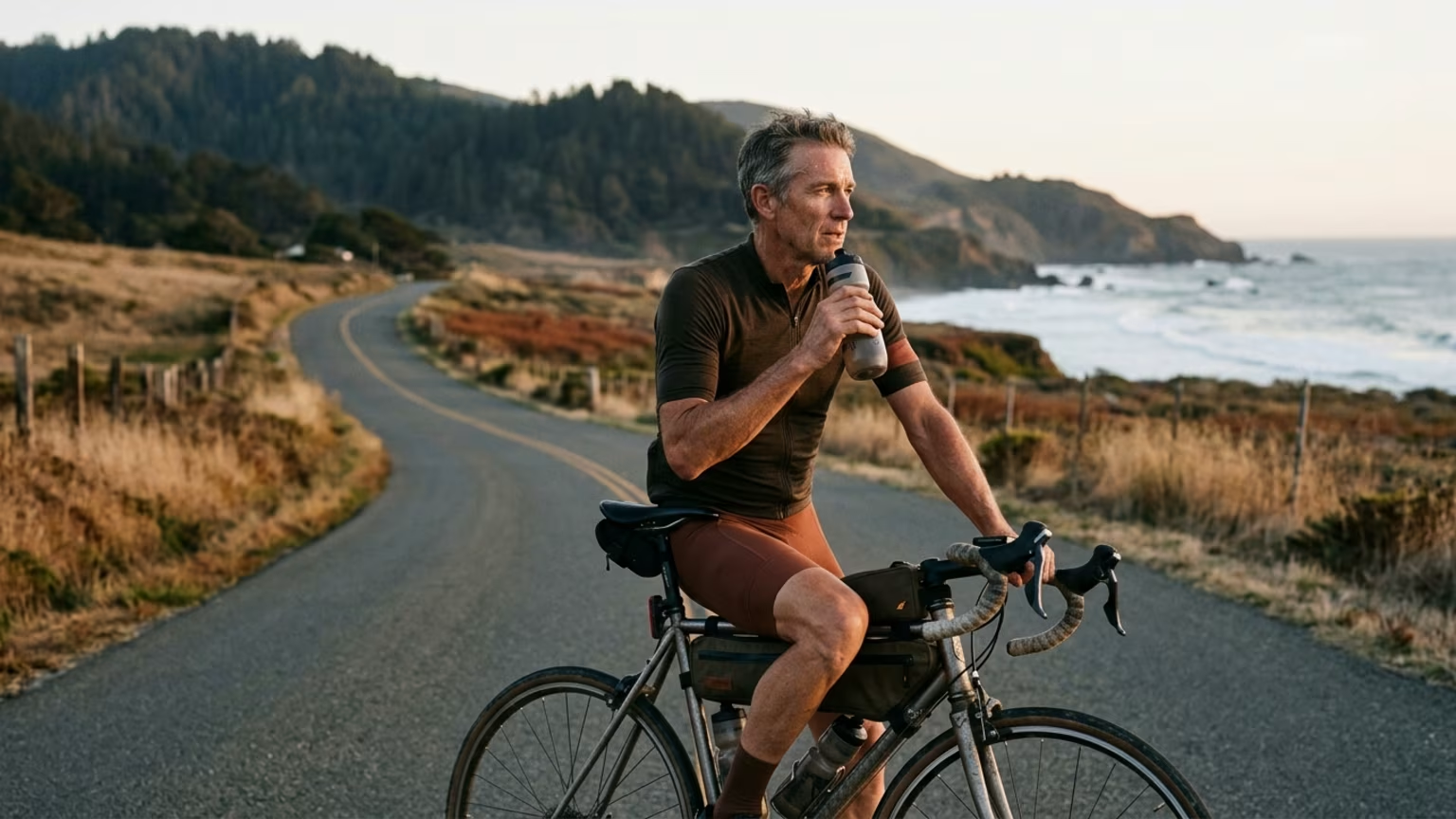

A 69-year-old cyclist rode 30,000 kilometers to set a global record. New research explains how older athletes can balance endurance with muscle preservation.





On September 28, 2026, Guinness World Records confirmed a remarkable achievement alongside a newly published physiological study in GeroScience. Canadian cyclist Mark Herbst was born on June 3, 1956. He completed a bicycle circumnavigation of the globe. He officially became the oldest male to accomplish this feat by bicycle.
Herbst finished his historic journey at age 69, surpassing the previous record held by a 66-year-old cyclist. The simultaneous release of long-term aging research provides a unique opportunity to understand endurance sports in later life.
The Guinness report confirms that Herbst completed his massive physical challenge over the course of 324 days. He departed from Bangkok, Thailand, on January 8, 2025. He then traveled across the globe before returning to his exact starting point on November 27, 2025. During this nearly year-long effort, he rode more than 30,000 kilometers and crossed through 25 different countries.
The official Guinness account notes his route covered the coastline of Australia, southern Asia, central Europe, and America. The organization identified the previous record holder as Christopher Bennett of New Zealand. Bennett was 66 years old when he completed his own ride. The physical output required to sustain this continuous volume of cycling is staggering.
Herbst was clear that his primary drive was personal rather than competitive. He undertook the journey to honor his late wife, Jackie. She died of squamous cell cancer in 2021 at the age of 55 after seven years of medical treatment. Herbst used the extensive cycling trip to cope with his grief and spread her ashes in places they had hoped to visit.
He also used the high-profile ride to generate financial support for cancer research. Guinness reports that Herbst donated a $67,746 CAD cheque to the Princess Margaret Cancer Foundation. The article provides currency conversions of $48,000 and £36,000 to highlight the international scale of his effort. Its headline also rounds the impressive fundraising total to $70,000.
At the exact same time, a detailed GeroScience study showed how aging impacts highly active athletes over a nine-year period. Researchers measured the peak oxygen consumption of amateur road cyclists in a clinical setting. They observed an average decline of 19.7 percent in the 78 participants who completed that specific test. Their absolute values dropped steadily from 44.1 to 35.4 ml·kg⁻¹·min⁻¹.
Despite this measured decline, the veteran cyclists maintained a distinct physiological advantage over the general public. The researchers found that 98.7 percent of the tested athletes remained at or above the 90th percentile of reference values. This proves that consistent training preserves an incredibly high baseline of cardiorespiratory function. Long-term athletic habits clearly keep older adults operating at a highly capable level.
However, the longitudinal study also revealed significant and concerning shifts in body composition. Over the nine years, the cycling cohort experienced an 8.1 percent decline in lean tissue mass. Their fat mass increased by 20.0 percent, even as their overall body mass remained stable. The data proves that endurance cycling alone cannot stop the natural loss of muscle tissue associated with aging.
Herbst prepared extensively before starting his global circumnavigation. The Guinness article states he spent a full year planning and training for the expedition. He also drew heavily on his prior experience completing several ultra-endurance cycling races. This deep background provided a solid foundation for managing the daily physical demands of continuous travel.
He carried his necessary belongings on his back throughout the 324-day journey. He frequently relied on practical help from strangers for basic daily necessities. Generous people provided him with hot meals, safe lodging, and critical logistical assistance. In one notable instance, a supporter drove hundreds of kilometers just to deliver a replacement bicycle tire.
The Guinness article does not provide the complete list of countries or the detailed daily route log. It also omits his exact equipment details and the detailed eligibility rules for the record. Guinness has not publicly released the underlying evidence used to officially adjudicate the record. Therefore, we only have a broad overview of his physical preparation and daily execution.
The clinical study on older athletes followed a much stricter observational protocol. Researchers initially tested a cohort of highly active amateur road cyclists in 2012 and 2013. They followed up with these same individuals nearly a decade later between 2021 and 2023. A total of 82 original participants returned for the second round of physiological testing.
These returning participants ranged in age from 64 to 86 years old at the time of follow-up. Every single returning athlete was still actively cycling when they were tested again. The study carefully tracked specific cardiovascular markers and shifting body composition metrics. This provided a rare window into the realities of lifelong endurance training.
The study authors clearly noted the inherent limitations of their scientific findings. They cautioned that the subjects represented a highly selected group of older cyclists. They pointed out that 43 of the original 125 participants did not return for the final evaluation. This attrition means the results may simply reflect survivor and return-participant selection.
Therefore, the clinical data does not establish exactly what would happen to all older adults. It also does not predict the medical safety of someone attempting an extreme endurance expedition. The research offers valuable context, but it is not a universal guarantee of health. Individual athletes must still manage their own specific medical risks and structural limitations.
Ambitious older athletes can learn valuable lessons from both the world record and the clinical data. Herbst provides a clear example of how long-term motivation can sustain athletic engagement. He proves that demanding endurance goals remain highly compatible with later life. His ride is a testament to the power of finding deep personal purpose in your training.
However, his specific achievement is not a template that every aging athlete should attempt to copy. A 30,000-kilometer ride is an extreme undertaking that requires exceptional personal dedication and risk tolerance. The available information does not outline a specific training schedule, medical clearance protocol, or injury management plan. Athletes should view his ride as inspiration rather than a mandatory physical benchmark.
Finding that lasting purpose often requires a shift in perspective as we age. Herbst noted he specifically chose a slower circumnavigation because his past racing habits had caused him to miss out on scenery. He recalled riding past the entrance to the Grand Canyon four times without ever actually seeing it. Shifting your focus away from pure speed can help you build a seasonal planning framework that keeps you motivated.
Herbst stated his belief that people should keep challenging themselves physically and mentally. He wisely noted that a meaningful challenge does not need to be an around-the-world ride. Everyday athletes can find deep satisfaction in localized events, gravel races, or long weekend tours. Matching your current physical capacity with a goal that excites you encourages consistent healthy habits.
Reendure focuses heavily on helping athletes build practical routines for lifelong activity. You can learn more about how we structure these habits by reading about our core methodology. Our primary goal is to translate complex science into sustainable training practices. The GeroScience data provides strict guidance on how to physically support those long-term goals.
The study explicitly states that cycling does not provide the progressive resistance training needed to optimize muscle maintenance. Endurance athletes cannot rely entirely on aerobic volume to protect their bodies. The documented 8.1 percent loss of lean tissue mass is a clear warning sign. You must actively incorporate strength training into your routine to preserve essential muscle mass.
Lifting weights provides the mechanical stress required to maintain your structural integrity. This foundation protects your joints, improves your power, and absorbs the repetitive impact of endurance sports. Integrating strength work helps ambitious athletes pursue their goals safely and effectively. You must treat your time in the weight room with the same respect as your long rides.
Athletes must also recognize that absolute peak performance will naturally decline over time. The 19.7 percent drop in peak oxygen consumption is a biological reality for aging individuals. You cannot entirely stop the clock, but maintaining a high relative fitness level ensures you have the capacity to enjoy your sport. Focusing on structural durability and optimizing your daily protein intake provides the necessary building blocks for healthy aging.
The physical demands of a massive athletic undertaking go far beyond simple aerobic fitness. Managing your daily stress, optimizing your hydration, and processing emotional fatigue are equally critical. For athletes balancing a demanding career with their athletic pursuits, these recovery fundamentals are paramount. You must treat your planned rest days as your most important training sessions of the week.
This comprehensive approach to training allows you to handle unexpected challenges on the road. When your structural foundation is strong, you can easily adapt to poor weather conditions or mechanical failures. A balanced athletic protocol builds the true physical resilience needed for long-term success. It ensures that you remain highly capable, confident, and ready for whatever challenge you choose next.
Veteran athletes must combine the cardiovascular benefits of sustained endurance sports with mandatory progressive resistance training to protect their longevity and achieve their personal performance goals.

Follow ReEndure for practical insights on endurance training, recovery, nutrition and healthy aging. Stay connected for new articles, research led guidance and ideas to help you perform better for longer.



Read practical ideas on endurance training, recovery, nutrition and healthy aging to keep progressing for years to come.
Read the Blog