

Learn how older endurance athletes are shifting from lifetime personal bests to durable race goals, prioritizing tactical execution and long-term performance.





The Outdoor Industry Association's 2026 running report says road running reached 52.3 million U.S. participants in 2025. That massive volume comes with a notable demographic shift at the starting line. Older runners are becoming a highly visible and competitive segment of the modern race field.
In August 2026, Runner's World published recent data on average marathon finish times by age group. The reported male averages ranged from 3:59 for ages 18 to 24 to 5:12 for ages 65 to 74, while female averages ranged from 4:21 to 5:40 for those same respective groups. These figures highlight an evolving reality for long distance competitors. The traditional obsession with lifetime personal bests is making room for a more durable approach to performance.
Endurance sport is increasingly a long term lifestyle rather than a young athlete's game. The 2025 New York City Marathon reportedly had 59,226 finishers, marking its largest field to date. Among those participants, the number of finishers aged 60 and older was reported to be 88 percent higher than in 2015. The same report indicated that the share of New York Road Runners event participants aged 60 and older increased from 3.6 percent in 2015 to 6.1 percent in 2025.
This growth extends far beyond a single city or organization. The same account notes that Chicago and Boston each experienced increases of more than 50 percent in participation by runners over 60 during the same period. A 2026 narrative review in Medicina similarly reports that marathon participation among runners over 40 has increased since 1980. However, the review clarifies that the largest participation group remains ages 30 to 44.
This data confirms that ambitious athletes are staying in the sport for decades. The focus is shifting away from purely outcome based achievements toward a broader definition of athletic success. For veterans checking our training and performance articles, this requires a mental shift. Reendure advocates for goals that remain meaningful even when life demands change.
The sports science community provides clear parameters for how athletes age over long periods. A report on a 2025 Mayo Clinic Proceedings cohort study followed 3,889 adults aged 46 to 75 for a median of nearly 11 years. The study found that relative muscle power was more strongly associated with mortality than muscle strength in that analysis. This specific finding underscores that cardiovascular fitness is only one piece of the puzzle.
Researchers are also looking closely at cardiovascular outcomes for veteran competitors. A 2026 narrative review in the European Journal of Preventive Cardiology evaluated long term cardiac health. The review concludes that long term intensive sport is safe for most athletes and is generally associated with favorable health and survival outcomes. It also noted that some athletes may develop signs of cumulative cardiovascular stress over time.
Athletes must remain vigilant about their personal health as they accumulate decades of training volume. Persistent fatigue should never be dismissed as a normal part of the process. Individualized medical screening helps athletes manage risk while continuing to train at a high level. Developing a relationship with a sports cardiologist can provide peace of mind during heavy training blocks.
In our experience, "Hitting my forties brought a harsh reality check. The track workouts were not getting slower, but the days after them felt significantly heavier. Instead of forcing my old Tuesday and Thursday intensity schedule, I looked at the data on Masters athletes and muscle protein synthesis."
"I pushed my second hard session to Friday, allowing an extra forty eight hours of low intensity recovery. My total weekly volume stayed the same, but the quality of my intervals skyrocketed." This type of adjustment is mandatory for athletes who want to race competitively into their later decades. The body requires more deliberate recovery to execute high quality efforts.
Stubbornly adhering to a training program from your twenties usually leads to chronic overuse injuries or burnout. Our healthy aging resources emphasize that progress is rarely linear. Workouts need to be scaled appropriately around accumulated fatigue and changing physiology. You can still target impressive race times by making strategic concessions in your weekly schedule.
Racing in your forties and beyond requires a refined perspective on pacing and performance. The 2026 pacing review in Medicina warns that age group comparisons in mass participation races should be interpreted cautiously. The results may reflect participation and selection effects as well as biological aging. Simply put, measuring your current performance solely against younger competitors often paints an incomplete picture.
Instead of relying purely on speed, veterans can leverage their deep well of racing experience. Pacing strategy becomes a conscious regulation of effort rather than a mechanical adherence to a split watch. A smart athlete plans for environmental factors, terrain changes, and their own physiological feedback during the event. This measured approach often yields a faster finish than an aggressive, uncontrolled start.
Setting precise process goals gives you tangible targets that are entirely within your control. You might aim to hold a specific effort level on a massive hill climb. You might focus entirely on executing your hydration plan at every aid station. These execution goals provide a reliable framework for evaluating your race regardless of the final time on the clock.
Athletes over 35 should construct a tiered goal system for every race on the calendar. An outcome goal, such as an age group podium or a Boston qualifying time, sits at the top. A performance goal, like executing a negative split or managing a headwind properly, forms the second tier. The foundation consists of process goals, such as maintaining relaxed shoulders or fueling every forty-five minutes.
This structure protects your motivation if the weather turns dangerous or an old injury flares up. You can abandon a time goal without abandoning the competitive spirit of the race. The event simply becomes a valuable data gathering session for your next starting line. Readers of our endurance performance resources know that consistency over years matters far more than a single heroic weekend.
Redefining success does not mean lowering your standards. It means establishing standards that measure your race intelligence and adaptability. The athlete who masters their early pacing will often pass dozens of younger runners in the final three miles. That tactical victory feels just as rewarding as a lifetime personal record.
Another critical aspect of the veteran mindset involves evaluating your tactical decisions under pressure. Young runners often rely on brute force to overcome poor tactical choices early in a race. A veteran athlete must conserve energy meticulously, making conscious choices about when to push and when to hold back. This deliberate conservation turns the race into a mental chess match rather than a simple test of lung capacity.
You can evaluate your tactical execution by analyzing how you managed external stressors throughout the morning. Did you successfully hide from the wind by tucking into a pack of similar runners? Did you make intelligent choices about tangent running, saving precious meters on a winding course? These small, calculated decisions accumulate over twenty-six miles, often saving several minutes on the final clock.
Evaluating these choices after the race provides excellent feedback for your next training cycle. If you neglected your hydration early and cramped late, you have a clear tactical error to fix. This analytical approach ensures that every single race teaches you something valuable. It removes the emotional sting of a slow finish time, replacing it with a concrete plan for future improvement.
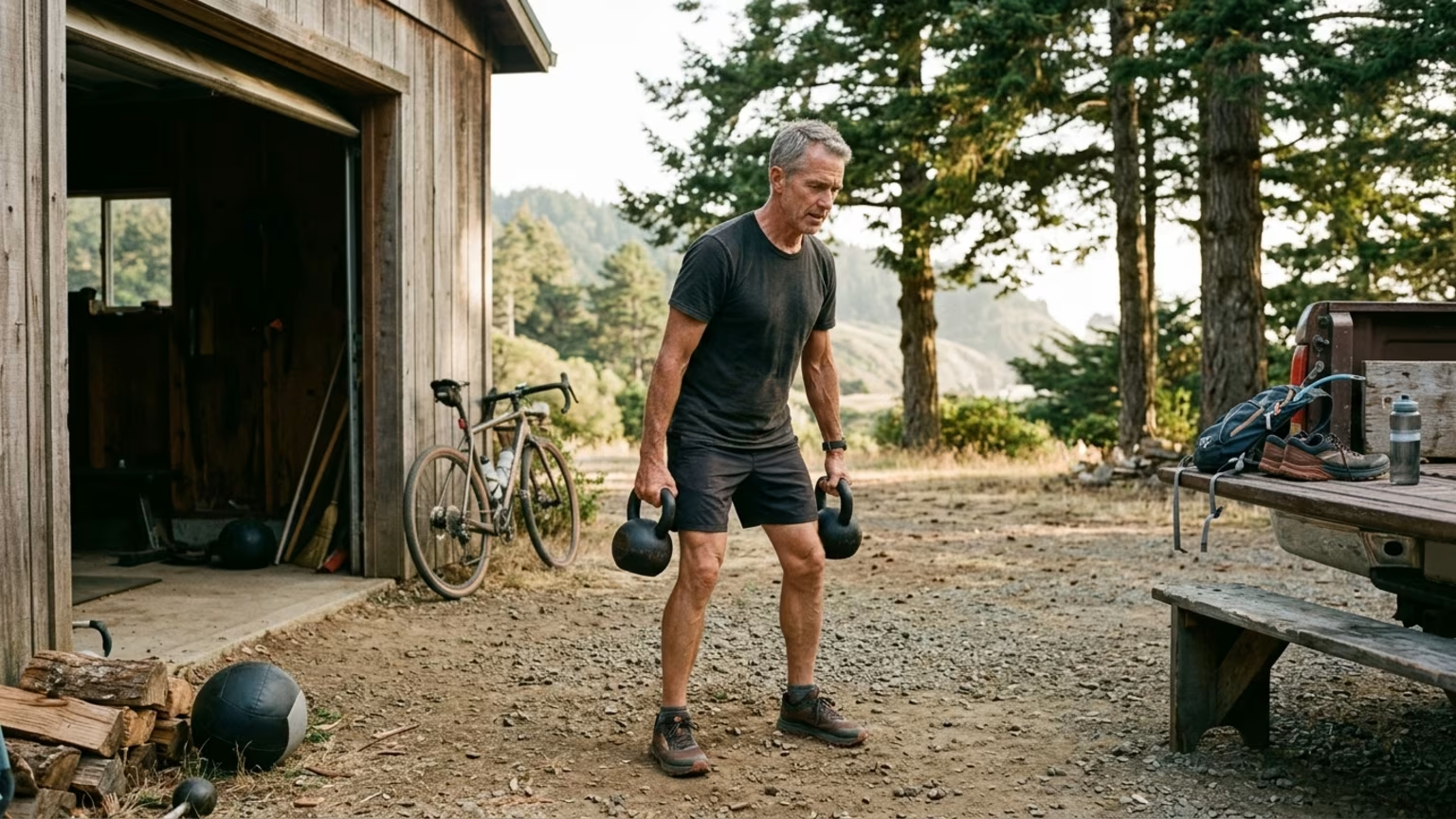
The science of maintaining athletic capability points heavily toward building a broader physical base. Running alone cannot sustain the musculoskeletal system through decades of high impact competition. Developing robust muscle power requires deliberate resistance training alongside the usual aerobic volume. The Mayo Clinic Proceedings study highlighted the importance of this specific relative muscle power for long term outcomes.
Veterans must allocate dedicated time to mobility work, heavy lifting, and balance exercises. These sessions directly support the aerobic engine by fortifying the tendons and joints against repetitive stress. When a runner ignores this structural maintenance, their risk of a season ending injury increases dramatically. A comprehensive training program respects the demands placed on the aging frame.
We highly recommend reviewing recovery resources to build a routine that supports longevity. The goal is to build a body resilient enough to handle race day without breaking down completely afterward. A durable athlete recovers faster because their underlying structural foundation is strong. Lifting heavy weights twice a week often provides the resilience necessary to cross the finish line without a limp.
When you line up alongside those 52.3 million other runners this year, your success will not depend on matching past speeds, but on executing a smart race that keeps you competitive for decades to come.

Follow ReEndure for practical insights on endurance training, recovery, nutrition and healthy aging. Stay connected for new articles, research led guidance and ideas to help you perform better for longer.





Read practical ideas on endurance training, recovery, nutrition and healthy aging to keep progressing for years to come.
Read the Blog