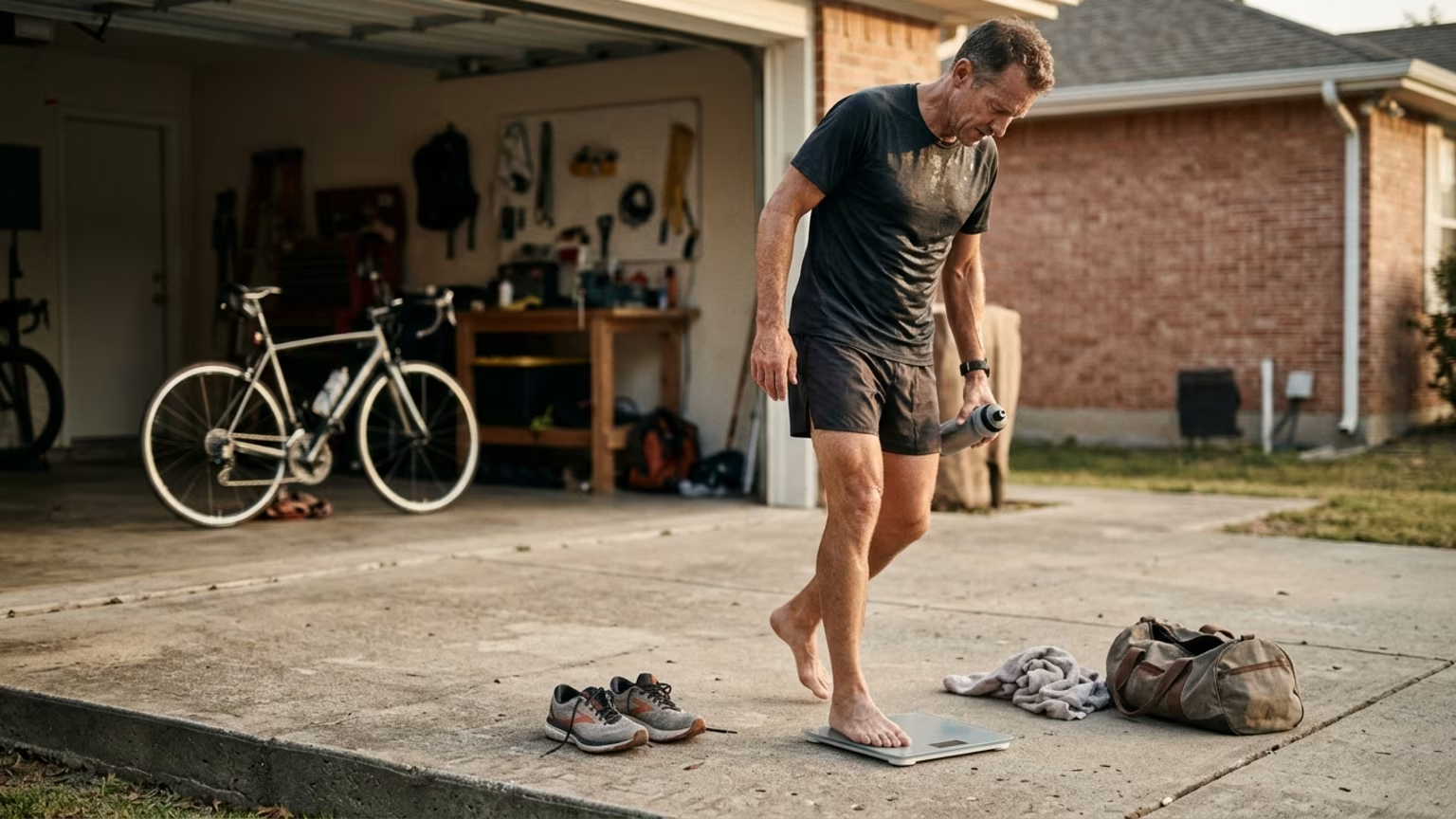

Learn how sweat-rate estimates, thirst, and body-weight observations can inform an individualized hydration plan without forcing fluid on a fixed schedule.





Do you need a fixed drinking schedule to stay hydrated during endurance exercise? Not as a universal rule: the evidence supports individualized fluid replacement rather than one schedule for everyone. The aim is to avoid excessive dehydration without forcing more fluid than you need.
That distinction matters because a hydration plan should support judgment rather than replace it. Training observations can help you prepare. Thirst provides information during exercise. Neither should become an excuse to chase a rigid number regardless of what is happening.
Fluid intake should be individualized rather than copied from a universal hourly target. A published summary of the American College of Sports Medicine's 2007 position stand describes its recommendation to customize fluid replacement because sweat rates and sweat-electrolyte content vary considerably among individuals.
That recommendation changes the starting question. Instead of asking which drinking schedule is best for everyone, ask what your own training observations suggest about the sessions you are preparing for. Another athlete's approach may be a useful discussion point. It is not a measurement of your needs.
The position stand also identifies water-deficit losses above 2% of body weight as excessive dehydration to avoid. That threshold belongs to the guideline's discussion of dehydration. It is not an instruction to aim for that loss or a requirement to replace every drop of sweat during exercise.
This is where hydration advice often becomes too rigid. A general aim gets converted into a bottle-emptying requirement. Yet the same position stand that warns against excessive dehydration also calls for customization. Reading those recommendations together makes more sense than treating either one as an isolated command.
A useful planning distinction is between an estimate and an obligation. An estimate helps you think about likely needs. An obligation tells you to keep drinking simply because the clock says so. The evidence supports the former more clearly than a universal version of the latter.
Our discussion of fluid balance rather than maximum intake develops that distinction further. The practical aim is not to prove how much you can drink. It is to build a more informed understanding of your own fluid needs.
The ACSM position stand says body weight measured before and after exercise can be used to estimate individual sweat rate. That makes representative training sessions useful opportunities to learn rather than occasions to test a borrowed drinking rule.
The important word is estimate. The method is supported by the position stand, but the available summary does not provide a complete field-testing protocol. It would therefore be misleading to turn a pair of weigh-ins into a precise sweat-rate calculation without the additional measurement details that such a calculation requires.
At the level supported by this evidence, the learning process has three parts:
Weather, route, and effort can serve as labels for organizing those observations. The purpose is to preserve context. A note attached to a particular session is more useful for planning than a number stripped of the circumstances in which it was collected.
This is not a reason to make every workout a measurement exercise. The editorial lesson is narrower: when you collect hydration information, collect it to answer a relevant training question. For example, the question might be whether an observation from one type of session is a sensible reference for the event you are preparing for.
Our guide to using sweat-rate observations in race planning offers a related discussion. The essential principle here remains simple: a measurement should improve your understanding of a session before it becomes part of a race plan.
There is also a useful separation between learning and drinking. A sweat estimate helps with preparation. It does not automatically establish how much fluid must be consumed during exercise. The ACSM recommendation to individualize replacement should remain attached to the measurement rather than disappearing as soon as a number becomes available.
The 2017 review on exercise-associated hyponatremia supports thirst-guided drinking rather than forcing intake to meet a universal schedule. A summary of that review identifies drinking beyond thirst as a primary factor in the condition. It also describes fixed fluid-intake ranges as inappropriate given the variation in fluid losses.
The review's stated prevention guidance has a specific scope: drinking to thirst during and immediately after exercise in temperate conditions for exercise lasting less than 17 hours. That does not establish that thirst alone is sufficient in every environment, event, or medical circumstance.
Within that scope, thirst is not something a predetermined schedule should routinely overrule. The review presents it as an individualized cue that helps limit overdrinking. This gives the athlete a practical alternative to consuming fluid merely to stay on schedule.
Planning and thirst are not opposing ideas. Planning can organize what you have learned from training. Thirst can inform decisions during exercise. The mistake is treating the plan as unquestionable when its original purpose was to help you respond intelligently.
A useful question when reviewing a drinking schedule is: Does this help me prepare, or does it require me to ignore what I am experiencing? That is an editorial way to apply the evidence rather than a new physiological rule. It keeps the plan in a supporting role.
The distinction also helps separate consistency from rigidity. A consistent habit might be paying attention to thirst and reviewing representative training observations. A rigid habit is insisting that the same intake must apply regardless of context. Only the latter conflicts with the evidence's emphasis on individualization.
For a related perspective, consider keeping conditions central to fueling and hydration decisions. Preparation remains valuable without becoming a demand to follow the same drinking pattern in every session.
Yes. The 2017 review describes exercise-associated hyponatremia as resulting in most cases from drinking hypotonic fluids in excess of losses. Those fluids include water and sports drinks.
That last point is important. The review cautions that sodium-containing sports drinks do not prevent the condition if an athlete overdrinks. A sports drink is therefore not permission to force fluid beyond need. The presence of sodium does not remove the risk associated with excessive intake.
Body-weight change can provide another piece of information. The review says weight gain during an event indicates that intake has exceeded losses and advises athletes not to gain weight during an event. It also describes weight as an imprecise hydration indicator and cautions that weight loss does not rule out hyponatremia in every case.
That qualification belongs in the same conversation as the usefulness of weighing. A scale can contribute information without settling a medical question. Treating it as a complete safety check would give the measurement a role the review does not support.
The practical lesson is not to become fearful of drinking. It is to stop equating more fluid with better hydration. Both the ACSM position stand and the hyponatremia review point away from extremes: excessive dehydration is undesirable, but excessive drinking is not the solution.
Personal medical questions about fluid balance belong with a qualified healthcare professional. Training measurements and general guidance are tools for learning, not methods for diagnosing a hydration-related condition or deciding on treatment.
The strongest lesson across these questions is that hydration is a judgment task supported by evidence. Pre- and post-exercise body weight can inform sweat-rate estimates. Thirst has an important role within the circumstances described by the review. Neither a sports drink nor a scale reading makes forced drinking a sound default.
At Reendure, we favor guidance that helps athletes make informed decisions rather than collect rules. A useful hydration plan connects observations to the sessions they came from. It also leaves room for real-time cues instead of turning preparation into an inflexible demand.
Learn from representative training, keep the context attached, and do not confuse a drinking schedule with a requirement. That is a more useful foundation than either ignoring fluid losses or trying to replace every drop on the clock.

Follow ReEndure for practical insights on endurance training, recovery, nutrition and healthy aging. Stay connected for new articles, research led guidance and ideas to help you perform better for longer.


Read practical ideas on endurance training, recovery, nutrition and healthy aging to keep progressing for years to come.
Read the Blog