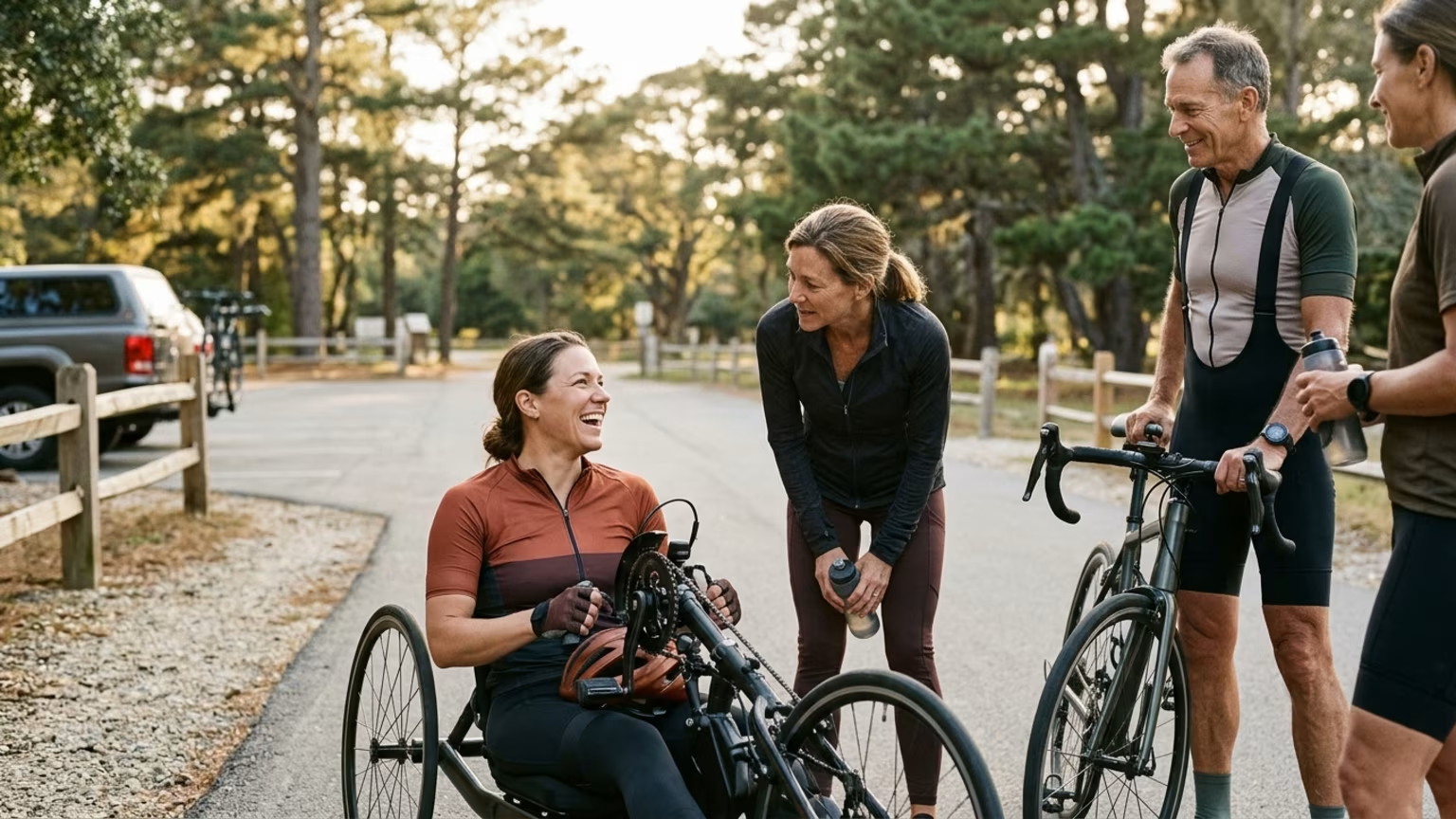

Leanne Taylor’s return to Para triathlon offers a grounded look at peer support, coaching and rebuilding belief after injury.





The Canadian Paralympic Committee’s “Before the Podium” profile looks back at Canadian Para triathlete Leanne Taylor’s return to sport after a cycling injury. Its central thread is not a breakthrough workout. It is how encounters with other people helped make an unfamiliar sporting future easier to imagine.
Visiting Paralympians introduced possibilities that Taylor had not considered. Online research helped her identify a sport. A coach explained its demands, while a peer mentor offered a broader picture of life after injury.
For endurance athletes over 35, the useful lesson sits in that sequence: learning what is possible can be a meaningful starting point before any performance target takes shape.
According to the Canadian Paralympic Committee’s account, Taylor initially thought swimming and cycling were no longer possible for her. Running seemed out of reach too. Visits from Paralympians during her hospital stay introduced the possibility of competing in Para sport.
Taylor and her sister then researched Paralympic sports online. She chose Para triathlon because it combined swimming, cycling and racing. That choice gave her curiosity a specific direction rather than leaving a return to sport as an abstract hope.
Peer mentor Kristine Cowley brought a different kind of perspective. Cowley visited through a Spinal Cord Injury Manitoba program. Taylor described the encounter as important because it helped her imagine having a full life after injury.
That is a broader contribution than explaining equipment or a race format. In Taylor’s account, the peer relationship addressed what life could look like. The sporting questions mattered within that larger picture rather than standing apart from it.
The distinction is worth keeping in view. Taylor was not simply collecting technical advice. She was encountering people whose experience challenged her initial assumptions about what remained available to her.
The Canadian Paralympic Committee describes coach Carolyn Murray explaining Para triathlon to Taylor. Taylor then began training independently. She improvised sessions and reported back before Murray later began programming workouts for her.
The account therefore includes both self-directed learning and formal coaching. Taylor brought observations from trying the sport herself. Murray supplied sport-specific knowledge and eventually structured workouts. The reported sequence shows those contributions developing together rather than presenting them as competing approaches.
Taylor’s first race opportunity arrived a few months after her injury. It was a classification race in Florida. She had not previously swum in open water, and the profile says her first outdoor ride took place during course familiarization.
She recalled that ride as exciting. Her aim going into the race was to finish. At that point in the story, participation itself was a meaningful ambition rather than a lesser version of a podium goal.
This is one of the account’s most revealing details. The early objective was concrete and connected to the experience in front of her. The later competitive record had not yet been written.
The Canadian Paralympic Committee describes Para triathlon as a young field in which athletes’ bodies and equipment setups differ. Taylor’s account includes situations where an expert could not necessarily supply an answer to her particular problem. She had to develop confidence in her own judgment alongside learning from others.
Taylor described that learning as the hardest part. Her story does not position confidence as something she possessed fully before beginning. Instead, it describes her learning to rely on herself while also drawing on coaching and peer experience.
That makes this a more specific account than a familiar message about determination. Taylor’s return involved information and relationships. It also involved making decisions when an answer was not ready-made.
The profile includes another encounter before the Paris 2024 Paralympic Games. At her final tune-up race, a five-year-old girl with spina bifida challenged Taylor to a race. By that point in the narrative, Taylor was no longer only the athlete receiving a picture of what might be possible.
The scene connects the beginning of her story with a later moment of participation. Someone who had once struggled to imagine a sporting future was meeting a child who wanted to race her. Its significance is human rather than statistical.
World Triathlon’s athlete profile lists Taylor with 31 starts and 11 podiums. Those results provide competitive context beyond the early experiences described in the Canadian Paralympic Committee’s story.
The profile records fourth-place finishes at the 2026 Para Series events in Montreal and Hamburg. It also lists fifth at the Yokohama Para Series and fifth at the Para World Championships in Pontevedra.
Those entries show where the sporting story continued. They also help keep the chronology clear: the initial hospital visits and first race belong to an earlier chapter. Her 2026 performances are a later update, not the immediate outcome of those first conversations.
Taylor’s story is an individual account rather than a study of masters athletes. It supplies no tested training progression or recovery timetable, and it does not establish which part of her experience caused her later results. Her early race timeline is not a benchmark for another athlete. Personal decisions about rehabilitation and returning to exercise after major injury belong with qualified healthcare professionals.
For Reendure’s audience, the useful translation is therefore about how to approach uncertainty. The story offers specific examples of gathering information and finding support without turning either into a universal comeback formula.
Taylor’s route began with learning that Para sport existed as a possibility for her. Research with her sister then helped turn that possibility into a particular sporting interest. Before there was a race objective, there was something she wanted to understand.
For an athlete facing disruption, an information-gathering goal deserves consideration alongside a performance goal. What sporting options are available? Who understands their demands? What would need to be adapted rather than simply resumed?
These questions keep attention on the situation that exists now. They do not require an immediate answer about future race pace or competitive level. Where injury concerns are part of that situation, our guide to recognizing and responding to early warning signs addresses a related part of the training conversation.
Murray and Cowley contributed different things in Taylor’s account. Murray explained the sport and later programmed workouts. Cowley helped Taylor imagine a full life after injury through the perspective of someone with relevant experience.
The practical question is not simply whether an athlete has support. It is what question that support helps answer. Technical guidance and the chance to speak with someone who understands a changed life are distinct contributions.
Reendure’s focus is translating evidence into useful training and recovery guidance for athletes over 35. Within that perspective, Taylor’s story is a reminder to keep the person’s broader sporting life in view rather than reducing every difficulty to a programming problem.
Taylor entered her first race hoping to finish. That objective belonged to the experience she was undertaking. It did not need to resemble the results that would appear later in her athlete profile.
For an experienced endurance athlete, this is a useful question to carry into a return: what would make the next sporting experience worthwhile? A meaningful answer can concern participation or learning rather than a comparison with an earlier result.
When racing becomes part of that discussion, examining an event before registering is a separate decision from wanting to compete. Ambition gives a goal importance. Looking carefully at the actual event gives that ambition something concrete to work with.
The strongest lesson in Taylor’s story is not that belief alone produces a return to competition. It is that her early belief had identifiable points of contact: people who introduced possibilities, research that clarified options and experience that gave her something to learn from.
Her later results matter, but they are not the only meaningful part of the account. The hospital visits and peer conversation belong in the story too.
For endurance athletes over 35, the modest takeaway is to give those early connections their due. A return to sport does not have to begin with certainty about the final outcome. In Taylor’s account, it began with seeing a possibility and finding people who could help her understand it.

Follow ReEndure for practical insights on endurance training, recovery, nutrition and healthy aging. Stay connected for new articles, research led guidance and ideas to help you perform better for longer.



Read practical ideas on endurance training, recovery, nutrition and healthy aging to keep progressing for years to come.
Read the Blog