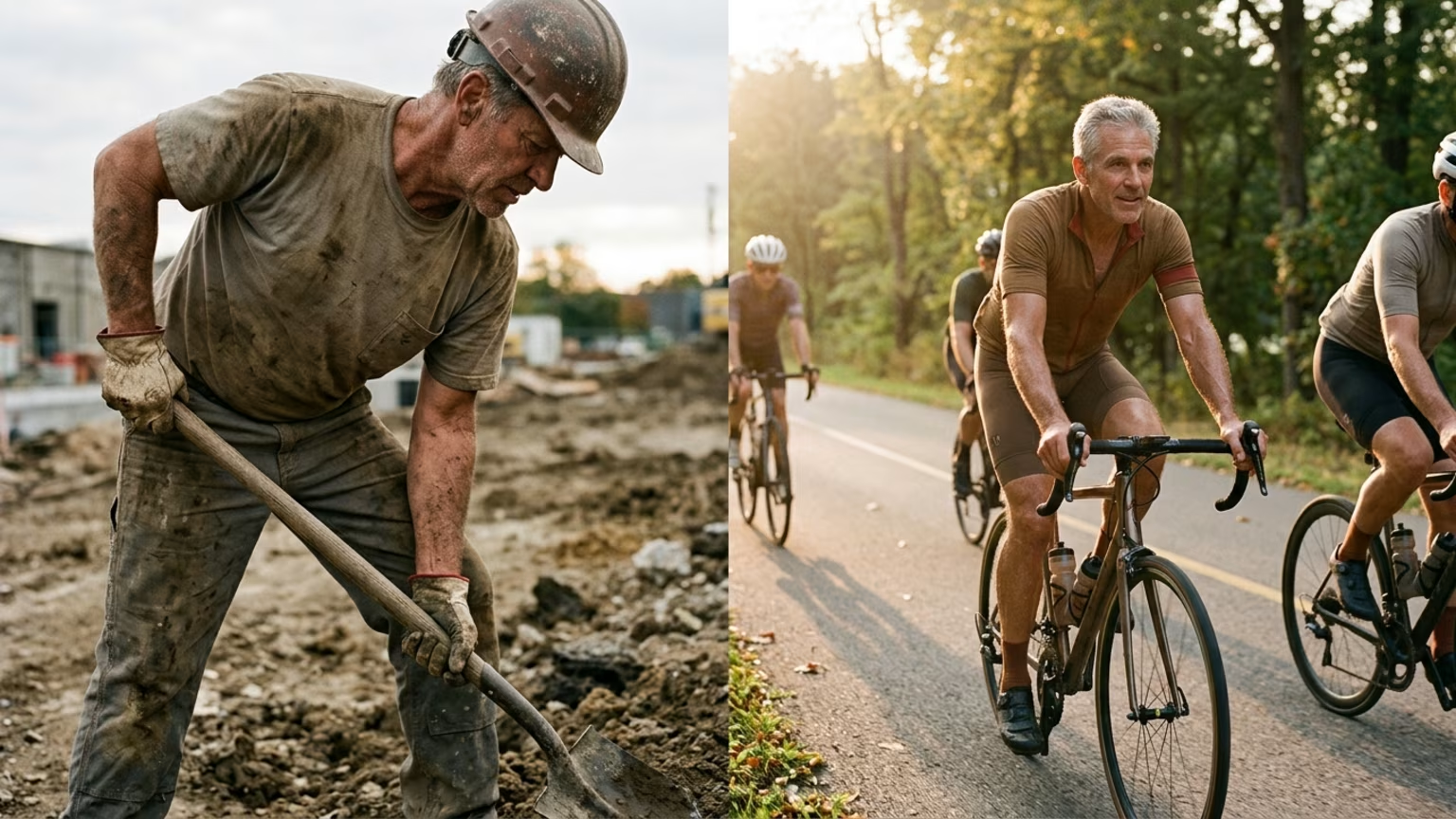

A meta-analysis of 4.2 million people reveals that leisure-time exercise lowers dementia risk, while heavy occupational manual labor may increase it.





Structured leisure-time physical activity is associated with a 24% lower risk of all-cause dementia, while heavy occupational labor correlates with a 20% higher risk. A heavy shift of manual labor feels identical to a grueling workout. Your heart races, your muscles ache and you finish completely exhausted. Yet, the physical strain of forced work does not automatically translate into long-term cognitive health for your brain.
A systematic review and meta-analysis published in The Lancet Public Health brought this stark contrast to light. Researchers examined domain-specific physical activity and dementia risk across 74 cohort and case-control studies. This massive effort pooled data from approximately 4.23 million people across 30 countries. The study participants ranged from 45 to 93 years old with a median baseline age of 67.3.
Researchers followed these individuals for a median of 10 years to track cognitive outcomes. The extensive analysis included 64,009 cases of all-cause dementia, 5,859 cases of Alzheimer’s disease and 1,607 cases of vascular dementia. Higher overall physical activity was associated with a 20% lower risk of all-cause dementia. This active group showed a relative risk of 0.80 with a 95% confidence interval of 0.75 to 0.86.
Higher overall physical activity was also associated with lower risks of specific cognitive conditions. The data revealed hazard ratios of 0.79 and 0.71 for Alzheimer’s disease and vascular dementia, respectively, compared with the least active group. The study combined cohort and case-control research using different approaches to measuring physical activity. These assessment methods included both self-reported questionnaires and objective tracking measures.
The study classified leisure-time activities as pursuits like running, cycling, swimming and playing sports. These voluntary sessions provide distinct physiological benefits compared to the strain of heavy manual labor. David Raichlen of the University of Southern California noted that the context of physical activity may matter just as much as movement itself. These findings clearly align with the broader physical activity paradox.
This paradox suggests that physically demanding work leads to less favorable health outcomes than structured exercise. Occupational physical work often involves lifting heavy loads, prolonged standing and irregular shifts. Workers face high physical strain while lacking the autonomy to stop and recover when fatigued. This chronic lack of control limits the body’s ability to adapt positively to the applied stress.
In our experience at Reendure, applying purposeful stress rather than uncontrolled strain is crucial for long-term health. When my Achilles flared up right before a major marathon build, the standard advice was total rest. But reviewing the clinical research on tendon loading changed my approach entirely. I swapped complete rest for heavy slow resistance training, specifically utilizing heavy calf raises on a deficit.
It felt counterintuitive to load an injured tendon, but the science was clear. Within six weeks, the morning stiffness faded, and I was back to building mileage without the chronic ache. Just as structured loading healed that tendon, structured exercise appears to protect the brain differently than forced occupational strain. Quality recovery and controlled intensity matter far more than sheer physical exertion.
As athletes progress through their 30s and 40s, separating work strain from training stress becomes essential. The relationship between physical activity and dementia risk is distinctly nonlinear in both domains. Increasing leisure-time activity is associated with progressively lower dementia risk until the neurological benefit plateaus. In contrast, increasing occupational activity correlates with progressively higher risk before it also reaches a plateau.
This established plateau means that endless hours of exercise will not provide endlessly increasing brain protection. Endurance athletes in their 50s should prioritize sustainable routines over extreme training volumes. Lucrecia Moreno, a pharmacology professor at CEU Cardenal Herrera University, emphasized this critical balance. She noted that greater physical demands across working life may provide less protection than structured training.
By the time athletes reach their 60s, preserving cognitive function requires a holistic approach to movement. A separate 2026 review associated structured exercise with better global cognitive outcomes in community-dwelling older adults. However, that review did not support a simple rule that more minutes or higher frequency automatically produce greater cognitive benefits. A related 2026 review of exercise in people with dementia reported modest but meaningful potential benefits.
These meaningful benefits included improvements in cognitive function, mobility, daily functioning and psychological well-being. However, researchers found that household physical activity appeared beneficial based on only one study. Active commuting was associated with a modestly higher dementia risk, but that result came from only two studies. Neither of these secondary results should be treated as robust evidence for altering your daily routine.
Midlife adults must treat structured exercise as distinct brain-protective movement. Building recovery into training is critical when work involves high physical demands or strict time pressure. The available evidence does not show that specific workplace exposures directly caused dementia. However, it strongly suggests that occupational exertion should not be treated as interchangeable with recreational exercise.
Additionally, 93% of the included studies were conducted in high-income countries. This heavy regional concentration may limit how confidently the findings apply to lower-income settings. Physical activity was assessed in studies using different definitions and reference groups. These differences can introduce heterogeneity and make direct comparisons between activity categories much more difficult.
This meta-analysis is strictly observational, meaning it identifies associations but cannot prove absolute causation. The 24% lower risk for leisure activity and 20% higher risk for occupational activity are relative associations. They are not absolute promises that an individual’s dementia risk will fall or rise by those exact margins. The occupational-activity result was statistically compatible with a modest increase in risk since its 95% confidence interval extended from 1.01 to 1.42.
The study’s association between occupational activity and elevated risk persisted after adjusting for age, education and chronic disease. Still, residual confounding cannot be completely ruled out by the researchers. The results do not prove that occupational activity directly causes dementia. Workers in physically demanding jobs should not assume their careers are inherently neurologically damaging.
For employers and workplace-health programs, reducing physical load alone may not address the full issue. Combining ergonomic improvements with lower job stress and greater worker control could be much more effective. However, this remains a practical interpretation rather than a finding from a randomized intervention. Ultimately, athletes should use this study as a reason to preserve purposeful exercise across midlife.
Athletes should view these findings as a strong endorsement for maintaining endurance performance habits. You cannot simply count a strenuous workday as a replacement for purposeful training. The physiological adaptations required for healthy aging come directly from self-directed exercise. Treat your daily training as an independent necessity for both your body and your mind.
Do not let these statistics cause unnecessary stress about the exact volume of your workouts. Use this data as a reminder to prioritize proper recovery and mobility after demanding days at work. Focus on maintaining a consistent and enjoyable routine rather than chasing a specific mileage target. Schedule one manageable session of voluntary exercise this week to protect your long-term cognitive health.

Follow ReEndure for practical insights on endurance training, recovery, nutrition and healthy aging. Stay connected for new articles, research led guidance and ideas to help you perform better for longer.


Read practical ideas on endurance training, recovery, nutrition and healthy aging to keep progressing for years to come.
Read the Blog