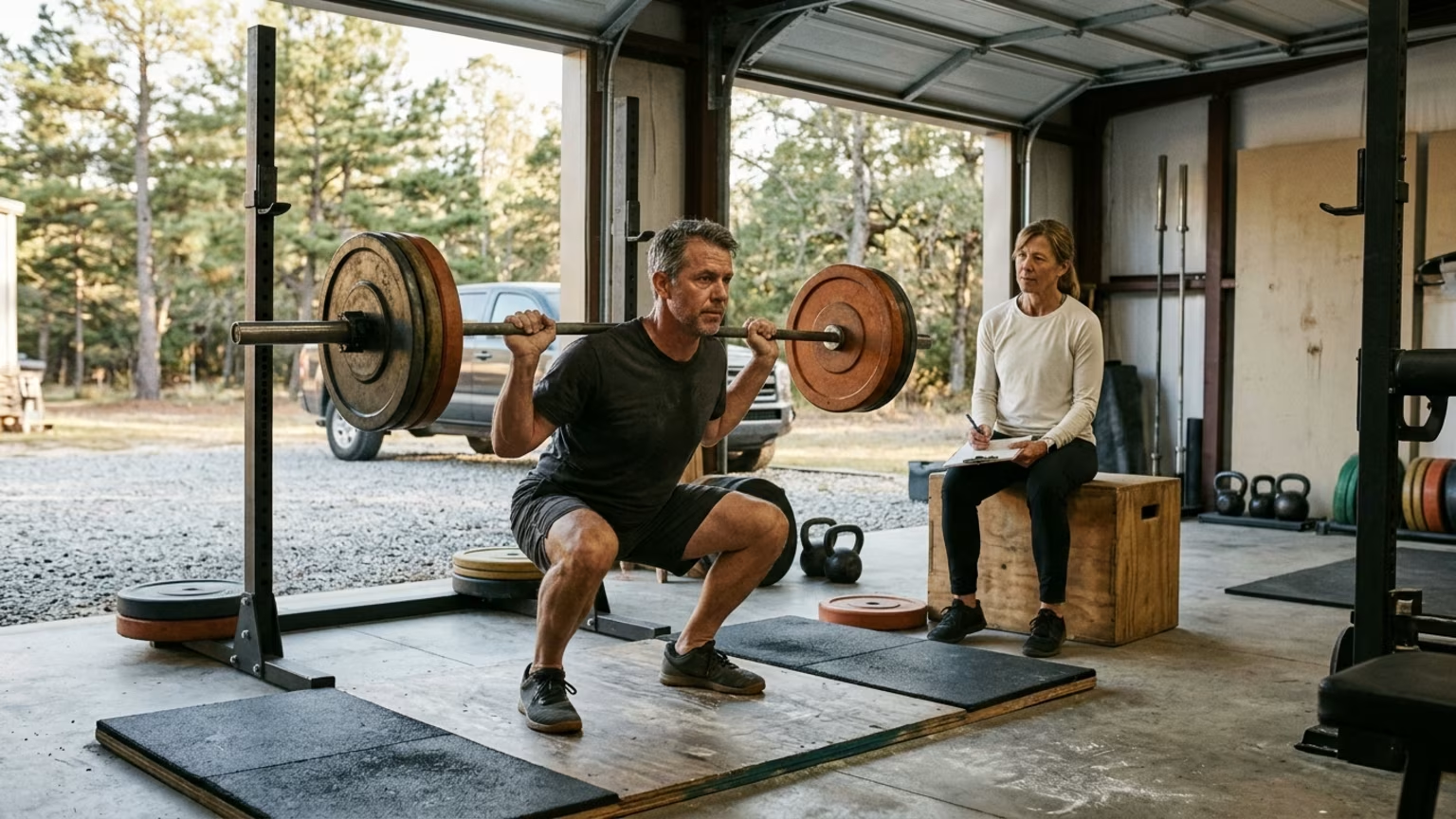

A squat trial found gains with split and continuous sessions. Here is how athletes over 35 can interpret the scheduling finding without overreaching.





An eight-week squat trial found improvements in strength and muscular endurance when participants divided their training into brief bouts or completed it in one session. According to Yahoo Health’s reporting, both approaches outperformed a control group. The researchers did not detect a statistically significant difference between the training schedules.
For endurance athletes over 35, the interesting question is about scheduling. Does supplementary squat work always need one uninterrupted appointment in the training calendar? This study gives that question some evidence behind it, while keeping the answer tied to a specific exercise and group of participants.
Yahoo Health reports that the trial compared prescribed squat training delivered in different formats. One group spread its work across three brief bouts on training days. Another completed its squats in a single session.
Both training groups improved on strength and muscular-endurance measures relative to participants who did not receive the supervised squat program. The continuous group’s gains were reported as slightly larger. However, the difference between the training groups was not statistically significant.
The useful distinction is between shortening each appointment and reducing the prescribed work. The split group still completed the assigned squats. Its training was distributed across the day rather than collected into one session.
That makes this a scheduling finding first. The intervention was not simply an invitation to move whenever convenient. It involved a defined exercise with a prescribed repetition count and a load that increased over the program.
There was also a difference in how participants experienced the sessions. According to Yahoo Health, those in the split group reported greater enjoyment. That adds a practical dimension to the result because the format of training can matter to the person doing it.
The reported trial followed 45 male students between 18 and 25 years old who already lifted weights. Yahoo Health identifies the study as published in the Journal of Exercise Science & Fitness and describes it as led by researchers at Tongji University.
Participants trained three times weekly during the eight-week program. The comparison included:
The squats were performed on a Smith machine under supervision. The load increased over the program. Those details matter because they describe the training that produced the reported results.
In particular, the researchers compared ways of arranging prescribed squat work. They did not compare a structured strength session with an unspecified collection of movement breaks. The split format retained the exercise and repetition total rather than replacing them with whatever activity happened to fit.
The study therefore offers a more precise question than the broad phrase “exercise snacks” sometimes suggests: how did participants respond when a defined squat workload was divided into smaller appointments? Keeping that question visible makes the result easier to interpret without turning it into a claim about every kind of short workout.
The limitations belong together because they define where the practical interpretation should stop.
First, the participants were young male students with weight-training experience. The study did not test older adults or masters endurance athletes. It also did not measure endurance-sport performance, so these findings do not establish benefits for running or cycling performance.
Second, no statistically significant difference is not the same as demonstrated equivalence. Yahoo Health’s detailed analysis notes that the trial was not designed to prove the schedules equivalent. The small sample leaves uncertainty about whether smaller differences between them might exist.
Third, the trial did not measure muscle growth or evaluate a full-body strength program. Its findings concern prescribed loaded squats. They should not be extended to claims that brief bouts replace a complete strength program or produce the same muscle growth as continuous training.
Finally, greater reported enjoyment is not evidence of better long-term adherence. The split group’s ratings describe participants’ experience during the trial. They do not establish whether people would maintain that format over a longer period.
Those boundaries still leave a useful interpretation: distributed bouts are a plausible scheduling option for supplementary squat work. For older endurance athletes, that is a possibility worth considering rather than a reason to overhaul an established plan.
At Reendure, we believe research is most useful when the practical takeaway stays close to the question tested. Here, that means separating a scheduling decision from decisions about the content of a strength program.
The study gives a reasonable basis for discussing whether supplementary squat work needs to happen in one block. That is a more focused question than asking whether brief workouts are generally better than longer ones.
A scheduling problem deserves a scheduling answer. If the difficulty is finding an uninterrupted window, dividing existing work may be worth discussing. The trial supports considering that format without making it the preferred option for everyone.
There is also no need to treat the continuous format as outdated. It produced improvements in the study too. The useful choice is between ways of arranging the work, not between a supposedly modern method and an inferior traditional one.
When evaluating a short-session approach, look beyond the duration of each appointment. In this trial, the important details included weighted squats and a prescribed repetition total. Supervision and increasing load were also part of the intervention.
That makes “brief” an incomplete description of the training. A clearer description is “prescribed squat work divided across the day.” The second phrase preserves what the participants actually did.
This distinction is useful when reading training headlines. Ask what work was redistributed and what stayed the same. A claim about session length becomes more informative when the exercise and workload remain visible.
The reported repetition counts describe the experiment. They are not a personal prescription for an endurance athlete’s strength training.
A finding about splitting squat work answers a different question from deciding where strength belongs in an endurance schedule. Keep those planning conversations separate rather than expecting this trial to settle both.
For the broader scheduling discussion, Reendure’s guide to placing strength work around priority endurance sessions addresses how gym work fits alongside the sessions an athlete values most. It provides a separate planning lens rather than an additional result from this squat trial.
Likewise, the question of whether to divide a session is distinct from the question of how demanding work relates to rest days. Our discussion of organizing strength work beside harder running days focuses on that part of the calendar.
The practical aim is to keep the decision specific. Consider the format of supplementary work without letting a finding about one exercise decide the structure of the entire week.
A useful conversation with a qualified coach would focus on whether the scheduling option fits an established training plan. It would not begin by copying the study’s repetition count simply because it appeared in a successful intervention.
Where pain, injury or other health concerns affect the decision, seek guidance from a qualified healthcare professional. Personal exercise choices require context that a report of a group trial cannot supply.
For an athlete whose current arrangement is workable, this study creates no obligation to change it. Its value is in adding a possible format to the discussion when scheduling is genuinely the obstacle.
The clearest result is modest but worthwhile: prescribed squat training produced improvements when delivered in brief bouts and when completed in one session. The study gives distributed training a credible place in the scheduling conversation.
For endurance athletes over 35, the practical message is not to chase the shortest possible workout. It is to consider whether useful supplementary work needs one uninterrupted appointment. Keep the training purpose clear, then assess the format in the context of the wider plan.

Follow ReEndure for practical insights on endurance training, recovery, nutrition and healthy aging. Stay connected for new articles, research led guidance and ideas to help you perform better for longer.


Read practical ideas on endurance training, recovery, nutrition and healthy aging to keep progressing for years to come.
Read the Blog