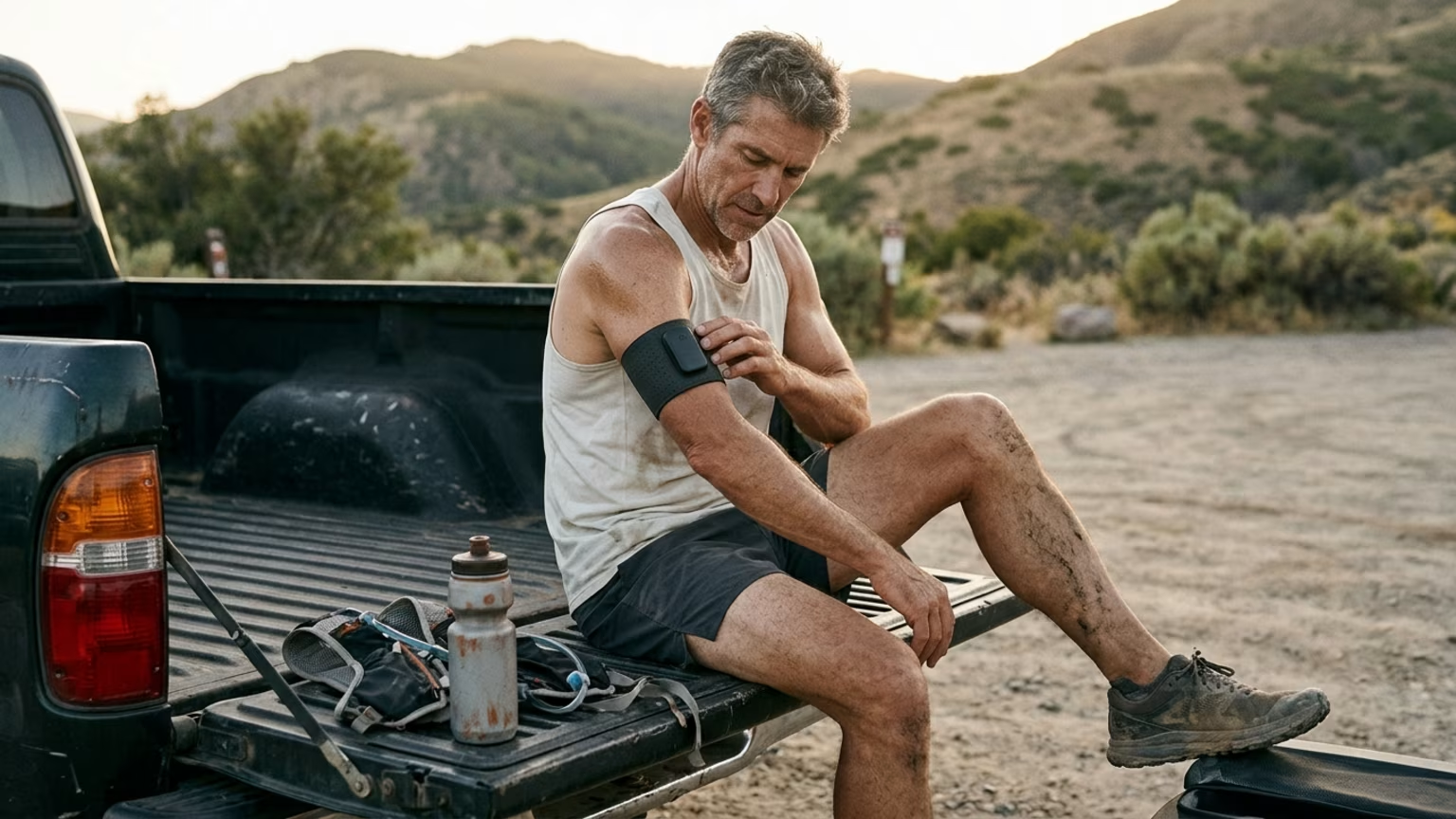

Suji’s Muscle Score beta tracks exercise performance. Here is how athletes over 35 can weigh its ratings, related BFR research and cost.





Suji, the maker of app-connected blood-flow-restriction (BFR) cuffs, launched its Muscle Score beta on November 2, 2026. The feature is available in the Suji app for Premium subscribers, according to ACTIVE. It produces separate upper- and lower-body performance ratings from guided bodyweight assessments.
For endurance athletes over 35, the interesting question is whether these ratings add useful context to training. A convenient assessment could provide another way to follow performance over time. The important distinction is between recording a result and knowing what that result means.
According to ACTIVE’s launch coverage, Muscle Score uses two prescribed assessments:
Each assessment generates a score from 0 to 100. The app reports the upper- and lower-body results separately rather than combining them into a single rating.
Suji says its scoring considers repetitions, movement consistency and force production. The company also lists fatigue and movement quality alongside power output and symmetry. These are the inputs Suji describes for the feature.
That gives the score a specific intended role: tracking performance during the prescribed exercises. It is not a direct measurement of muscle mass or body composition. It is also not a medical diagnosis or a validated substitute for strength testing.
This distinction matters when interpreting change. A better push-up assessment result answers a different question from whether someone has gained muscle. Keeping those questions separate makes the score easier to place within a broader training picture.
Suji founder and CEO Alex Birks characterized the feature as a way to check muscle performance and training response without heavy weights, according to ACTIVE. That describes the company’s aim. For an athlete, the useful starting point is narrower: understanding the two assessment results before attaching a larger meaning to them.
A separate exploratory randomized trial published in BMC Geriatrics on November 3, 2026, provides relevant context about BFR training. It studied 36 oldest-old adults with both sarcopenia and mild cognitive impairment.
Researchers assigned participants to supervised low-load BFR resistance training, matched low-load resistance training or a no-exercise control. Training took place three times weekly for eight weeks. This was a training intervention rather than a study of an app-based assessment.
The authors reported favorable changes for BFR compared with no exercise in handgrip strength and 4-meter walking performance. They also reported favorable changes in verbal learning and delayed recall. However, evidence that BFR added benefits beyond matched low-load resistance training was limited for most outcomes.
The comparison matters. Favorable results against no exercise do not establish that adding BFR is better than doing comparable low-load training. The trial’s small and specific clinical population also limits its relevance to endurance athletes. It did not test Suji’s product or validate Muscle Score.
On the product side, ACTIVE said it had received the cuffs but had not completed a full evaluation. It identified score consistency and usefulness as subjects for future testing. Comfort, setup and value were also on that list. The launch coverage did not independently verify how Suji’s proposed scoring inputs were measured or weighted.
These are separate evidence questions. Research into a training method addresses what happens when people follow that intervention. Evaluation of a scoring tool addresses whether its readings are consistent and useful. Evidence for the first should not be treated as an answer to the second.
For an endurance athlete, the most reasonable use is to follow performance on the two prescribed movements alongside training and recovery. That is a smaller task than assessing overall muscle health, but it is also a clearer one.
Suji says day-to-day performance may reflect training load and recovery. Illness and other factors may also affect results, according to the company. ACTIVE therefore advises testing under similar conditions when comparing readings over time.
The practical guidance is to keep interpretation tied to the assessment rather than letting the number stand alone. Three questions help organize that judgment:
These questions do not require a new testing schedule or a score threshold. Neither is established in the approved launch information. They simply keep the feature within its stated purpose as a personal performance-tracking signal.
For Reendure, the priority is useful interpretation rather than collecting a number for its own sake. That is the same broad issue behind reading recovery trends in context. A metric should support judgment rather than take over the decision.
An athlete who already follows a strength program does not need to reorganize it around this launch. The more relevant question is whether recording these particular movements would answer something useful about their training. If there is no clear question, adding another rating need not become a priority.
The longer-term goal remains putting muscle health within a wider endurance plan. The device is one possible tool within that discussion, not the purpose of the plan itself. Personal decisions about whether BFR is appropriate belong with a qualified clinician who understands the athlete’s health history.
At launch, ACTIVE reported that Suji listed its Complete Kit at $749. It also reported a Premium subscription price of $4.99 per month after a 30-day free period, based on information from Suji.
Those costs make it worth separating interest in the assessment from interest in the equipment. For someone considering a purchase mainly for Muscle Score, the hardware and subscription belong in the same value judgment. The relevant question is what useful information the feature would add for that person.
For someone who already has the equipment and Premium access, the decision is different. It is about whether using the beta adds worthwhile context to an existing setup. There is no need to assign the same value to the feature in both situations.
A prospective buyer can also separate two goals: using BFR as part of training and recording performance through the guided assessments. Interest in one does not automatically establish a need for the other. Keeping those goals distinct makes the purchase question more concrete.
Suji’s launch offers a way to turn guided push-ups and bodyweight squats into separate app-based performance ratings. For endurance athletes over 35, the modest response is curiosity rather than an immediate change in training.
Treat the beta as an optional record of those movement assessments. Compare results in context and decide whether the information answers a useful question. Training decisions should still rest on the wider picture rather than a single score.
The standard is straightforward: does the feature add enough useful information to justify its place in the athlete’s routine? That is a more productive question than assuming a new number must become a new training priority.

Follow ReEndure for practical insights on endurance training, recovery, nutrition and healthy aging. Stay connected for new articles, research led guidance and ideas to help you perform better for longer.




Read practical ideas on endurance training, recovery, nutrition and healthy aging to keep progressing for years to come.
Read the Blog