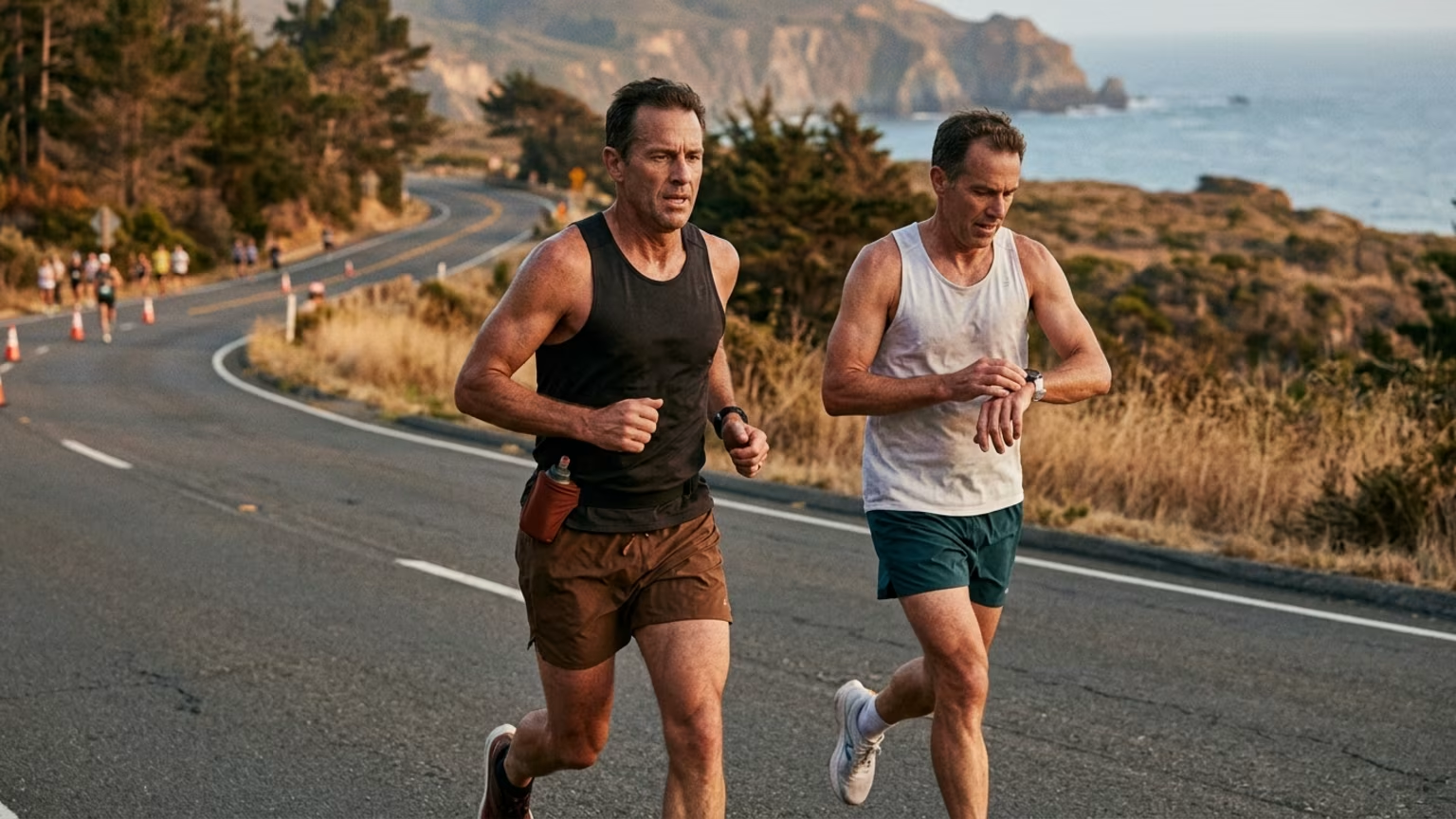

The 2026 World Athletics Road Running Championships offers masters athletes practical lessons on pacing strategies, tactical control, and specific preparation.





On 15 September 2026, Olympics.com and World Athletics detailed the official formats and elite rosters for the World Athletics Road Running Championships Copenhagen 2026. The published event preview outlines a concentrated weekend of competition scheduled for 19 to 20 September 2026. Nearly 500 athletes are expected to compete in Denmark. This announcement provides a clear view into how championship events organize high speed racing.
The core of the upcoming championship centres on three distinct road distances. Competitors will face the road mile, the 5km, and the half marathon. Yared Nuguse leads the men's road mile field with a career best time of 3:51.90. Nuguse and Vincent Ciattei hold the two fastest road mile times reported for 2026, at 3:54.06 and 3:54.62 respectively. Hobbs Kessler, who won the previous Road Running mile title in Riga in 2023 with a time of 3:56.13, adds incredible depth to the field.
The longer distances feature equally impressive standards. The 5km field includes reigning 10,000m world champion Jimmy Gressier. Gressier is credited with a 2026 world leading road 5km time of 12:51. Joshua Cheptegei will compete in the half marathon, bringing his experience as an Olympic 5,000m champion and a three time 10,000m world champion. Nicholas Kipkorir leads that half marathon field with a personal best of 58:08 from Lisbon. For the women's events, Likina Amebaw is identified as a leading contender in the 5km, while the women's mile field includes athletes attempting a major competition treble across consecutive weekends.
The event methodology relies on a strict single race format with no heats. RunRepublic reports that each distance is decided in one attempt. The road mile and 5km events are scheduled for Saturday, 19 September. A published Irish schedule lists the women's road mile at 9:10 a.m., the men's road mile at 9:30 a.m., and the men's 5km at 1:40 p.m. in local Irish time. The half marathon takes place on Sunday, 20 September, starting at 8:45 a.m. on the same schedule.
The Irish schedule lists those events in Irish time, so viewers should verify the final official broadcast timetable. You must convert these times to your own time zone before planning your viewing schedule or race day analysis. World Athletics describes Saturday as the primary championship day for speed. Sunday is designated as the day the half marathon takes over Copenhagen. The available coverage describes all three courses as quick and designed for fast racing. The road mile routes around Østerbro. The 5km passes landmarks including the Copenhagen lakes, and the half marathon finishes in Fælledparken.
The single race structure places immense pressure on the opening kilometres. Without a second chance round, pacing errors become incredibly expensive. For ambitious athletes aged 35 to 65, the lesson here is absolute discipline from the starting gun. The format rewards a controlled execution over an erratic early sprint.
A mile race requires a specific three part model for success. You must accelerate decisively but avoid sprinting away from the start. The middle section requires maintaining relaxed mechanics and resisting the urge to respond to every surge. Finally, you should increase effort progressively using good posture rather than an uncontrolled sprint.
This approach mirrors the tactical restraint needed to master short distance endurance. Choosing the right race strategy for your event is essential for maintaining control and preserving your top speed for the finish line.
The descriptions of the Copenhagen routes highlight the need for course specific preparation. Fast courses passing landmarks like the Copenhagen lakes do not eliminate tactical challenges. Wind exposure, sharp turns, and pack crowding can ruin a perfectly even split if you are unprepared. A course that feels fast simply makes disciplined effort control more important.
The half marathon finishes in Fælledparken, which requires runners to map out their final progression carefully. Accelerating too early in anticipation of a fast finish can drain your legs prematurely. Match your training block to the specific demands of your target event. Rehearse turns, test your hydration, and prepare for tactical surges.
If you face adverse weather on an exposed route, knowing how to pace your race by multiple signals can save your performance. Relying strictly on a watch during a technical or windy section often leads to early exhaustion.
Elite benchmarks are fascinating to watch, but they are not practical performance targets for age group runners. Trying to scale your own race plan off an elite time often leads to physiological collapse. A 58:08 half marathon or a 12:51 road 5km represents world class capacity. Masters athletes must prioritize relative progress over absolute elite standards.
Hitting my forties brought a harsh reality check. The track workouts were not getting slower, but the days after them felt significantly heavier. Instead of forcing my old Tuesday and Thursday intensity schedule, I looked at the data on Masters athletes and muscle protein synthesis. I pushed my second hard session to Friday, allowing an extra forty eight hours of low intensity recovery.
My total weekly volume stayed the same, but the quality of my intervals skyrocketed. This recovery shift allowed me to practice precise pacing targets without entering a state of chronic fatigue. I could finally hit my goal rhythm for the middle kilometres of a half marathon simulation. Older athletes should track their age group placing or use age graded tables to measure success.
Elite times can inspire your training ambition, but your specific preparation must respect your recovery limits. For more insight on pacing correctly, read our guide for Masters runners on how tactical restraint at the start improves overall outcomes.
The three championship distances should never be approached with one generic pacing strategy. The mile requires speed control and tactical awareness. The 5km requires precision under high effort. The half marathon rewards restraint and late race durability.
The 5km is long enough for pacing errors to become expensive but short enough that a runner can sustain a demanding effort from the opening kilometre. A useful age group plan is to run the first kilometre slightly below maximum effort. You should then settle near your target pace through the middle kilometres. Finally, begin racing your competitors instead of merely watching the clock in the final kilometre.
A robust half marathon plan involves running the opening 3 to 5km with deliberate restraint. You should settle into a pace that feels sustainable rather than urgent. Treat the middle section as a rhythm phase. Begin a controlled progression after 15 to 16km if your breathing and form remain stable.
Finally, you can race the last 2 to 3km by effort and position. Athletes preparing for a local race can use the Copenhagen schedule as a template for a training block. Mile focused runners can practice fast but controlled starts. Runners targeting the 5km can rehearse kilometre splits and responses to pace changes.
Half marathon runners can practice conservative starts and steady middle sections. Establishing a structured evaluation system to review your performance will help you refine these tactics over time.
The veteran endurance athlete treats elite championship formats as masterclasses in tactical pacing and discipline rather than raw finish times to chase.

Follow ReEndure for practical insights on endurance training, recovery, nutrition and healthy aging. Stay connected for new articles, research led guidance and ideas to help you perform better for longer.






Read practical ideas on endurance training, recovery, nutrition and healthy aging to keep progressing for years to come.
Read the Blog