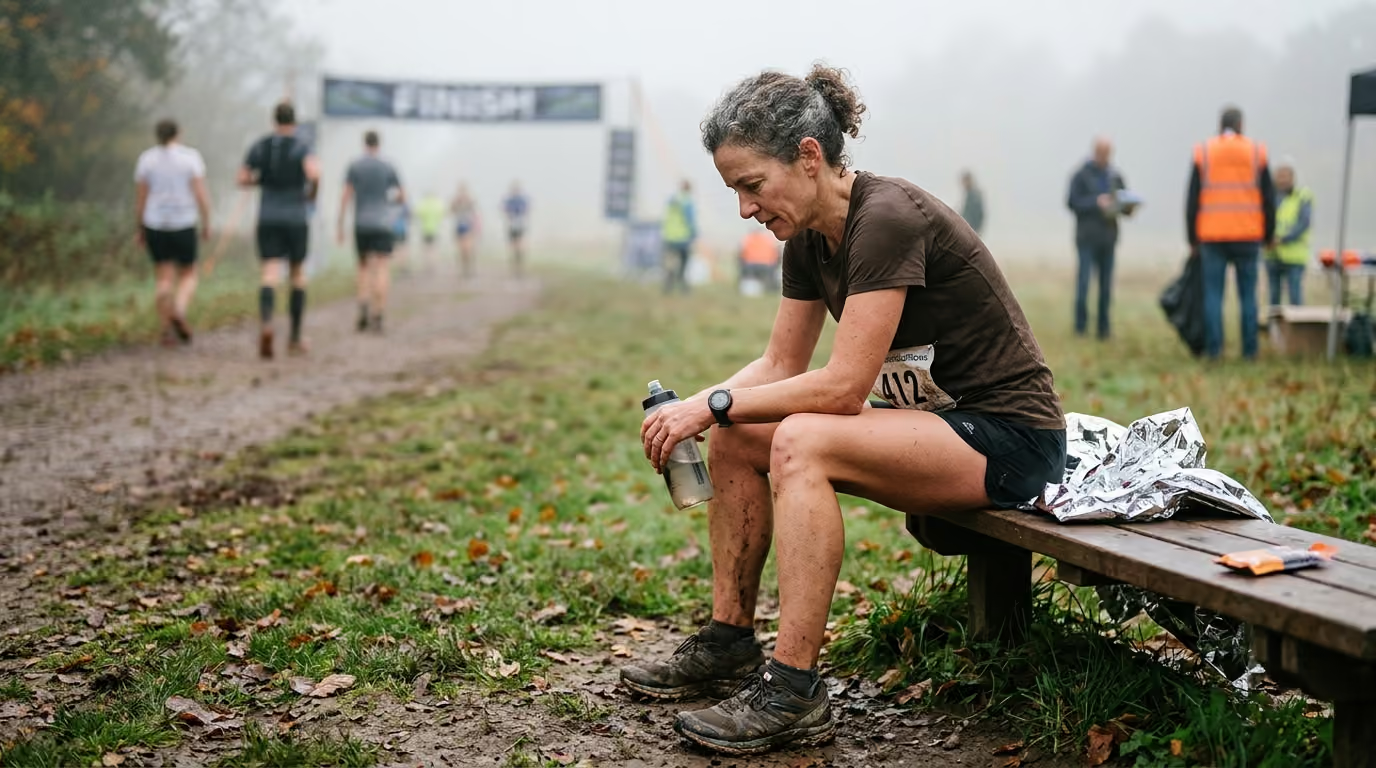

Rigid split times seem reliable, but matching dynamic pacing anchors to terrain and physiology prevents catastrophic late-race fatigue across long events.





Endurance race pacing is the deliberate distribution of physiological work, mechanical power, and energy expenditure across the duration of an athletic event. It is not simply running at a steady target speed or pedaling at a predetermined wattage until exhaustion sets in. A complete pacing strategy balances current external output against the internal rate of fatigue accumulation. It accounts for changing weather, terrain, metabolic fuel availability, and the psychological perception of effort.
Athletes frequently rely on a single metric to guide their race execution. A runner might stare rigidly at a GPS watch, while a cyclist might focus solely on a handlebar-mounted power meter. This single-metric approach often fails when environmental conditions shift, when hills alter muscular strain, or when internal physiological stress drifts upward. Mastering race execution requires understanding the difference between pacing profiles, pacing anchors, and multi-metric decision systems across varied race distances.
Consider a familiar scenario played out at mass-participation road marathons and endurance cycling events every weekend. An athlete trains for months, establishing a clear goal pace during cool, flat morning training sessions. On race day, surrounded by hundreds of competitors and fueled by pre-race adrenaline, the target pace feels remarkably easy during the first three miles. Heart rate is slightly elevated due to excitement, but the athlete ignores the signal because the watch displays the exact planned split.
By the midpoint of the event, the ambient temperature has climbed by eight degrees, and the course encounters a series of rolling hills. The athlete forces their body to maintain that same predetermined split on the climbs, burning through finite muscle glycogen stores at an accelerated rate. By mile eighteen, perceived exertion spikes dramatically, breathing becomes labored, and the legs feel heavy. The target pace quickly slips away, turning the final six miles into a painful battle against severe muscular fatigue and energy depletion.
This breakdown happens because the athlete treats external pace as an absolute target rather than a dynamic variable. External speed measures output, but it does not reflect the internal physiological cost of producing that speed under changing conditions. When headwinds, hills, heat, or accumulated fatigue increase the metabolic cost of movement, forcing an unchanging speed creates unsustainable metabolic strain. The athlete experiences a catastrophic drop in performance, not from a lack of fitness, but from an inflexible pacing framework.
A similar breakdown occurs among trail runners and cyclists who fail to account for terrain shifts. A cyclist attempting to maintain a flat-road power target into a fierce headwind may exhaust their anaerobic capacity before the midpoint of a time trial. A trail runner who attacks early climbs at road-race intensity often incurs deep eccentric muscle damage that ruins their ability to run efficiently on subsequent descents. Successful race execution demands a system that adapts to physical strain rather than fighting against it.
At its physiological foundation, pacing is how an athlete manages metabolic resource consumption, thermal strain, and neuromuscular fatigue across time. To understand how work should be distributed, sports scientists distinguish between four separate components of race execution. Treating these four components as interchangeable is one of the most common errors in endurance sports.
The first component is the pacing profile, which describes how external performance changes over time. A pacing profile can be even, positive, negative, variable, or terrain-dependent. The second component is the pacing anchor, which represents the specific metric used to regulate intensity, such as heart rate, power, pace, or perceived exertion. The third component is the pacing strategy, which is the deliberate overarching plan chosen for a specific event. The fourth component is pacing execution, which measures how accurately the athlete applies their chosen plan under real-world conditions.
The primary physiological challenge during any endurance event is managing the rate of metabolic byproduct accumulation and fuel depletion. When an athlete exercises below their lactate threshold, energy is supplied predominantly through oxidative phosphorylation. In this domain, fat and carbohydrate oxidation remain balanced, metabolic byproducts are cleared effectively, and the effort can be sustained for long periods. Once intensity crosses the threshold into the heavy or severe exercise domains, the rate of muscle glycogen consumption increases rapidly.
Higher intensities also accelerate the accumulation of hydrogen ions, inorganic phosphate, and other metabolites that impair muscular contraction. If an athlete spends too much time above threshold early in an event, they incur a metabolic debt that cannot easily be recovered while continuing to move at race pace. The central nervous system continuously monitors these internal physiological signals, including muscle temperature, core body temperature, substrate availability, and blood chemistry. This continuous monitoring forms the basis of the psychobiological model of endurance performance.
According to modern sports science, perceived exertion acts as an integrative sensory hub. The brain combines conscious motivation, knowledge of the remaining distance, and afferent physiological signals into an overall Rating of Perceived Exertion, commonly abbreviated as RPE. As described in exercise physiology research, RPE rises naturally as a race progresses. A well-paced race is one where RPE reaches its near-maximal value precisely at the finish line, rather than ten miles before it.
Another critical physiological concept is cardiovascular drift, often termed aerobic decoupling. During prolonged exercise, especially in warm conditions, stroke volume gradually decreases as fluid is lost through sweat and blood is redistributed to the skin for cooling. To maintain adequate cardiac output and supply oxygen to working muscles, heart rate must rise over time even if external work remains perfectly flat. A target heart rate that reflects moderate aerobic effort in the first twenty minutes may demand a substantial reduction in speed three hours later. Understanding these physiological mechanisms allows athletes to choose the right pacing profile for their specific event.
Endurance researchers generally classify race performances into five distinct pacing profiles. Each profile distributes work differently across the duration of an event, and each has specific applications based on course design and environmental conditions.
Even pacing involves maintaining a constant speed or power output throughout the entire event, with minimal fluctuations between segments. It is widely considered the gold standard for events conducted on flat courses under stable environmental conditions. By avoiding unnecessary surges, an athlete minimizes rapid glycogen depletion and prevents excessive blood lactate spikes.
Laboratory research underscores the energetic efficiency of this approach. In a 20-kilometer cycling time-trial study published in sports science literature, an even-paced condition produced significantly lower blood lactate and lower perceived exertion than self-paced or variable-paced conditions when total work and completion time were matched. The even-paced protocol achieved identical performance outcomes with noticeably less internal physiological strain.
Even pacing is ideal under specific conditions:
Even pacing does not require absolute second-by-second perfection. Minor variations caused by passing other competitors, negotiating sharp corners, or passing through aid stations are normal. The objective is simply to eliminate unnecessary surges that increase the internal cost of work.
A positive split occurs when the opening segment of a race is completed faster than the closing segment, resulting in a progressive reduction in speed. Positive splitting is exceptionally common in endurance events, but it can represent either a deliberate tactical choice or an uncontrolled physiological collapse. The key distinction is between a planned, controlled positive split and an unintentional blow-up.
Extensive research on marathon fields demonstrates that positive splitting is the dominant profile among recreational athletes. In a large-scale analysis of New York City Marathon participants, all performance groups displayed positive pacing profiles on average. However, faster runners demonstrated significantly lower speed variability than slower competitors. Top male runners showed a 5-kilometer split speed coefficient of variation of 7.8 percent, and top female runners recorded 6.6 percent. In contrast, less successful finishing groups recorded coefficients of variation ranging from 8.3 percent to 14.4 percent.
A controlled positive split can be appropriate in specific situations:
When a positive split is uncontrolled, it almost always stems from early overexertion, inadequate fueling, or poor heat management. Starting twenty seconds per mile faster than sustainable capacity creates a metabolic deficit that often leads to a slowdown of several minutes per mile late in the race.
A negative split occurs when the second half of an event is completed faster than the first half. This strategy requires deliberate early restraint, allowing the athlete to conserve glycogen, limit thermal stress, and maintain muscular integrity for a strong late-race progression.
Negative splitting is particularly effective in these circumstances:
A proper negative split does not mean starting at an excessively slow jogging pace. Useful negative-split plans begin near the lower boundary of the athlete's sustainable target range, transitioning smoothly into the upper boundary past the midpoint.
Variable pacing involves deliberate, strategic fluctuations in speed or power output across a race. While uncontrolled variation generally reduces efficiency, planned variable pacing is often necessary when an athlete faces changing external resistance such as wind or rolling hills.
In a classic cycling study analyzing a 16.1-kilometer time trial with equal headwind and tailwind sections, researchers found that adjusting power by approximately plus or minus 5 percent improved performance by roughly 12 seconds compared to baseline efforts. Increasing power slightly into a headwind or on an incline yields a significant time savings, while reducing power slightly with a tailwind or on a descent allows for partial physiological recovery.
Variable pacing must be divided into two distinct categories:
Course-responsive variation optimizes total speed over varied terrain. Uncontrolled variation simply wastes energy and accelerates muscular fatigue without improving finishing times.
A terrain-dependent strategy adjusts speed and power according to the elevation profile while keeping internal physiological effort relatively stable. The athlete purposefully slows down on ascents and allows speed to rise naturally on descents, avoiding the costly mistake of forcing a flat-course pace onto steep gradients.
Practitioners classify terrain-dependent pacing as an essential model for trail running, mountain biking, and mountain ultramarathons. In a study examining athlete pacing during a mountain ultramarathon, runners demonstrated a positive pacing profile where speed declined steadily until roughly 70 to 90 percent of total race duration before increasing slightly in the final 10 percent. Interestingly, heart rate decreased during that same 70 to 90 percent window, while perceived exertion continued to climb.
Terrain-dependent pacing is the mandatory framework for:
By letting terrain dictate speed while internal effort remains regulated, athletes protect their musculoskeletal system from premature failure.
A pacing anchor is the measurement tool an athlete uses to monitor and adjust work output during an event. Choosing the correct anchor depends on the sport, the accuracy of available equipment, the race duration, and the surrounding environment.
Pacing by speed or pace is intuitive, direct, and exceptionally popular in road running. It offers an unambiguous link to finishing time and allows athletes to track their progress against precise time goals. Athletes can consult evidence-based training performance principles to establish accurate baseline splits from recent workout data.
The primary limitation of pace is that it measures only external mechanical output, ignoring the internal metabolic cost required to sustain that output. Running at a seven-minute-per-mile pace on a cool, flat road requires moderate aerobic effort. That exact same pace on a 4 percent uphill grade or into a 15-mile-per-hour headwind demands high-intensity anaerobic contribution. Relying solely on pace during bad weather or on hilly courses almost always leads to premature fatigue.
Pace should be regulated by clear execution rules:
Power measures mechanical work rate in watts. It is the gold standard pacing anchor in cycling and has gained significant adoption among runners using wearable running-power sensors. Power provides instantaneous feedback, entirely unaffected by wind speed, gradient changes, or drafting effects.
In cycling time trials, monitoring power allows athletes to manage their work distribution with extreme precision. Research shows that varying power by plus or minus 5 percent on rolling courses creates minimal additional physiological stress while maximizing overall velocity. Power-based pacing helps athletes avoid over-powering short climbs, which is the most frequent tactical error in cycling events.
However, power pacing has several important limitations:
Athletes should establish a sustainable target power range alongside a strict upper ceiling for brief climbs. Power should always be cross-referenced with internal sensations of effort.
Heart-rate pacing uses beats per minute or percentage ranges based on maximum heart rate, heart-rate reserve, or lactate-threshold heart rate. Guidelines from the American College of Sports Medicine (ACSM) classify moderate aerobic exercise as 64 to 75 percent of maximum heart rate, or 40 to 59 percent of heart-rate reserve. Vigorous exercise is classified as 76 to 95 percent of maximum heart rate, or 60 to 84 percent of heart-rate reserve.
Heart rate provides a window into the internal cardiovascular strain experienced by the body. It is particularly valuable during long-duration events, hot weather, and multi-hour ultramarathons where early restraint is critical. When external pace feels deceptively easy during the first hour of a race, a high heart rate can alert an athlete to hidden physiological stress.
Despite its benefits, heart rate has notable drawbacks:
In prolonged cycling research, the relationship between heart rate and perceived exertion changed continuously based on exercise duration and workload. A specific heart rate does not represent a static physiological state across a four-hour race. Consequently, heart rate is best utilized as an intensity ceiling early in long events rather than an immutable target.
The Borg 6 to 20 RPE scale and modified 0 to 10 categorical scales provide structured frameworks for monitoring effort based on bodily sensations. ACSM documentation correlates moderate intensity with an RPE of 12 to 13 on the Borg scale (or 3 to 4 on a 0 to 10 scale), while vigorous intensity corresponds to an RPE of 14 to 17 (or 5 to 7 on a 0 to 10 scale).
Rather than assigning a single static RPE number to an entire event, experienced athletes use a race-segment RPE model:
Perceived exertion integrates breathing rate, muscular burning, joint strain, and core temperature into a single real-time assessment. It operates effectively when GPS signals drop, power meters fail, or weather conditions invalidate planned pace charts. Its main weakness is susceptibility to psychological distortion. Athletes often underestimate RPE early due to race excitement and overestimate their reserves near the finish.
The talk test is a low-technology, practical tool for monitoring aerobic intensity. Supported by ACSM exercise prescription materials, it defines exercise intensity by an athlete's ability to speak comfortably. At moderate aerobic intensities, an athlete can speak in complete, conversational sentences. As intensity rises toward the lactate threshold, speech becomes broken, limited to short phrases or single words.
While the talk test lacks the precision required for elite road racing, it is a practical tool for ultramarathons, long-distance cycling events, and early-season base races. If an ultramarathon runner cannot speak a full sentence without gasping during the first two hours of a 50-mile race, their current intensity is metabolically unsustainable.
The most dependable race execution comes from combining these tools into an integrated multi-metric hierarchy. Relying on a single metric creates blind spots, whereas a layered approach allows one metric to cross-check another.
If an athlete's target pace on a flat road feels unusually demanding and pushes their heart rate past the planned ceiling, RPE serves as the master override. The athlete dials back external pace to protect their metabolic stability, ensuring a resilient overall performance.
Race duration and external environmental factors significantly alter physiological demands. A pacing approach that works for a 10-kilometer road race will lead to severe failure in a mountain ultramarathon.
Short events, such as 4-kilometer track cycling time trials or 1500-meter to 3000-meter runs, require athletes to operate near maximal aerobic capacity. However, starting at an absolute all-out sprint is counterproductive. In a study examining 4-kilometer cycling time trials, an all-out opening start did not improve performance compared to a controlled fast start where riders rapidly transitioned into sustainable target power.
The optimal strategy for short events follows three phases:
Heart rate is largely unhelpful for real-time adjustments in these events due to response lag. Power, pace, and practiced neuromuscular rhythm must serve as the primary guides.
Middle-distance races operate close to the athlete's lactate threshold. Glycogen availability is rarely the sole limiting factor in a well-fueled athlete, but metabolic byproduct accumulation can quickly end a race if early pacing is undisciplined.
Athletes should aim for an even or mildly progressive pacing profile. Pacing should be conservative during the opening 5 percent of the race distance, preventing premature lactate spikes. Once settled into rhythm, the athlete holds a stable pace or power output through the middle miles. An intentional progression can begin past the halfway mark if muscular comfort and breathing remain stable. For those organizing their season, reviewing structured race preparation can help align target paces with specific fitness levels.
The marathon distance magnifies minor pacing errors. Running just ten to fifteen seconds per mile too fast in the opening half can cause premature glycogen depletion, progressive muscle damage, and severe late-race slowing.
A marathon pacing framework should include:
Elite and top-performing amateur marathoners consistently display highly even pacing profiles. Protecting energy stores early ensures the athlete has the muscular resilience needed to navigate the final 10 kilometers.
Ultramarathons introduce complex variables, including severe musculoskeletal trauma, gastrointestinal distress, and sleep deprivation. Research analyzing 24-hour ultramarathon races revealed a reverse-J-shaped pacing pattern across the field, with speed declining steadily before a sharp drop in the final hours. Notably, the most successful runners started at lower relative intensities and maintained more even profiles than slower competitors.
In ultramarathon pacing, heart rate and RPE completely replace pace as primary anchors. Athletes must manage uphill hiking transitions, enforce downhill braking control to spare quadriceps muscles, and adhere strictly to caloric intake goals. Pacing success in an ultramarathon is measured by continuous, efficient forward movement and minimal time spent stopped at aid stations.
External weather and terrain conditions require immediate, proactive adjustments to any pacing plan:
Pacing strategies must adapt to the physiological realities of aging. Masters athletes, particularly those over the age of forty or fifty, experience changes in cardiovascular dynamics, thermoregulation, and tissue recovery that influence how work should be distributed during a race.
With age, maximal heart rate naturally declines, which narrows the functional heart-rate reserve between resting effort and maximal capacity. Older athletes also experience earlier onset of cardiovascular drift during warm-weather events due to slight decreases in sweat gland sensitivity and lower blood plasma volume. Consequently, a heart-rate zone that represents sustainable aerobic effort at age thirty may carry an older athlete into heavy metabolic strain much earlier in a race. Setting heart-rate ceilings based on recent field tests rather than age-predicted formulas is critical for masters runners and cyclists.
Musculoskeletal recovery during a race also shifts with age. Tendons and muscle fibers lose small amounts of resting elasticity, making older athletes more susceptible to eccentric muscle damage on long downhills. A younger athlete might aggressively hammer downhill sections of a road marathon or trail race with minimal immediate penalty. A masters athlete who adopts that approach often experiences severe quadriceps fatigue and cramping hours later. Pacing downhill segments with controlled turnover and minimal braking impact protects muscle tissue for the final miles.
Older competitors benefit from conservative opening splits and even pacing profiles. Surges and tactical accelerations carry a higher metabolic cost that takes longer to recover from mid-race. Masters athletes exploring healthy aging and endurance longevity should focus on multi-metric pacing, using RPE to override external pace targets when conditions demand caution.
Even experienced competitors fall prey to psychological and strategic errors on race day. Avoiding these common pitfalls preserves months of dedicated training.
Courses feature turns, wind shifts, and minor gradient changes that alter the energy required to hold a specific pace. Forcing a GPS watch to read the exact same number on every kilometer wastes energy. Athletes must allow minor variations within a defined target range.
One of the most destructive pacing fallacies is running or riding faster than sustainable pace early in an event to build a time cushion for later fatigue. Physiologically, banking time guarantees a severe late-race collapse. The glycogen burned and lactate accumulated during those fast early miles create fatigue that costs minutes later for every few seconds gained early.
Mass-start events tempt athletes into matching the pace of surrounding runners or riders. Racing tactically against other competitors during the first third of an endurance event is almost always a mistake. Disciplined athletes execute their own pacing plan, confident that overzealous competitors will drift backward later in the day.
Assuming that a target pace developed in 50-degree weather applies equally on an 80-degree race morning is a recipe for medical trouble and physical failure. When weather forecasts change, the pacing strategy must change with them before the start horn sounds.
GPS drift in city centers, cadence-lock errors on wrist-based heart-rate monitors, and uncalibrated power meters can provide faulty data during a race. When an athlete's internal sense of effort sharply contradicts what a device displays, the athlete should trust RPE and physiological sensations over the screen.
Evaluating pacing accuracy after a race or key workout provides valuable data for future events. Athletes can track several objective metrics to assess whether their work distribution was effective.
Athletes can calculate the coefficient of variation (CV) of their splits across a flat race. By taking the standard deviation of their split times and dividing it by their average split time, they obtain a clear percentage of variability:
A lower CV on a flat course indicates disciplined, even pacing execution, which strongly correlates with optimal finishing times.
Aerobic decoupling, often abbreviated as Pw:HR (power to heart rate) in cycling or Pa:HR (pace to heart rate) in running, measures the relationship between external output and internal cardiovascular cost across an event.
In a well-paced, properly fueled endurance event, decoupling should typically remain under 5 percent for events lasting up to three hours. A decoupling value greater than 8 to 10 percent indicates substantial cardiovascular drift, often driven by starting too fast, becoming dehydrated, or experiencing thermal stress.
Following every major race, athletes should conduct a structured review to refine future strategy. Athletes seeking further race analysis methods can consult our broader racing and lifestyle resources for structured performance templates.
To see how these principles function in practice, consider how an athlete applies multi-metric pacing across five distinct competitive scenarios.
The athlete establishes a target pace range of 7:30 to 7:35 per mile based on recent half-marathon results and lactate threshold testing. For the first five miles, the runner enforces a strict heart-rate cap of 80 percent of maximum heart rate to eliminate adrenaline surges. Through the middle miles (miles 6 to 20), the runner locks into target pace, allowing minor five-second variations for water stops and wind changes while keeping RPE at a steady 13 to 14 on the Borg scale. At mile twenty, if RPE remains controlled and muscular soreness is manageable, the runner gradually opens their stride, using RPE as the primary guide to execute a strong finish.
Rather than trying to hit an identical split on every mile, the runner divides the course into distinct segments based on elevation changes. On uphill sections, the runner accepts a 20 to 30 second per mile drop in pace, focusing on keeping breathing rhythm steady and preventing heart rate from crossing threshold. On downhill sections, the runner increases cadence, allowing speed to increase while keeping muscular impact gentle. The runner evaluates progress by average pace across entire four-mile segments rather than individual miles, ensuring overall race duration matches their goal without blowing up on climbs.
Race morning temperatures start at 68 degrees and are forecasted to reach 82 degrees by noon. The athlete immediately adjusts their planned finishing time goal downward by 5 percent. The runner uses heart rate as the primary governor from the start, refusing to let it exceed 78 percent of maximum heart rate during the first ten miles regardless of pace. As cardiac drift begins in the second half due to heat, the runner uses RPE to govern effort, maintaining a steady 14 to 15 on the Borg scale and actively cooling with water and ice at every aid station. By prioritizing thermoregulation and internal strain, the athlete avoids medical distress and finishes strong while competitors around them walk.
A cyclist tackles a 40-kilometer out-and-back time trial with a 12-mile-per-hour headwind on the outward leg and a tailwind on the return leg. Based on an established Functional Threshold Power (FTP) of 300 watts, the cyclist plans a variable power strategy. On the outward leg into the headwind, the rider targets 315 watts (roughly 105 percent of FTP), maximizing speed during the slowest, most aerodynamically resistant portion of the course. On the return leg with the tailwind, the rider dials power back to 285 watts (roughly 95 percent of FTP), utilizing the tailwind to maintain high speed while allowing metabolic clearing. The overall average power remains exactly at target threshold, but the variable distribution produces a faster total time.
The trail runner disregards road-based pace entirely. On climbs steeper than an 8 percent grade, the athlete immediately transitions to a power hike, keeping heart rate firmly in the moderate aerobic zone (below 75 percent of maximum) to conserve glycogen. On technical descents, the runner focuses on high cadence and light foot placement to prevent quadriceps damage. The athlete evaluates pacing success by two non-negotiable rules: the ability to consume 250 calories per hour without nausea, and arriving at the 35-mile mark with the physical ability to run all flat and gently rolling sections. This disciplined effort distribution ensures steady progress while over-aggressive runners succumb to muscular cramping and gastrointestinal shutdown.
Immediately transition your primary pacing anchor to perceived exertion and breathing rhythm. If you are wearing a heart-rate monitor, use your established heart-rate ceiling to prevent overexertion. Look for official course mile or kilometer markers and use a standard stopwatch function on your device to calculate your actual splits manually.
Do not attempt to accelerate or maintain a high-intensity pace on depleted glycogen reserves. Dial back your pace or power by 5 to 10 percent immediately to lower your body's rate of carbohydrate oxidation. Focus on consuming easily digestible fluids, electrolytes, or simple carbohydrate gels at small, frequent intervals until your gastrointestinal system processes the fuel and your energy stabilizes.
Not necessarily. While negative splitting is effective for managing risk, the fastest finishing times on flat courses under ideal weather conditions are typically achieved with a very narrow, highly disciplined even-pacing profile. A severe negative split often means an athlete ran the first half too conservatively, leaving unused physical capacity at the finish line.
Establish a strict objective ceiling for the first 10 percent of your race distance using heart rate, power, or a fixed pace band. Consciously force yourself to feel as though you are moving too slowly during the opening miles. Remind yourself that a race cannot be won in the first two miles, but it can easily be lost there.

Follow ReEndure for practical insights on endurance training, recovery, nutrition and healthy aging. Stay connected for new articles, research led guidance and ideas to help you perform better for longer.


Read practical ideas on endurance training, recovery, nutrition and healthy aging to keep progressing for years to come.
Read the Blog