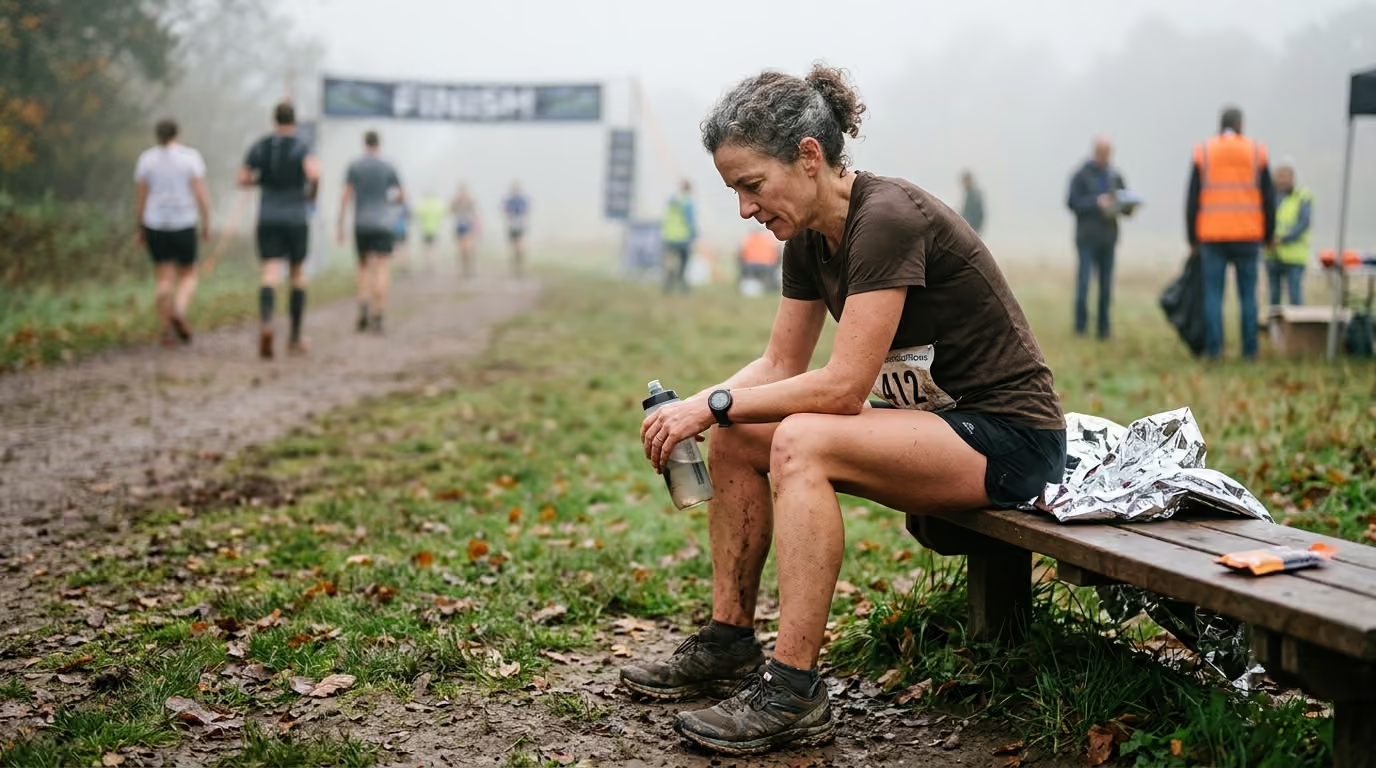

While older competitors usually worry about cardiovascular decline, aging actually challenges subtle sensory skills, recovery rates, and temperature control on race day.





The standard story about aging in endurance sports says that you simply slow down. Most runners, cyclists, and triathletes assume that getting older means producing a few less watts, running thirty seconds slower per mile, and watching their race times gradually slide.
That view is incomplete and dangerously misleading.
Aging does not degrade your athletic performance uniformly. Instead, it alters how your body processes light at dusk, how quickly your skin dissipates heat on a humid afternoon, how your tendons tolerate abrupt downhill braking, and how many days your muscle fibers require to restore glycogen and repair tissue. When older athletes struggle on race day, it is rarely because their aerobic engine suddenly failed. It is usually because a sensory, thermoregulatory, or structural system failed under competitive stress that their training did not account for.
Consider a familiar scenario from the masters racing circuit. A 56-year-old runner enters an autumn trail 50K in peak cardiovascular fitness. Their threshold workouts felt sharp all summer, their long runs went smoothly, and their weekly mileage matched their training blocks from five years ago.
Yet six hours into the race, everything unravels. As the afternoon light fades into the tree canopy, the runner cannot distinguish grey granite rocks from dark soil shadows. Their quads lock up not from lack of aerobic stamina, but from the mechanical pounding of hesitant, unstable descending. The athlete finishes frustrated, believing that age has finally caught up to their aerobic engine.
In reality, their aerobic fitness was never the limiting factor. The issue was an unaddressed change in visual contrast sensitivity, altered connective tissue stiffness, and a race execution plan built for a younger version of their physiology.
Understanding how aging genuinely reshapes racing allows you to adjust your preparation, upgrade your gear, and execute smarter strategies. You do not need to surrender your competitive drive. You simply need a better field guide for the physiological reality of masters racing.
The starting point for any masters athlete is abandoning chronological age as a training prescription. Your chronological age measures only the number of birthdays you have celebrated. It tells a coach or physiologist very little about your current tissue capacity, metabolic flexibility, or competitive resilience.
To make intelligent decisions, you must distinguish between four separate timelines:
A highly trained 60-year-old masters athlete often displays higher functional capacity and greater aerobic power than a sedentary 40-year-old. Research on masters endurance competitors demonstrates that older athletes consistently retain superior physiological function compared to inactive peers of the same age.
However, aging still introduces biological realities that interact with your athletic history. A useful framework for masters racing is the interaction between age-related changes, training exposure, task demand, and individual reserve.
Age-related biological shifts alter your ceiling. Your training exposure determines how much of that ceiling you maintain or rebuild. The task demand represents the specific race environment, such as high heat, technical terrain, or night running. Your individual reserve is the buffer you possess before performance breaks down.
Longitudinal observations in masters endurance athletes reveal that aerobic capacity declines between 5 percent and 46 percent per decade. This massive range proves that your trajectory is not fixed.
The athletes who experience the steepest drops are almost always those who cut their training volume and intensity. The athletes who maintain consistent, intelligent loading preserve the vast majority of their performance. You cannot stop calendar aging, but you directly control the training exposure that preserves your functional reserve.
To support this physical foundation, explore our healthy aging resources for sustained athletic longevity.
Endurance performance is an interconnected system rather than a single metric. While younger athletes can often get away with focusing almost entirely on aerobic capacity, masters athletes must manage six distinct capacities that interact during a race:
Reviews of masters endurance athletes indicate that age-associated performance declines stem from reductions in maximal heart rate, lactate-threshold velocity, blood volume, and muscle mass. A lower maximal heart rate reduces your maximum cardiac output. Because stroke volume cannot fully compensate for this lower ceiling, your aerobic ceiling drifts downward over time.
However, exercise economy and lactate threshold as a percentage of your maximum capacity often remain exceptionally stable in well-trained masters athletes. An experienced 55-year-old runner may have a lower top-end sprint speed than a 25-year-old. Yet the older runner can frequently operate at a higher percentage of their aerobic maximum for hours without accumulating excess lactate.
Durability becomes the central battleground in long races. Research analyzing masters competitors in ultra-endurance events shows performance declines of roughly 8 percent per decade in male 100-kilometer ultramarathoners. Female Ironman triathletes show performance declines of roughly 15 percent per decade.
These decrements reflect population averages across specific demanding events rather than universal limits. The primary driver of these drops is rarely a sudden loss of willpower. It is the gradual erosion of training volume and intensity, frequently triggered by recurring injuries or inadequate recovery between hard blocks.
To keep your engine performing at its highest level, integrate structured work from our training and performance guides.
One of the least discussed aspects of masters racing is how age alters sensory processing. When athletes plan their race strategies, they obsess over heart rate zones and carbohydrate grams. They rarely evaluate how changes in their eyes, ears, and balance systems affect their speed on race day.
Aging causes measurable changes in visual function that extend far beyond standard visual acuity. You can easily possess 20/20 vision on a brightly lit eye chart while experiencing significant deficits in dynamic race conditions.
Four specific visual changes impact endurance athletes:
Research demonstrates that reduced contrast sensitivity in older adults directly correlates with poorer balance and slower performance on complex physical tasks. In a road marathon, these visual shifts might matter very little. In a trail race, gravel event, or high-speed criterium, they change everything.
A masters runner with reduced contrast sensitivity struggles to identify roots, potholes, and loose stones at dawn or dusk. This visual hesitation forces the athlete to brake constantly, creating massive eccentric muscle damage in the quadriceps and driving up the energy cost of running.
To counteract these visual shifts, adjust your equipment and tactics:
Age-related hearing changes can quietly degrade your situational awareness during packed competitive events. Hearing research shows that adults with mild to moderate hearing changes often experience more fragmented movement patterns in noisy, chaotic environments.
In a race setting, diminished hearing makes it difficult to hear approaching cyclists, course marshal warnings, or verbal instructions at crowded aid stations.
To improve race safety and communication:
For more race execution and logistics advice, consult our racing lifestyle resources.
Thermoregulation changes significantly with primary aging. As you get older, your body undergoes subtle shifts in how it senses, manages, and dissipates heat during continuous exertion.
Adults over 60 often experience reduced skin blood flow, delayed onset of sweating, a reduced total sweat rate per gland, and lower total body water. Furthermore, aging dulls the central thirst mechanism. By the time an older athlete feels thirsty on a hot course, they may already have accumulated a notable fluid deficit.
These physiological alterations mean that older competitors heat up faster and take longer to shed core temperature once it rises. However, this is not an insurmountable limitation.
Studies show that healthy, highly conditioned masters athletes aged 55 to 70 with matched aerobic fitness and body composition demonstrate heat storage rates remarkably similar to younger athletes. An older body retains the biological capacity to adapt to thermal stress if you provide the proper stimulus.
Research confirms that a heat acclimation protocol lasting six to eight consecutive days effectively increases sweat rate and expands blood plasma volume in athletes aged 50 and older. Acclimation lowers resting core temperature, reduces cardiovascular strain, and enhances thermal comfort during hard efforts.
To manage heat and hydration on race day, follow a structured protocol:
Review your fueling approach with our fueling and hydration articles to maintain optimal fluid and electrolyte balance.
Tendon and muscle biology undergo structural changes as the decades advance. Understanding these changes will help you avoid the chronic soft tissue injuries that derail masters training blocks.
Aging tendons experience alterations in collagen architecture, reduced water content, and an accumulation of advanced glycation end-products. These chemical cross-links alter the mechanical properties of the tendon.
The tendon becomes less compliant, showing altered viscoelasticity and a reduced tolerance for abrupt spikes in training load. Ligaments and articular cartilage also experience slower cellular turnover, meaning they take longer to adapt to mechanical stress and heal more slowly following an injury.
Older tendons are not inherently broken or permanently worn out. Rather, they have a narrower tolerance for rapid spikes in volume, speed, or hill work. A sudden jump in downhill running volume can trigger persistent tendinopathy in an older athlete that might have caused only minor tightness in a younger runner.
Mechanical loading remains the most effective tool to restore tendon integrity. Controlled resistance training increases tendon stiffness and modulus in older adults. Clinical trials demonstrate that fourteen weeks of progressive, heavy resistance exercise can increase tendon stiffness by up to 73 percent in septuagenarian men.
To build resilient connective tissue, master the following habits:
For detailed structural health protocols, explore our injury prevention resources.
Muscle tissue in older adults experiences a phenomenon known as anabolic resistance. This means that older muscle requires a higher concentration of amino acids and a more robust mechanical stimulus to trigger muscle protein synthesis compared to younger muscle.
When a 22-year-old athlete consumes 20 grams of dietary protein after a workout, their muscle protein synthesis spikes robustly. In an athlete over 50, that same 20-gram dose produces a significantly smaller synthetic response. To achieve the same cellular remodeling signal, an older athlete typically requires 35 to 40 grams of high-quality protein containing roughly 3 grams of the amino acid leucine.
Furthermore, muscle protein synthesis remains elevated for 24 to 48 hours following resistance training or high-intensity intervals in older men. Remodeling is not a quick two-hour process. It is an extended physiological project that requires steady nutritional support across several days.
Follow these nutritional rules to support muscle preservation:
One of the most important findings in masters sports science centers on recovery kinetics. When sports scientists compare masters endurance runners to younger runners after long-distance races, they observe a fascinating pattern.
The initial markers of muscle damage, such as muscle soreness and blood markers of inflammation, are often quite similar between the two groups. However, the time required for functional muscle strength, neuromuscular power, and running economy to return to baseline is significantly longer in older athletes.
Younger competitors can often bounce back from a grueling Sunday long run and complete a productive interval workout by Tuesday morning. For a masters athlete, executing that same schedule often leads to chronic overreaching. The older athlete's muscles may feel moderately fine, but their underlying neuromuscular power and connective tissue integrity have not fully regenerated.
A sustainable training structure must balance progressive overload with extended recovery windows:
Evaluate our recovery resources for methods to accelerate your post-workout tissue restoration.
Translating your training into a successful race requires adjusting your tactics based on specific course demands and environmental variables. Apply these concrete operational adjustments across common racing scenarios:
Deepen your tactical preparation by checking our racing and events articles for comprehensive pacing and gear selection guides.
As you progress through your forties, fifties, and beyond, your physiological profile continues to shift. Adapting your training volume, intensity distribution, and lifestyle recovery ensures you remain competitive while avoiding chronic setbacks.
During your forties, cardiovascular capacity often remains exceptionally strong, but initial changes in tissue recovery and hormone levels begin to appear:
Entering your fifties and sixties requires deliberate management of sensory inputs, thermoregulation, and joint health:
To keep your functional mobility high, study our recovery and mobility guides for joint preservation protocols.
When masters athletes run into performance plateaus or chronic injuries, it is usually because they have fallen into one of these common traps:
To ensure your adjustments are producing genuine performance gains, track specific functional metrics rather than relying on gut feeling:
By shifting your focus from fighting the clock to mastering your physiology, you can build a resilient, durable racing career that thrives across every decade.

Follow ReEndure for practical insights on endurance training, recovery, nutrition and healthy aging. Stay connected for new articles, research led guidance and ideas to help you perform better for longer.


Read practical ideas on endurance training, recovery, nutrition and healthy aging to keep progressing for years to come.
Read the Blog