
Over 84 percent of endurance event travel stress disappears when athletes build structured local testing protocols around their primary target races.





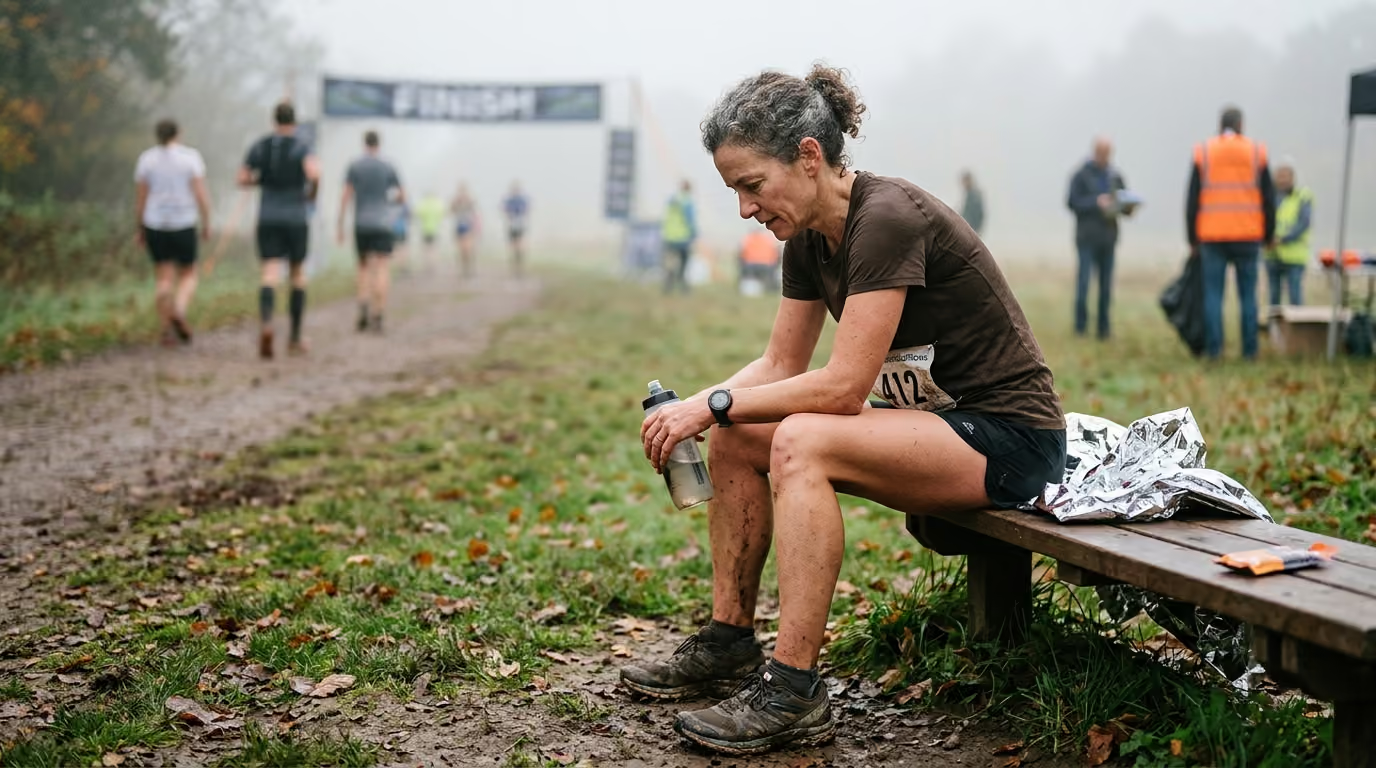
You wake up at four in the morning in an unfamiliar hotel room. The air conditioning unit hums loudly, your pre-race breakfast is limited to whatever you packed in your carry-on luggage, and you spent six hours yesterday sitting in transit. By the time you reach the start line of the destination race, you have already spent hundreds or thousands of dollars, accumulated acute travel fatigue, and disrupted your standard weekly routine. Two weeks later, you find yourself wondering why your performance felt flat despite months of rigorous preparation.
Many dedicated athletes believe that maintaining a serious competitive edge requires frequent travel to marquee events. This assumption creates an unnecessary burden. When every competition requires flights, hotel reservations, logistical coordination, and substantial financial investment, your racing calendar becomes fragile. A single scheduling conflict or minor illness can derail months of momentum.
A competitive athletic life does not require attending every major destination event. Real athletic development depends on a repeatable system that fulfills the core functions of competition. These functions include performance benchmarking, tactical practice, psychological pressure, and social accountability.
By building a structured framework around local races, club events, standardized time trials, and virtual challenges, you can maintain high performance standards without excessive travel. You can preserve your budget, protect your recovery, and compete more consistently across your entire athletic career.
To build an intelligent racing calendar, you must first understand the physiological and logistical mechanisms that influence competitive outcomes. Athletic performance improves through structured overload followed by adequate recovery. Frequent long-distance travel introduces external stressors that can impair this adaptation cycle.
Research on endurance event participation shows that long-distance travel accounts for the vast majority of environmental and logistical overhead. A study published in the Journal of International Multidisciplinary Business and Entrepreneurship analyzed participant travel across twenty-eight endurance events. The researchers found that participant travel accounted for 98.9% of total event carbon emissions, with long-distance travel responsible for 84.2% of that total. Beyond environmental considerations, this travel volume reflects significant time spent in cramped transit, altered sleep schedules, and inconsistent nutritional access.
When you travel across time zones or spend extended hours driving before an event, your nervous system experiences elevated sympathetic tone. Cortisol levels remain elevated, resting heart rate increases, and deep sleep duration frequently declines. Attempting to execute a peak physiological effort under these conditions increases the risk of underperformance or injury.
Conversely, sports science confirms that standardized local testing provides exceptional scientific reliability for measuring fitness gains. A study published in the Journal of Sports Sciences examined the repeatability of outdoor 5 km running time trials. The researchers reported a mean coefficient of variation of 0.95% and an intraclass correlation coefficient of 0.984. This demonstrates that a carefully controlled local time trial has minimal measurement noise, making it fully capable of detecting genuine improvements in aerobic capacity.
Endurance training research also emphasizes the necessity of polarized or pyramidal training distributions. Comprehensive reviews of elite endurance programs demonstrate that athletes complete roughly 80% of their total volume at low intensity and 20% at high intensity. Engaging in all-out destination racing too frequently disrupts this balance by creating extended post-race fatigue that compromises weekly training continuity. Reviewing training intensity distribution helps explain why high-frequency racing without proper development blocks leads to stagnation.
Athletes often confuse competition with event attendance. These two concepts represent entirely different aspects of the sport. Separating them allows you to make deliberate decisions about where to invest your energy and capital.
Competition is the act of testing your physical capacity against an objective standard, a clock, a specific tactical challenge, or other athletes. It requires focus, emotional commitment, pacing discipline, and the willingness to tolerate physical discomfort. Competition can take place on a certified championship course, on a quiet stretch of local road, or on an indoor trainer.
Event attendance is the logistical consumption of an organized production. It includes expo booths, commemorative t-shirts, mass-participation start corrals, aid stations, and finish-line festivals. While these elements create excitement, they are not necessary for physiological adaptation or competitive benchmarking.
When considering any event on your calendar, ask yourself what specific competitive function you are buying. Every race or benchmark serves a distinct purpose:
Group dynamics, drafting, cornering, positioning, and surging cannot be simulated in solo training. Local criteriums, park runs, and club road races provide these stimuli at low cost.
Tracking physiological progression requires repeatable, controlled conditions. A standardized solo time trial often measures progress more accurately than a crowded mass event.
Executing an effort when you feel nervous is a learned skill. Local club championships and regional leagues generate real social stakes without travel friction.
Testing yourself against deep fields on certified courses remains valuable for seasonal peaks or national qualifications. These specific goals justify selective travel.
When you break competition down into these distinct components, you realize that you do not need an expensive destination weekend to fulfill every single function. You can distribute these demands across accessible, low-friction formats near your home.
Rather than planning your year around four or five expensive travel weekends, you can construct a sustainable racing portfolio. A tiered portfolio categorizes competitive opportunities based on their physical demands, preparation requirements, and logistical investment.
This is your primary A-race for the season or year. It is the singular event where you execute a full taper, optimize all logistical variables, and seek a peak performance. This race may justify travel because it offers a verified qualifying standard, a historically deep field, or a major personal milestone. Limiting these events to one or two per year protects your financial resources and prevents chronic central nervous system exhaustion.
These are regional or municipal races that you enter with a modest training reduction rather than a full multi-week taper. You might race a local 10 km or a weekend road race in the middle of a heavy training block. The goal here is tactical execution, practicing nutritional protocols under stress, or handling pack dynamics. You race aggressively, but your athletic identity does not depend on the outcome.
These are recurring time trials, club handicaps, or segment challenges that you complete as part of normal training. You do not taper for them, and you do not travel more than thirty minutes to reach them. These sessions serve as repeatable checkpoints to assess aerobic power, threshold pace, or movement efficiency.
A complete portfolio must include designated periods with no competitive events whatsoever. Endurance adaptations occur during uninterrupted blocks of consistent volume and structured recovery. Stacking continuous races without off-season periods blunts long-term progression. Exploring structured recovery protocols will help you design these critical rest phases between competitive cycles.
To make local competition effective, you must establish rigorous protocols. A casual solo effort with fluctuating stops and variable pacing does not provide reliable data. You need standardized local benchmarks that produce clean, actionable metrics.
An official result requires sanctioning by a governing body. World Athletics maintains strict competition rules for road races, requiring certified course measurement and electronic transponder timing. Similarly, USA Cycling specifies exact regulations for record-eligible time trial courses, allowing only circuit or out-and-back routes to balance wind effects.
A standardized benchmark does not need governing-body certification to be valuable for your training. It simply requires environmental and procedural consistency. When you eliminate variables like course elevation changes, surface shifts, and traffic interruptions, your local time trial becomes a powerful diagnostic tool.
To build a high-fidelity running time trial, choose an accessible route such as an open all-weather track or a flat, uninterrupted road loop. Standardize the following variables:
Repeat this specific benchmark every six to eight weeks at the conclusion of a training block. Keep your warm-up routine, shoes, and nutritional intake identical across attempts. When your time drops by fifteen seconds on this standardized course, you can be confident that your fitness has improved.
For cyclists and triathletes, an outdoor time trial course should feature a continuous out-and-back layout or a closed loop to neutralize wind direction. A ten-mile out-and-back road with smooth asphalt and minimal intersections serves as an exceptional proving ground.
Alternatively, a twenty-minute sustained climb with a consistent gradient provides an excellent assessment of functional threshold power. Execute the test using consistent aerodynamic equipment, record average power alongside elapsed time, and avoid drafting other riders during the test.
Local clubs can create outstanding competitive infrastructure without significant financial investment. Consider organizing:
These events provide the psychological arousal and social pressure of a major race while requiring only a brief drive and nominal club dues. Finding balance through sustainable racing habits ensures you stay engaged without burning out on event logistics.
Digital platforms and virtual events offer valuable tools for motivation, accountability, and consistency. However, using them effectively requires understanding both their strengths and their limitations.
Research on digital exercise interventions demonstrates that online platforms enhance short-term adherence. A systematic review published in sports medicine literature evaluated digital interventions across randomized trials. The review found improved adherence when digital tracking and community challenges were integrated into home-based training.
During virtual challenges, the presence of a specific completion window, a published leaderboard, and shared team objectives provides the psychological deadline needed to complete challenging workouts. When weather or work schedules prevent in-person racing, an online time trial maintains competitive sharpness.
Virtual competitions cannot fully replicate physical road racing. Differences in GPS hardware, barometric altimeters, wind conditions, and descent profiles mean that virtual leaderboard times are rarely equivalent. Furthermore, solo efforts on a home trainer or open road cannot reproduce the split-second tactical decisions and pack positioning required in mass-start events.
To keep your digital racing credible and constructive, apply these guidelines:
Athletes over the age of forty and fifty face distinct physiological changes that make low-travel racing particularly advantageous. Understanding these biological factors allows you to tailor your schedule for longevity and sustained speed.
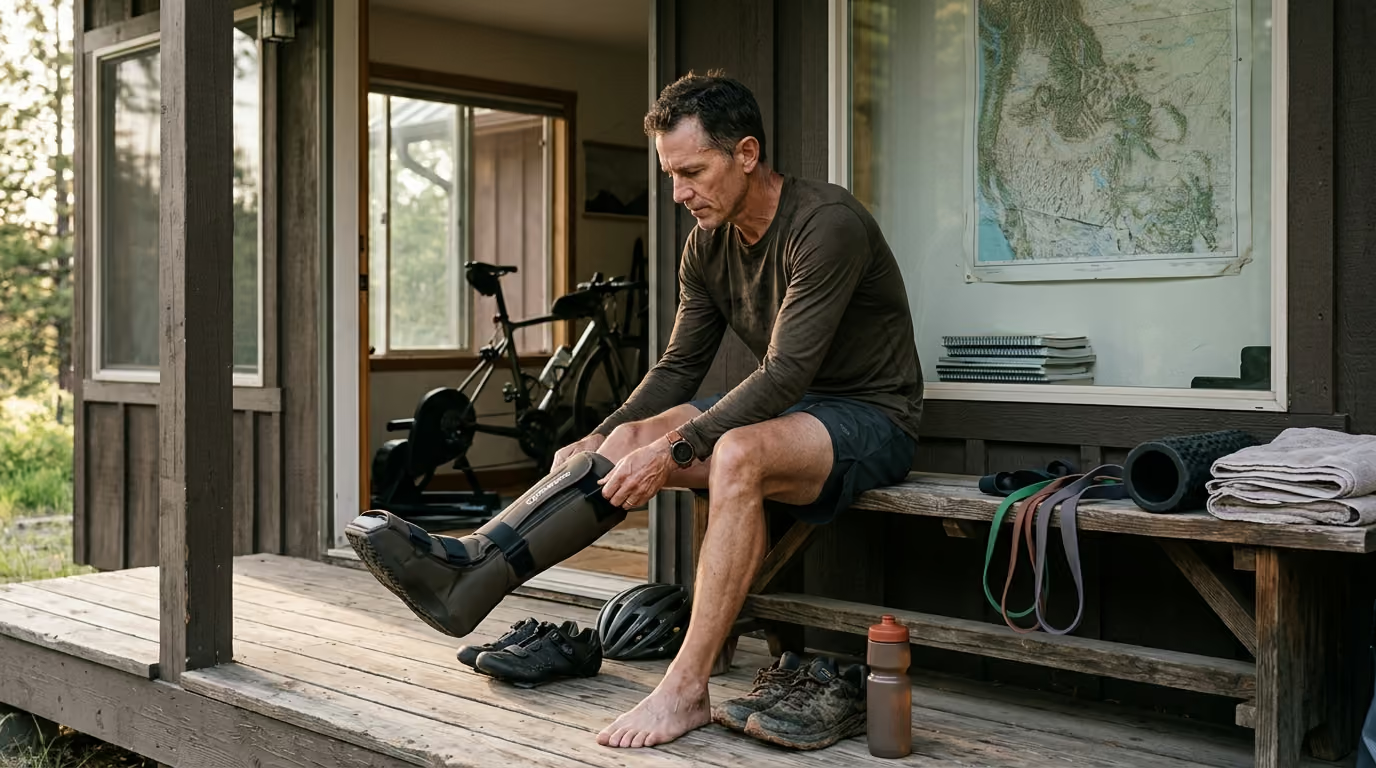
As we age, maximal heart rate declines gradually and muscle protein synthesis rates slow down. Connective tissues lose elasticity, requiring longer intervals to repair micro-trauma after maximal eccentric efforts. Traveling long distances compounds these challenges. Hours spent sitting in cramped positions stiffen the hip flexors, reduce spinal mobility, and impair lower-extremity circulation.
Master athletes often discover that their recovery timeline doubles after a destination race compared to a local event. The combination of race-level exertion, disrupted sleep hygiene, and transit stress demands extensive downtime. By shifting your schedule toward local events, you sleep in your own bed, prepare your habitual meals, and return home within hours of crossing the finish line.
When structuring your season, utilize age-graded tables to assess performance across time. Age grading evaluates your time against the standard for your specific age and biological sex. This allows a fifty-year-old athlete to evaluate their true physiological quality objectively across different local courses without needing to chase arbitrary overall podiums. Implementing healthy aging strategies helps maintain power output and joint health across decades of competition.
Transitioning to a local and virtual racing model is straightforward, but athletes frequently make tactical errors that undermine their progress. Avoiding these common mistakes will protect your consistency and performance.
Because local races and solo time trials carry low financial costs, athletes often schedule them every weekend. Racing hard every seven days produces chronic autonomic fatigue and eliminates the base training volume necessary for endurance adaptations. Treat every local race with the same physiological respect as a distant event.
Allowing social media segments and online leaderboards to dictate your daily workouts leads to uncontrolled training intensity. Turning easy recovery days into aggressive leaderboard attempts disrupts your polarized training structure. Keep your easy sessions genuinely slow and reserve maximal efforts for designated benchmark days.
Athletes who cut travel expenses sometimes redirect those savings into endless purchases of high-end equipment, aerodynamic accessories, or expensive supplements. While reliable equipment is necessary for safety, buying marginal gains cannot replace consistent, high-volume aerobic training. Allocate your savings toward quality coaching, physical therapy, or balanced nutrition instead.
Comparing a time trial run on a cool, overcast morning against a race completed in high heat and humidity yields inaccurate conclusions. Failing to account for elevation profile, wind velocity, and surface grip will cause unwarranted frustration. Always document environmental variables alongside your performance metrics.
To ensure that your low-travel racing system produces genuine athletic growth, you need a disciplined tracking methodology. A structured training log converts subjective race feelings into objective performance trends.
Maintain a dedicated record of your standardized benchmarks across the season. Rather than reacting emotionally to an isolated poor performance, examine rolling trends across three to four test cycles.
Key metrics to evaluate over time include:
A drop in average heart rate at your standard benchmark pace indicates expanding aerobic efficiency and plasma volume expansion.
Evaluate your pacing distribution across the test. Highly conditioned athletes exhibit even or slight negative splits, while poorly conditioned or undisciplined athletes show rapid deceleration over the final third of the event.
Record how many beats your heart rate drops within sixty seconds of finishing a standardized benchmark effort. Faster post-exercise cardiac deceleration indicates robust parasympathetic reactivation and improved cardiorespiratory fitness.
Grade yourself on how well you followed your predetermined strategy. Did you hold your target wattage on the opening climb? Did you avoid surging during the chaotic first kilometer of the local race? Process execution reflects true athletic maturity.
For a deeper look into testing protocols and training design, consult our comprehensive endurance performance guides.
Designing an effective annual calendar requires conducting a realistic constraint audit before selecting events. By auditing your available time, personal finances, and family obligations, you can build a stable competitive season.
A working professional or parent with limited free time might construct a balanced year around:
This profile provides thirteen meaningful competitive touchpoints throughout the year while requiring only one travel weekend. The athlete saves thousands of dollars, avoids chronic travel exhaustion, and maintains strict training consistency.
An athlete rebuilding fitness after an injury needs low-stakes competitive environments where dropping out carries no financial guilt. Their annual blueprint focuses on:
Planning your calendar systematically allows you to enjoy the thrill of competition without destabilizing your life. Exploring our resources on structuring your racing schedule provides additional strategies for balancing event choices across the season.
Revisit this guide at the beginning of each seasonal planning cycle, whenever you experience racing burnout, or if family and professional commitments suddenly limit your travel availability.
A sustainable racing life does not depend on collecting travel stamps or accumulating mass-event finisher medals. It is built on deliberate execution, repeatable testing, local community connection, and consistent athletic progression.

Follow ReEndure for practical insights on endurance training, recovery, nutrition and healthy aging. Stay connected for new articles, research led guidance and ideas to help you perform better for longer.


Read practical ideas on endurance training, recovery, nutrition and healthy aging to keep progressing for years to come.
Read the Blog