
Sustaining meaning in racing requires balancing athletic passion with practical life demands through psychological science and the five-fit assessment model.





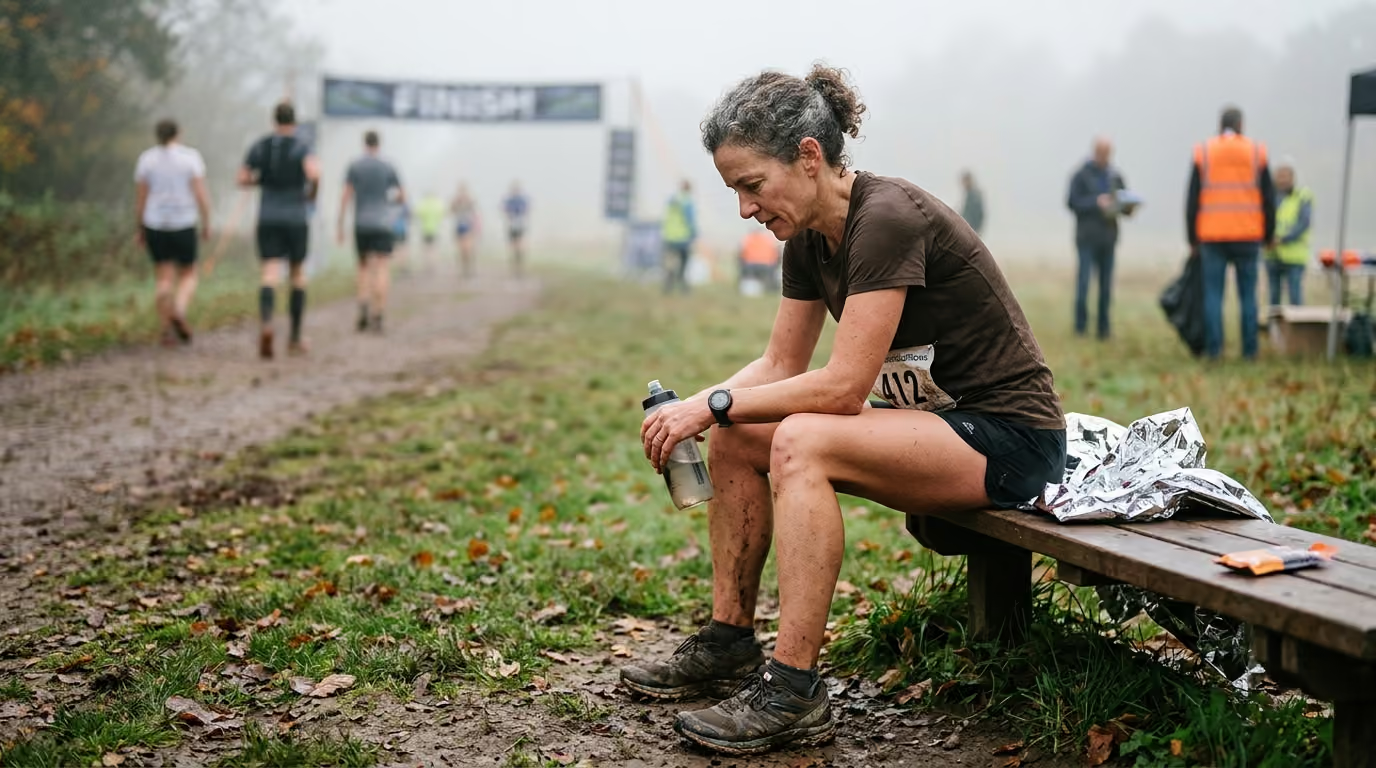
The alarm rings at 5:00 AM on a Tuesday morning. You swing your legs out of bed, feeling the familiar stiffness in your Achilles tendons and lower back. For years, this routine was automatic. You laced up your shoes, stepped into the dark, and hit your split times without hesitation. Lately, however, a quiet friction has begun to appear.
You find yourself staring at your training log with a sense of dread rather than anticipation. Upcoming race dates on the calendar feel more like contractual obligations than exciting opportunities. You are working just as hard as you did five or ten years ago, but the finishing times are slower, recovery takes longer, and the personal bests that once defined your athletic self-worth seem increasingly out of reach. You might ask yourself whether it is time to hang up your timing chip completely, or if you simply need to push through the slump.
This scenario represents one of the most common crossroads in endurance sports. Many athletes believe their only two choices are relentless pursuit of youth-era personal records or total retirement from competition.
That framing is a false binary. Racing does not have to remain static to remain valuable. The central question for long-term athletic longevity is not simply whether you can still race. The real question is whether the way you race today supports the life you are trying to live.
To build a competitive life that lasts for decades, you must understand the psychological mechanisms that drive motivation. Sports scientists and psychologists have studied athletic persistence, burnout, and satisfaction for decades. Their findings show that what keeps an athlete engaged over thirty years is fundamentally different from what fuels a two-year performance peak.
One of the most reliable frameworks for understanding athletic motivation is Self-Determination Theory, developed by psychologists Edward Deci and Richard Ryan. This theory proposes that human beings have three basic psychological needs: autonomy, competence, and relatedness.
Autonomy represents the feeling that your participation is freely chosen rather than imposed by outside pressure. Competence represents the sense that you are capable of learning, executing skills, and meeting challenges. Relatedness represents a feeling of meaningful connection to a community, teammates, coaches, or family.
When endurance athletes race primarily to satisfy these three basic needs, their motivation is considered self-determined or intrinsic. Research demonstrates that self-determined motivation protects against psychological fatigue. In a landmark study of 201 competitive athletes published in the Journal of Sports Sciences, researchers found that autonomy, competence, and self-determined motivation accounted for 74 percent of the variance in global athlete burnout symptoms. When athletes felt controlled by external expectations or lost their sense of competence, burnout scores rose dramatically.
A comprehensive systematic review of athlete burnout published in Sports Medicine confirmed these dynamics across dozens of athletic populations. The researchers found strong negative relationships between burnout and autonomy, competence, relatedness, and social support. Conversely, burnout was positively associated with amotivation, negative emotions, socially prescribed perfectionism, and controlling motivational climates. Racing remains meaningful across a lifespan only when it continues to feed these three basic psychological needs.
Not all dedication is created equal. The Dualistic Model of Passion, developed by psychologist Robert Vallerand, divides athletic passion into two distinct types: harmonious passion and obsessive passion.
Harmonious passion occurs when an athlete engages in sport because they love the activity itself. The sport occupies a significant space in their life, but it remains fully compatible with other priorities such as family, work, and personal health. An athlete with harmonious passion can voluntarily take a week off when injured or busy without feeling worthless.
Obsessive passion develops when sport becomes an uncontrollable urge tied directly to social status, self-esteem, or fear of failure. The athlete feels compelled to train and race even when participation causes severe relationship conflict, career damage, or physical breakdown.
Research consistently identifies harmonious passion as a protective factor against burnout, while obsessive passion significantly increases burnout risk. When assessing your own racing, a useful diagnostic question is simple. If an unexpected injury forced you to stop training for a month, would you feel disappointed, or would you feel that you had become worthless as a human being? A sense of total worthlessness points toward obsessive passion, suggesting that your competitive drive has become untethered from your well-being.
Athletic identity is the degree to which an individual defines their overall self-concept through their athletic role. A strong athletic identity provides clear focus, daily discipline, and a supportive social circle. However, an overly narrow athletic identity creates extreme psychological vulnerability.
When an athlete defines their entire worth by their finishing times, normal life events become existential threats. Aging, parenthood, career shifts, and acute injuries do not just disrupt training schedules. They threaten the athlete's core sense of self. A scoping review on athletic retirement and transition published in International Review of Sport and Exercise Psychology showed that high, exclusive athletic identity is consistently linked to severe adjustment difficulties, identity loss, and emotional distress when competitive sport ends.
The solution is not to abandon your athletic identity. The goal is to cultivate identity breadth. You can be a dedicated endurance athlete while simultaneously being a committed partner, a dedicated professional, a reliable friend, and an active mentor. When your identity rests on multiple sturdy pillars, a poor race or an age-related slow down will not collapse your psychological house.
Athletes often confuse physiological fatigue with psychological burnout. Understanding the differences between these states is critical for choosing the correct solution. Applying a physical solution to a psychological problem, or vice versa, often makes the situation worse.
Normal training fatigue is the acute, predictable tiredness that follows a hard workout or a focused training block. It is a necessary stimulus for adaptation and resolves within twenty-four to forty-eight hours of proper nutrition and sleep.
Overreaching occurs when training volume or intensity outpaces recovery over several days or weeks. Functional overreaching leads to a temporary performance dip followed by a supercompensatory rebound after a recovery period. Non-functional overreaching occurs when recovery is insufficient for weeks, leading to persistent stagnation that requires weeks or months of light training to reverse.
Overtraining syndrome is a serious neuroendocrine and physiological state. It involves chronic underperformance, severe sleep disturbances, hormonal disruption, altered immune function, and mood swings that persist for months despite complete rest.
Athlete burnout is distinct from overtraining, although the two can occur at the same time. While overtraining is primarily a physiological failure to recover from mechanical and metabolic stress, burnout is a multidimensional psychological syndrome. As established by researchers Thomas Raedeke and Alan Smith, burnout consists of three core components:
The first component is physical and emotional exhaustion, where the athlete feels drained of energy and psychological resources. The second component is a reduced sense of athletic accomplishment, where the athlete feels that their efforts no longer produce meaningful progress or competence. The third component is sport devaluation, characterized by cynicism, resentment, and a loss of care for the sport itself.
You can experience high training fatigue without being burned out if you still love the process and value the challenge. Conversely, you can experience severe burnout while training at very low physical volumes if the motivational climate is toxic or driven by fear.
To help evaluate your current state, consider how symptoms appear across four distinct domains:
Recognizing these patterns early allows you to adjust your approach before psychological exhaustion leads to complete abandonment of the sport. Explore our racing and lifestyle frameworks to see how sustainable schedules prevent chronic exhaustion.
To evaluate whether your current approach to racing is working, you need an objective assessment tool. The Five-Fit Model provides a structured method to evaluate your competitive life across five dimensions: enjoyment, alignment, sustainability, identity health, and relational cost.
Meaningful racing requires genuine intrinsic enjoyment. This does not mean that every single mile of a marathon or interval session must feel pleasant. Endurance sport inherently involves voluntary exposure to physical discomfort, acute fatigue, and mental struggle.
The critical distinction is whether the difficulty serves a purpose you actively value, or if it feels like pointless punishment. Ask yourself the following questions:
If your honest answers reveal that racing has become a joyless exercise in avoiding embarrassment, your enjoyment fit is low.
Your racing ambitions must match your current life circumstances rather than the circumstances you had a decade ago. A training plan that worked when you were twenty-four, single, and working entry-level hours will produce severe friction if you are forty-five, managing a department, and raising children. Ask yourself:
High alignment means your athletic pursuits fit comfortably inside your life, drawing energy from your daily routine rather than competing with it.
Athletic longevity depends on physiological sustainability. Pushing through chronic soft-tissue inflammation, running on four hours of sleep, or relying on stimulants to finish workouts is unsustainable. Ask yourself:
Sustainability requires honoring biological realities. Research on masters athletes shows clear population-level declines in physiological parameters with age. Maximum oxygen uptake, muscle mass, and recovery rates change naturally over time. Trying to out-train biology through stubbornness inevitably results in injury and forced lay-offs.
Your relationship with competition should expand your life, not constrict it. Healthy athletic identity allows for deep dedication while maintaining perspective. Ask yourself:
When identity health is high, competition is something you do, not everything that you are.
Endurance sports consume time, energy, and financial resources. An athletic plan that damages marriages, isolates you from non-running friends, or drains your savings is fundamentally broken. Ask yourself:
Meaningful competition enhances your social connections rather than eroding them. If your athletic pursuits leave you socially isolated or financially strained, your overall fit is poor.
Once you assess your racing through the Five-Fit Model, you must make a clear decision about how to move forward. Rather than viewing the future as an all-or-nothing choice between high-intensity competition and total retirement, use four distinct pathways: Keep, Change, Pause, or Leave.
You should keep your current training and racing approach when all five dimensions of the assessment model are positive. You have high intrinsic motivation, your goals fit your current schedule, your body recovers well, your identity is balanced, and your relationships are strong.
In this phase, maintain your trajectory. Continue refining your training, setting challenging performance targets, and pursuing competitive mastery. Re-evaluate your baseline once a year to ensure that your approach continues to serve your broader life.
The Change pathway is appropriate when you still love racing, but your current format, volume, or goal structure creates friction. You do not need to quit racing. You need to redesign how you compete.
You can modify your racing model in several practical ways:
Modifying your format is not an admission of defeat. It is a strategic adjustment that keeps competition stimulating and sustainable. Explore our training performance principles to adapt your structure without sacrificing fitness.
A structured pause is necessary when physical exhaustion, chronic injury, or life stress makes healthy participation temporarily impossible. Pausing is fundamentally different from quitting. A pause is a deliberate, time-bound training intervention designed for physical and psychological restoration.
A well-executed pause should follow clear parameters:
A planned pause removes the chronic pressure of competition. It gives your nervous system and your mindset time to reset, helping you rediscover genuine motivation.
Leaving a specific race format, competitive distance, or racing altogether is a completely valid choice. Choosing to leave sport should be viewed as an intentional life decision rather than a failure of will.
You might leave overall elite competition while continuing to race in masters age groups. You might leave Ironman-distance triathlons while remaining an active sprint-distance racer. Or you might leave organized racing entirely to focus on wilderness adventures, general physical health, or coaching.
Leaving one arena creates the time and emotional space required to build new pursuits. You can preserve your love of movement, physical competence, and endurance fitness without ever pinning on another race number.
As you move through different life stages, your physiology, available time, and emotional priorities inevitably change. Adapting your competitive approach to each life chapter is essential for lifelong participation.
During your twenties and early thirties, physical resilience is high, but career and financial instability can create significant lifestyle stress. Athletes in this stage often face long working hours, relocations, and financial limitations.
To maintain meaningful racing during this phase, prioritize flexibility over rigid perfectionism. Build a minimum viable training routine that maintains baseline fitness during intense work periods. Avoid using sport as another high-stakes arena where you feel pressured to prove your worth. Let training provide stress relief, physical grounding, and reliable social connection.
Becoming a parent or caring for aging family members dramatically alters your available time and sleep quality. Trying to maintain a high-volume training schedule during early parenthood often leads to severe sleep deprivation, frequent illness, and relationship resentment.
During caregiving seasons, redefine athletic success as consistency within constraints. Focus on high-efficiency workouts, such as short interval sessions and focused strength work. Consider targeting one primary race per year, or switch to shorter race distances that do not require multi-hour weekend sessions. Recognize that supporting your family is not an interruption to an authentic athletic life. It is the primary life that your athletic practice must support.
Midlife often brings a combination of greater career stability, increased discretionary time, and noticeable physiological shifts. Recovery times lengthen, muscle mass naturally declines without targeted strength work, and hormonal changes alter training tolerance.
This stage requires shifting away from the subconscious goal of proving you are still young. Focus instead on physical mastery, tactical intelligence, and sustained durability. Research on masters athletes published in clinical sports reviews shows that endurance performance can remain remarkably high well into later decades when training includes proper intensity, resistance work, and adequate recovery.
For older adults, the World Health Organization recommends at least 150 to 300 minutes of moderate aerobic activity or 75 to 150 minutes of vigorous aerobic activity weekly, alongside muscle-strengthening activities on two or more days per week. The Centers for Disease Control and Prevention similarly highlights multicomponent physical activity that includes balance training to preserve functional independence.
Masters racing provides an exceptional arena to pursue competence, but training must prioritize joint health, tendon resilience, and recovery. Incorporate structured recovery routines and healthy aging strategies for masters athletes to protect your musculoskeletal system against overuse injuries.
Continuing to compete in your sixties, seventies, and beyond is a powerful way to maintain vitality, bone density, and cognitive health. At this stage, racing becomes less about proving dominance and more about celebrating movement, community connection, and personal independence.
Later-life competition can take many forms:
At every stage, the goal remains the same. Align your competitive targets with your current biological and psychological reality so that racing continues to enrich your life.
Severe injuries and major life interruptions do not just cause physical deconditioning. They disrupt athletic routines, damage movement confidence, and create psychological distress. Returning to competition requires managing both physical healing and emotional readiness.
A systematic review published in the British Journal of Sports Medicine investigated the psychological factors associated with returning to sport after injury across 11 studies and 983 athletes. The researchers found that psychological factors, including high self-efficacy, positive motivation, and low fear of re-injury, were strongly associated with returning to pre-injury participation levels. Fear was the most prominent emotion hindering return, often causing athletes to hesitate, alter biomechanics, or drop out prematurely.
To navigate this process safely, use a structured return-to-racing ladder:
Treating psychological readiness as a formal part of injury rehabilitation prevents premature race entries and minimizes fear-based performance anxiety.
Setting narrow, all-or-nothing outcome goals is one of the fastest routes to athletic dissatisfaction. If your only definition of success is winning your age group or setting a lifetime personal record, external factors like extreme heat, sudden illness, or mechanical issues can instantly ruin months of preparation.
To preserve meaning and agency under any conditions, structure every race around a three-layer goal model.
Outcome goals focus on the final competitive result. Examples include:
Outcome goals provide clear direction and high excitement. However, they carry the lowest level of personal control because they depend heavily on weather, course conditions, and the performance of your competitors.
Performance goals focus on personal execution metrics that remain largely within your control, regardless of where your competitors finish. Examples include:
Performance goals give you an objective standard of athletic mastery that cannot be taken away by an unusually fast field of rivals.
Process and experience goals focus on internal psychological states, tactical adaptability, and personal values. Examples include:
When unexpected weather, illness, or minor injuries make your primary outcome goal impossible, your performance and process goals remain fully intact. This multi-layered structure ensures that every race offers an opportunity for genuine accomplishment.
Treating every race on your calendar as a high-stakes, maximum-pressure event leads directly to physical and emotional burnout. Instead, organize your annual schedule as a balanced portfolio, assigning distinct roles to different events:
This seasonal portfolio prevents your entire self-worth from riding on a single morning's performance, distributing meaning across diverse athletic experiences.
At the conclusion of each competitive season, set aside an hour to complete an annual meaning audit. Answer these ten diagnostic questions in a training journal:
Taking time to answer these questions honestly ensures that you design your upcoming season around your genuine values rather than unexamined habit.
When endurance athletes struggle to maintain enthusiasm for racing, they often fall into predictable traps. Recognizing these common errors helps you make proactive adjustments:
Athletes often pride themselves on never missing a workout, regardless of illness, minor injuries, family emergencies, or severe exhaustion. Research published in Psychology of Sport and Exercise shows that socially prescribed perfectionism and obsessive passion are primary predictors of chronic burnout and overtraining syndrome. True athletic discipline is not about blind adherence to a spreadsheet. It is the wisdom to adjust training intelligently when circumstances demand it.
Public tracking platforms and social media feeds provide immediate access to the training metrics and race results of thousands of peers. Research on social comparison theory demonstrates that while comparing yourself to a slightly better peer can provide constructive motivation, constant exposure to extreme upward comparisons promotes chronic inadequacy, anxiety, and disengagement. Treat digital platforms as selective highlights rather than objective standards for your personal athletic worth.
When career or family demands force a reduction in weekly training volume, athletes often adopt an all-or-nothing mindset. They assume that if they cannot train twelve hours a week, their five hours of training are pointless. A focused, high-efficiency training block can preserve an extraordinary amount of cardiorespiratory fitness and muscular power. Adapting your training volume to your current life season represents intelligent self-management, not a lack of commitment.
An athlete may boast exceptional fitness numbers while their personal life falls apart. If your athletic pursuits leave you chronically inattentive to your partner, disconnected from your children, or professionally compromised, your competitive model is failing. A truly successful athletic practice operates in harmony with your broader responsibilities.
Athletes frequently jump back into high-stakes competition the moment a physician gives basic anatomical clearance. However, physical healing often outpaces neurological and psychological readiness. Returning to hard competition while still harboring deep fear of re-injury alters motor patterns, increases anxiety, and ruins the racing experience. Progress systematically through the return-to-racing ladder to ensure full mental and physical integration.
Examining how other athletes navigate competitive crossroads can clarify your own path. Consider these common scenarios:
An athlete who spent their twenties and early thirties competing for overall race wins now finds themselves finishing mid-pack due to career demands, natural aging, and reduced training time. They still love the physical effort and tactical engagement of race day, but they feel deep embarrassment when looking at their finishing times.
Actionable Intervention:
A dedicated marathoner continues hitting all planned paces in training, but experiences constant morning dread, emotional numbness after hard sessions, and intense anxiety about missing workouts. They view rest days as personal failures and fear losing their fitness.
Actionable Intervention:
A veteran triathlete experiences a severe hamstring tendon tear that requires surgical repair and six months of rehabilitation. Stripped of their daily training routine and weekly group rides, they describe feeling lost and state that they are no longer an athlete.
Actionable Intervention:
To build a healthy, lifelong relationship with competition, you must track metrics that reflect overall athletic wellness, not just finishing times and heart-rate splits. Incorporate these non-chronological metrics into your regular training log:
Tracking these markers ensures that your athletic journey builds lasting vitality rather than consuming your physical and emotional reserves. For additional long-term training frameworks, review our full catalog of longevity resources.
Bookmark and review this guide whenever you experience significant life transitions, including:
Lifelong athletic fulfillment is not about holding onto a single, unchanging version of your younger self. It is the practice of continually adapting your passion to the life you are living today.

Follow ReEndure for practical insights on endurance training, recovery, nutrition and healthy aging. Stay connected for new articles, research led guidance and ideas to help you perform better for longer.


Read practical ideas on endurance training, recovery, nutrition and healthy aging to keep progressing for years to come.
Read the Blog