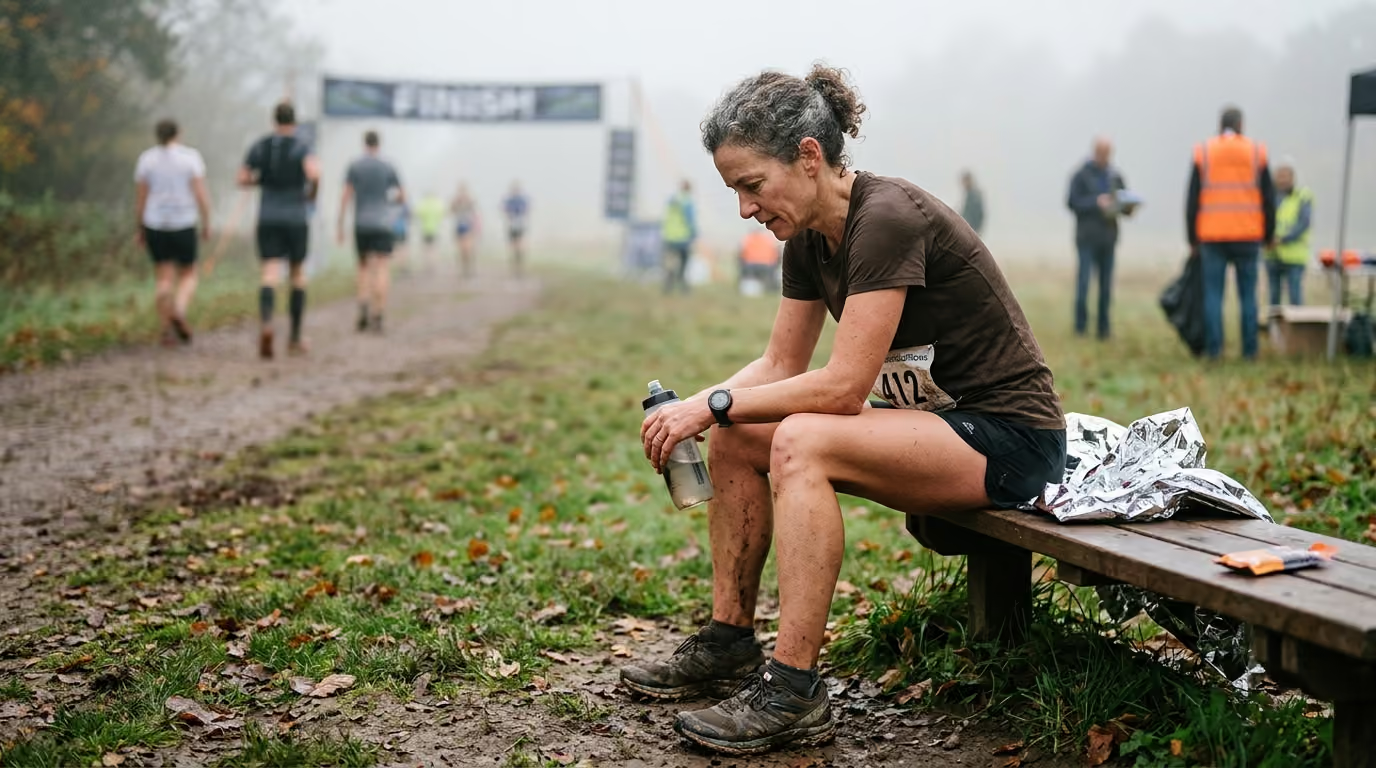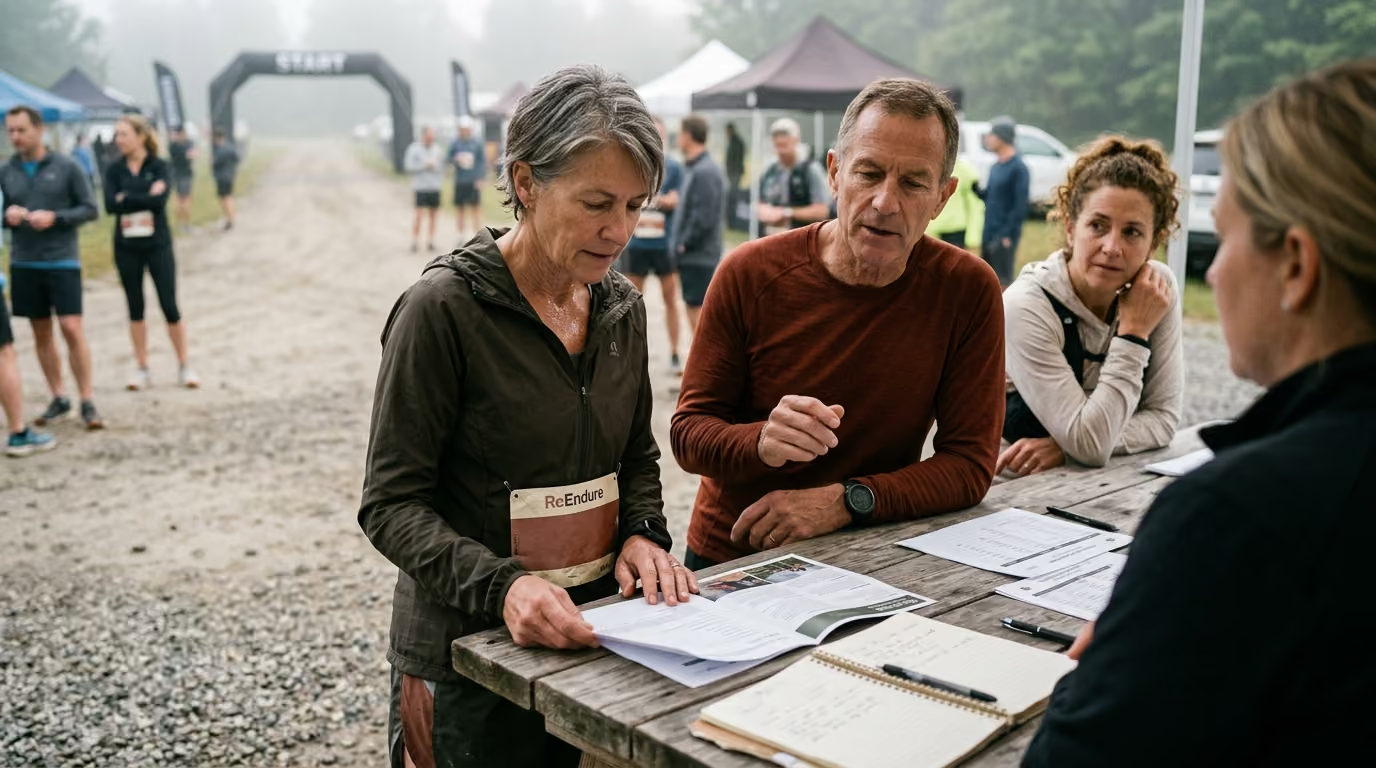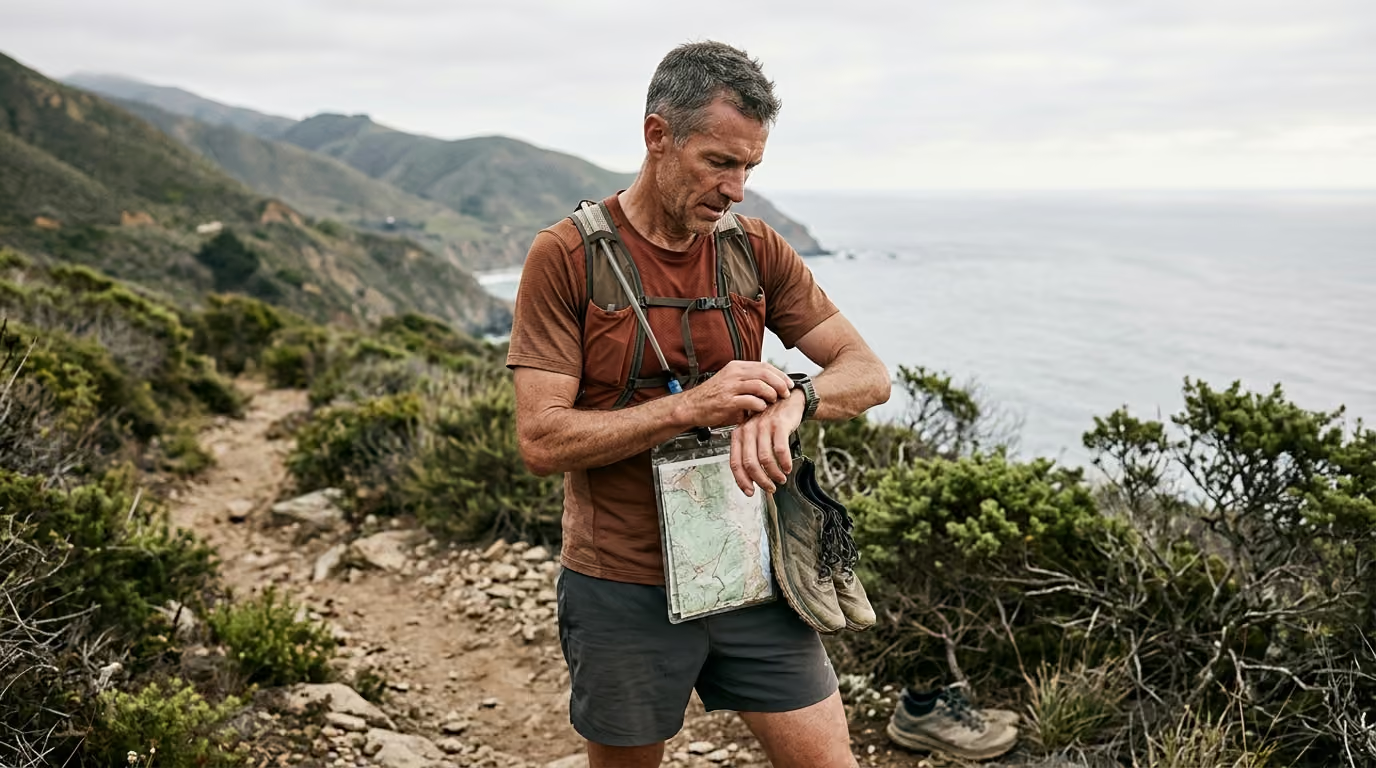

Standing at a remote start line without a crew requires mastering personal readiness, rigorous communication protocols, and self-extraction logistics.





Most endurance athletes assume that traveling with a companion makes racing safer. In reality, informal support networks often create a false sense of security. Friends and family members frequently lack medical training, miss critical split times, or become stranded in spectator traffic.
Racing solo forces you to trade casual assumptions for explicit operational systems. When you do not have an entourage, every variable requires deliberate planning. You must establish positive control over your gear, your transportation, and your physiological reserves.
Going to a starting line alone is not an act of isolation. It is an exercise in building a structured, redundant framework that protects your performance and your safety. This field manual provides the tools to plan, execute, and recover from an endurance event without relying on an in-person crew.
Solo racing success depends on replacing casual roadside help with a methodical operating framework. The Solo Race Support Stack organizes your preparation into six distinct layers. If any single layer fails, the remaining layers preserve your safety margin.
Personal readiness encompasses your baseline physical capacity, chronic health management, and current medical status. You must verify that your training matches the specific demands of the course profile. You also need to confirm that all required personal medications are stocked and carried securely.
Event readiness means knowing the exact rules and operational realities of your race. You must understand official cutoff times, bag drop locations, aid station spacing, and medical station operating hours. You should review event documents to confirm how organizers handle athlete withdrawals and transport.
Travel readiness addresses the logistical chain between your home, your hotel, and the race precinct. It includes choosing accommodations close to transit hubs and mapping primary and secondary travel routes. You must also maintain access to emergency funds and verify your health insurance coverage.
Communication readiness creates an explicit link between you, a remote support person, and local event officials. It establishes structured check-in deadlines, escalation rules, and hardware redundancy. A solo athlete never assumes that a single mobile phone will solve every communications challenge.
Course resilience is your ability to maintain navigation, hydration, and thermal balance while moving. It requires carrying tools to manage shifting weather conditions and sudden course changes. It also requires the discipline to stop or slow down when your safety envelope narrows.
Recovery and extraction cover the vulnerable period immediately after you cross the finish line. This layer details how you collect gear, access warm clothing, consume recovery calories, and travel back to your room. It also includes clear protocols for accessing professional medical evaluation if you experience delayed complications.
Athletes who build their campaigns around the solo endurance lifestyle understand that minor inconveniences differ from systemic safety threats. A delayed flight or a crowded packet pickup is an inconvenience. An inability to navigate in adverse weather or a failure to reach shelter is an acute safety failure. The support stack ensures you never cross that boundary.
Every solo race plan begins with a structured risk assessment. Rather than relying on gut feelings, evaluate your event across five clear domains before you book nonrefundable travel.
Examine your current physical condition with complete objectivity. Document any recent soft-tissue injuries, respiratory infections, or gastrointestinal issues. Review how your body handles environmental stress, including high heat, cold rain, or high altitude.
Verify that you have an adequate supply of all daily medications. Travel health guidance from public health agencies recommends carrying medical identification that states your chronic conditions, daily prescriptions, and known allergies. If you have a significant medical condition, wear an emergency alert bracelet during the entire race.
Examine the physical characteristics of the course and the nature of the race infrastructure. Urban marathons offer continuous barriers, municipal police support, and frequent aid stations. Trail and mountain ultras often feature long gaps between remote checkpoints, technical terrain, and limited vehicle access.
Determine whether the course uses physical signage, reflective course tape, or requires autonomous GPS navigation. Verify whether medical stations are staffed continuously or open only during specific timing windows. According to official event guidelines from major urban races, medical stations along the course often close shortly after the official sweep vehicle passes.
Weather changes dictate clothing choices, fluid requirements, and pacing strategies. High ambient temperatures increase the risk of exertional heat illness, while wet and cold conditions accelerate heat loss if your pace drops. A solo athlete cannot rely on a companion to hand off extra layers at mile twenty.
Establish clear weather thresholds before the race starts. Decide in advance what gear you will carry if rain is forecasted. Define the specific conditions under which you will slow your pace to protect your core body temperature.
Cellular coverage is never uniform, especially in remote trail environments or crowded metropolitan centers. Government search and rescue guidelines indicate that cellular phones frequently lose signal in wilderness areas, which rapidly drains battery life as the device searches for a network.
Identify potential dead zones along the course before race morning. If you are participating in a backcountry or remote endurance event, carry a dedicated satellite messenger or personal locator beacon. For urban events, identify landline access points at official aid stations or police checkpoints.
Map out the exact sequence of events if a failure occurs on course. Ask yourself what happens if you miss an intermediate cutoff or sustain a severe soft-tissue injury. Consider how you will return to your lodging if you lose your phone, room key, or wallet.
Answering these questions in advance prevents a single minor failure from cascading into a major emergency. When uncertainty increases during an event, your primary rule must always be to reduce your performance objective rather than increase your personal risk.
A remote support person serves as your off-site safety coordinator. This individual must be someone who is not traveling with you and who has the availability to monitor your progress. Assigning a remote contact is effective only if you establish strict communication triggers and escalation procedures.
Provide your primary and backup contacts with a comprehensive digital dossier at least forty-eight hours before you travel. This dossier must contain the following operational elements:
Post-race fatigue makes typing long narrative messages difficult and prone to error. Use single-word standardized status codes to confirm your safety at key trip milestones.
Send "TRAVELING" when you begin transit, and "ARRIVED" when you reach your destination city. Send "LODGED" once you confirm your room access. On race morning, send "START" when you enter your assigned starting corral.
After the race, send "SAFE" as soon as you exit the finish chute and collect your gear. Once you return to your room, send "RECOVERED" to close out the operational monitoring window. If you enter a medical tent for treatment, send "MEDICAL" along with the specific station number.
A check-in deadline is useless without a clear action sequence. Agree with your remote contact on a precise escalation schedule before you line up.
Establish a grace period of thirty to sixty minutes past your estimated finish time to account for course delays. If the contact receives no message and sees no tracking update when the grace window expires, they must attempt to call your mobile phone.
If you do not answer within thirty minutes of that call, the contact must call the official race emergency desk. If race officials cannot confirm your location on course or in a medical facility, the contact must contact local emergency dispatch. Having this sequence in writing eliminates hesitation during critical moments.
Managing travel independently requires defensive logistics. You must remove points of failure from your itinerary so that minor travel disruptions do not derail your race preparation.
Book your lodging well in advance and prioritize operational convenience over low cost. The U.S. Department of State advises solo travelers to select properties situated near major public transportation routes. Choose hotels with staffed front desks and secure access controls.
Confirm that the property offers twenty-four-hour check-in so late flight arrivals do not leave you locked outside. Check whether the hotel offers reliable food access on race morning, or ensure your room has refrigeration for self-catering. Request a quiet room away from street traffic to protect your pre-race sleep architecture.
When you enter your hotel room, inspect the emergency exit map posted on the door. Locate the two closest stairwells and verify that the exit pathways are unobstructed.
Confirm that your room deadbolt and door latches function correctly. Store your passport, backup credit cards, and original medical documents in the room safe. Keep a written card with the hotel address and telephone number in your gear bag at all times.
Design your race morning timeline so that you never depend on a single transportation method. If you plan to take an official race shuttle, map a secondary walking route or note local transit lines in case the bus is full.
Carry sufficient local currency to secure private transport if your primary options fail. Allow ample time for bag drop, security checks, and portable toilet queues. Treat race morning logistics as an extension of your race logistics planning rather than an afterthought.
Racing internationally introduces legal, linguistic, and medical complications. Standard domestic health insurance policies rarely cover overseas emergency room care, hospital stays, or medical repatriation.
Public health authorities recommend obtaining dedicated travel medical insurance with medical evacuation coverage before entering international events. Carry a translated summary of your medical history, current prescriptions, and emergency contact details. Save the contact information for your local embassy or consulate in your mobile phone and written dossier.
Urban road events provide continuous course marking, police escorts, and spectator fencing. Trail, mountain, and gravel events require active, continuous spatial discipline from the athlete.
Do not rely on the runner ahead of you for navigation. In endurance races, athletes frequently make navigational errors due to fatigue, poor visibility, or cognitive decline. Treat every intersection, fork, and trail junction as an independent navigation decision.
Load the official GPX track into a reliable GPS watch or bike computer before race day. Verify that the file matches the final course briefing, as organizers frequently alter routes due to weather, permits, or trail conditions.
If you travel for more than three to five minutes without seeing a course marker, tape streamer, or official sign, halt your progress immediately. Do not push forward in the hope that a marker will appear around the next turn.
Check your GPS device or paper map to determine your deviation from the recorded course line. If you are uncertain of your path, retrace your steps to the last visible, confirmed marker. Continuing down an unverified trail increases your distance from the course and complicates emergency search operations.
If you cannot find the course after retracing your steps, stay in place. Find a safe, visible spot near the trail, put on an extra insulating layer, and contact race officials. Conserve your mobile device battery by keeping it warm and minimizing screen brightness.
Never leave an official race route to take unsanctioned detours, search for private restrooms, or meet friends. Race directors and medical coordinators track participants based on designated course corridors.
Major road races strictly prohibit sudden stops or erratic course crossing. If you need to stop to adjust your footwear, stretch, or consume nutrition, check behind you and move cautiously to the outer curb.
Understanding medical epidemiology in endurance sports allows you to respond rationally to physical symptoms during competition. Minor physical distress is common, but serious medical events require immediate, decisive intervention.
Peer-reviewed epidemiological studies of major road marathons show that medical encounters occur at a predictable rate. Research published in sports medicine journals indicates that approximately 19 to 25 runners per 1,000 starters require medical evaluation during typical marathon conditions.
The vast majority of these encounters involve low-acuity conditions. Musculoskeletal injuries, strains, and joint pain represent roughly 79% of all medical visits, while muscle cramping accounts for 13%, and blisters or skin abrasions make up nearly 4%. Serious, life-threatening emergencies occur at a much lower rate of approximately 1.8 per 1,000 participants.
Catastrophic cardiac events remain rare. Large-scale cardiovascular registry data examining millions of marathon and half-marathon runners show a cardiac arrest incidence of roughly 0.54 to 0.60 per 100,000 runners. Studies indicate that these events occur more frequently in male participants and disproportionately during the final quarter of the race.
A solo participant must establish non-negotiable physiological abort criteria before toeing the line. If you experience any of the following symptoms, stop moving immediately and request professional medical assistance:
Continuing to run through these warning signs drastically increases your risk of catastrophic physiological collapse. If symptoms subside while resting at an aid station, do not assume it is safe to resume your race. Official event medical protocols advise runners experiencing these red-flag symptoms to withdraw and undergo clinical evaluation.
As a solo athlete, you may be the first person to encounter an injured or unconscious competitor on a remote course section. If you encounter an athlete in distress, your first duty is to stop and assess their basic responsiveness.
If the person is unresponsive, check for breathing and immediately call the race emergency number or municipal dispatch. State your exact location, the athlete's bib number, and their apparent condition. Do not move an injured runner unless their physical position exposes them to immediate traffic or environmental hazards.
Remain with the athlete until medical personnel, a course sweep vehicle, or a designated course marshal arrives to relieve you. Modern race organizations routinely credit lost time to athletes who stop to provide emergency aid to fellow competitors.
If you must withdraw from an event, do so exclusively through official race channels. Proceed to the nearest staffed aid station, checkpoint, or medical tent and notify the lead official that you are abandoning the race.
Ensure that the race staff records your bib number on the official drop sheet so organizers do not dispatch search crews looking for you. Acknowledge and follow their instructions regarding sweep vehicles or transport shuttles back to the finish precinct.
Once you are safely inside an official transport vehicle or medical tent, send your standardized check-in message to your remote support contact. Never leave the course, take a private taxi, or return to your hotel without informing race officials.
Solo racing demands that your equipment provide self-reliance across navigation, communication, and basic survival. Pack your gear into functional systems that are fully tested during your peak training blocks.
Complete every emergency information field on the reverse side of your official race bib using a permanent waterproof marker. List your full name, remote contact phone numbers, hotel details, and known medical conditions.
Carry a durable plastic card with your government identification, health insurance details, and primary medical alert information in your running belt. If you take prescription medications, carry a signed note from your physician explaining their medical necessity, especially during international travel.
Equip yourself with a primary GPS-enabled sports watch capable of displaying breadcrumb trails or topographic mapping. Ensure the device battery is fully charged and set to an appropriate recording accuracy that preserves battery life for your projected finish time.
For backcountry trail events, carry a waterproof physical course map and a compact magnetic compass as a tertiary backup. Pack a compact, lightweight external power bank and a short charging cable in your transition or drop bag to recharge your phone after the race.
Keep your smartphone protected in a waterproof, sweatproof case and secure it in a bounce-free waist pack or vest pocket. Store the race emergency dispatch number, the local emergency services number, and your hotel front desk number directly in your phone contacts.
Carry a laminated emergency contact card in your pocket as a secondary physical backup in case your phone battery dies or the screen shatters. When running remote ultra-distance courses without cellular infrastructure, rent or purchase a two-way satellite communicator to maintain tracking and emergency messaging capabilities.
Carry environmental protection that matches the worst-case weather forecast for the venue. A packable, seam-sealed waterproof jacket provides vital thermal insulation if you are forced to stop walking due to muscle failure or injury.
Pack an ultralight foil space blanket or emergency bivy sack when participating in wilderness or mountain events. These emergency shelters weigh less than three ounces and prevent rapid hypothermia while you wait for search and extraction teams.
Assemble a compact medical kit containing blister treatment pads, adhesive tape, antiseptic wipes, and your required daily prescriptions. If you have exercise-induced asthma or life-threatening allergies, carry your rescue inhaler or epinephrine auto-injector on your body at all times.
Structure your nutrition and hydration plan around tested sports science principles. When refining your hydration and fueling strategies, balance carbohydrate intake with appropriate fluid and sodium intake. Avoid consuming excessive plain water without electrolytes, which can lead to exercise-associated hyponatremia during long events.
Prioritize preventing acute race injuries by applying anti-chafe lubricants to high-friction areas before you dress. Carry a small emergency tube of lubricant in your pack for mid-race adjustments.
Athletes over forty and fifty face distinct physiological changes that require specific modifications to their solo racing strategies. Aging alters cardiovascular compliance, thermoregulation, soft-tissue recovery, and nighttime visual acuity.
Cardiovascular event risks during endurance competitions increase progressively with advancing age, particularly in male runners over forty-five. Master athletes should undergo regular clinical evaluations, including resting electrocardiograms and exercise stress testing when clinically indicated.
When racing solo, older competitors must maintain strict pacing discipline and avoid surging recklessly during the final miles of an event. Never dismiss unusual chest sensations, neck tightness, or severe fatigue as routine athletic discomfort.
Aging reduces microvascular skin blood flow and decreases overall sweat gland output, which impairs the body's natural heat dissipation mechanisms. Older runners heat up faster in warm conditions and cool down faster in wet, cold environments.
Adjust your fluid and sodium replacement schedules when competing in hot conditions. Carry extra thermal layers during cold or rainy events, as older muscle tissue produces less shivering thermogenesis when stationary.
Pupillary response times and dark adaptation decline naturally as the eye ages, which reduces depth perception and obstacle detection on technical trails. Master athletes running through the night need lighting systems with higher lumen output and wider beam spreads.
Carry a primary headlamp rated at a minimum of 300 to 500 lumens for night running, accompanied by a lightweight waist-mounted secondary light. The low-angle waist light casts distinct shadows over rocks and roots, which enhances ground contrast and prevents catastrophic tripping falls.
Post-exercise muscle protein synthesis and glycogen resynthesis rates operate more slowly in master athletes. An older solo athlete cannot finish a grueling race and immediately manage a stressful, high-demand travel itinerary.
Build an extra rest day into your travel schedule following an event. Dedicate this time to proper hydration, balanced nutrition, and gentle walking before driving long distances or boarding international flights. Explore evidence-based post-race recovery protocols to restore functional mobility safely.
Solo endurance campaigns frequently falter due to predictable behavioral and logistical errors. Review these common pitfalls to ensure your race plan remains resilient from start to finish.
Many solo runners casually mention to friends that they are traveling to a race without providing specific details. If you encounter an emergency, vague statements like "I am running a marathon in California" are useless to rescue personnel. Provide your designated contact with exact bib numbers, lodging details, and official route maps.
Mobile phones are susceptible to cold-induced battery drops, water damage, cracked screens, and network congestion. A phone is merely one component of an integrated communication system. Always carry printed contact cards, physical route notes, and adequate cash for emergency transit.
Crossing the timing mat does not mean your safety plan is complete. Post-race hypotension, acute muscle cramping, hypothermia, and hypoglycemia frequently peak twenty to sixty minutes after you stop running.
Remain in the secure finish area until you have collected your warm gear, consumed simple carbohydrates, and established that you can walk stably without dizziness. Do not attempt to navigate crowded city streets or drive a rental vehicle if you feel faint or disoriented.
Attempting to secure a rideshare vehicle or navigate complex public subway systems immediately after an ultra-endurance event is exceptionally challenging. Extreme physical exhaustion and brain fog make navigating unfamiliar transit hubs stressful and error-prone.
Pre-book your airport and hotel transfers whenever possible, or choose accommodations located within a safe, short walking distance of the finish precinct. Have a clear, step-by-step transit plan written on your emergency card so you can execute it without relying on complex decision-making.
To ensure that your solo racing framework functions smoothly across multiple events, track specific logistical and physiological metrics over time. Review these indicators after each competition to identify weaknesses in your support systems.
Record whether you executed your planned status messages on schedule throughout the trip. Note any missed deadlines, false alarms, or communication dead zones along the course. If your remote contact was left guessing about your status, refine your escalation windows for your next event.
Review the equipment you carried during the race and assess its real-world utility. Identify any redundant safety items that were difficult to access when needed, or gear that proved inadequate for the conditions. Refine your packing systems so that essential medical and safety tools remain instantly accessible under extreme fatigue.
Assess how well your fueling and fluid plan maintained your physiological stability. Document your post-race body weight changes to ensure you avoided significant fluid deficits or overhydration. Consensus guidelines from athletic training organizations suggest that maintaining body weight losses below 1% to 2% reflects well-managed hydration balance during extended exercise.
Track the elapsed time between crossing the finish line and resting safely inside your hotel room. If post-race transit, gear retrieval, or medical evaluation took longer than anticipated, identify the operational bottlenecks. Use these insights to choose better lodging locations and optimize your recovery workflows in future solo campaigns.
Racing alone demands rigorous preparation, but executing a flawless, self-reliant race provides an unmatched sense of athletic independence.

Follow ReEndure for practical insights on endurance training, recovery, nutrition and healthy aging. Stay connected for new articles, research led guidance and ideas to help you perform better for longer.


Read practical ideas on endurance training, recovery, nutrition and healthy aging to keep progressing for years to come.
Read the Blog