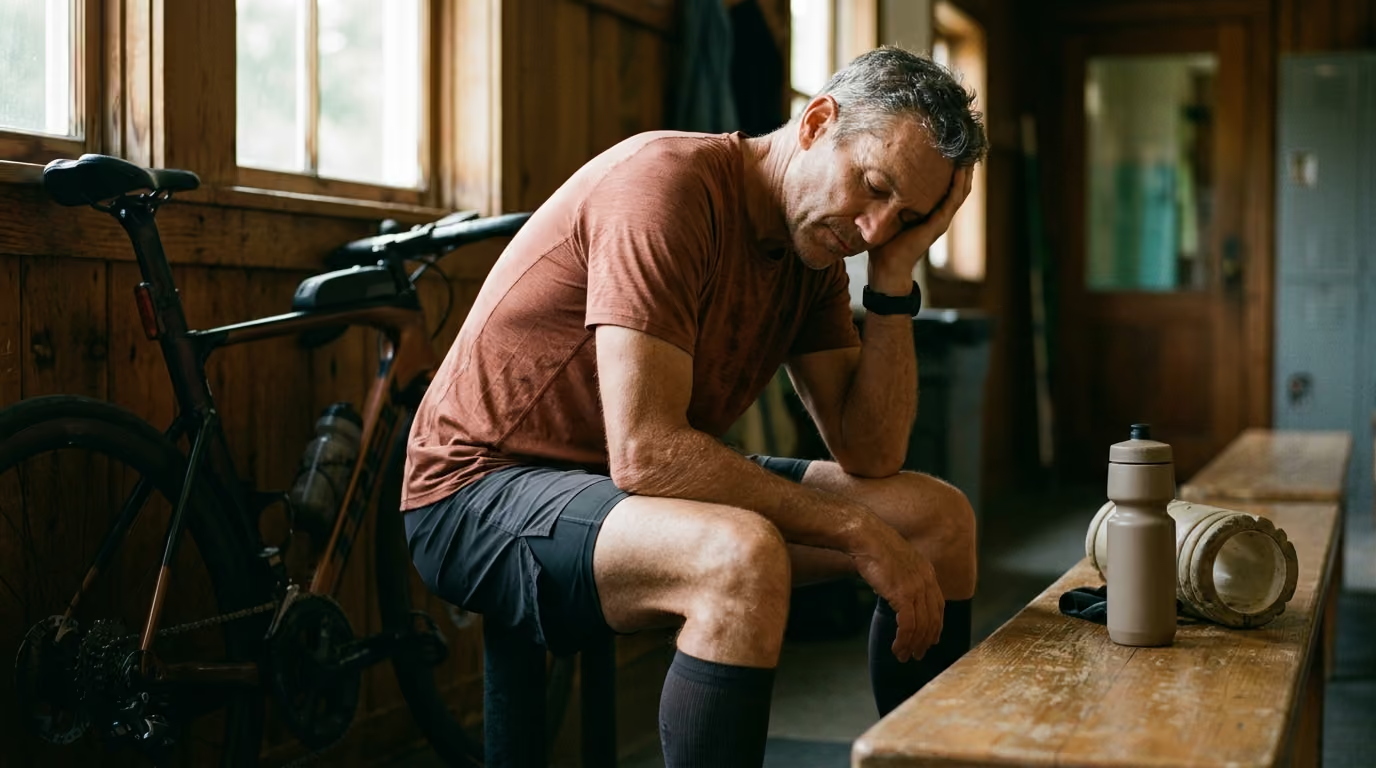

While sleep is often viewed as a direct injury shield, physiological evidence shows it primarily governs neuromuscular control and tissue repair.





Sleep for endurance athletes is a biological recovery system, not an absolute guarantee against physical breakdown. It is an active state of physiological repair, neurological recalibration, and hormonal balance that supports your ability to absorb training stress. It is not an impenetrable shield that prevents every overuse injury, nor is it a standalone cure for flawed training program design.
Understanding this distinction is critical for master runners, cyclists, and triathletes balancing demanding careers, family commitments, and high athletic ambitions. When you understand what sleep can and cannot do, you can build a sustainable routine that reduces vulnerability while maximizing training adaptations.
This guide provides an evidence-based manual on sleep duration, sleep consistency, sleep quality, and sleep timing. You will learn how peer-reviewed research connects sleep disruption to injury vulnerability, how to adjust your training when rest is compromised, and how to execute practical protocols across realistic life constraints.
Consider the typical routine of an amateur marathoner or long-course triathlete. The alarm sounds at 4:45 AM after six hours of interrupted rest. You swallow a mug of dark coffee, lace up your shoes, and head out into the cold for a session of tempo intervals before your workday begins.
By the fourth interval, your legs feel unusually heavy, your perceived exertion spikes, and an unfamiliar ache flares along your Achilles tendon. You complete the session out of discipline, yet your movement mechanics deteriorate over the final two miles as your stabilizing muscles fatigue prematurely.
This scenario plays out across endurance communities every week. Athletes often treat sleep as negotiable time that can be traded for extra mileage or early morning workouts.
When chronic fatigue meets high mechanical load, the margin for error narrows significantly. Examining how sleep interacts with physiological recovery and neuromuscular control provides the exact tools needed to protect your longevity in endurance sports.
To understand how sleep affects injury vulnerability, we must separate scientific findings from popular endurance mythology. Research requires us to examine three distinct questions:
The scientific evidence is significantly stronger for the second and third questions than for the first when evaluating adult athletes. While popular media frequently claims that sleeping under eight hours doubles your injury rate, the primary literature presents a more nuanced reality.
Much of the widely cited literature linking sleep duration directly to injury comes from adolescent athletic populations. A frequently referenced study on middle and high school athletes found that those sleeping fewer than eight hours per night were 1.7 times more likely to sustain an injury compared to those who slept eight hours or more.
Another study in adolescent athletes observed that sleeping more than eight hours on weekday nights was associated with a 61 percent reduction in new injury odds. These adolescent findings are clinically meaningful, but they cannot be uncritically applied to adult master athletes. Adolescents undergo rapid growth, skeletal development, and distinct hormonal fluctuations, alongside strict school schedules that create unique lifestyle stresses.
In adult endurance populations, the data is far more heterogeneous. A systematic review published in BMJ Open Sport & Exercise Medicine evaluated twelve prospective cohort studies on adult athletes and found limited evidence for an association between poor sleep and injury. The researchers concluded there was insufficient evidence to prove that sleep loss independently causes injuries in adult endurance athletes, professional athletes, or collegiate dancers.
A broader scoping review examining actigraphy-based sleep metrics across multiple sports reached a similar conclusion. While four out of seven studies evaluating sleep duration and sports injury reported an association between reduced sleep and higher injury incidence, the overall evidence across adult sports remains inconclusive.
A meta-analysis of nine observational studies comprising over one thousand athletes reported that shorter sleep was associated with a 34 percent increase in injury odds. Because these studies were observational, they identify sleep as a significant risk marker rather than a solitary, isolated cause.
Observational tracking in elite sports environments provides valuable insights into how real-world sleep deficits manifest. In an investigation of elite athletes, researchers recorded time in bed and total sleep time using actigraphy before days with and without injuries.
Athletes averaged 508 minutes in bed before injury days compared to 525 minutes before non-injury days. Their total sleep time was 443 minutes before injury days compared to 457 minutes before healthy days.
The researchers noted that sleep opportunity was inversely correlated with injury likelihood. They suggested that an extra twenty minutes of real-world rest might serve as a protective margin. This finding illustrates that small, continuous deficits in sleep opportunity can degrade an athlete's physical tolerance over time.
Even if sleep loss does not act as an independent, single cause of tissue failure, it modifies several physiological and cognitive pathways that elevate your vulnerability. Understanding these pathways allows you to implement smart injury prevention strategies before small niggles become chronic setbacks.
Endurance sports demand continuous neuromuscular coordination. A trail runner must react to loose rocks, tree roots, and steep gradients within milliseconds. A road cyclist in a pack must track sudden changes in momentum, braking distances, and pavement defects.
Sleep restriction significantly slows psychomotor response time and impairs executive function. A scoping review of athletic performance noted that poor objective sleep metrics correlate with slower response times in endurance cyclists and elite youth athletes.
When your nervous system is tired, the firing rates of motor units slow down. Your deep stabilizing muscles, such as the gluteus medius during running or the core musculature on a bike, experience accelerated fatigue.
As these stabilizers tire, movement mechanics drift. A runner may display increased hip adduction, greater knee valgus, or excessive braking forces on foot strike. Over tens of thousands of repetitive foot strikes, this altered movement pattern loads tendons and bones unevenly, setting the stage for bone stress injuries or tendinopathies.
Sleep loss alters central brain processing and elevates your rating of perceived exertion for a given submaximal workload. When you run at marathon pace after a night of fragmented rest, that pace feels noticeably harder than it does when you are fully rested.
This mismatch complicates workout execution. Athletes frequently misjudge their physical limits, overcompensate with poor form, or push through pain signals that would normally prompt a sensible reduction in effort.
In racing or group training environments, impaired decision-making can lead to poor pacing during opening miles. You overreach early, experience catastrophic energy depletion, and compromise your running or cycling mechanics under severe exhaustion.
Musculoskeletal tissues experience micro-damage during training. Tendons, ligaments, cartilage, and bones require an ongoing cycle of breakdown and remodeling to adapt and grow stronger.
Deep, slow-wave sleep is the primary physiological window for systemic tissue restoration. During this phase, your body releases human growth hormone and insulin-like growth factor one, both of which support protein synthesis and structural repair.
Research in exercise recovery highlights that extending sleep duration supports positive growth hormone release and reduces pain sensitivity.
When you chronically restrict sleep, circulating cortisol levels rise while anabolic hormone release drops. This hormonal shift creates a catabolic environment that slows collagen synthesis in tendons and retards bone remodeling, leaving connective tissues vulnerable when you ramp up training volume.
To build an actionable sleep routine, you must structure your habits across four practical pillars: duration, consistency, quality, and timing.
Duration is the foundation of recovery, but it must be measured accurately. Athletes often confuse time in bed with total sleep time. If you spend eight hours in bed but spend sixty minutes tossing and turning, your actual sleep duration is only seven hours.
The British Journal of Sports Medicine athlete sleep consensus recommends an individualized approach based on an athlete's personal recovery needs rather than an arbitrary universal threshold.
The National Sleep Foundation provides sound baseline guidelines:
If you consistently log seven hours of sleep during light training, you may require eight hours or more when mileage peaks. To increase duration, focus on expanding your sleep opportunity window by thirty to forty-five minutes.
Establish your baseline for two weeks, move your bedtime earlier in fifteen-minute increments, and monitor how your morning muscle soreness and alertness respond.
Consistency refers to the day-to-day regularity of your sleep and wake times. Many endurance athletes maintain a strict schedule during the workweek, only to shift their bedtime and wake-up times by several hours on weekends.
This pattern, known as social jetlag, disrupts your internal circadian clock and compromises sleep architecture.
Maintaining a regular wake-up time within a sixty-minute window every day reinforces your natural circadian rhythm. When your schedule prevents a fixed bedtime, use a predictable thirty-minute wind-down routine as an anchor.
A reliable sequence of low-light relaxation, light mobility work, and reading cues your brain for sleep, regardless of when you get into bed.
Quality reflects the architecture of your sleep, including your sleep-onset latency, sleep efficiency, and wake time after sleep onset. A study of collegiate soccer and basketball players revealed that athletes with poor sleep quality experienced an injury odds ratio of 2.2 compared to those with good sleep quality.
Optimizing your environment requires addressing primary sleep disruptors:
Sleep timing involves synchronizing your rest and training windows with your biological clock. Training at times that fight your biology degrades both sleep duration and workout quality.
A systematic review published in the British Journal of Sports Medicine found that athletic training sessions beginning before 07:00 AM significantly impaired total sleep time. This occurred because athletes rarely shifted their bedtimes early enough to compensate for their early alarms.
Conversely, intense training late in the evening elevates core body temperature, raises sympathetic nervous system activity, and delays sleep onset. Plan high-intensity interval sessions for mid-day or late afternoon whenever possible, leaving early mornings and late evenings for lower-intensity, aerobic recovery sessions.
Sleep quality and training load interact directly to dictate your injury risk. A review of collegiate athletes demonstrated that sleep deprivation and sudden spikes in training load are independent risk factors that produce their greatest injury hazard when combined.
Athletes need a clear, objective system to adjust their training based on recovery status. This traffic-light framework balances training stress against accumulated sleep debt:
Return to normal training only after you log a restorative night of sleep and your movement mechanics return to baseline. Integrating these rules with structured recovery protocols ensures your training load matches your biological capacity.
Ambitious master athletes aged 35 to 65 face unique physiological and logistical hurdles. As we age, our sleep architecture naturally changes. Deep, slow-wave sleep decreases, nighttime awakenings become more frequent, and total sleep efficiency often declines.
Balancing these changes with demanding professional careers, family commitments, and master-level training requires proactive time management.
Working athletes often underestimate the real time required for workouts. A one-hour run rarely takes only sixty minutes. When you factor in preparing equipment, fueling, driving to a running path, warming up, cooling down, showering, and preparing recovery meals, that one-hour workout requires ninety to one hundred twenty minutes of real time.
When time is tight, athletes usually sacrifice sleep rather than work or family commitments. They go to bed at 11:00 PM and wake up at 4:30 AM to log their miles.
If your schedule requires a 4:30 AM wake-up, you must be in bed with the lights out by 8:45 PM to protect an eight-hour sleep opportunity. If career and family realities make an 8:45 PM bedtime impossible, you must adjust your training schedule rather than continuously cutting your sleep.
Consider these practical schedule modifications:
Parents with young children or athletes caring for aging relatives often face unpredictable nighttime interruptions. Demanding an uninterrupted eight-hour block of sleep every night can create frustration and added stress.
In these situations, focus on achieving minimum viable consistency rather than demanding an unbroken night of rest:
Endurance athletes frequently travel across time zones for destination races, training camps, or corporate travel. Travel disrupts your circadian rhythm through two mechanisms: travel fatigue and circadian jet lag.
Managing these demands requires specific protocols that preserve recovery capacity.
A systematic review published in the British Journal of Sports Medicine noted that athlete-specific evidence for pharmacological and non-pharmacological jet lag interventions remains limited.
However, consensus travel frameworks recommend practical strategies to speed up your circadian adaptation:
When an early morning workout or unexpected work emergency cuts into your nighttime sleep, a strategic nap helps restore alertness without harming your sleep that night.
Athletes often fall into common traps when trying to optimize their sleep. Avoiding these mistakes will protect your health and keep your training on track.
Believing that you must get exactly eight hours of sleep every night can cause unnecessary performance anxiety. Some adult athletes thrive on seven hours and fifteen minutes of high-quality sleep, while others need nearly nine hours during heavy training blocks.
Track how you feel, how you move, and how you perform rather than stressing over an arbitrary number.
Sleeping five hours a night from Monday through Friday and then sleeping ten hours on Saturday and Sunday disrupts your circadian clock. This pattern creates social jetlag, leaving you tired on Monday morning and unable to fall asleep on Monday night.
Aim to keep your weekend sleep duration within sixty to seventy-five minutes of your weekday average.
Wrist-worn fitness trackers provide helpful general trends in your sleep duration, but they are not medical diagnostic tools. Their estimates of specific sleep stages, such as light, deep, and rapid eye movement sleep, can vary in accuracy.
If you wake up feeling refreshed, energetic, and ready to train, do not cancel your workout just because an algorithm gave you a low recovery score. Use wearable data as a secondary reference alongside your actual physical symptoms.
While alcohol makes you feel drowsy, it fragments your sleep architecture, suppresses restorative rapid eye movement sleep, and raises your nighttime resting heart rate.
Over-the-counter antihistamine sedatives may leave you feeling groggy the next day and can impair your reaction time. Rely on consistent habits, a relaxing wind-down routine, and an optimized bedroom environment rather than chemical sleep aids.
Using coffee, energy gels, or pre-workout drinks to push through severe fatigue hides the body's natural warning signals. Caffeine blocks your brain's adenosine receptors, masking your fatigue without restoring your neuromuscular coordination or tissue repair capacity.
Set a strict caffeine cutoff eight to ten hours before bedtime to protect your sleep quality that night.
Pushing through high-speed track repeats, maximum power cycling tests, or heavy weight sessions after an exceptionally short night of sleep significantly increases your injury vulnerability.
When you are exhausted, use the traffic-light system to downshift the workout to easy aerobic miles and reschedule your hard effort for a day when you are well rested.
To turn these principles into a lasting habit, you need a simple monitoring system. Tracking a few key metrics helps you spot chronic fatigue patterns before they lead to an overuse injury.
Record these five simple variables in your training log every morning:
Review your log every Sunday evening and ask yourself these four questions:
If your weekly review shows accumulating sleep debt and rising muscle soreness, adjust your schedule immediately. Reduce your training volume by twenty percent, replace high-intensity workouts with steady Zone 2 efforts, and expand your nightly sleep window by thirty to forty-five minutes.
Integrating this habit alongside proper fueling and hydration practices provides a complete, sustainable recovery system.
Sleep hygiene practices cannot solve every sleep problem. If you consistently give yourself an eight-hour sleep window in a dark, quiet, cool room but experience persistent insomnia, loud snoring, witnessed breathing pauses, restless leg sensations, or severe daytime sleepiness, consult a qualified physician or board-certified sleep specialist.
Conditions such as obstructive sleep apnea, upper airway resistance syndrome, and clinical sleep disorders require medical diagnosis and targeted treatment rather than more athletic recovery tips.
A twenty-minute power nap cannot fully replace lost nighttime slow-wave or rapid eye movement sleep. However, it can temporarily restore reaction time, sharpen focus, and reduce daytime sleepiness.
Think of a nap as a quick boost to help you get through the day safely, while keeping your primary focus on getting sufficient sleep at night.
Research shows that a single night of poor sleep driven by pre-race nerves has little impact on your aerobic endurance or muscular strength. Your athletic performance is powered by the sleep you banked over the entire two-week taper leading up to the race.
Stay calm, rest quietly in bed, and trust the training and sleep you logged over the previous weeks.
If your choice is between doing a hard interval workout on five hours of sleep or skipping it, you are usually better off modifying or skipping the session. Pushing through high-intensity training while sleep-deprived increases your perceived exertion, degrades your movement mechanics, and elevates your injury risk.
Either use that time for an extra hour of sleep or switch the workout to an easy, low-risk aerobic recovery run or ride.
Falling asleep quickly after drinking evening coffee does not mean your sleep is restorative. Caffeine disrupts your sleep architecture by reducing deep, slow-wave sleep and increasing nighttime micro-awakenings.
Even if you do not remember waking up, your nervous system misses out on deep rest, leaving your muscles and connective tissues under-recovered the next morning.

Follow ReEndure for practical insights on endurance training, recovery, nutrition and healthy aging. Stay connected for new articles, research led guidance and ideas to help you perform better for longer.


Read practical ideas on endurance training, recovery, nutrition and healthy aging to keep progressing for years to come.
Read the Blog