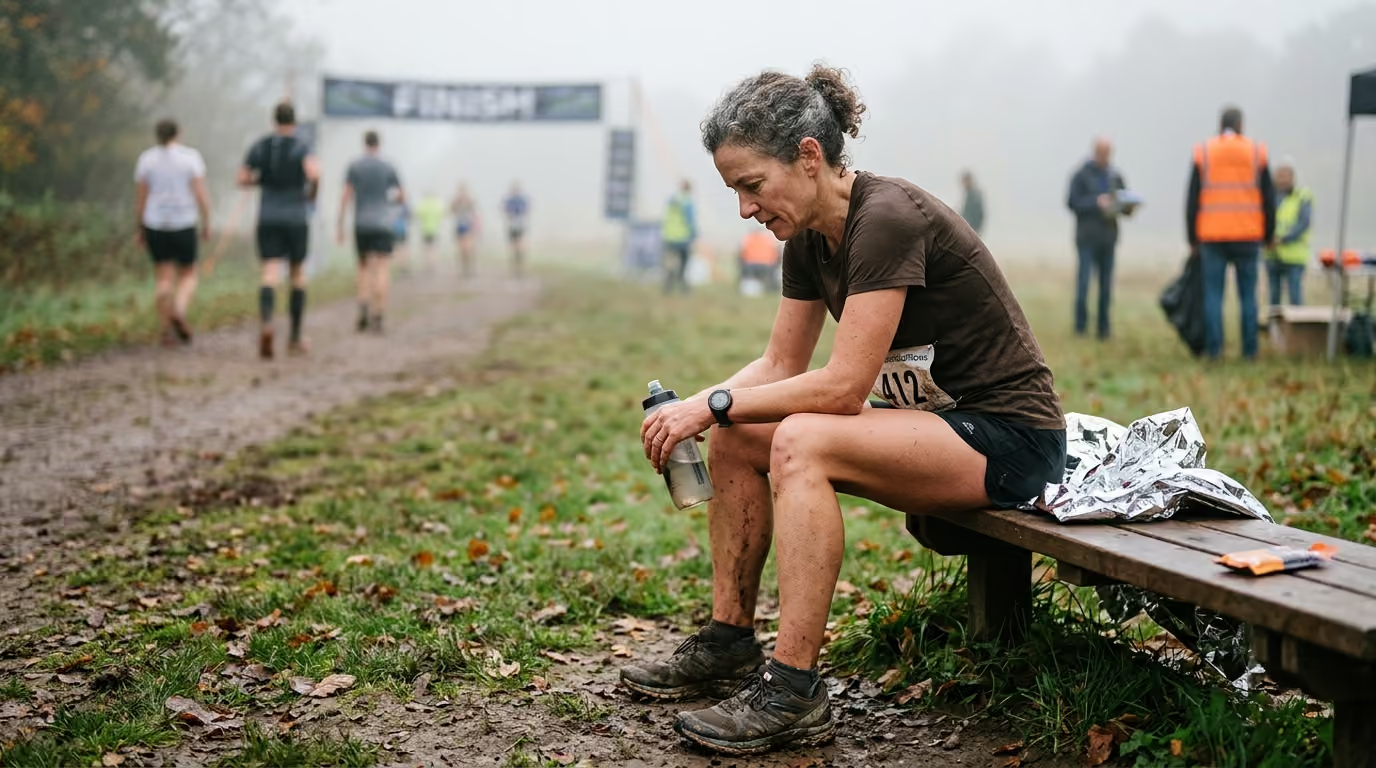

Athletic balance is not about equal time distribution, but managing overall life stress, effective training doses, and energy budgets across everyday demands.





Balancing athletic ambition with professional and personal commitments is not about equal time distribution. It is a systematic process of resource allocation. True balance does not mean giving identical hours to your career, your partner, your children, and your training schedule every single day. Instead, it is the deliberate management of finite time, physical energy, nervous system recovery, financial resources, and emotional goodwill.
When you treat balance as dynamic prioritization rather than static equality, you eliminate chronic guilt. You stop viewing missed miles as personal failure. You begin to understand that an intense period at work or a family transition requires an intentional shift in athletic volume. This comprehensive resource examines the sports science of total life load, outlines minimum effective training doses, and provides practical frameworks to help you perform at your best across every domain of your life.
Consider a standard Thursday for an ambitious amateur athlete. The alarm sounds at 5:00 AM for an interval workout on the trainer. Before the first interval finishes, a crying child wakes up with a fever. At the same time, an urgent message from a client arrives on your phone. You end the session thirty minutes early, rush through a shower, manage family logistics, and sit down at your desk already drained.
By the time the evening arrives, your scheduled strength session feels impossible. You are left with a persistent sense of frustration. You feel like a compromised employee, an absent partner, and an underperforming athlete all at once. This scenario is not a failure of character or self-discipline. It is the natural outcome of treating training in a vacuum without accounting for the demands of the rest of your life.
Sociologists and sports scientists describe this reality as the dual-career or triple-career challenge. A dual career involves balancing high-level sport with employment or formal education. A triple career adds the significant cognitive, logistical, and emotional demands of parenting and family care. When you operate as a whole-life athlete, your daily schedule is not your only constraint. You must also balance cognitive strain, physical fatigue, and relationship capital.
Success requires shifting away from the myth of simply finding more time. You cannot manufacture extra hours in a day. You can only choose how to allocate the finite energy available to you. Building a sustainable endurance lifestyle means designing a flexible framework that accounts for unexpected disruptions, protects your health, and keeps racing fun.
The human body does not have separate energy accounts for athletic stress, professional deadlines, and emotional conflict. Every stressor draws from the same central nervous system and physiological reserves. When you complete an intense track workout, your body initiates an inflammatory and metabolic cascade that requires rest, nutrients, and sleep to repair. If that workout is immediately followed by eight hours of high-stakes meetings, a stressful commute, and interrupted sleep, your recovery capacity drops drastically.
The International Olympic Committee published a consensus statement on load in sport that defines athletic load far beyond physical miles. The IOC framework emphasizes that overall load includes training volume, competition density, travel stress, psychological strain, and rapid life changes. The consensus highlights the critical difference between external load, which is the work you complete on paper, and internal load, which is the physiological and psychological stress your body actually experiences.
When non-training stressors spike, a training session that normally feels manageable can push your body into deep fatigue. If you fail to adjust your plan, this imbalance accumulates over weeks and months. Sports scientists categorize this progression into distinct phases:
This is the expected, temporary tiredness that occurs after a hard workout or a long week of training. It resolves completely after twenty-four to forty-eight hours of proper nutrition, hydration, and sleep. Performance remains stable or improves as your body adapts.
This represents a planned, short-term increase in training stress that temporarily reduces performance. After a few days of lighter activity or active recovery, your body supercompensates. You emerge with higher fitness levels than before the training block.
This occurs when high total load continues without adequate rest, leading to a performance drop that takes several weeks or months to reverse. It is often accompanied by sleep disturbances, elevated resting heart rate, mood changes, and frequent minor illnesses.
This is a severe, prolonged neuroendocrine and physiological breakdown. It is characterized by persistent exhaustion, heavy performance decrements, emotional instability, and hormonal disruption that can take months or years to resolve. Research from the European College of Sport Science and the American College of Sports Medicine confirms that overtraining syndrome is rarely caused by athletic training alone. It is almost always driven by an unmanageable combination of physical workouts and severe life stress.
Understanding this spectrum changes how you view a missed workout. When life stress spikes, scaling back your training intensity is not laziness. It is smart physiological management that protects your long-term consistency. To learn more about managing these variables, explore our guides on recovery strategies for athletes.
Ambitious athletes often operate under the all-or-nothing fallacy. They believe that if they cannot complete their full ten-hour training week, their time is wasted. Sports science demonstrates that this assumption is completely incorrect. The human body is remarkably efficient at preserving aerobic adaptations when training volume is reduced, provided that workout intensity is maintained.
A systematic review published in the journal Sports Medicine evaluated the minimum effective training dose required to maintain physical performance. The researchers found that endurance athletes can maintain their cardiorespiratory fitness and endurance performance for up to fifteen weeks with significant training reductions. Specifically, cutting overall exercise volume by 33% to 66%, or dropping frequency down to just two sessions per week, preserved baseline adaptations as long as exercise intensity remained high.
This finding is a vital tool for the busy amateur. When a critical project hits at work or a family member needs extra care, you do not have to abandon your sport. You can transition into a maintenance phase without losing months of hard work.
Resistance training follows a very similar principle. A comprehensive review of resistance-trained individuals found that performing just one hard set of six to twelve repetitions, two to three times per week, produced meaningful strength maintenance and even modest strength gains over eight to twelve weeks. While one set per exercise will not maximize muscle growth, it will preserve your structural integrity and muscular power when your calendar is overwhelmed.
When training time is restricted, training intensity distribution becomes critical. Research on endurance athletes shows that a polarized training model, where roughly 75% to 80% of volume is completed at low intensity and 15% to 20% at high intensity, delivers superior physiological improvements compared to spending excessive time in the middle zones. If you only have five hours a week to train, make three and a half hours truly easy and spend ninety minutes on high-quality intervals. Do not drift into moderate-intensity gray zones that generate high fatigue with minimal adaptation.
Sleep serves as the biological foundation for all of these adaptations. Research on athletic populations shows a direct link between chronic sleep deprivation and injury risk. A landmark study published in the Journal of Pediatric Orthopaedics found that adolescent athletes who slept fewer than eight hours per night were 1.7 times more likely to sustain an injury compared to those who slept eight hours or more. Additional sports medicine research indicates that even modest sleep losses of twenty to thirty minutes per night impair cognitive reaction times, reduce muscle glycogen storage, and elevate systemic inflammation.
If you are forced to choose between waking up at 4:30 AM on five hours of sleep to complete an easy run or sleeping until 6:00 AM, choose sleep. Sacrificing essential recovery to complete non-essential training miles increases your injury risk and compromises your daily health. You can find more evidence-based training principles in our endurance training performance library.
Most athletes build their training calendars by opening a blank week and inserting every workout they hope to complete. This aspirational approach almost always fails because it ignores non-training obligations. A resilient plan must be built using constraints-based planning. You map your non-negotiable life commitments first, and then fit your training into the genuine space that remains.
To do this effectively, evaluate your life through the five-budget model. Each budget represents a finite resource that can easily become overdrawn.
This is the literal math of your week. A week contains 168 hours. Subtract 56 hours for healthy sleep, 40 to 50 hours for work and commuting, 14 hours for meals and personal hygiene, and 15 to 20 hours for family care and household chores. The remaining hours represent your true maximum ceiling for training, logistics, and social connection.
Hours on a calendar do not reflect cognitive and physical vitality. A difficult two-hour budget meeting does not take physical energy, but it drains the central nervous system. If your day involves high cognitive stress, your evening energy budget will be too low for a demanding interval session.
This represents your capacity to absorb training stress. It includes access to nutrient-dense food, quiet time for mental decompression, physical rest, and consistent sleep quality. If your recovery budget is limited by life demands, your training volume must decrease to match it.
Every hour you spend training, traveling to races, or resting on the couch is time taken away from shared household labor and personal connection. Your partner, children, and friends have a finite capacity for your athletic absence. If you constantly overdraw this account, you create interpersonal friction that generates massive emotional stress.
Endurance sports carry significant financial costs. Entry fees, travel accommodations, coaching fees, equipment upgrades, nutrition products, and massage therapy add up quickly. Overspending on athletic ambitions creates financial anxiety that directly impairs your health and recovery.
To balance these five budgets, apply the 70/20/10 commitment framework to your year. Allocate 70% of your energy to essential life pillars, including family stability, career excellence, and baseline health. Dedicate 20% to your primary athletic focus, such as your main race of the season. Reserve the final 10% for optional activities, spontaneous social events, or secondary races.
When schedule conflicts inevitably arise, rely on a structured priority ladder to make quick decisions without emotional turmoil:
Having this explicit hierarchy prevents you from making training decisions based on guilt or momentary emotion. If an urgent family matter emerges, it instantly supersedes an A-race workout on the priority ladder. You make the adjustment cleanly and move forward.
Treating every event on your calendar like a championship race is a direct route to physical breakdown and domestic tension. High-priority events demand strict tapering, rigorous nutritional prep, extensive travel, and substantial mental focus. You cannot sustain that level of intensity all year long. You must categorize your race schedule into clear tiers to preserve your resources.
These are your primary objectives for the season. You should schedule no more than one or two A-races per calendar year. Everything in your athletic calendar points toward these days. Your training block includes a full race-specific peak, a calculated taper, and dedicated travel plans. Your family and support network are fully aware of these dates well in advance.
These are secondary competitive events used as dress rehearsals. You use B-races to practice your race-day fueling, refine pacing strategies, test new gear, and experience pack dynamics. You do not execute a prolonged taper for a B-race. You train through the event, perhaps taking a single easy day beforehand, and use the race as a high-quality workout.
These are low-stakes local events, club time trials, or casual fun runs. You enter C-races purely for enjoyment, community connection, or training variety. They should require zero logistical stress, minimal travel, and very little financial cost. If a work conflict or family need arises on the morning of a C-race, you can skip it without regret.
To decide whether a prospective race fits into your life, use a structured race-selection scorecard. Score each event from one to five across ten key metrics:
If a race scores poorly in family impact, travel burden, and financial cost, it should not be an A-race, regardless of its prestige.
Managing your year also requires understanding the dynamic status of different life domains. You cannot grow every area of your life simultaneously. Use this three-part status model to set realistic expectations for each domain:
This domain receives your primary energy, creative focus, and time surplus. You are actively building and pushing for new milestones. For example, during an eight-week peak training block, your athletic domain is in Advance mode.
This domain receives the minimum effective dose required to preserve existing performance and stability. You are not striving for personal records or major promotions here. When your sport is in Advance mode, your career might operate in Maintain mode, where you execute your job reliably without taking on massive voluntary projects.
This domain represents non-negotiable boundaries that must never drop below a safe baseline. Sleep, fundamental health habits, core financial stability, and basic family trust must remain protected at all times.
Here is how different athletes apply these principles across real-world situations:
This athlete has predictable evening and weekend hours. They advance their career during major corporate initiatives by shifting training to a maintenance dose. When their work schedule stabilizes, they advance their training volume, maintain their social connections, and protect eight hours of sleep opportunity each night.
This athlete faces unpredictable sleep and high domestic labor. They advance their training using modular indoor sessions on a smart trainer or treadmill, keeping workouts to forty-five or sixty minutes. They maintain their strength with short home workouts and protect their relationship by scheduling regular non-athletic dates with their partner. For more advice on this lifestyle, read our guide on endurance lifestyle integration.
This athlete works rotating twelve-hour shifts that disrupt normal circadian rhythms. They abandon the standard Monday-to-Sunday weekly training format. Instead, they operate on a rolling ten-day cycle, scheduling intense workouts only after restful sleep blocks and using recovery days immediately following night shifts.
This athlete spends multiple days each month in transit. They treat travel weeks as planned maintenance blocks, utilizing hotel fitness centers for short strength sessions and easy treadmill runs. They protect their hydration and nutrition during travel, resuming progression only when they return to their home environment.
As endurance athletes cross the age milestones of forty, fifty, and sixty, the biological parameters of recovery change. Muscle protein synthesis rates decline, tendon and ligament elasticity decreases, and the deep stages of restorative slow-wave sleep become shorter. Masters athletes often carry higher professional responsibility and care for both adolescent children and aging parents. Balancing life and sport becomes even more critical.
The most important physiological adaptation for the aging athlete is the non-negotiable inclusion of heavy resistance training. Research indicates that age-related loss of muscle mass, known as sarcopenia, selectively degrades fast-twitch motor units. Incorporating two brief strength sessions each week preserves muscle fiber recruitment, enhances bone mineral density, and protects vulnerable joints. When time is tight, a masters athlete should cut twenty minutes of easy aerobic volume to ensure their strength work gets completed.
Recovery kinetics also dictate that masters athletes require longer spacing between high-intensity sessions. A thirty-year-old athlete might handle hard interval workouts on Tuesday and Thursday followed by a long run on Saturday. A fifty-five-year-old athlete often performs better with three full days of easy aerobic recovery between demanding sessions. Adopting an eight-day or nine-day training microcycle instead of a rigid seven-day week allows older athletes to absorb their workouts while managing demanding professional careers.
The traditional rule of thumb suggesting a 10% maximum weekly volume increase must be applied with great caution as you age. Tendons and cartilage adapt far more slowly than the cardiovascular system. A sudden jump in mileage might feel comfortable for your heart and lungs, but it can trigger chronic Achilles or patellar tendinopathy that sidelines you for months.
Masters athletes must balance ambition with self-awareness. Your athletic capacity is not defined by how you trained in your twenties. It is defined by how intelligently you adapt your training to your current physiology. Maintaining consistent, injury-free training over several years will always yield better results than alternating between extreme training blocks and prolonged injury rehabilitation. Check out our resources on healthy aging for endurance athletes for more specific guidance.
Even experienced athletes frequently fall into predictable behavioral traps when trying to balance multiple life roles. Recognizing these pitfalls helps you correct course before fatigue turns into injury or burnout.
Many endurance cultures glorify sheer exhaustion. Athletes often believe that feeling completely drained is proof of a successful training block. In reality, persistent fatigue reflects an inability to absorb your current workload. True athletic competence is achieving the maximum possible adaptation with the least necessary physiological strain.
Setting an alarm for 4:00 AM to complete a workout after going to bed at 11:30 PM is counterproductive. You are performing physical work in a state of high systemic inflammation and impaired motor coordination. Over time, chronic sleep deprivation degrades your endocrine system, elevates injury rates, and ruins daytime focus.
When an unexpected meeting or family illness forces you to miss a key session, your first instinct may be to double up your training the following day. This creates an unnatural spike in acute training load. Missed workouts should be treated as lost opportunities that simply disappear from the ledger. Move forward with your planned schedule rather than creating a dangerous backlog of fatigue.
Athletes routinely calculate the exact minutes spent running, riding, or swimming, but they forget the surrounding overhead. Preparing sports nutrition, packing gear bags, driving to training locations, showering, washing athletic apparel, and maintaining equipment require several additional hours each week. If you budget ten hours for training, you are often spending fourteen hours on athletic logistics.
Your partner or family members may support your athletic goals, but their patience is not limitless. If your training regularly causes you to miss family meals, arrive late to social events, or remain mentally disengaged on the couch, resentment will build. Athletic balance requires continuous communication, gratitude, and clear boundaries around family time.
A training plan that only works when the weather is mild, work is calm, and everyone in the household is healthy will fail quickly. Resilient athletes build adaptable training plans. For every critical workout, establish a Plan A, a Plan B, and a Plan C:
Having pre-planned alternatives prevents decision fatigue and keeps your momentum alive when circumstances change. To build more durability into your daily routine, review our injury prevention training resources.
You cannot manage what you do not evaluate. To ensure that your athletic training and life commitments remain in healthy equilibrium, implement a simple monitoring system that tracks both objective data and subjective feelings.
Use the Red-Yellow-Green traffic light system every morning. It takes less than sixty seconds and gives you an immediate assessment of your readiness to train.
In addition to daily monitoring, conduct a quarterly life and athletic audit. Every twelve weeks, sit down and ask yourself four fundamental questions:
If the honest answers to these questions reveal rising friction, adjust your athletic volume before minor imbalances turn into significant crises. For more insights on balancing lifestyle demands, check out our endurance life resource center.
The most critical skill for a whole-life endurance athlete is the ability to decline opportunities cleanly and without guilt. Every time you say yes to a non-essential commitment, you are automatically saying no to your sleep, your family presence, or your training consistency. Saying no is not an act of selfishness. It is a protective measure for the core commitments you have already chosen.
You should proactively say no under several specific conditions:
Declining requests becomes straightforward when you use clear, respectful, and definitive language. Here are practical scripts for common athletic and personal scenarios:
"Thank you for thinking of me for that event. My race calendar is completely full this season, and I am focusing all of my preparation on my October marathon. I hope you have a fantastic race."
"I appreciate the invite, but that workout is longer and harder than what my coach has prescribed for this block. I need to stick to my specific training plan this weekend, so I will pass this time."
"Thank you for considering me for this project. Given my current professional workload and family commitments, I cannot give this the time it deserves. I need to decline so I do not overcommit."
"I would love to run with you on Wednesday, but I have a strict sixty-minute time cap before I need to be home for family breakfast. If that timeframe works for your schedule, let us do it."
Framing your refusals around clear personal boundaries removes awkwardness. People respect individuals who understand their priorities and manage their time with integrity.
During the first year of a child's life, your athletic goal should transition entirely from performance progression to mental health and physical maintenance. Sleep will be fragmented, and domestic demands will be high. Use short, modular thirty-minute home workouts, utilize a running stroller when appropriate, and drop all expectations of high-volume training. Focus on preserving your athletic identity and baseline cardiovascular health until consistent sleep patterns return.
Caregiving creates substantial emotional strain and unpredictable time demands. Training should become entirely opportunistic and flexible. Shift into a low-volume maintenance program, rely on brief bodyweight strength routines, and view exercise as a form of stress relief rather than a rigid performance quest. If caregiving demands escalate, take a complete pause from structured training without guilt.
High-level endurance performance does not require expensive equipment, luxury gym memberships, or costly international races. Focus on local, low-cost events such as community 5Ks, club time trials, or grassroots trail races. Build your training around running from your front door, bodyweight strength work, and affordable home training gear. Consistency and smart physiological loading matter far more than premium equipment.
While cardiovascular fitness can be preserved with low-volume training, technical sports like open-water swimming, downhill mountain biking, and technical trail running require regular skill maintenance. If you must reduce your training volume in these sports, prioritize short, frequent sessions that emphasize movement mechanics, bike handling, and neuromuscular coordination rather than pure physiological exhaustion.

Follow ReEndure for practical insights on endurance training, recovery, nutrition and healthy aging. Stay connected for new articles, research led guidance and ideas to help you perform better for longer.


Read practical ideas on endurance training, recovery, nutrition and healthy aging to keep progressing for years to come.
Read the Blog