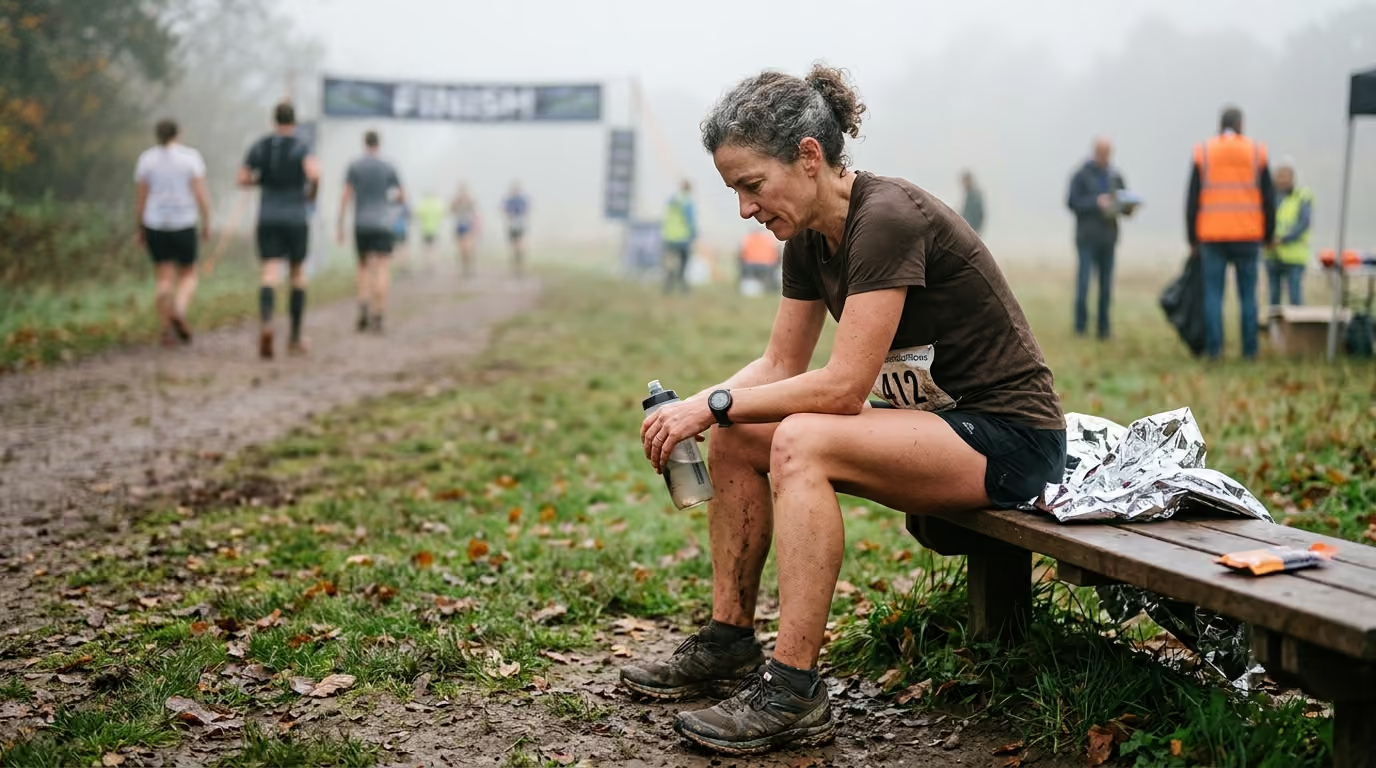

Confident race-day execution begins with selecting the right target by auditing your training, mastering pacing science, and choosing the perfect event goal.





A race goal is not simply a predicted finish time written on your wrist. It is a deliberate definition of what success means for one specific day, shaped by your current fitness, recent health, life stress, course profile, and long-term athletic intentions. It is not an inflexible contract that ignores shifting weather or missed training blocks. By setting the proper goal before you arrive at the starting line, you establish a clear operational plan for race day and protect yourself against unnecessary emotional volatility once you cross the finish line.
Every season, thousands of dedicated runners and triathletes step up to the start line with an unexamined objective. Consider a common scenario: a runner enters a spring half marathon six months in advance with the intention of setting a personal record. In the intervening months, work demands escalate, a minor calf strain costs three weeks of running, and race morning arrives with temperatures fifteen degrees above normal. Instead of adjusting the objective to reflect these constraints, the athlete clings to the original pace, struggles through the final miles, and finishes physically depleted and mentally discouraged. The training was not wasted, but the evaluation framework failed.
Defining your race objective requires matching your ambition with the reality of your current preparation. When you understand how to navigate the four primary race goal types, align process targets with outcome desires, and audit your readiness objectively, you gain control over your athletic progression. This definitive guide breaks down the sports science of goal setting, outlines a practical selection framework, and helps you execute with clarity.
Endurance events serve many different purposes throughout an athletic career. Forcing every start into a personal best attempt creates unnecessary pressure and overlooks the broader value of competitive events. Categorizing your event into one of four distinct goal types allows you to align your tactical execution with what truly matters on the day.
A personal best goal makes maximal physiological performance the central objective of the competition. The athlete targets a specific finishing time or an improved mark relative to previous attempts at that exact distance. This goal demands precise pacing, disciplined nutrition, and a willingness to tolerate substantial physical discomfort in the closing stages.
This objective is appropriate only when training consistency has been high, health is stable, and course conditions cooperate. Pursuing a personal best requires narrowing your focus to internal cues, split times, and tactical efficiency. Because this goal relies on tight margins, it is highly sensitive to environmental stressors like heat, humidity, and steep elevation profiles.
A controlled completion goal prioritizes finishing the distance with physiological stability, smooth mechanics, and energy reserves intact. Rather than chasing a maximal pace, the athlete establishes an effort ceiling to prevent severe late-race deceleration or acute breakdown.
This goal is ideal when stepping up to an unfamiliar distance, returning from a training interruption, or using a race as a fully supported long run. Controlled completion is not an admission of defeat. It is an intelligent, strategic decision to build structural tolerance and racing confidence without incurring the excessive fatigue debt of a maximal effort.
A social race goal places shared connection and community participation above individual finishing times. In this scenario, you might run alongside a friend attempting their first finish, pace a family member to their target, or participate as part of a charity team.
Research on recreational runners demonstrates that social motives, health, and well-being frequently drive participation just as strongly as competition. Choosing a social goal requires an explicit agreement on expectations before race morning. If one runner wants to pause at aid stations while another constantly accelerates, friction is inevitable. Clarify pacing, walk breaks, and regrouping points early to ensure the shared experience remains positive.
A learning-oriented goal approaches the race as a practical field experiment. The primary objective is gathering data to inform future training blocks and target events. Athletes often use tune-up races to evaluate specific variables under true competitive conditions.
You might use a learning race to test an aggressive carbohydrate intake protocol, practice conservative early pacing in a crowded field, or assess how new footwear performs over varying terrain. To maximize the value of this approach, limit your experiments to one or two variables per event. Changing your breakfast, shoes, hydration mix, and pacing strategy all at once makes it impossible to identify what caused your success or distress.
Sports psychology and exercise physiology offer valuable insights into how athletes should structure their race intentions. Setting effective race targets is not just about choosing a number. It is about understanding the psychological mechanisms of motivation and the physiological realities of energy distribution.
Sport psychology categorizes goals into three distinct tiers: outcome goals, performance goals, and process goals. An outcome goal focuses on an external result that depends partly on other competitors, such as winning an age group or placing in the top ten percent. A performance goal specifies an absolute standard independent of others, such as finishing a marathon under three hours and thirty minutes. A process goal targets the specific actions, technical behaviors, and mental strategies an athlete executes during the event.
A systematic review and meta-analysis published in International Review of Sport and Exercise Psychology by Williamson and colleagues evaluated the impact of goal-setting interventions in sport. The researchers reported that process goals produced the largest performance effect size (d = 1.36), substantially outperforming performance goals (d = 0.44) and outcome goals (d = 0.09).
Focusing on controllable processes, such as posture checks, fueling schedules, and effort management on inclines, reduces cognitive anxiety and optimizes physiological execution. Process goals serve as the actionable engine beneath any broader performance target.
The physiological cost of poor pacing is well documented in endurance literature. A systematic review on marathon pacing strategies published in Sports Medicine identified positive pacing, negative pacing, and even pacing as the primary pacing profiles in competition. Positive pacing, where an athlete runs the first half of an event significantly faster than the second half, is the most common pattern among recreational runners and frequently leads to severe late-race fatigue.
A large-scale analysis of marathon runners published in PLOS ONE demonstrated that even pacing was consistently associated with the fastest average finishing times across all age and performance demographics. While observational data cannot prove direct causation, the physiological rationale is straightforward. Starting too fast accelerates glycogen depletion, increases core temperature, and elevates blood lactate accumulation prematurely.
Furthermore, research examining pacing durability shows that accumulated training volume and long-distance racing experience correlate strongly with reduced second-half pace decline. If your training background does not support an aggressive opening pace, choosing an ambitious time goal will almost certainly lead to an unsustainable positive split.
Choosing the right race goal requires an honest assessment of your current physical and logistical reality. Athletes often base their race targets on idealized expectations rather than the physiological evidence accumulated during their training cycle. A structured readiness audit prevents this disconnect.
Clarify why you entered this specific competition. Determine whether the race is your primary target for the season, an intermediate fitness test, a social gathering, or an event tied to travel and vacation.
Your initial motivation when registering months ago might no longer match your current circumstances. Acknowledging this shift allows you to adjust your expectations without viewing the adjustment as a failure.
Examine your training log from the preceding eight to twelve weeks. Look for consistent execution of key long sessions, weekly volume stability, and workouts completed at your target race pace.
Avoid basing your race plan on a single standout workout while ignoring several weeks of interrupted mileage. Sound athletic progression in our training and performance guides emphasizes that cumulative consistency, rather than individual peak efforts, provides the foundation for race-day performance.
A clinical consensus statement from the International Olympic Committee on training load and injury risk highlights the necessity of monitoring an athlete's physical and psychological well-being alongside external workloads. Minor aches, localized stiffness, and systemic fatigue must be factored into your goal selection.
World Athletics guidance on injury prevention explicitly advises that athletes should race only when uncompromised by acute musculoskeletal pain. Racing with an injury often alters biomechanics, increasing the risk of compensatory damage.
External conditions dictate what pace is physiologically sustainable. High ambient temperatures, elevated humidity, strong headwinds, and hilly terrain demand higher metabolic output for the same running speed.
The American College of Sports Medicine position stand on exertional heat illness emphasizes that environmental heat stress impairs endurance capacity and elevates cardiovascular strain. Attempting to maintain a predetermined cool-weather pace in high temperatures drastically increases the risk of heat exhaustion and severe pacing collapse.
Consider the downstream consequences of an aggressive race strategy. If attempting a personal best leads to severe muscle damage or aggravates an existing tendon issue, you may lose weeks of subsequent training.
Ask yourself whether the potential reward of chasing a specific time standard justifies the recovery debt it will create. For non-target events, preserving your long-term consistency is almost always more valuable than chasing an incremental time improvement.
To assist your decision, rate your readiness across five key domains using a scale from one to five, where one represents severe disruption and five represents optimal preparation:
A total score between 21 and 25 points supports an aggressive personal best attempt. A score between 14 and 20 points points toward a controlled completion or learning-oriented race. A score below 14 suggests that prioritizing a social race, adjusting to an easy supported run, or withdrawing from the event is the most rational choice.
Relying on a single, binary target creates unnecessary psychological vulnerability. If an athlete only defines success as running under four hours, a finish time of 4:01 feels like complete failure, regardless of how well they managed challenging headwinds or late-race cramping. A multi-tiered framework provides tactical flexibility.
Your primary goal represents your preferred target assuming reasonable execution and cooperative environmental conditions. This might be a specific time standard or an aggressive pacing strategy executed across the full course.
This target should be challenging yet grounded in your training data. It serves as your initial pacing guide when the race begins.
The secondary goal is your immediate operational fallback if your primary target becomes unviable during the event. This transition often occurs due to unpredicted heat, gastrointestinal distress, or early muscular fatigue.
Shifting to your secondary goal is not a failure of willpower. It is an intelligent tactical pivot designed to preserve a strong performance. Your secondary goal might focus on maintaining a specific perceived exertion ceiling rather than a fixed clock split.
The minimum-success goal establishes the baseline that keeps the event valuable and worthwhile. It is completely independent of the clock.
Examples of minimum success include executing your pre-planned hydration schedule, practicing positive self-talk through difficult miles, or finishing without aggravating an Achilles tendon. Defining this baseline in advance ensures that unexpected adversity does not erase the educational value of the race.
Every athlete must establish explicit safety boundaries before race day. A stop rule removes the burden of making high-stakes health decisions while under severe physical fatigue.
Sports medicine guidelines highlight clear warning signs that require immediate withdrawal from competition:
Establishing these boundaries in advance helps you protect your long-term athletic health when competitive adrenaline is running high. You can review more on safe decision making in our dedicated racing and lifestyle resources.
Aging alters physiological recovery kinetics, soft tissue compliance, and metabolic flexibility. For athletes aged 35 to 65, goal setting must reflect these biological shifts without diminishing competitive ambition.
As athletes mature, tendon and ligament remodeling takes longer following maximal eccentric loading. A maximal marathon or ultra-endurance effort creates structural muscle damage and inflammatory responses that require extended recovery windows.
Younger athletes might recover from an all-out race effort within a couple of weeks. For a master athlete, a maximal race can compromise high-quality training for four to six weeks.
Choosing a controlled completion or learning goal for intermediate races preserves musculoskeletal integrity. This approach ensures your primary training consistency remains uninterrupted throughout the season.
Research on pacing dynamics indicates that experienced older runners frequently exhibit superior pacing consistency compared to younger competitors. Decades of accumulated aerobic base training provide excellent physiological efficiency at submaximal intensities.
Master athletes should lean into this strength by prioritizing even or slightly negative pacing strategies. Chasing aggressive early splits often backfires, as older muscle tissue is less forgiving of premature lactate accumulation and erratic speed changes.
Thermoregulatory efficiency declines modestly with age due to subtle decreases in skin blood flow and sweat gland output. Older athletes must remain vigilant when racing in hot and humid environments.
When temperatures rise on race morning, older runners benefit from immediately converting a personal best goal into an effort-managed completion goal. Lowering your target intensity preserves cardiovascular stability and minimizes the risk of heat-related illness.
For mature competitors, longevity in the sport is the ultimate performance metric. Sacrificing three months of consistent running to hit an arbitrary finishing time in an early-season 10k is a poor trade-off.
Prioritizing structural health, functional mobility, and sustainable progression ensures you remain competitive in your age group for decades to come. Explore our curated healthy aging resources for more evidence-based strategies on training longevity.
Athletes frequently fall into predictable traps when establishing their race-day targets. Recognizing these pitfalls helps you make rational choices during race week.
One of the most common mistakes in endurance sports is treating every registered event as a maximal performance test. Racing at peak capacity too frequently leads to chronic autonomic nervous system fatigue, elevated injury risk, and mental burnout.
Designate one or two primary peak events per season. Use intermediate competitions to build race-day experience, test nutrition, or enjoy the camaraderie of the endurance community.
Wanting to run a specific time does not mean your physiological systems are prepared to support it. Training volume, long run completion, and tempo consistency dictate your race-day capacity.
When athletes set goals based solely on ambition, they tend to start too fast, leading to severe muscular breakdown and disappointing finishes. Base your targets on the training data you have logged, not the time you hope to see on the clock.
Pace is an output, not an input. On a flat course with cool temperatures and no wind, a specific pace might represent a sustainable sub-lactate threshold effort. On a hilly course with direct sun and high humidity, that same pace will push you deep into anaerobic metabolism.
Failing to adjust your pace targets for environmental stress is a primary cause of late-race collapse. Incorporate perceived effort and heart rate boundaries to keep your physiological workload sustainable.
An athlete cannot simultaneously pursue a maximal personal record, act as a supportive pacer for a slower friend, field-test an unproven shoe, and take scenic photos along the course. These intentions pull your focus and pacing in opposing directions.
Select one primary objective for the event. If secondary opportunities arise naturally, treat them as pleasant bonuses rather than mandatory success criteria.
Endurance athletes invest substantial time, money, and emotional energy into race preparation. When illness strikes during race week, many struggle to make the rational decision to withdraw.
Medical guidance from sports physicians emphasizes that competing with systemic illness, fever, chest congestion, or significant dehydration is dangerous. A virus elevates resting heart rate, impairs thermoregulation, and can lead to post-viral complications or myocarditis. If you experience systemic symptoms below the neck, forfeit the race and reset your training schedule.
Evaluating a race requires looking beyond the final finishing time. A rigorous post-race review examines execution, environmental context, and tactical decision-making, helping you convert every race into actionable insights for your next training cycle.
Conduct a structured debrief within 24 to 72 hours of finishing your race. Waiting a day or two allows acute emotional reactions to settle, leading to a more objective evaluation.
Document the following elements in your training log:
A successful performance does not always yield a personal best time, and a personal best time does not prove that your pacing strategy was flawless. For instance, executing a disciplined, conservative pacing plan in ninety-degree heat might produce a slower finishing time, yet represent an exceptional athletic performance.
Conversely, an overly aggressive opening pace on a cool day might still result in a personal record due to high baseline fitness, despite costing you several minutes in the final miles. Evaluating your execution independently of your finishing time ensures you draw accurate lessons from every start line.
Sports psychology research demonstrates that an athlete's mental response to performance setbacks significantly influences their long-term development. A study investigating coping mechanisms among competitive athletes found that self-compassion and a growth mindset correlated strongly with adaptive coping strategies following performance setbacks (r = .54 and r = .48, respectively).
Athletes who practice constructive self-reflection experience less shame, lower performance anxiety, and greater intrinsic motivation than those who engage in harsh self-criticism. When a race does not go according to plan, treat the outcome as valuable physiological data. Analyze what occurred, identify the variables within your control, make the necessary training modifications, and continue forward with your athletic journey.
Do not speed up. Early miles in an endurance event are heavily influenced by the pre-race taper, reduced training volume, and competitive adrenaline. This initial ease is deceptive and does not mean your planned target was overly conservative. Stick precisely to your pre-race pacing strategy through the halfway point. If you still have surplus energy with 10k or 5k remaining, you can safely accelerate and finish strong.
Assess your symptoms using the clinical neck rule. If your symptoms are strictly localized above the neck, such as a mild runny nose or minor sneezing, and you have no fever or body aches, you can generally participate. However, you should downgrade an aggressive personal best goal to a controlled completion or easy social run. If you experience symptoms below the neck, such as chest congestion, deep coughing, gastrointestinal upset, or elevated resting body temperature, sit the race out to avoid medical complications.
Establish clear communication and explicit agreements before arriving at the starting area. Decide in advance whether your primary commitment is crossing the finish line side by side or running at your own natural paces and reuniting at the finish festival. If you commit to running together, agree that the pace will be dictated entirely by the slower runner on that specific day, without pressure or frustration. Clear boundaries prevent misunderstandings and preserve both the relationship and the enjoyment of the event.

Follow ReEndure for practical insights on endurance training, recovery, nutrition and healthy aging. Stay connected for new articles, research led guidance and ideas to help you perform better for longer.


Read practical ideas on endurance training, recovery, nutrition and healthy aging to keep progressing for years to come.
Read the Blog