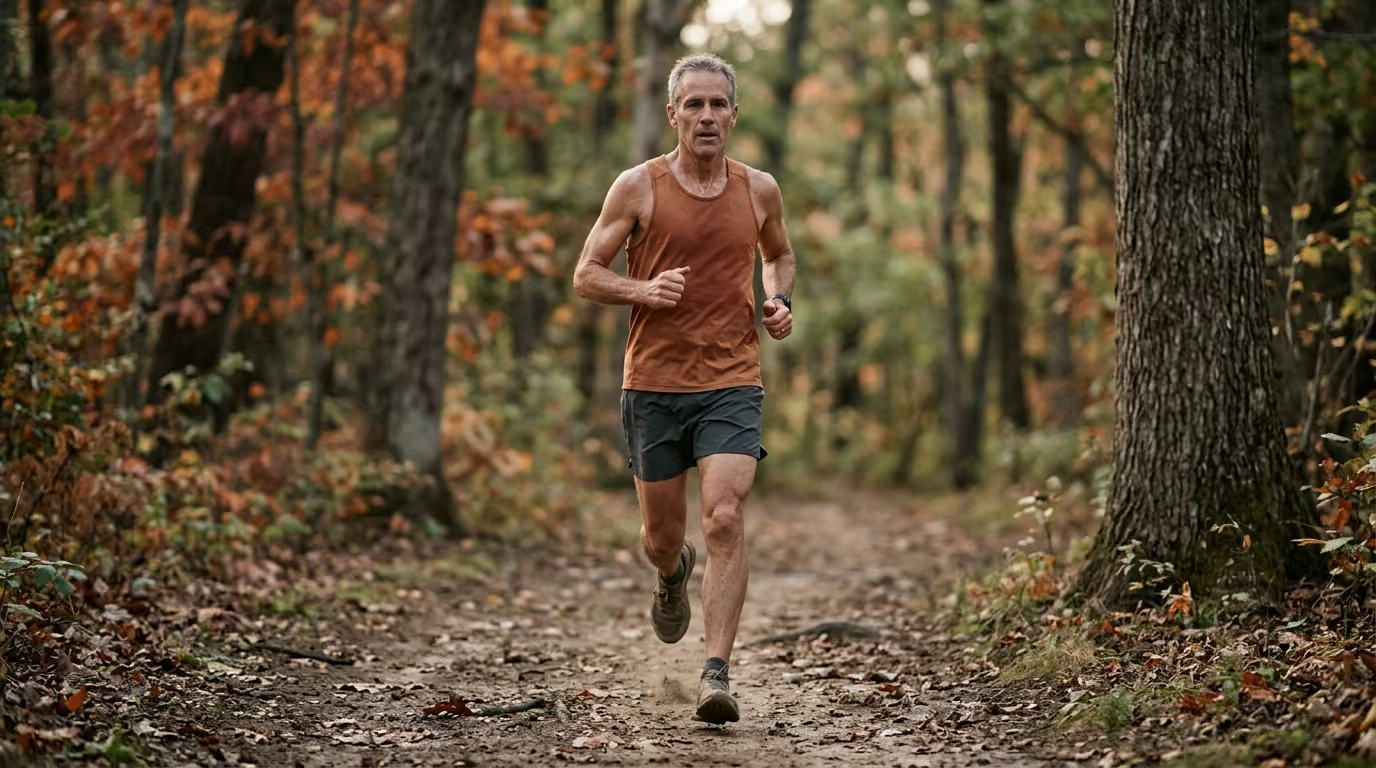

Banking early race time seems advantageous, but effective endurance pacing actually requires disciplined energy conservation to finish without painful late deceleration.





The morning air is crisp, the starting corral is packed with nervous energy, and the gun finally goes off. You settle into a rhythm that feels almost effortless, ticking off the first few miles well ahead of your goal split. You tell yourself that banking a few minutes now will provide a cushion for the later stages. By the midpoint of the course, however, your breathing turns ragged, your legs feel heavy, and every small incline begins to demand maximal focus. What began as a confident effort rapidly devolves into a desperate fight against deceleration, turning the final third of the event into a survival slog.
This scenario plays out every weekend across marathons, gravel rides, trail ultras, and triathlons. Athletes spend months building cardiovascular capacity and muscular stamina, only to unravel their preparation within the first thirty minutes of racing. Pacing is rarely just about running or riding at a single speed. It is the active, continuous allocation of your metabolic and cognitive resources across the duration of an event.
Mastering this skill requires understanding how your body generates energy, how terrain and weather alter physiological cost, and how to adjust your plan when race conditions change. When you align your effort with physiological reality, you unlock the ability to finish strong, avoid severe late-race deceleration, and extract the maximum performance from your training.
Pacing is the goal-directed regulation of exercise intensity across an event. It distributes finite physiological and psychological resources so that you cross the finish line without leaving excessive capacity unused or collapsing prematurely. This process is governed by a dynamic interaction between anticipatory planning and real-time sensory feedback.
Before the start line, your brain sets an initial intensity template based on your training history, expected race duration, course knowledge, and current conditions. Once movement begins, your central nervous system continuously updates this template. It processes incoming signals from working muscles, core temperature sensors, blood chemistry, and perceived exertion to regulate motor unit recruitment.
At the core of this regulation is energy-system management. Endurance performance relies on a continuous blend of aerobic and anaerobic energy production. The relative contribution of each system changes dramatically with intensity. Lower intensities rely primarily on fat oxidation and aerobic glycolysis, which produce sustainable energy with minimal metabolic byproducts. As intensity rises toward critical thresholds, carbohydrate utilization increases, anaerobic metabolism contributes more heavily, and finite intracellular reserves are depleted.
Sports scientists describe the boundary between sustainable heavy exercise and unsustainable severe exercise using concepts like critical power and critical speed. Critical power represents the highest mechanical power output that an athlete can sustain for an extended period without a continuous drift in oxygen uptake and blood lactate. Above this boundary sits a finite work capacity, often designated as W-prime in cycling or D-prime in running.
This finite reserve acts like a small, rechargeable battery. You can draw on it to climb a steep hill or bridge a gap, but repeated excursions above critical threshold rapidly deplete the reserve. When that capacity is exhausted, your body enforces a sharp reduction in power or speed to prevent catastrophic fatigue.
Functional threshold power provides a practical field benchmark for cycling, representing the highest quasi-steady power an athlete can maintain for roughly one hour. Research demonstrates that relative power derived from standardized 20-minute threshold testing correlates strongly with competitive endurance performance. However, threshold numbers should serve as reference anchors rather than rigid race-day mandates.
In longer events, muscle damage, core temperature rise, glycogen depletion, and cardiac drift lower your sustainable percentage of threshold. Perceived exertion integrates these systemic stresses, allowing your brain to adjust output before physiological failure occurs. Effective training and performance strategies train both your energetic capacity and your ability to interpret these internal signals accurately.
Athletes generally execute endurance events using one of five primary pacing profiles. Selecting the right profile depends on the duration of the event, the uniformity of the course, and the environmental conditions.
An even-paced effort maintains an approximately constant speed or power output from start to finish. This profile is the most biomechanically and metabolically efficient model for flat, uniform courses in stable weather. Large fluctuations in speed increase anaerobic energy contribution and glycogen consumption without yielding a proportional gain in average velocity.
Analyses of competitive marathon fields demonstrate that minimal variation in split times strongly correlates with superior overall finish times. A steady application of force minimizes unnecessary surges, keeps core temperature stable, and delays the onset of neuromuscular fatigue.
A positive split occurs when the first half of an event is completed faster than the second half. While a minor positive split of one to two percent can occasionally happen due to late-race fatigue, large positive splits are almost always the result of pacing errors.
Starting above a sustainable metabolic threshold accelerates glycogen depletion and creates premature thermal strain. Athletes often fall into this trap by trying to bank time early in the race. The physiological cost of early overexertion is nonlinear, meaning that the minutes lost to late-race deceleration invariably exceed the seconds gained during an aggressive opening.
A negative split involves running or riding the second half of an event faster than the first. This approach is achieved by starting with deliberate conservatism, allowing cardiovascular and metabolic systems to stabilize, and increasing output as the finish approaches.
While negative splitting protects against early blowups, an excessively timid start can leave usable performance capacity on the table. A comprehensive 2026 systematic review found no universal superiority for any single imposed pacing strategy over self-selected pacing, noting that prolonged, overly slow starts can impair overall race times. The goal of a conservative opening is control, not passivity.
Parabolic pacing follows a U-shaped or reverse J-shaped distribution. The athlete begins with a controlled, steady effort, settles into an even-paced middle block, and progressively increases effort during the closing miles.
This profile represents a practical compromise between strict even pacing and an aggressive negative split. It ensures that finite anaerobic reserves are preserved throughout the long middle miles and then spent deliberately once the remaining duration is too short for accumulated fatigue to stop forward progress.
Variable pacing is required whenever the course presents changing topography, sharp turns, technical terrain, or shifting wind conditions. Attempting to maintain a flat, unchanging speed on a hilly course leads to extreme physiological spikes on the climbs and underutilization on the descents.
Variable pacing focuses on maintaining consistent physiological effort rather than identical velocity. On an uphill segment, this means capping power or heart rate and accepting a slower speed. On a descent or tailwind section, it means utilizing gravity and momentum to travel faster without overworking the cardiovascular system.
Setting a realistic target requires an objective evaluation of your current fitness rather than an aspiration based on past personal bests. A structured target-setting process follows five sequential steps.
Begin with a recent race result or standardized time trial completed on terrain and in conditions similar to your target event. A flat five-kilometer road race provides an accurate measure of maximum aerobic capacity, but it tells you very little about your muscular durability for a hilly fifty-mile trail run.
For road running, empirical formulas like the classic Riegel model estimate race times across distances using a power-law relationship between time and distance:
T2 = T1 * (D2 / D1)^1.06
In this equation, T1 is the known performance time, D1 is the known distance, T2 is the predicted time, and D2 is the target distance. The standard fatigue exponent of 1.06 assumes robust, distance-specific training. If your weekly volume or long workouts have been limited, your actual fatigue exponent will be higher, leading to greater deceleration over longer distances. Use these calculations as a ceiling for what your cardiovascular system can support, not as a guaranteed outcome.
As the anticipated duration of an event increases, the fraction of your maximal threshold capacity that you can sustain drops significantly. Longer durations bring greater exposure to glycogen depletion, core temperature elevation, gastrointestinal distress, and neuromuscular fatigue.
For events lasting under one hour, athletes can operate near or slightly above threshold, drawing meaningful energy from anaerobic capacity. For events lasting between one and two and a half hours, effort must sit just below threshold to preserve muscle glycogen and limit metabolic byproduct accumulation. In events stretching beyond two and a half hours, metabolic conservation, fat oxidation, and continuous fueling become the primary limiters of speed. For ultramarathons and all-day events, pacing is governed by movement economy, gastrointestinal tolerance, and muscular resilience.
Never look at a race profile simply as a total distance. Break the course down into a functional effort map that highlights specific tactical sectors before race day.
Identify the locations of prolonged climbs, steep short ramps, technical descents, exposed flats, aid stations, and tight turns. For each segment, establish clear operating rules.
Decide in advance where you will enforce strict power or heart rate caps, such as the initial third of every major ascent. Identify sections where you can settle into an efficient rhythm, and mark the exact point late in the race where you are permitted to empty any remaining physical reserves.
Ambient temperature, humidity, solar radiation, wind speed, and altitude dramatically alter the internal physiological cost of maintaining any external speed or power.
A pace that produces a manageable heart rate and low thermal strain at 50 degrees Fahrenheit can trigger rapid overheating and cardiovascular drift at 75 degrees Fahrenheit with high humidity. Establish a secondary, weather-adjusted baseline whenever the forecast diverges from your primary training conditions.
Avoid relying on a single data field on your watch or head unit. A single metric can easily mislead you if satellite connection degrades, heart rate monitors experience optical interference, or cardiac drift sets in. Establish a clear hierarchy of control metrics:
Perceived exertion acts as your primary governor, integrating internal and external strain. Mechanical power provides immediate feedback on physical output without the lag associated with heart rate. Kinematic pace tells you your rate of progress across the ground. Heart rate confirms your internal cardiovascular load over time, and split times allow you to monitor cumulative execution.
Race conditions rarely match optimal training weather. To maintain a sustainable effort, you must understand how environmental variables increase physiological stress and adjust your targets accordingly.
When air temperature and humidity rise, your body must redirect a large volume of blood flow away from working skeletal muscles toward the skin surface to facilitate evaporative cooling. This mechanism reduces cardiac stroke volume, forcing heart rate to rise to maintain cardiac output, a phenomenon known as cardiovascular drift.
In a hot environment, maintaining your cool-weather target pace leads to rapid heat accumulation, high perceived exertion, and sudden muscular failure. Research on marathon performance shows that every 1 degree Celsius increase in the environmental heat index measurably slows overall finish times.
When competing in warm conditions, reduce your opening speed by one to three percent for every five degrees Fahrenheit the wet-bulb temperature rises above fifty-five degrees. Prioritize external cooling with cold water at every aid station, and evaluate our fueling and hydration protocols to maintain circulating plasma volume.
The energetic cost of moving your body mass upward against gravity increases sharply with even slight increases in gradient. Attempting to hold a flat-ground pace up a six percent grade forces your metabolic output deep into the severe intensity domain, rapidly draining your finite anaerobic work capacity.
When running uphill, transition your focus entirely from pace to effort or running power. Allow your forward speed to drop naturally while keeping your breathing rate, cadence, and perceived exertion stable.
On steep ascents, switch to an efficient power-hiking stride before your leg muscles build excessive lactate. On cycling climbs, utilize low gearing to keep your cadence above eighty revolutions per minute and cap your power output at no more than five to ten percent above your baseline target. Once over the crest, use the descent to recover aerobically while maintaining efficient biomechanical turnover.
Aerodynamic drag increases with the square of your velocity. Cycling or running directly into a stiff headwind requires substantially more mechanical energy to maintain a given forward speed.
When facing a sustained headwind, abandon your target pace or velocity. If cycling, pace strictly by mechanical power output or perceived exertion, and make yourself as aerodynamically compact as possible. If running in a pack, position yourself behind other competitors to take advantage of drafting, which reduces metabolic cost by several percent. When turning into a tailwind, do not coast passively; maintain your target power or effort to capitalize on the faster road conditions.
At elevated altitudes, the fraction of oxygen in the air remains the same, but the barometric pressure drops. This reduction in pressure lowers the driving force that pushes oxygen across the alveolar membrane in your lungs into your arterial blood. The resulting decrease in arterial oxygen saturation reduces your maximal aerobic capacity and increases ventilation at any given speed.
If you are competing at altitudes above 5,000 feet without several weeks of acclimatization, your sea-level power and pace targets are unattainable. You must downscale your race-day targets by three to eight percent depending on the elevation.
Start the event with heightened conservatism. The reduced oxygen availability significantly slows your rate of metabolic recovery after any surge above threshold.
Nutrition is not a secondary detail in endurance racing; it is a fundamental pacing governor. When muscle glycogen and circulating blood glucose fall below critical levels, the central nervous system downregulates motor drive to working muscles, causing perceived exertion to spike and pace to drop.
International sports nutrition consensus guidelines recommend consuming 30 to 60 grams of carbohydrate per hour for exercise lasting between one and two and a half hours. For events extending beyond two and a half hours, increasing intake up to 90 grams per hour improves endurance capacity and delays fatigue.
To absorb high rates of carbohydrate without gastrointestinal distress, select products that combine glucose and fructose in a 2:1 or 1:0.8 ratio, which utilize distinct intestinal transporters. Practice this fueling rate repeatedly during your weekly long workouts to train your stomach to absorb fluid and nutrients under race-intensity conditions.
Fluid management must be tailored to your individual sweat rate, body size, and ambient weather conditions. The American College of Sports Medicine recommends a fluid intake range of 0.4 to 0.8 liters per hour during endurance exercise, with higher volumes reserved for heavier, faster athletes in warm environments.
Avoid the outdated practice of drinking as much water as possible. Overdrinking plain water without adequate sodium can dilute blood electrolyte levels, leading to exercise-associated hyponatremia, a potentially life-threatening condition.
Incorporate 400 to 1,100 milligrams of sodium per liter of fluid to maintain plasma volume and stimulate fluid absorption. If you fall behind on your carbohydrate or hydration intake early in a race, your perceived exertion will rise prematurely, forcing an unplanned deceleration later in the event.
A comprehensive pacing strategy requires a systematic decision framework for executing the race in real time. Dividing your event into three operational phases prevents emotional, adrenaline-fueled errors.
The opening phase is where most pacing disasters originate. Adrenaline, fresh taper legs, cheering crowds, and competitive gravity make race pace feel deceptively easy during the first several miles.
Your sole objective during this phase is emotional and physiological restraint. Lock your eyes on your power meter or watch, and strictly enforce your pre-planned intensity ceiling.
Do not weave through congested fields or surge around slower participants. Begin your carbohydrate and fluid consumption within the first fifteen to twenty minutes. Ask yourself: "Could I maintain this exact rhythm for four times this distance if a headwind kicked up?" If the answer is uncertain, ease your output immediately.
The middle phase is the working heart of the event. During this block, the initial excitement has dissipated, and the cumulative fatigue of the effort begins to surface.
Establish predetermined checkpoints every twenty to thirty minutes to run a systematic diagnostic on your body:
Classify your status using a simple three-tier triage system:
The final phase represents the payoff for early discipline. At this point, the remaining duration is short enough that accumulated fatigue will not prevent you from reaching the finish line.
Begin to spend your preserved physical and mental reserves. Increase your mental focus and allow your perceived exertion to rise naturally.
If your diagnostic checks remain positive, begin passing athletes who mismanaged their opening miles. In the final ten to fifteen percent of the course, empty your remaining anaerobic capacity by progressively accelerating toward the line. A strong finish is the physiological consequence of an intelligent start.
Pacing strategies must adapt to the physiological changes that occur with aging. Ambitious endurance athletes over thirty-five, forty, or fifty possess distinct strengths and limitations that should directly inform their race execution plans. For broader context on long-term athletic development, review our healthy aging framework.
Maximal heart rate declines predictably with age, primarily due to intrinsic changes in cardiac electrophysiology and decreased beta-adrenergic sensitivity. As a result, older athletes operate within a narrower absolute heart rate bandwidth.
Relying on generic age-predicted heart rate formulas like 220 minus age can produce significant errors. Calibrate your training zones using direct field testing or laboratory assessments.
Furthermore, the finite work capacity above threshold recovers more slowly in older athletes. While a twenty-five-year-old athlete might surge above critical power multiple times on an early climb and recover quickly, a masters athlete requires longer to clear metabolic byproducts and restore muscle phosphocreatine.
Older athletes must enforce strict caps on early climbs and surges. Eliminating sharp spikes in intensity preserves the muscular system for the final quarter of the race.
Aging is accompanied by subtle changes in thermoregulatory efficiency. Cutaneous vasodilation and sweat gland output can be slightly reduced, leading to faster core temperature increases in hot and humid environments.
Older athletes should be proactive with race-day cooling strategies. Utilize ice bandanas, cold water dousing, and early electrolyte ingestion to support vascular volume.
In warm events, downscale your baseline pacing targets earlier than your younger competitors. This simple adjustment prevents the severe late-race collapse that often stems from unmanaged thermal strain.
While maximal anaerobic capacity and raw sprint velocity decline modestly over time, aerobic efficiency, fat oxidation capacity, and mental discipline often improve with decades of endurance training. Masters athletes excel at steady-state, rhythm-based execution.
Lean into these durability advantages by choosing an even-paced or slightly parabolic race profile. Older athletes are less susceptible to the ego-driven errors of chasing competitors off the start line.
Use your psychological experience as a competitive advantage. Let younger athletes surge ahead during the chaotic opening miles, confident that your steady, disciplined pace will overtake them in the final stages.
Even well-prepared athletes fall victim to predictable pacing errors. Recognizing these behavioral and tactical traps allows you to implement corrective measures before your race is compromised.
The belief that you can bank time during the first half of a race to cushion an inevitable late-race slowdown is the most destructive myth in endurance sport.
As physiological research confirms, the energetic cost of running or riding above your sustainable threshold is nonlinear. Running thirty seconds per mile faster than your optimal pace for the first five miles will easily cost you two to three minutes per mile over the final five miles. Treat the opening miles of an event as an investment in metabolic stability rather than an opportunity to get ahead of schedule.
Modern GPS watches provide real-time pace feedback, but instantaneous pace displays fluctuate constantly due to tree cover, tall buildings, and satellite drift. Athletes who constantly look at their watch and speed up or slow down every few seconds create a ragged, fatiguing rhythm.
Set your watch display to show lap average pace or use a rolling three-second to ten-second power average on cycling computers. Learn to confirm your mechanical data with internal perceived exertion and breathing cadence. If your watch says you are five seconds slow but your breathing is at its maximum sustainable rhythm, trust your physiology over the satellite signal.
When a competitor accelerates past you or a large group surges ahead, your instinct is to match their acceleration. Engaging in tactical surges early in a long endurance event consumes valuable glycogen and spikes blood lactate.
Unless you are competing for an outright podium position in the final miles of a race, ignore the tactical moves of surrounding athletes. Run your own race plan according to your physiological constraints. The athletes who surge past you on the first climb will often be the same runners you pass walking on the final descent.
Many athletes spend twelve to sixteen weeks visualizing a specific finishing time, such as breaking three hours in a marathon or finishing a century ride under five hours. When race day arrives with unexpected heat, strong winds, or a muddy course, they refuse to alter their target pace.
Chasing a dry, cool-weather time goal in ninety-degree heat guarantees failure. Detach your self-worth from a specific finishing time and focus on executing the optimal physiological effort for the conditions at hand. An intelligently paced race that yields a slower clock time due to extreme weather represents a superior athletic performance compared to a blown-up race driven by rigid stubbornness. Explore our endurance performance guides for further strategies on adapting targets.
Evaluating your pacing accuracy after every race and hard workout is essential for long-term athletic development. Use these concrete metrics to determine whether your pacing strategies are improving over time.
Track the split consistency of your races by analyzing standardized segments, such as five-kilometer splits in a marathon or ten-mile splits in a long cycling event. Calculate the percent variation between your fastest non-finishing split and your slowest split.
In flat, steady-state events, a well-paced race exhibits a pacing variation of less than three to four percent across the entire distance. If your split times show a standard deviation greater than eight percent, your opening effort was too aggressive, or your nutrition strategy failed to support your energy demands.
For cyclists using power meters, the Variability Index, calculated as Normalized Power divided by Average Power, provides an objective measurement of pacing smoothness.
In flat to rolling road time trials, non-drafting triathlons, and steady gravel events, your Variability Index should sit between 1.02 and 1.05. A high Variability Index of 1.15 or above indicates frequent, unnecessary surges above threshold, pointing to poor discipline on short climbs or erratic group dynamics.
Aerobic decoupling measures the relationship between your mechanical output (power or pace) and your internal physiological strain (heart rate) across an event. In a well-paced, properly fueled endurance effort, heart rate and power should track together in a parallel line.
If your power remains flat while your heart rate drifts steadily upward, or if your heart rate remains flat while your power collapses, significant aerobic decoupling has occurred.
A decoupling rate below five percent indicates robust aerobic conditioning and appropriate pacing. Decoupling rates exceeding eight to ten percent point toward premature pacing, severe dehydration, poor heat adaptation, or inadequate carbohydrate intake.
Within forty-eight hours of completing an event, conduct a structured post-race pacing audit:
Document these observations in your training log to refine your baseline targets for future training blocks and races. If you experienced severe muscle breakdown or cramping, integrate dedicated recovery and mobility practices before returning to high-intensity training.
Pacing is a dynamic skill that evolves alongside your physical fitness, age, and racing environment. Revisit this guide whenever you begin a new race-specific training block, transition to a longer race distance, prepare for an event with challenging topography or climate, or after an event where your pacing execution did not match your fitness expectations.
Mastering the disciplined allocation of your physiological energy transforms endurance racing from an unpredictable struggle into a calculated, satisfying expression of your true athletic potential.

Follow ReEndure for practical insights on endurance training, recovery, nutrition and healthy aging. Stay connected for new articles, research led guidance and ideas to help you perform better for longer.


Read practical ideas on endurance training, recovery, nutrition and healthy aging to keep progressing for years to come.
Read the Blog