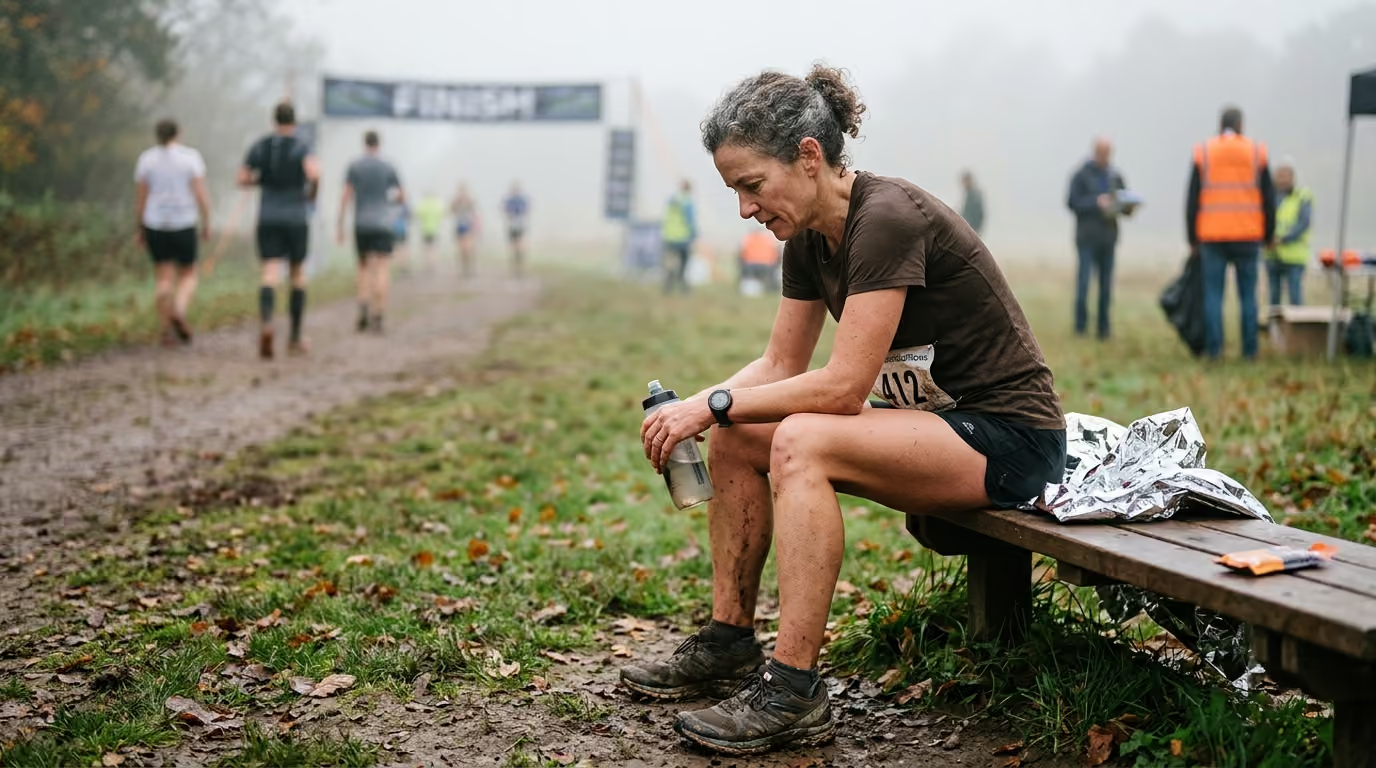

Four interconnected goal tiers help endurance athletes build resilient season plans that maintain high performance without causing injury or burnout.





An endurance goal framework is not a single finish line target written on a calendar. It is not an unyielding commitment to run a specific marathon pace regardless of weather, injury, or family illness. Instead, an endurance goal framework is an integrated operating system. It organizes your seasonal ambitions into distinct layers of control, protecting your biological capacity while directing daily training behaviors toward clear milestones.
Setting goals for an endurance season often feels straightforward during the enthusiasm of early winter planning. Athletes look at qualification standards, personal records, and dream events, circling a date and assuming willpower will handle the rest. Yet research in sports psychology and exercise physiology consistently shows that single-point outcome goals create brittle training plans. When life disrupts the schedule, an injury flares, or race day brings extreme heat, an all-or-nothing goal collapses.
This comprehensive resource establishes a multi-tiered goal architecture. It balances external results against personal standards, daily execution, and lifestyle sustainability. By structuring your season through this hierarchy, you can pursue aggressive athletic milestones while ensuring your health and daily life remain fully intact.
Consider a common scenario familiar to experienced runners, cyclists, and triathletes. You select an ambitious race early in the year, such as qualifying for a prestigious marathon or securing an age-group podium at a half-distance triathlon. In January, your motivation is peak. You calculate the required splits, post the target pace on your refrigerator, and commit to an aggressive training block.
For the first six weeks, everything progresses smoothly. You hit your threshold intervals, complete long weekend sessions, and watch your fitness scores climb on your training software. Then, reality intervenes. A major deadline hits at work, requiring late nights and early morning meetings. One of your children catches a viral illness, disrupting your sleep for four consecutive days.
Because your entire season is defined by a single outcome number, you make compromises. Rather than adjusting the volume, you wake up at four in the morning on four hours of sleep to complete a demanding tempo run. You cut corners on post-workout nutrition to get to work on time. You ignore a growing tightness in your Achilles tendon because missing a key workout feels like surrendering the race goal.
Within three weeks, the Achilles tightness becomes a reactive tendinopathy. Chronic sleep debt suppresses your immune system, leading to a persistent upper respiratory infection. By the time race week arrives, you are either under-recovered, managing a structural injury, or completely sidelined from starting. The outcome goal, which was intended to inspire excellence, ended up destroying the physical capacity needed to perform.
This failure pattern does not stem from a lack of discipline. It occurs because the athlete built a goal structure with zero elasticity. When the external result is the sole metric of success, every life disruption is viewed as an existential threat rather than normal friction. To build a season that withstands real-world stress, you must understand how human psychology and physiology respond to different types of objectives.
Sports science categorizes athletic targets into distinct classifications. The primary categories are outcome goals, performance goals, process goals, and lifestyle goals. Each category carries a different level of personal control, psychological effect, and physiological demand.
Outcome goals focus exclusively on the final competitive result of an event. Examples include placing in the top ten of your age group, winning a local gravel race, or earning a qualifier slot. Outcome goals provide direction and excitement, but they suffer from a major limitation: you cannot control what your competitors do. You can execute the race of your life, but if three world-class athletes show up in your age division, your outcome goal may vanish despite exceptional fitness.
Performance goals define an internal standard of performance independent of other competitors. Examples include running a sub-three-hour marathon, holding 250 watts for a forty-kilometer time trial, or improving your 1500-meter swim split by sixty seconds. Performance goals offer significantly more control than outcome goals because they measure your output against yourself. However, external variables like heavy wind, high ambient heat, or undulating terrain can still distort the metric.
Process goals focus on the specific technical skills, tactical decisions, and behavioral habits executed during training and racing. Examples include taking eighty grams of carbohydrates per hour on the bike, executing a three-minute dynamic warm-up before every run, or maintaining a steady breathing pattern up steep climbs. A 2024 systematic review and meta-analysis published in sports psychology literature demonstrated that process goals produce a substantially larger effect on athletic performance than outcome or performance goals alone. Process goals yielded an effect size of d = 1.36, compared to d = 0.44 for performance goals and just d = 0.09 for outcome goals.
Lifestyle goals represent the biological and environmental foundation supporting the entire system. These include sleep duration, nutritional energy availability, work boundaries, and family obligations. In the sports science literature, recovery is not viewed as passive time spent away from exercise. It is the active physiological window during which adaptation occurs. The International Olympic Committee consensus statements on Relative Energy Deficiency in Sport (REDs) and training load emphasize that inadequate energy intake and insufficient recovery lead directly to maladaptation, hormonal disruption, and chronic injury.
A 2025 meta-analytic review on goal setting in competitive athletes reinforced that specific, difficult, and personalized goals combined with short-term milestones outperform vague or purely distant targets. When you understand the science, you stop viewing goals as isolated finish-line times. You begin viewing them as an interconnected hierarchy where lifestyle protects capacity, process directs behavior, performance measures output, and outcome provides direction.
To put this research into practice, an athlete must design a structured hierarchy before registering for events. You can explore structured resources on our endurance performance portal to align your testing protocols with these standards. A resilient seasonal plan consists of four complementary tiers.
Outcome goals should never function as a binary pass-or-fail test of your athletic worth. Instead, they should serve as a compass for the season, establishing a target zone. A practical framework divides outcome goals into three tiers:
Structuring your outcomes across this spectrum preserves ambition while removing the destructive pressure of a single rigid target.
Performance goals translate your seasonal ambitions into measurable physiological benchmarks. However, a raw time or power number is meaningless without environmental context. A 3:15 marathon on a freezing, flat course requires a different physiological cost than a 3:15 marathon on a hilly, humid course.
Design your performance goals as flexible bands tied to specific conditions:
Process goals are the daily building blocks that make performance possible. They should be binary, fully controllable, and tied to specific actions. In our experience, athletes who document their process routines outperform those who rely on race-day motivation.
For years, I capped my mid ride fueling at around sixty grams of carbs per hour, convinced that taking in more would wreck my stomach. Then I read a series of recent studies on gut training and higher oxidation limits for endurance athletes. I spent a three month base phase gradually increasing my intake up to ninety grams using a mix of glucose and fructose. The difference during my next Gran Fondo was staggering. I had a late race surge that I had never experienced before, completely avoiding the usual energy crash.
Key process goals should include:
Lifestyle goals protect the biological resources required to adapt to training load. Without these guardrails, aggressive training simply accelerates breakdown. You can read more about sustainable balancing strategies in our racing and lifestyle section.
Practical lifestyle goals include:
Once the four tiers are established, you must map them across the calendar year. A common error is treating every race on the calendar with equal importance. This creates perpetual fatigue and prevents true physiological peaking.
Every event on your schedule must have an explicit role:
Goal focus shifts as you move backward from your A race through the annual training cycle:
An implementation intention is a pre-determined psychological strategy that links a specific situational obstacle to an immediate behavioral response. Research demonstrates that athletes who use structured if-then planning are far more resilient when unexpected friction occurs.
You do not wait for race-day chaos to decide how to respond. You write out explicit protocols beforehand:
As athletes cross into their forties, fifties, and sixties, biological realities alter how the body responds to training load. Aerobic capacity, maximum heart rate, muscle protein synthesis efficiency, and tissue elasticity undergo gradual shifts. An effective goal framework for masters athletes must account for these changes rather than attempting to copy the training templates of twenty-year-olds.
Recovery kinetics change with advancing age. While an athlete in their twenties might recover from an exhaustive interval session in thirty-six hours, an athlete in their fifties may require forty-eight to seventy-two hours. Setting rigid weekly mileage or hourly goals without accounting for this extended recovery curve invites overuse injuries. Masters athletes should build flexible ten-day or fourteen-day training microcycles rather than forcing workouts into a standard seven-day week.
Strength and neuromuscular retention must become primary process goals. Sarcopenia, the age-related loss of muscle mass and fast-twitch motor units, accelerates if resistance training is neglected. For older endurance athletes, completing two heavy resistance sessions per week should take equal priority to aerobic volume. Lifting heavy loads preserves tendon stiffness, improves economy, and protects against common overuse conditions like patellofemoral pain and hamstring tendinopathy.
Furthermore, masters athletes must carefully manage total life stress. Career responsibilities, adolescent or college-age children, and aging parents often converge during middle age. This creates an elevated baseline of non-training stress. Because the autonomic nervous system processes psychological and physical stress through identical pathways, an older athlete must evaluate their lifestyle capacity honestly. A goal that demands fifteen weekly training hours during a high-stress professional period is structurally flawed. True athletic longevity means aligning your ambition with your biological and systemic capacity.
Even well-intentioned athletes can fall into predictable traps when establishing seasonal targets. Recognizing these pitfalls early protects your health and keeps your training on track.
A frequent error in endurance sports is tying performance expectations directly to weight loss. Athletes often assume that lower body mass automatically produces faster race times. This approach frequently triggers low energy availability, compromised recovery, hormonal dysregulation, and bone stress injuries. The International Olympic Committee consensus guidance strongly advises athletes and coaches to de-emphasize weight targets. Instead, focus on fueling the work and supporting training adaptations through adequate caloric and carbohydrate intake. You can discover evidence-based guidelines in our nutrition and fueling library.
While process goals improve performance, setting too many creates cognitive overload. An athlete attempting to track cadence, vertical oscillation, breathing ratios, heart rate, power, and split-second fueling simultaneously will experience mental exhaustion. On race day, limit your process focus to two or three critical execution cues. Pacing discipline, steady hydration, and upper-body relaxation are usually sufficient to drive exceptional outcomes.
Modern wearables and training platforms provide sophisticated training load metrics, such as acute-to-chronic workload ratios and stress scores. While these tools offer helpful macro-level context, sports science research shows that load numbers alone cannot reliably predict injury or guarantee readiness. Relying entirely on an algorithm while ignoring perceived exertion, joint soreness, sleep quality, and mood creates blind spots. Load data should inform your subjective assessment, never replace it.
A goal is an adaptable roadmap, not an unbreakable contract. Many athletes view modifying a target due to illness, injury, or unexpected work demands as a sign of weakness. In reality, stubborn adherence to an outdated goal is a leading cause of overtraining syndrome. Periodic reviews are a mandatory feature of elite sports programming. Adjusting your target from a specific time to a strong execution effort is a mark of tactical intelligence.
To ensure your goal framework is delivering real-world results, you must monitor metrics across all four tiers of your architecture. Evaluating a season solely by your final race time leaves you with zero actionable data on why you succeeded or failed.
Track your daily execution using simple binary or percentage metrics:
Measure performance capacity at structured intervals throughout the season rather than waiting for race day:
At the conclusion of your racing season, evaluate your performance using a comprehensive scorecard. Review the outcomes achieved against your original targets, but examine the process with equal rigor. Did you execute your fueling plan under pressure? Did you maintain healthy sleep and life boundaries during peak volume? Did you finish the racing calendar healthy, uninjured, and excited to train for the following year?
When an athlete completes a season with high fitness, zero chronic injuries, and strong personal relationships, the goal architecture has succeeded. Ambition is not validated by suffering through avoidable breakdown. It is validated by sustaining high performance year after year through smart, scientific design. For more in-depth strategies on season planning, review our full training and performance articles.
Do not attempt to cram missed workouts into the following week. Resume training at a reduced volume with purely aerobic intensity for the first three to five days to assess your physiological response. If your key event is fewer than six weeks away, consider adjusting your outcome goal from a primary time target to an acceptable execution target. This prevents overstressing an immune system that is still recovering.
Combining racing with family travel is common, but it requires realistic expectation management. Traveling with family introduces altered meal timing, walking fatigue, and disrupted sleep schedules. Classify the event as an execution rehearsal or training race rather than a high-stakes performance test. Clear communication with your family regarding your race-morning schedule will keep stress levels low for everyone.
Analyze your training data from the previous twelve to eighteen months rather than relying on wishful thinking. A realistic performance goal typically represents a one to three percent improvement over your current validated baseline during a single season. If a goal requires a ten percent leap in power or pace within eight weeks, it enters fantasy territory and dramatically elevates your injury risk.
Post-race emotional slumps are common following the completion of a major milestone. Take a mandatory two-to-four-week unstructured transition phase where performance tracking, rigid schedules, and high-intensity metrics are removed. Shift your focus toward enjoyable recreational activities, low-stress movement, and social connections. Your motivation for structured goal setting will return naturally once your nervous system has fully recovered.

Follow ReEndure for practical insights on endurance training, recovery, nutrition and healthy aging. Stay connected for new articles, research led guidance and ideas to help you perform better for longer.


Read practical ideas on endurance training, recovery, nutrition and healthy aging to keep progressing for years to come.
Read the Blog