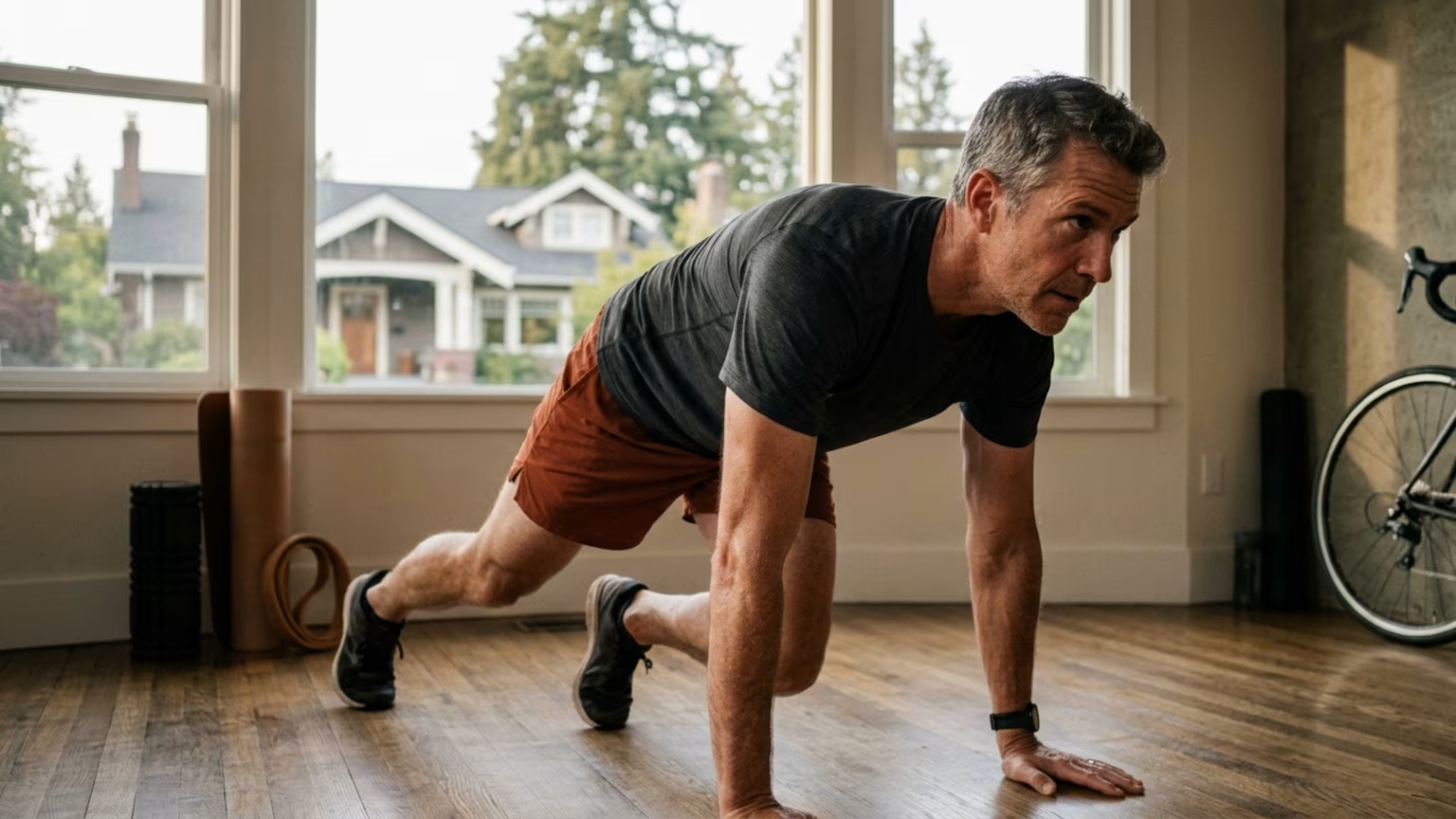

A breakdown of a recent 20-minute floor-to-stand routine from The New York Times, and how endurance athletes can use it to maintain functional mobility.





On September 9, 2026, The New York Times published a detailed feature presenting a moderate-intensity 20-minute workout for aging well. The routine is intended to improve the ability to move from the floor to standing and back again. Developed with physical therapists Ashley Katzenback and Fuhrmann, the session specifically addresses functional movement for older adults. The primary intention of the workout is to help individuals preserve practical independence throughout their lives.
The publication builds on a recent series of aging and mobility features from the same outlet. Recent coverage has included in-depth articles on balance, rotational strength, and physical therapy exercises. This pattern of reporting reflects a growing public interest in maintaining functional movement instead of relying solely on conventional gym metrics. For ambitious athletes, the routine offers a highly structured approach to preserving essential joint control and stability.
The core finding of the featured routine is that floor-to-stand transitions remain a highly practical component of long-term independence. The movement requires a person to get down to the ground and successfully rise back up with control. Fuhrmann notes that this capability directly applies to everyday activities like gardening, playing with grandchildren, or retrieving objects from beneath furniture. It represents a fundamental skill that supports a high quality of life for older adults over many decades.
Katzenback recommends practicing this floor-to-stand movement at least once daily. Rather than insisting on a completely unsupported motion from the beginning, she advises using any means necessary to complete the transition. This distinction is critically important for highly ambitious athletes to understand. The goal is to build movement control and spatial awareness safely.
The initial objective is controlled exposure to the specific movement pattern, not a maximal flexibility or strength test. This conservative approach helps individuals rehearse the specific stages required to return to a standing position. The broader rationale for this daily practice is supported by stark fall-prevention data from the U.S. Centers for Disease Control and Prevention. The CDC reports that more than one in four adults aged 65 and older falls each year.
Furthermore, experiencing a previous fall doubles the likelihood of an older adult falling again. The agency records approximately three million emergency department visits and about one million hospitalizations related to falls annually. These statistics highlight the severe consequences of losing basic functional mobility as we age. To address these significant risks, the CDC identifies lower-body weakness and difficulties with walking or balance as primary modifiable factors.
Physical, sensory, and cognitive systems must work together to maintain bodily stability over time. Laurie King, a neurology professor and co-director of the Balance Disorders Laboratory at Oregon Health & Science University, provided commentary for The New York Times. She cautioned that balance depends on multiple interacting systems. King stated that there is no single exercise that guarantees adequate stability.
King characterised individual exercises as merely a starting point for physical maintenance. She recommends choosing activities that target the various sensory systems involved in balance. This caveat argues against viewing the 20-minute routine as a complete fall-prevention program or a substitute for professional clinical assessment. A person may improve their floor transitions without adequately addressing vision, vestibular function, or reaction speed.
The 20-minute routine begins with gentle exercises on the ground. Participants progressively integrate the individual stages required to safely return to a standing position. The workout is specifically designed to develop components of strength and flexibility before requiring the full movement. By breaking the transition into manageable steps, the routine allows participants to identify specific areas of weakness safely.
Physical support is heavily encouraged during the initial learning phase of the movement. Participants should start in a stable environment and clear any floor clutter before beginning. Using a firm support like a sturdy chair, wall, or a countertop is highly recommended to control the descent. This scales the difficulty appropriately and prevents unnecessary strain on vulnerable lower body joints.
Relying on a stable support object allows the central nervous system to focus on control rather than fear of falling. The CDC specifically lists home hazards such as loose rugs, clutter, and uneven steps as significant fall risks. Ensuring a safe practice environment is just as important as the physical movement itself. Individuals should progress gradually from supported transitions to less-supported transitions only when their control is highly consistent.
Slower movement and stable support are excellent ways to scale the difficulty of the routine for any fitness level. The broader physical therapy coverage in The Times outlines several complementary movement drills. These include controlled sit-to-stand work, hip hinges, and single-leg balance. Additional drills feature core exercises and push-ups.
For balance training, the coverage recommends practicing single-leg balance for at least 30 seconds per leg each day. The CDC similarly lists chair-rise exercises among its fall-prevention resources. This reinforces the critical importance of controlled sitting and standing transitions. While chair rises are not identical to floor-to-stand transitions, they share similar mechanical demands.
While the workout is highly accessible, it is not presented as a clinically validated fall-prevention protocol. The routine simply rehearses controlled changes in body position, hip and knee flexion, and trunk control. Anyone experiencing pain, dizziness, neurological symptoms, or significant joint instability should seek individualized guidance from a qualified clinician before attempting the movements. The exercises must be modified if physical restrictions, recent surgery, or a history of falls dictate a more conservative approach.
Competitive masters athletes often preserve substantially better physical function than their sedentary peers. However, a strong history of consistent endurance training does not eliminate all age-related physiological changes. A German Aerospace Center report on competitive masters athletes outlines specific age-related declines. It states that aerobic fitness, muscle strength, and flexibility decrease over time.
The report also notes that balance and vascular function typically decline with age. This gradual decline occurs even though many older athletes maintain high levels of athletic performance, cognitive health, and well-being. The DLR report places the entire discussion in a clear sports science context. Endurance training provides distinct protective benefits, but it leaves some minor gaps in structural resilience.
A 2026 scoping review reported that lifelong sports participation was associated with a lower prevalence of confirmed sarcopenia. This prevalence was lower than that seen in community-dwelling older populations. The same review found that endurance training was linked to low adiposity, superior aerobic capacity, and favorable muscle oxidative characteristics. However, it noted that this training did not fully prevent reductions in muscle mass, motor-unit loss, or muscular power.
These physical properties are crucial for arresting a fall quickly. For athletes between the ages of 35 and 65, a massive aerobic engine does not necessarily guarantee good floor mobility. The ability to recover safely from an unexpected stumble requires specific neuromuscular coordination. Steady-state running or cycling cannot provide this vital coordination alone.
This means older athletes remain slightly vulnerable to specific functional declines if they only focus on aerobic capacity metrics. Endurance athletes should never assume that fitness in one domain automatically transfers to floor mobility. This is precisely why ambitious athletes should view daily floor-to-stand practice as a vital movement quality habit. It serves as a moderate-intensity session that rehearses controlled changes in body position and pushing through the limbs.
You can incorporate it seamlessly into your recovery and mobility routines on lighter training days. The routine demands a distinct focus on hip and knee flexion while maintaining balance during complex transitions. Practicing these movements regularly keeps the relevant neural pathways highly active and responsive. It is crucial to note that the workout has not been shown to improve race times or reduce injury rates directly.
Do not treat this daily practice as a maximal flexibility test or a strenuous strength workout. Instead, use the movements to assess asymmetry, joint control, and overall physical comfort. A pronounced difference between sides, pain during the descent, or an inability to control the lowering phase is important feedback. This functional feedback is often more valuable than the total number of repetitions you manage to complete.
Athletes should integrate these moderate-intensity movements carefully to avoid generating excessive muscular fatigue. A hard interval session or a demanding long run might not be the best time to challenge your neurological balance systems. Proper timing ensures that the mobility work successfully complements your training rather than detracting from your physical recovery. Adjust the use of support during the floor-to-stand transitions depending on your daily levels of training fatigue, soreness, and injury status.
Athletic status can sometimes create a sense of false confidence regarding fundamental physical skills. Recognizing that balance and mobility require deliberate practice is a highly vital step in longevity training. Combining targeted movement sessions with aerobic volume provides a much broader foundation for healthy aging. This comprehensive approach helps athletes protect against functional physical declines while remaining highly competitive in their chosen events.
Daily floor-to-stand practice offers ambitious masters athletes a practical, moderate-intensity method to maintain the joint control and functional mobility required for a lifetime of healthy performance.

Follow ReEndure for practical insights on endurance training, recovery, nutrition and healthy aging. Stay connected for new articles, research led guidance and ideas to help you perform better for longer.


Read practical ideas on endurance training, recovery, nutrition and healthy aging to keep progressing for years to come.
Read the Blog