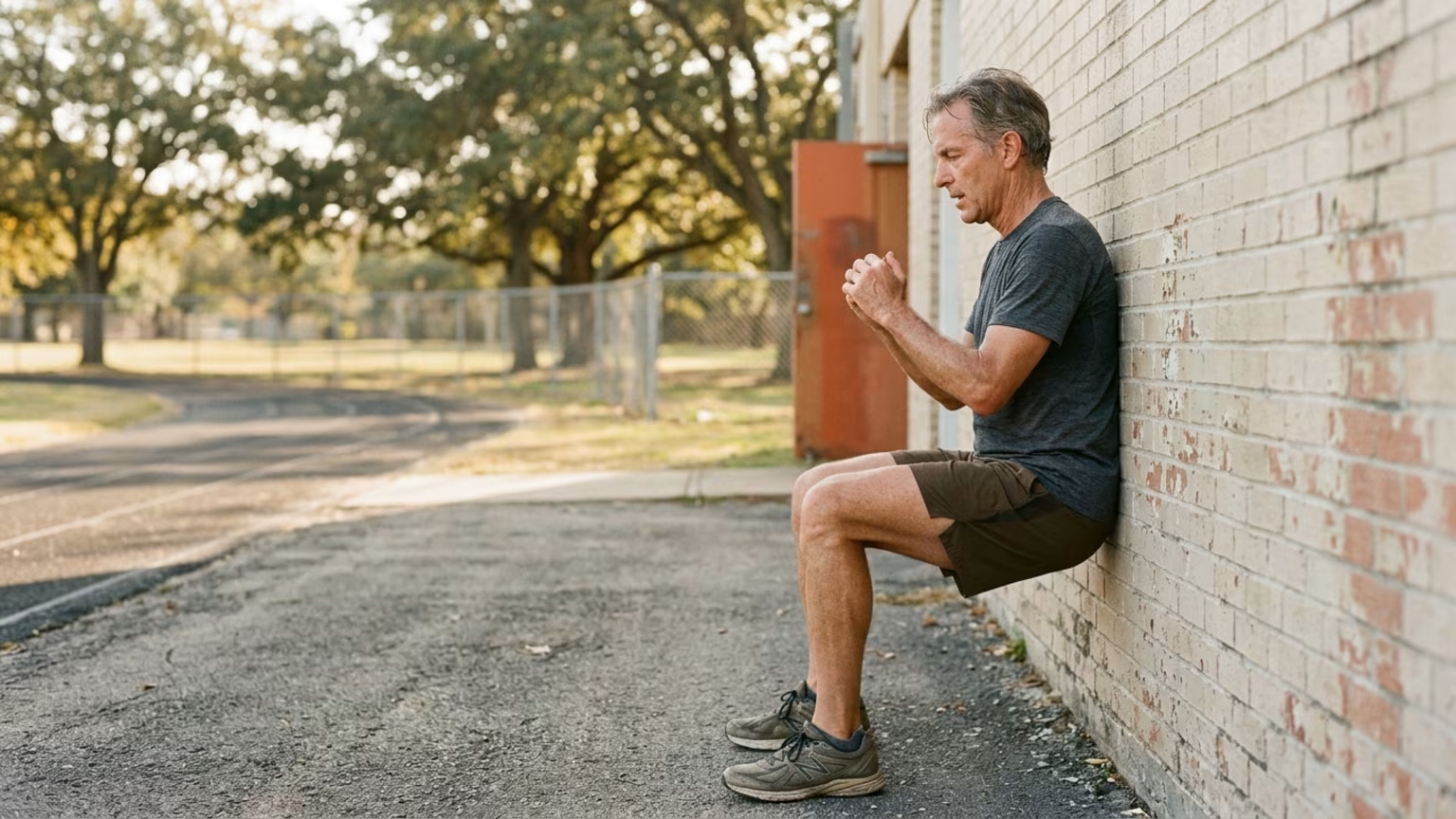

A new Men’s Journal feature outlines three simple wall assisted exercises to help older adults preserve muscle mass, combat sarcopenia, and maintain balance.





On September 17, 2026, Men’s Journal published a feature detailing three body weight exercises designed to support lower body strength and balance. The routine specifically targets the natural loss of muscle mass that older adults face. This is not a complex gym program requiring heavy machinery or specialized equipment. It is a highly practical sequence built entirely around wall assisted movements.
Ambitious endurance athletes can easily adapt these concepts to maintain joint stability and support long term training consistency. The publication outlines a simple protocol proposed by movement expert Jay Campbell. The feature identifies Campbell as a men’s physique champion, a five time international best selling author, and the chief strategy officer of BioLongevity Supplements. His guidance centers on the sobering reality of human aging and muscle retention.
Adults naturally lose approximately three to eight percent of their muscle mass per decade after age 30. This rate of muscle loss accelerates noticeably after age 60. To counteract this physical decline, Campbell recommends three specific exercises that use a wall for external stability. The prescribed movements are wall sits, wall assisted single leg stances, and wall supported reverse lunges.
According to the feature, completing this entire routine takes approximately five minutes. Campbell notes that these exercises can be added to a home or gym schedule a few times per week. The routine provides an accessible entry point for adults looking to preserve functional muscle tissue. The wall sit serves as an isometric exercise that heavily involves the quadriceps, glutes, and core.
The feature directly connects this isometric hold to the functional leg strength required for rising from a chair or toilet. Next, the wall assisted single leg stance trains the hip and ankle stabilizing muscles. Finally, the wall supported reverse lunge helps develop the controlled single leg strength needed to lower toward the floor safely. Campbell argues that the wall provides crucial support for anyone concerned about balance.
This external structure allows individuals to train strength and control without experiencing extreme instability. The stable surface reduces the immediate need for a spotter during lower body movements. By eliminating the fear of falling backwards, athletes can focus entirely on proper muscle recruitment and joint alignment.
Many runners and cyclists assume their aerobic miles provide enough lower body strength to maintain muscle mass. The physiological reality is quite different. The constant repetitive motion of endurance sports does not build the dynamic strength required to counteract natural muscle loss. Aerobic training simply cannot replace dedicated resistance work when it comes to preserving structural integrity.
Hitting my forties brought a harsh reality check. The track workouts were not getting slower, but the days after them felt significantly heavier. Instead of forcing my old Tuesday and Thursday intensity schedule, I looked at the data on Masters athletes and muscle protein synthesis. I pushed my second hard session to Friday, allowing an extra forty eight hours of low intensity recovery.
My total weekly volume stayed the same, but the quality of my intervals skyrocketed. During those two extra recovery days, I needed low friction ways to maintain tissue health without adding systemic fatigue. A five minute wall routine fits seamlessly into that exact recovery window. It requires zero travel time to a gym and asks very little of an already taxed central nervous system.
These practical exercises for core stability keep the muscles engaged while the primary endurance engines recover.
You should view these three wall exercises as a movement minimum rather than a complete replacement for heavy lifting. They offer a supplemental stimulus that complements your primary training schedule. The wall sit provides an isometric demand that is entirely different from the steady concentric contractions of running or cycling. Isometric holds force your tissues to sustain tension without changing length.
This builds excellent resilience in the tendons and muscles around the knee joint. The wall assisted single leg stance addresses a glaring weakness for many masters endurance athletes. Endurance sports happen on one leg at a time, yet athletes rarely train lateral hip and ankle stability directly. Using the wall removes the immediate fear of falling and allows you to practice sustained single leg control.
This aligns seamlessly with broader long term injury prevention strategies for older active adults. You can gently challenge your neuromuscular coordination without risking a catastrophic joint tweak on a recovery day. Similarly, the wall supported reverse lunge builds essential confidence in deep ranges of motion. You can manually control the lunge depth based on how your knees and hips feel on any given afternoon.
Do not treat this short sequence as a medical treatment or a clinically proven cure for advanced frailty. If you have significant joint pain or a diagnosed condition, you must seek professional medical advice before starting. For the healthy aging athlete, this protocol serves as a simple bridge to better training consistency and healthy aging. It is an incredibly accessible entry point that keeps your structural foundation resilient.
The broader context of healthy aging requires a mix of cardiovascular effort and structural maintenance. The World Health Organization clearly outlines the importance of diverse movement patterns for long term physical independence. WHO guidance emphasizes balance oriented or multicomponent activity for older adults with poorer mobility, particularly to help prevent falls. While active masters athletes might not struggle with basic mobility, they still face the same age related decline in balance.
Endurance training alone does not qualify as a multicomponent activity. Cycling primarily locks the body into a fixed sagittal plane while running demands highly repetitive linear force production. Neither sport asks the athlete to move laterally or stabilize against unpredictable external forces. Adding a wall assisted routine introduces a much needed secondary stimulus to your weekly schedule.
It forces the nervous system to practice stability in a safe and controlled environment. The beauty of this specific Men’s Journal routine is its incredibly low barrier to entry. Older athletes frequently skip strength work because a full gym session feels too daunting after a long weekend run. A wall is available in every single home, office, or hotel room.
You can perform these exercises in your regular clothes while waiting for your morning coffee to brew. This accessibility dramatically increases the likelihood of long term adherence. Consistency always outperforms intensity when it comes to fighting off sarcopenia and joint stiffness. Doing five minutes of focused isometric work three times a week yields excellent physical dividends.
The wall assisted single leg stance and reverse lunge quietly rebuild the neuromuscular control that aging naturally erodes. Endurance athletes must actively combat the slow creep of sarcopenia if they want to race well into their later decades. We cannot rely purely on our cardiovascular fitness to protect our joints and maintain our muscle mass. A minimal investment of five minutes a few times per week provides a high return on movement quality.
Wall assisted strength exercises provide a practical and highly effective way for aging athletes to maintain essential lower body stability without disrupting their primary endurance training.

Follow ReEndure for practical insights on endurance training, recovery, nutrition and healthy aging. Stay connected for new articles, research led guidance and ideas to help you perform better for longer.






Read practical ideas on endurance training, recovery, nutrition and healthy aging to keep progressing for years to come.
Read the Blog