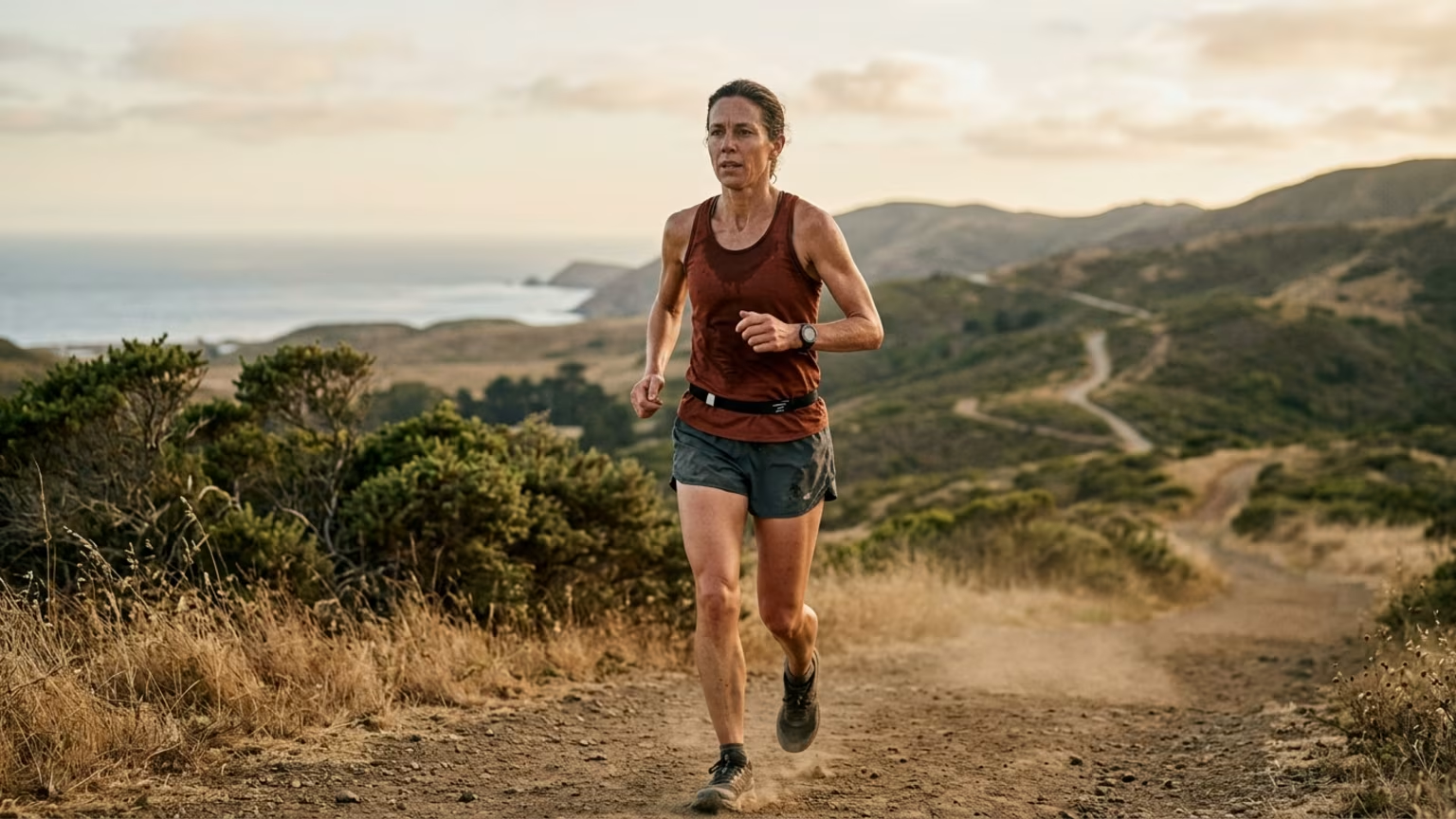

An analysis of GPS watch performance during Ben Dhiman's 2026 UTMB win. Learn why elite equipment choices require independent testing for older athletes.





Elite athlete equipment choices tell us very little about what actually caused a race victory. We watch a runner cross the finish line and immediately credit the watch on their wrist. This assumption fundamentally misinterprets the relationship between technology and human endurance. Ben Dhiman won the 2026 UTMB in a recorded time of 18:16:29 while wearing an Amazfit Cheetah 2 Ultra.
Wearable data validation is the process of confirming that a GPS device accurately measures physiological metrics under real world stress. The5krunner notes that UTMB race timing systems produced Dhiman's official time rather than the watch on his wrist. A device being present on a winning athlete does not automatically prove it has flawless battery life or reliable navigation. True validation requires independent testing against known variables in an objective manner.
During his victory, Dhiman wore the Amazfit Cheetah 2 Ultra, a trail watch priced at £599/€599. The5krunner reports that Amazfit added him to its athlete roster in July 2026. This sponsorship context is vital when we interpret the massive amount of training and race data released to the public. During his runner up finish at the 2025 UTMB, Dhiman used a COROS Apex 2 instead.
The training data leading up to the race reveals a focus on massive volume over equipment changes. The5krunner reports 107 hours of training in January, 95 hours in February, and 105 hours in March. Over his final 12 weeks, Dhiman increased his training volume to be 30% higher than the comparable period in 2025. During this same window, he cut his high intensity sessions in half.
Endurance work constituted 80% of Dhiman's Training Balance in July. One major preparation effort covered the route from Chamonix to Courmayeur, spanning 75.17 km with 4,519 metres of elevation gain. He finished that outing in 8:18:14 with an average heart rate of 134 beats per minute. This long term preparation strategy likely contributed more to his success than any single piece of hardware.
During the UTMB race itself, the watch recorded an average pace of 6:27 per kilometre and a grade adjusted average pace of 4:51 per kilometre. The device estimated 9,911 calories burned across the entire effort. Heart rate data showed a maximum heart rate of 185 bpm, exceeding 170 bpm four times during the first eight hours. Dhiman steadily built his advantage, leading by 19 minutes at 80 km, 22 minutes at 104 km, and 28 minutes at 127 km.
Despite falling heavily with about 10 km remaining, Dhiman finished more than 30 minutes ahead of the field. AS reports his finishing time was approximately 18 hours and 16 minutes, with Baptiste Chassagne finishing second in 18:47. Caleb Olson completed the podium about one minute later. However, no wearable metric captures the true significance of a late race fall or explains how an athlete recovers from it.
The course itself adds complexity to any data analysis. Thunderstorms delayed the start by two hours, and organizers removed the Pyramides Calcaires section from the route. Because of these alterations, organizers do not recognize the 18:16:29 finish as an official course record. For context, RunMotion lists François D’Haene’s 19:01:54 from 2017 as the record, while others cite Jim Walmsley’s 19:37:43 from 2023.
Dhiman maintained an impressive output over the rugged mountain terrain, recording an average pace of 6:27 per kilometre. The grade adjusted average pace of 4:51 per kilometre offers a clearer picture of his physiological effort on steep ascents. These metrics give ambitious runners a benchmark for what elite pacing looks like across an eighteen hour effort. However, runners must remember that grade adjusted pace algorithms vary significantly between different hardware platforms.
Older endurance athletes must rely on accurate metrics to balance ambitious goals with healthy aging. Unverified physiological data can easily mislead a veteran runner into making poor training decisions. We often see athletes using wrist based calorie estimates to manage their mid race nutrition without independently validating those numbers. Relying on an unverified 9,911 calories burned estimate could lead to dangerous fueling deficits in the mountains.
The reported training logs highlight a crucial lesson for older athletes focused on longevity. By logging 107 hours in January and heavily favoring endurance work in July, Dhiman built an aerobic foundation capable of withstanding massive trauma. Cutting high intensity sessions in half during the final twelve weeks likely preserved his nervous system and prevented overtraining injuries. This distribution aligns with cardiovascular health protocols that prioritize sustainable volume over aggressive, risky speed work.
Validating your inputs completely changes how you approach endurance events. "For years, I capped my mid ride fueling at around sixty grams of carbs per hour, convinced that taking in more would wreck my stomach. Then I read a series of recent studies on gut training and higher oxidation limits for endurance athletes. I spent a three month base phase gradually increasing my intake up to ninety grams using a mix of glucose and fructose."
"The difference during my next Gran Fondo was staggering. I had a late race surge that I had never experienced before, completely avoiding the usual energy crash." When athletes align verified scientific principles with accurate tracking, they can rewrite their physical limitations. This philosophy applies heavily to how we should view GPS watch performance during extreme endurance challenges.
The5krunner does not provide battery capacity figures, advertised GPS runtime, or starting charge details for the Amazfit Cheetah 2 Ultra. The available evidence does not confirm whether the device lasted the full duration or if Dhiman used a reduced power mode. Athletes choosing a device for long mountain events should verify the runtime in their exact intended GPS configuration. Wearing a watch during an eighteen hour race does not automatically constitute a documented eighteen hour battery test.
Mountain races demand reliable navigation systems when visibility drops and fatigue impairs cognitive function. The removal of the Pyramides Calcaires section forced athletes to adapt their mental models of the course on short notice. A watch must clearly communicate these deviations without causing the runner to doubt their location. Since the available coverage does not detail Dhiman’s navigation workflow, we cannot assume the device provided frictionless guidance during those critical moments.
Navigation usability requires similar scrutiny before a major mountain effort, as consistent mapping features are crucial for safety. The report does not state whether Dhiman followed downloaded maps, used breadcrumb navigation, or relied on turn alerts. You should test route following features locally on complex terrain, especially under heavy tree cover or during poor weather. True confidence comes from practicing with the interface when you are fatigued and moving through unfamiliar environments.
Athletes must also independently cross check their heart rate metrics against a reliable chest strap. The5krunner notes maximum heart rates and prolonged periods above 170 bpm, but it does not validate these against medical grade instruments. Devices can suffer from sensor dropouts during technical descents or cold weather conditions. If you rely on heart rate to maintain a sustainable long term performance strategy, verify your wrist readings during rigorous training sessions first.
Prepare for unexpected course alterations by carrying official route information rather than relying strictly on digital watch data. The 2026 UTMB modifications show that historical splits do not always map cleanly onto the current race day reality. Focusing on reliability over an extensive feature list ensures your core data remains accessible when conditions deteriorate. Ultimately, a watch is a tool to support your fitness, not a replacement for fundamental physical preparation.
We look at the winner crossing the line and want to buy the gear on their wrist, but elite equipment choices matter far less than rigorous personal testing and consistent physical preparation.

Follow ReEndure for practical insights on endurance training, recovery, nutrition and healthy aging. Stay connected for new articles, research led guidance and ideas to help you perform better for longer.


Read practical ideas on endurance training, recovery, nutrition and healthy aging to keep progressing for years to come.
Read the Blog