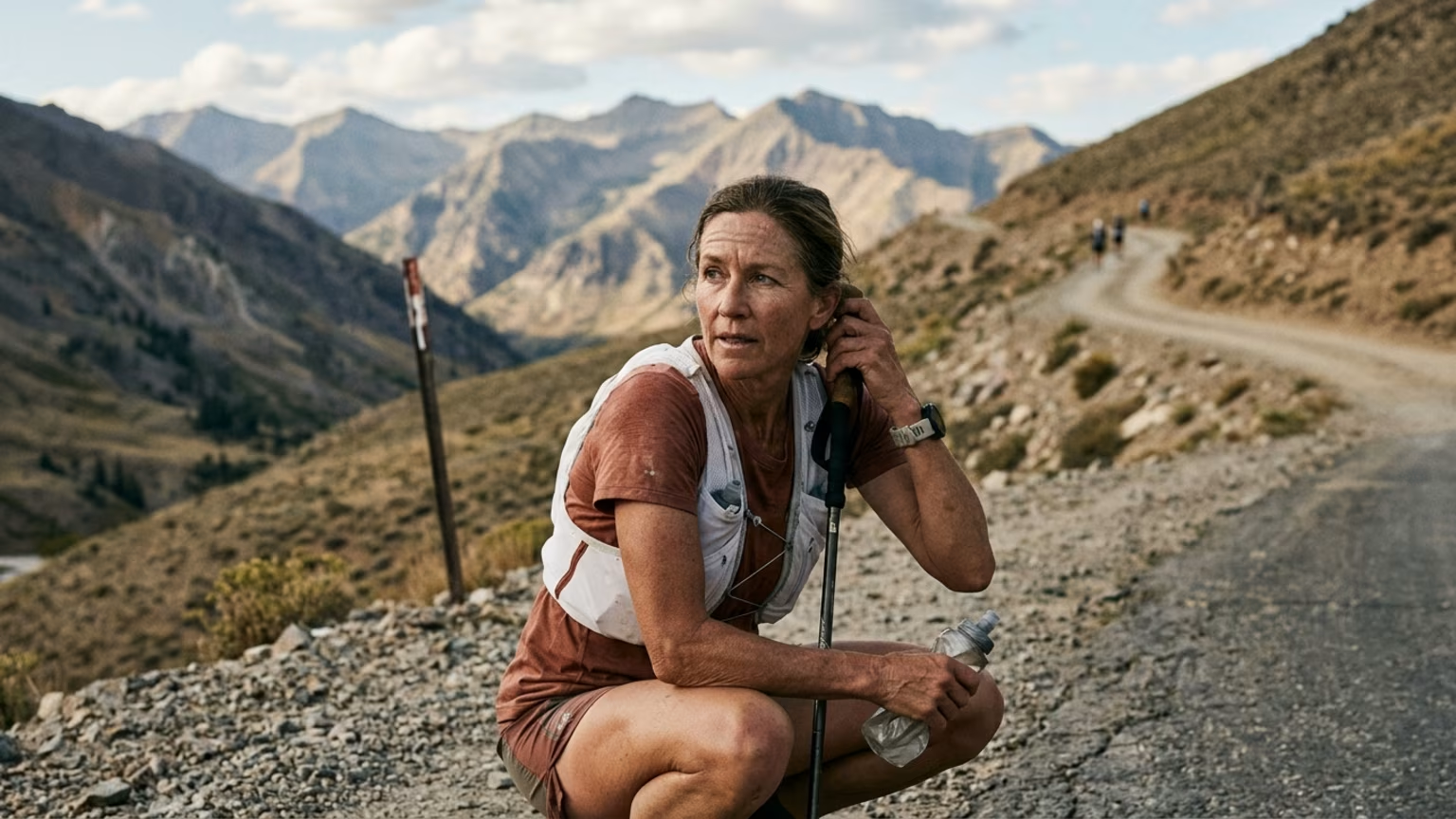

Amritsar-based athlete Kanwaldeep Kaur conquered the 72-kilometer Khardung La Challenge while balancing menopause, a demanding career, and family obligations.





On October 1, 2026, Khalsa Vox published a detailed profile on Amritsar-based physiotherapist and nutritionist Kanwaldeep Kaur. The report documented her successful completion of the 72-kilometer Khardung La Challenge. This gruelling event took place on September 11, 2026. The Ladakh administration confirmed that 359 participants took part in the demanding high-altitude race.
The profile provided a rare and practical look into the daily habits of a midlife ultra-distance runner. It specifically detailed how she managed her athletic preparation alongside her career and her family responsibilities. This report stands out because it avoids extreme narratives and focuses instead on consistent daily choices. It highlights how an amateur athlete navigated the very real physiological shifts associated with aging and menopause.
The primary conclusion from the reporting is that extreme endurance achievements do not require unbalanced lifestyles. The profile showed that Kaur reached the finish line of a massive mountain ultra by focusing strictly on foundational health practices. She explicitly stated that she relied on basic habits rather than any complex methods or shortcuts. Her approach prioritized high-quality sleep, consistent hydration, and simple home-cooked meals.
She combined this quiet consistency with a deep awareness of how menopause changed her bodily needs. Instead of ignoring these hormonal changes, she actively adapted her approach to prioritize recovery and maintain her muscle mass.
The physical demands of the Khardung La Challenge cannot be overstated. According to the event profile, the race course begins at an elevation of nearly 3,975 metres. Runners then face a massive climb up to the Khardung La pass. The Ladakh administration officially places the Khardung La pass at a staggering 17,618 feet above sea level.
After cresting this peak, participants must manage a punishing descent toward Leh. In total, athletes spend roughly 60 kilometers of the 72-kilometer course running at elevations above 4,000 metres.
The Khardung La Challenge is contested at an incredibly high level, making the environmental conditions even more daunting. According to reporting from the Hindustan Times, the 2026 men’s winner, Jigmet Stobdan, finished the race in a blistering 6:00:03. The women’s winner, Disket Dolma, crossed the finish line in 7:03:26. While the available coverage does not provide Kaur’s final finishing time, her objective was clearly centered on personal resilience.
Navigating environmental challenges in endurance racing at this scale requires a massive aerobic base. Kaur did not build this resilience overnight. Her successful finish was the result of nearly 15 years of consistent running and yoga practice. Over that decade and a half, she slowly transitioned from shorter daily runs to ultramarathons.
Prior to taking on the high-altitude Ladakh course, she had built significant structural durability. She had previously finished a plains marathon in under five hours and completed a 50-kilometer ultramarathon in under six hours.
The most striking aspect of the profile is the highly realistic training structure Kaur utilized. The report states that she generally maintained a moderate weekly running volume of 40 to 45 kilometers. Many ultra-distance plans demand double this volume, but Kaur focused on consistency over massive weekly mileage. She then executed a period of more intensive preparation between May and August to get ready for the September race.
This four-month window allowed her to safely adapt summer mileage and pacing structures to meet the specific demands of a mountain ultra. Fitting this intensive summer block into a working life required significant discipline and family coordination. As a holistic health practitioner, Kaur had to shape her training around her professional schedule. This logistical reality meant that some of her training sessions began as early as 3 a.m.
Her family played an active role in supporting these early morning efforts. Her 15-year-old son occasionally accompanied her during her sessions, while he and her husband tracked her location and overall progress. This support system provided safety and accountability during the darkest hours of her preparation.
The race execution itself required careful pacing and a willingness to accept physical suffering. Despite her years of preparation, the extreme altitude and distance took a heavy toll. Kaur described the final descent toward Leh as one of the hardest parts of the entire event. Severe exhaustion had set in by this late stage of the race.
She relied heavily on listening to her body to safely navigate the steep downhill sections while managing immense muscular fatigue.
For endurance athletes over 35, this story shifts the narrative away from physical decline and toward intelligent adaptation. Aging requires athletes to change how they manage physical stress, but it does not require them to lower their athletic ambitions. Kaur proved that physiological transitions can be managed through disciplined lifestyle choices. We can extract several clear and actionable insights from her approach to training, fueling, and recovery.
The emphasis on muscle maintenance is incredibly vital for aging athletes. Kaur specifically noted that menopause made recovery, nutrition, and maintaining muscle mass major areas of attention for her. Hormonal shifts during midlife can accelerate muscle loss and make connective tissues more vulnerable to injury. Ambitious athletes must counter this by integrating strong recovery and mobility practices into their weekly routines.
Furthermore, consuming adequate protein and prioritizing strength preservation become just as important as logging aerobic miles.
Many amateur athletes believe that successful ultramarathon preparation requires exhausting, high-volume running weeks. This profile challenges that assumption by showing the power of a moderate, consistent base. By holding her weekly mileage around 40 to 45 kilometers, Kaur left room for her body to recover and adapt. This moderate volume strategy prevents the chronic overuse injuries that often derail older runners.
It also leaves athletes with enough energy to perform well in their professional and family roles. When the event approached, she strategically increased her intensity for a focused four-month block rather than grinding all year.
Endurance sports can often become deeply isolating, especially when training for ultra-distance events. Kaur’s reliance on her husband and son for tracking and early morning accompaniment highlights a crucial lesson for veterans. Ambitious training should integrate your family rather than alienating them. Transparent communication about training schedules helps maintain balance in the household.
Using tracking technology also ensures physical safety during those unavoidable pre-dawn training sessions.
Mental preparation plays an equal role alongside physical conditioning when tackling extreme mountain events. Climbing a mountain pass of over 5,000 metres requires immense psychological resilience. Kaur emphasized the importance of listening to the body rather than stubbornly pushing toward catastrophic failure. Older athletes must develop the maturity to adjust their daily efforts based on how they feel.
Perhaps the most motivating takeaway is how athletic community shapes our perception of aging. Kaur mentioned that meeting female runners in their mid-60s at the Ladakh Marathon deeply inspired her. Seeing these older athletes thrive at high altitude prompted her to consider returning for the massive 122-kilometer race the following year. While she noted this is merely an aspiration and not a confirmed entry, the psychological shift is profound.
Exposure to successful, older athletes completely changes what we believe is physically possible in our later decades.
Ambitious midlife athletes can conquer extraordinary endurance challenges not by fighting the natural aging process, but by rigorously adapting their recovery, nutrition, and daily training habits to support long-term physiological health.

Follow ReEndure for practical insights on endurance training, recovery, nutrition and healthy aging. Stay connected for new articles, research led guidance and ideas to help you perform better for longer.


Read practical ideas on endurance training, recovery, nutrition and healthy aging to keep progressing for years to come.
Read the Blog