
Learn how Caltech's new continuous sweat sensor for lipid profiling compares to traditional blood testing for masters endurance athletes and healthy aging.





Look around the start line corrals of any major marathon, and you will see a distinct split in how athletes handle their health data. Half the pack relies entirely on annual lab tests to gauge their internal fitness. The other half swears by continuous wearable data to track every possible biometric metric. Masters athletes constantly seek better ways to monitor their cardiovascular health and metabolic responses.
Aging requires precise tracking to maintain optimal longevity and performance. The tension usually lies in how we choose to gather that physiological data. The choice often comes down to a proven clinical snapshot versus the promise of continuous monitoring. Both approaches offer unique advantages for endurance training.
The standard medical approach relies on an isolated blood draw to measure cholesterol and triglycerides directly. This method provides a highly accurate measurement at a particular point in time. Medical professionals use these specific results to make formal diagnoses. They also use them to guide specific treatment decisions safely.
Direct blood sampling remains the undisputed foundation of cardiovascular risk assessment. When an athlete visits a clinic for a lipid panel, the lab directly counts the lipid concentrations circulating in the bloodstream. There is no need to estimate the values through secondary fluids or complex algorithms. The medical community implicitly trusts these direct readings for their diagnostic reliability.
For athletes over 35, regular blood tests offer a clear baseline for metabolic health. They provide the concrete numbers needed to evaluate the impact of a consistent training regimen. If a reading comes back abnormally high, doctors rely on this direct sample to prescribe targeted lifestyle adjustments. The results carry the weight of decades of rigorous clinical validation.
Cholesterol and triglycerides serve as critical markers for long-term cardiovascular health in active adults. While endurance athletes often possess favorable lipid profiles, aging naturally alters how the body metabolizes fats and carbohydrates. Standard laboratory panels directly measure high-density lipoproteins, low-density lipoproteins, and total triglycerides. This exact composition dictates many of the long-term health risks associated with the aging process.
Doctors rely on this historical method because blood offers a highly stable testing environment. Blood volume remains relatively constant compared to the highly variable nature of sweat production. When measuring lipids directly from a vein, technicians do not have to account for recent exercise intensity or environmental temperature. This inherent stability makes the traditional lipid panel the gold standard for medical diagnostics.
However, this established methodology does have practical limitations for ambitious athletes. An isolated blood test provides a static picture of a highly dynamic biological system. It cannot show how cholesterol or triglyceride levels fluctuate around specific meals or long endurance sessions. You get a reliable snapshot of your health, but you miss the ongoing biological movie.
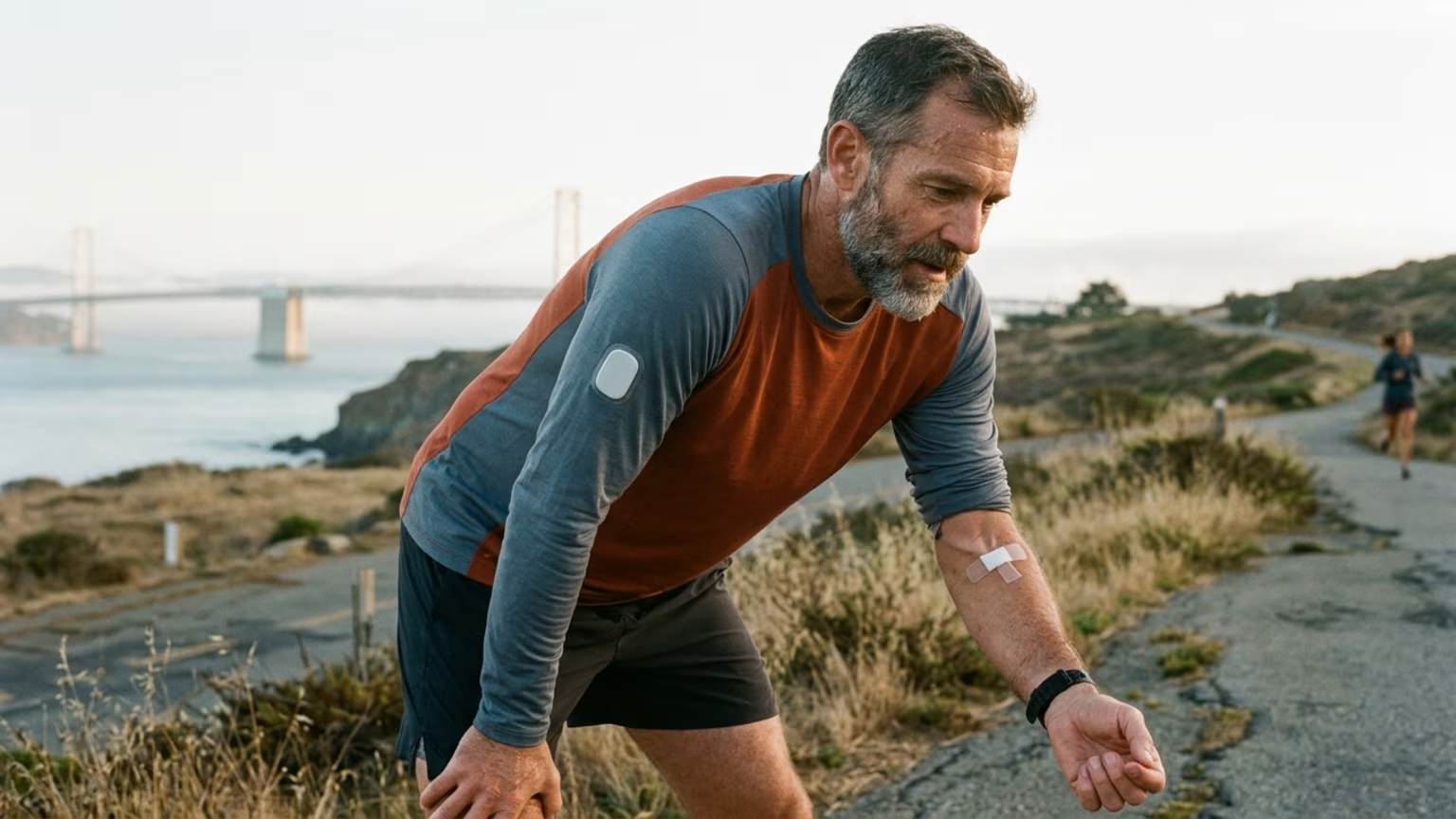
A new approach to tracking metabolic health focuses on continuous monitoring through sweat. Researchers led by Wei Gao at the California Institute of Technology developed a wearable epidermal patch designed to measure cholesterol and triglycerides in sweat. The work was published in Nature Sensors under the title "Non-invasive continuous lipid profiling via cofactor-refreshing cascading enzymatic reactions and causal machine learning." This device aims to track time-varying lipid behavior continuously rather than relying on a single blood draw.
The patch relies on a highly sophisticated chemical process to achieve these measurements. The sensor uses dual-step and cascading enzymatic reactions to detect sweat lipids accurately. The researchers included a polymeric cofactor-releasing module made from polypyrrole ATP nanostructures. This specific module replenishes adenosine triphosphate as sweat reaches the sensor.
Wearable biochemical sensors have traditionally faced a severe tension between convenience and analytical complexity. Measuring a single molecule once is much easier than maintaining a stable enzymatic reaction over many hours. The Nature Sensors paper directly addresses that specific problem with its unique cofactor-refreshing architecture. This design represents a major leap forward for longer-term biochemical sensing outside of clinical settings.
This ATP-refreshing system solves a major practical problem in wearable sports biochemistry. It supports longer-duration sensing by maintaining the necessary enzymatic chemistry without degrading. Secondary coverage reports that the triglyceride-sensing function continued for more than 20 hours during testing. This duration represents a massive technical achievement for continuous biomolecular monitoring outside of a lab.
The implications of a reliable 20-hour triglyceride sensor are massive for exercise physiology. Endurance athletes already use wearables to track continuously changing variables like heart rate, power, and temperature. Adding continuous cholesterol and triglyceride tracking would expand the type of biochemical information researchers can collect. It opens the door to studying how the human body fuels itself during ultra-endurance events.
The wearable does not simply read sweat concentrations and assume they equal blood concentrations directly. Instead, the researchers combine the sweat measurements with a causal machine-learning model intended to estimate blood lipid levels. This algorithmic approach accounts for complex physiological factors that can alter the relationship between sweat and blood. Reported model inputs include critical variables such as body-mass index, sex, and sweat volume.
Initial evaluations show significant promise for dietary and lifestyle observation. The research team tested the patch during dietary challenges and routine daily activity. The explicit goal was to observe changing lipid responses rather than collecting only one static measurement. Coverage reports that the device captured different post-meal responses associated with different macronutrient compositions.
Older endurance athletes need a practical framework for assessing these two monitoring strategies. Traditional blood testing clearly wins for medical confirmation and formal clinical diagnosis. The new sweat patch currently exists strictly as a preclinical research tool rather than an approved consumer product. The IPM Analytics headline covering the Caltech research explicitly cautions that blood tests are "not obsolete yet."
The Caltech team described their human testing as preclinical testing involving exactly 24 participants. A sample of this size serves as an early validation study rather than definitive proof of broad accuracy. It does not establish performance across the diverse range of ages, body compositions, and training conditions seen in endurance sports. Athletes must remember that sweat and blood are simply not interchangeable measurements.
The causal machine-learning model attempts to bridge the gap between sweat data and blood reality. Wei Gao noted that combining sweat measurement with the causal machine-learning model can predict blood lipid levels "with high accuracy." However, the accessible coverage does not provide specific error margins or strict diagnostic-agreement thresholds. Athletes should wait for independent validation in larger populations before trusting these estimates for serious health decisions.
Continuous sensing remains conceptually attractive for longevity tracking and athletic monitoring. Repeated measurements could eventually help athletes understand how their bodies respond to long training sessions and recovery routines. Detecting distinct post-meal lipid patterns could theoretically inform highly individualized nutrition strategies in the future. But the available results do not yet establish whether those responses can safely guide practical training decisions.
Furthermore, endurance training introduces unique environmental variables that complicate sweat-based sensing. Athletes experience changing sweat rates, prolonged physical motion, and significant hydration shifts during intense efforts. The current sources do not establish sensor accuracy during heavy dehydration, hot-weather racing, or extended outdoor competition. Until more data emerges, the patch remains a potential research platform rather than a proven cardiovascular-monitoring tool.
The broader trend in sports technology leans heavily on these types of algorithms. Sensors increasingly depend on software to translate indirect biological signals into estimates of familiar clinical variables. This creates an additional validation requirement for any new athletic wearable. A model might perform reliably in its initial development group while behaving erratically in older athletes with different training statuses.
Endurance athletes must carefully distinguish between established diagnostic tests and promising monitoring technology. Traditional blood panels remain an absolute necessity for anyone tracking their metabolic health over a lifespan. They provide the verified clinical data required to manage cardiovascular risk accurately and safely. You simply cannot replace a doctor and a standardized laboratory with an unapproved wearable device.
The Caltech sweat patch points toward an incredibly exciting future for sports science. The ability to monitor time-varying lipid behavior could eventually transform how we understand metabolic responses to exercise. It offers a glimpse into a future where biochemical tracking matches the continuous nature of modern heart rate monitors. Future research will likely expand on these initial 24 participants to test real-world endurance applications.
For now, rely on your annual blood work to confirm your foundational health metrics. Watch the development of continuous biomolecular sensors with informed optimism and scientific patience. True performance longevity comes from blending verified clinical data with smart, consistent daily habits. Reendure will continue monitoring these scientific advancements as they transition from the laboratory to the field.

Follow ReEndure for practical insights on endurance training, recovery, nutrition and healthy aging. Stay connected for new articles, research led guidance and ideas to help you perform better for longer.




Read practical ideas on endurance training, recovery, nutrition and healthy aging to keep progressing for years to come.
Read the Blog