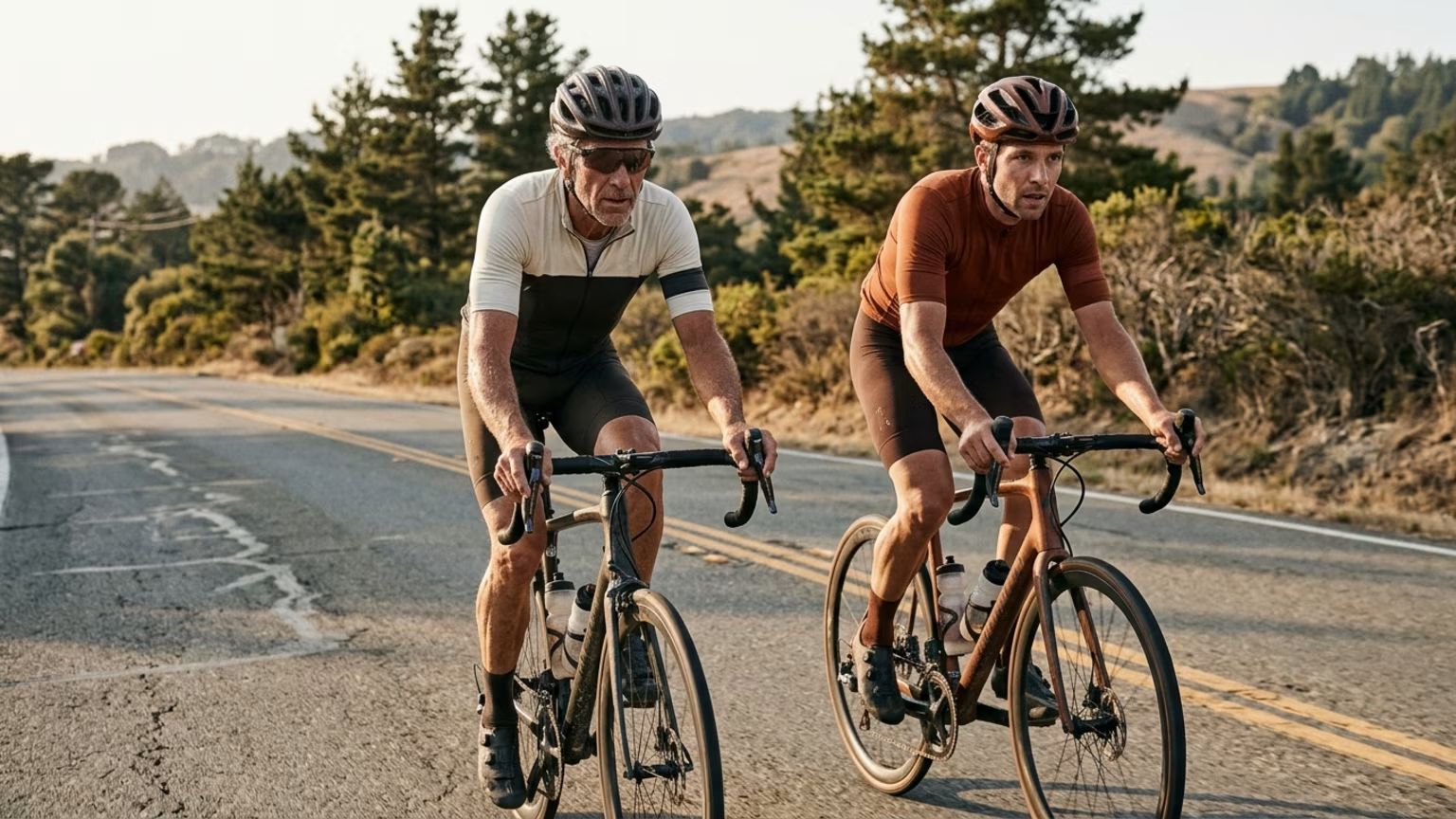

A cycling study found comparable distances in older and young trained men. We explain the results, study limits and implications for athletes over 35.





A self-paced cycling study indexed in PubMed found that trained men in their late fifties covered a distance that was not statistically distinguishable from that of young trained men. The older trained participants also rode significantly farther than young untrained participants in a protocol involving repeated sprints and lower-intensity segments.
For endurance athletes over 35, that is an encouraging result. It offers a concrete example of older trained athletes performing well in a demanding laboratory comparison. The useful story is not that age becomes irrelevant, but that the performance of these older men deserves attention on its own terms.
According to the study abstract, the older trained group covered an average of 12.87 km. The young trained group averaged 12.46 km. Researchers found no statistically significant difference between those distances.
The older trained group also covered significantly more distance than the young untrained group. That distinction matters because the study compared participants by both age and training status. Simply describing the trial as older men versus younger men would leave out a central part of the result.
The self-paced format is also important. Rather than measuring responses only at a fixed workload, researchers examined performance while participants regulated their output across repeated sprints and lower-intensity segments. The outcome therefore describes performance within an effort that involved changes in intensity and choices about output.
The study reported sprint-power variability across its five-sprint protocol:
Researchers found lower sprint-power variability in the older trained group than in the young untrained group. In plain language, the older trained participants produced more consistent sprint power across the repeated efforts in this comparison.
Distance and variability answer different questions. Distance describes the overall cycling outcome. Variability describes how much sprint power differed across the repeated efforts. Reporting both gives a fuller account than focusing only on the total distance or a single hard effort.
The study abstract also reported that the older trained men had a lower peak heart rate than both younger groups. The accompanying coverage reported group averages of 164 bpm for older trained men. The corresponding averages were 179 bpm for young trained men and 178 bpm for young untrained men.
Those heart-rate results sat alongside the comparable distances in the trained groups. The older participants did not need to record the same peak heart rate as the younger participants to produce the observed cycling performance.
The trial included 28 men divided among three relatively small and unequal groups: older trained men, young trained men and young untrained men. The accompanying coverage notes that training classification was based on activity. These features make the findings a limited snapshot rather than a broad verdict on older athletes.
The most important design gap was the absence of an older untrained group. As the coverage explains, that omission prevents the comparison from separating age effects from training effects. The results therefore do not establish that training caused the observed differences or prevented age-related decline.
There is also a statistical distinction worth keeping clear. Finding no statistically significant distance difference does not prove that the trained groups had identical performance. It means this study did not detect a difference on that measure. The numerical averages alone are not grounds for declaring the older group superior either.
The measurements have boundaries as well. The coverage notes that the researchers assessed isometric knee-extensor performance before and after the cycling effort. That assessment does not reproduce the cycling action. The available findings also do not establish a physiological mechanism explaining the distance pattern.
Sprint variability should remain a descriptive result rather than a universal benchmark. The reported percentages are observations from this protocol, not targets that other athletes need to reach. Lower variability alone does not explain why the groups covered the distances they did.
Finally, this was a specific laboratory comparison involving men. It does not directly establish outcomes for women or for running and triathlon performance. Nor does it prescribe intense-training frequency, sprint progression or personal heart-rate targets. Those decisions require evidence and individual context beyond this trial.
Understanding the difference between a measurement and the performance question it addresses is useful across sports science. Our discussion of interpreting laboratory measures of muscle fatigue considers a related reading challenge.
The practical value is a better way to interpret performance, not an instruction to copy the laboratory session. For an ambitious athlete over 35, the study supports keeping measured capability in the conversation rather than allowing age alone to define expectations.
At Reendure, the priority is evidence-based training and recovery guidance that keeps long-term athletic ambition in view. This result fits that outlook without requiring a dramatic change in direction.
The older trained participants supplied an encouraging example of self-paced cycling performance in their late fifties. Their result is a reason to take an older athlete's demonstrated capacity seriously.
A useful question when reading research like this is: what did the participants actually accomplish? Here, the answer includes their total distance and the consistency of their repeated sprint efforts. Starting with those observations keeps the discussion grounded in performance rather than assumptions about an age category.
That perspective also helps preserve ambition without turning one result into a promise. Continued engagement with structured training is a reasonable response to the study. There is no need to turn encouragement into a demand for immediate changes.
For a wider perspective on interpreting endurance performance as athletes age, the same distinction between an observed achievement and a general rule remains useful.
For cyclists who already track repeated hard efforts, sprint-to-sprint consistency is a useful observation alongside overall performance. The researchers measured it explicitly, and it helped distinguish the older trained group from the young untrained group.
The practical question is not simply how high the strongest effort was. It is also how output varied across the efforts being examined. This adds another way to describe a performance without reducing the entire session to its best moment.
That is an observation framework rather than a new workout. An athlete or coach reviewing an existing session can discuss both overall output and repeatability. The study's contribution is to show why both measures deserve a place in the account.
The heart-rate finding is best read alongside the distance finding. In this trial, the older trained men recorded lower peak heart rates while achieving comparable cycling distances to the young trained men.
For interpretation, keep the recorded heart rate and the achieved performance together. Looking only at the heart-rate figures would omit the central outcome of the test. Looking only at distance would omit part of the physiological response.
Personal questions about exercise intensity or health belong with qualified clinical guidance. An appropriately qualified coach can also help place performance observations within an athlete's training context.
The clearest finding is straightforward: in this self-paced cycling trial, the older trained men covered a distance that was not statistically distinguishable from that of young trained men. They also rode farther and showed lower sprint-power variability than young untrained men.
For veteran endurance athletes, that is useful encouragement to remain engaged with structured training and attentive to actual performance. Keep overall output and repeatability in view. Let the result support ambition while keeping the conclusion as specific as the evidence.

Follow ReEndure for practical insights on endurance training, recovery, nutrition and healthy aging. Stay connected for new articles, research led guidance and ideas to help you perform better for longer.


Read practical ideas on endurance training, recovery, nutrition and healthy aging to keep progressing for years to come.
Read the Blog