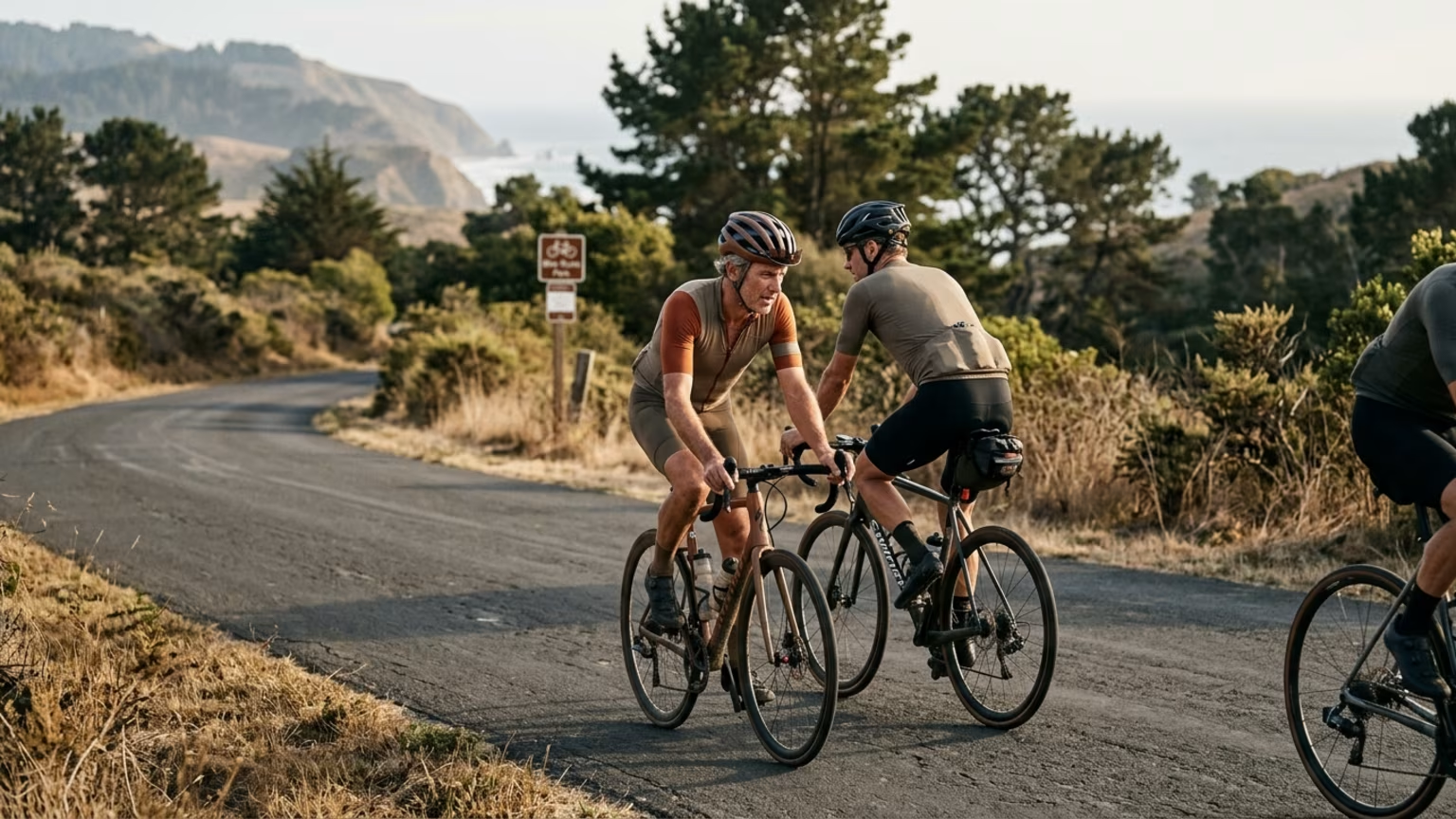

Mathieu van der Poel skipped the Canadian WorldTour races for a controlled training block in Spain. We break down the trade-offs of this preparation strategy.





On September 11, 2026, former professional cyclist Stef Clement appeared on the NOS Cycling Podcast to evaluate a divisive training strategy. Mathieu van der Poel chose a less conventional route toward the 2026 Road World Championships in Montréal. The Alpecin-Premier Tech rider opted for a short Spain-based training block rather than using the Québec Grand Prix and Montréal Grand Prix as immediate build-up races. This high-profile strategic decision highlights the ongoing debate between controlled aerobic volume and raw race intensity.
The choice between controlled training and competitive simulation is a critical one for any ambitious cyclist. Van der Poel based himself in Moraira, Spain, after returning briefly to Belgium following his late-August appearance at the Mountain Bike World Championships in Val di Sole. During that off-road event, he started from the fifth row and finished just inside the top 30 after failing to reach the leaders. He continued training in Belgium with Jasper Philipsen and other riders before travelling to Spain to find a more predictable training environment.
The details of the Spanish training block reveal a focus on significant distance. On Tuesday, September 8, Van der Poel completed a 116-kilometre road ride with regular training partner Freddy Ovett. Primary reports also described a separate, demanding 160-kilometre training ride in Spain during this same preparation period. He was not expected to remain in Spain for more than a week before starting the five-day Tour of Luxembourg on Wednesday, September 16.
Van der Poel reportedly considered the Canadian WorldTour races but ultimately chose not to use them as preparation. One reported reason for the decision was the two-week gap between the Montréal Grand Prix and the Road World Championships. Both of these major events are held in Montréal. The alternative plan was to train in Spain, race the Tour of Luxembourg, and then travel to Canada for the World Championships.
Other leading contenders adopted vastly different preparation strategies for the Canadian events. Riders like Paul Seixas, Remco Evenepoel, Tom Pidcock and Isaac del Toro prepared through the Québec and Montréal races. Meanwhile, Wout van Aert and Enric Mas chose to race the Vuelta a España. The timing of the Canadian races creates a genuine planning complication, leaving riders to balance race sharpness against the need to recover.
Stef Clement discussed the potential drawbacks of this isolation strategy at length. Clement said Van der Poel always makes his own plan and appeared to believe the alternative approach offered an advantage. However, Clement added, "But we're not really sure what that advantage is." His criticism focused heavily on the opportunity cost of skipping high-level racing and arriving in Canada without earlier race exposure.
Clement argued that racing in Québec and Montréal could have served multiple highly useful purposes. He noted those races would allow Van der Poel to study the course, adapt to the time zone and interact with people in a relatively low-pressure setting. Clement summarized his concern by stating that Van der Poel was allowing everything to happen "in one short burst, just before the World Championships."
Evenepoel's schedule perfectly illustrates the logistical complexity of the alternative Canadian option. Evenepoel was due to contest the World Time Trial Championships on the Sunday between the Montréal Grand Prix and the road race. He was also scheduled to join other Belgian riders at a chalet in Bromont, approximately 80 kilometres from Montréal. Managing this level of travel and racing fatigue is exactly what Van der Poel chose to avoid by staying in Europe. Clement still expressed confidence in the physical capacity of the top riders, noting Wout van Aert has a phenomenal engine.
While the broad strokes of the plan are public, the available coverage leaves significant gaps in the physiological data. Reports confirm the impressive distances of the 116-kilometre and 160-kilometre rides. However, they lack the duration, elevation gain, power data and precise intensity distribution for these sessions. A 160-kilometre ride can represent very different training stimuli depending on how it is fueled and executed.
This preparation model is not entirely unprecedented for the Alpecin-Premier Tech rider. His approach closely resembles his 2024 World Championships build-up, where he used the Tour of Luxembourg before finishing third in the road race in Zürich. That historical result shows the model has previously coincided with a strong performance. It does not establish that the preparation strategy directly caused the podium finish.
There is no peer-reviewed study or official team statement explaining the precise physiological rationale for skipping the Canadian races. The current debate is an informed practitioner opinion rather than a controlled scientific comparison. We must treat this event as a documented elite athlete decision rather than concrete proof that long rides are universally superior to targeted racing.
For the ambitious endurance athlete over 35, this debate reinforces the critical need to identify the exact purpose of every key session. A long, controlled ride can rehearse duration, fueling and pacing over demanding terrain. A tune-up race rehearses tactical decisions and unpredictable fatigue while demanding sharp positioning. Van der Poel's choice demonstrates that these are distinct training objectives rather than interchangeable labels for hard work. Older athletes often feel pressure to race frequently simply to build fitness.
This mindset ignores the massive opportunity cost of racing for a veteran athlete. When you enter a local tune-up race, you surrender complete control over your power output and your recovery timeline. A controlled simulation day allows you to dictate exactly how much stress your body absorbs. This predictability is vital for athletes who balance demanding careers with high athletic ambition. Finding the right consistent training foundation often means prioritizing these structured simulation days when daily life stress is already high.
Hitting my forties brought a harsh reality check. The track workouts were not getting slower, but the days after them felt significantly heavier. Instead of forcing my old Tuesday and Thursday intensity schedule, I looked at the data on Masters athletes and muscle protein synthesis. I pushed my second hard session to Friday, allowing an extra forty eight hours of low intensity recovery. My total weekly volume stayed the same, but the quality of my intervals skyrocketed.
Athletes must account for their own unique recovery limits and life constraints when evaluating a preparation block. Van der Poel's block in Spain offers a highly predictable environment to control his route, duration and overall workload. This level of control is crucial when excessive racing or travel would disrupt a broader training plan. The sources provide no evidence that a professional rider's workload or support system maps perfectly onto athletes aged 35 to 65. The safest application is always individual.
Everyday athletes must carefully avoid mistaking total distance for session quality. The reports provide impressive distances but absolutely no intensity, elevation or power data. A 160-kilometre ride should be judged entirely by its specific purpose and its effect on subsequent training days. Pushing for massive weekend mileage can easily compromise the critical workouts planned for the following week, so you must monitor sleep, daily soreness, motivation and overall performance.
Van der Poel is not simply replacing all competition with empty endurance mileage. His strategy intentionally includes the Tour of Luxembourg to provide a sharp competitive stimulus before the main event. Older athletes should also keep at least one source of race-specific intensity in their plan. You cannot rely strictly on long aerobic days if your goal event demands repeated high intensity efforts.
For a veteran competitor, that could mean retaining a carefully selected tune-up race, a hard group ride or a structured race simulation. This targeted intensity ensures you arrive at the start line ready to respond to attacks. This mirrors how complex tactical pacing decisions often dictate success on a demanding race day. Proper fueling and carbohydrate management during these controlled rides will ultimately define how well you recover for the next session.
Controlled training volume builds the necessary physiological engine for endurance performance, but carefully selected race intensity remains strictly necessary for true competitive sharpness.

Follow ReEndure for practical insights on endurance training, recovery, nutrition and healthy aging. Stay connected for new articles, research led guidance and ideas to help you perform better for longer.



Read practical ideas on endurance training, recovery, nutrition and healthy aging to keep progressing for years to come.
Read the Blog