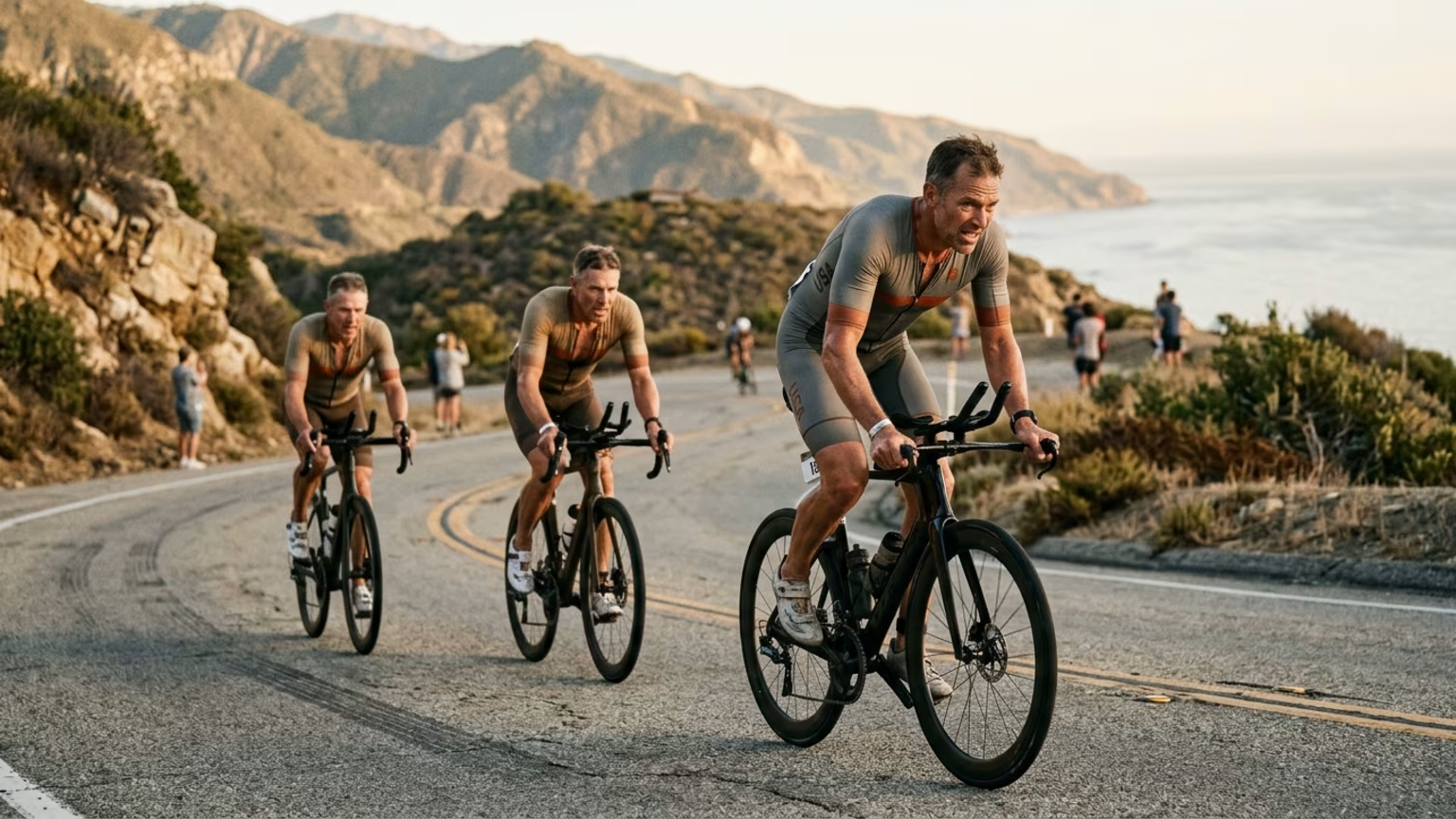

An evidence-based breakdown of Slowtwitch's tactical predictions for the 2026 IRONMAN 70.3 World Championship, focusing on pacing and course topography.





On September 10, 2026, Slowtwitch published a tactical preview for the 2026 IRONMAN 70.3 World Championship. The professional races in Nice, France, are scheduled for September 12 and September 13. Ryan Heisler released four distinct predictions detailing how the Mediterranean course might dictate the professional outcomes. His analysis outlines the specific race strategies required to conquer a highly challenging route.
The primary conclusion from the Slowtwitch analysis is that the Nice course heavily favors athletes who can manage intense elevation gain without destroying their running legs. The standard format requires a 1.9-kilometer swim, an approximately 90-kilometer bike, and a 21.1-kilometer run. The swim is a single-loop Mediterranean course starting near Plage des Ponchettes and the famous “I LOVE NICE” landmark. However, the defining challenge of this particular event is the bike course. The route contains roughly 1,200 meters of total elevation gain.
Most of this climbing is concentrated in the first half of the bike leg. The centerpiece of this elevation is the Col de Vence. This climb begins at approximately kilometer 26.6 and rises for about 9.7 kilometers. It features an average gradient of 6.6 percent.
Sections of the climb approach 10 percent, while the maximum gradient exceeds 12 percent. After Coursegoules around kilometer 44, the course becomes substantially flatter. The Nice Côte d’Azur tourist office notes there are less than 90 meters of additional elevation gain over the remaining 46 kilometers.
Based on these demands, Heisler predicts Taylor Knibb will win her fourth IRONMAN 70.3 world title. The tactical logic suggests Knibb can exploit the demanding bike course to build a significant lead. A flat run may give strong runners fewer opportunities to close a large gap. The real battle in the women's race may be for second place.
Slowtwitch identifies several leading contenders for the remaining podium positions. These athletes include Kat Matthews, Laura Philipp, and Julie Derron. Marjolaine Pierré, Paula Findlay, and Solveig Løvseth also enter the race as strong challengers. Laura Philipp is described as an athlete who tends to improve as race distance increases. Nice marks her first 70.3 World Championship appearance since 2023, where she finished sixth.
Marjolaine Pierré previously defended her 70.3 Pays d’Aix title by four minutes over Imogen Simmonds and Laura Philipp. Julie Derron enters the preview with a very strong recent record. Slowtwitch identifies her as the 2024 Olympic silver medalist. She also recorded four wins and a third place in middle-distance racing during the preceding 13 months.
Heisler expects Derron to begin the race behind the leading swimmers and attempt to move through the field. This makes her bike strategy especially important. The analysis suggests athletes like Findlay and Løvseth could use the difficult bike course to reduce the advantage of faster pure runners. They could then rely on their own strong half-marathon performances.
In the men's race, Slowtwitch selects Kristian Blummenfelt as a credible winner. Blummenfelt recently won three races in four weeks in 2026. These victories occurred at Geelong, Oceanside, and Texas. He achieved this winning streak after finishing sixth at IRONMAN New Zealand.
At a race-week practice swim, he finished second behind Lasse Nygaard Priester. The two men reportedly had nearly a minute on the athletes behind them. The tactical thesis is that Blummenfelt could be very difficult to catch if he carries a significant swim lead into the climbs.
Conversely, Slowtwitch predicts Hayden Wilde will finish in the top five but will not be a major factor in the victory battle. Wilde won six of seven T100 starts in 2025. His largest winning margin in that seven-race run came in Spain, where he finished 2 minutes and 25 seconds ahead of Jelle Geens. The preview notes that this entire margin was reportedly created on the run.
Wilde was third at Geelong in 2026 after Blummenfelt and Geens chased him down. At the 2026 T100 race in San Francisco, Wilde gave up nearly five minutes to Rico Bogen on the challenging bike course. He also lost 2 minutes and 30 seconds to Lasse Nygaard Priester during the same bike leg. Despite this, Wilde retained third place ahead of Morgan Pearson and Jason West.
The article notes that Wilde had raced less frequently in 2026. Slowtwitch explicitly acknowledges that his apparent fatigue could simply be an effectively timed end to a large training block.
To formulate these tactical predictions, Slowtwitch evaluated recent race histories against the specific geographical realities of the French Riviera. The analysis combined visual assessments of athlete fatigue with recent timing data. The preview specifically considered how the technical elements of the course will force athletes to balance aggressive racing with the need for physical preservation. It weighed how the course transitions from a steep mountain climb to a fast coastal flat.
The tactical demands highlighted in the Slowtwitch preview offer highly applicable lessons for ambitious endurance athletes over 35. A course with concentrated elevation gain requires a disciplined approach to pacing, fueling, and recovery. Older athletes cannot simply rely on raw threshold power to overcome a demanding route. You must manage your energy expenditure carefully. The transition from climbing to descending requires specific technical preparation.
The Col de Vence is not a place to test your maximum power output. With roughly 1,200 meters of climbing concentrated mainly in the first half of the bike course, aggressive riding here carries a heavy cost. You must pace the ascent carefully to preserve your legs for the final run. This conservative approach aligns closely with a comprehensive guide to qualification goals and championship racing that values energy preservation over early heroics.
The return to Nice includes an approximately 11-kilometer technical descent that begins around kilometer 64. Descending skill, visual scanning, and braking control are just as important as climbing fitness. You must maintain focus and handle your equipment smoothly to navigate sharp corners safely. Riders who tense up or brake poorly will lose significant time and waste valuable mental energy. Your ability to recover on the descent dictates your running potential.
The 21.1-kilometer run is a flat, two-loop half-marathon along the Promenade des Anglais. While a flat profile sounds easy, it places you on a fast, exposed route immediately after a demanding bike leg. Runners who overextend themselves on the Col de Vence will find themselves walking the coastal promenade. Proper run pacing requires discipline from the very first step. A flat course removes hills but exposes you to relentless mechanical repetition.
Because the first half of the course contains most of the elevation, your early fueling windows occur under high physical stress. The second half becomes flatter and faster, which changes how easily you can consume calories. You need a fueling plan that remains executable when your breathing rate and bike handling demands rise. Understanding how weather changes endurance fueling is critical when transitioning from a cooler mountain climb to an exposed coastal run.
The most transferable lessons from the Nice preview involve focusing strictly on elements you can manage. You should build your strategy around pacing, positioning, fueling, and knowing when to respond to competitors. Trying to copy a professional athlete's exact attack timing is a mistake for most age-group competitors. Your personal race plan should account for your unique fitness limits and nutritional needs.
The Slowtwitch preview noted historic equipment reliability concerns for Blummenfelt. On a course with steep climbs and a long technical descent, your gear must function flawlessly. Tires, shifting mechanisms, and brakes require systematic checks before race day. Your bike computer setup must also be thoroughly tested. A mechanical failure on an 11-kilometer descent is both dangerous and entirely preventable with proper preparation.
The speculation surrounding Hayden Wilde highlights the difficulty of managing physical fatigue. Slowtwitch noted that Wilde looked tired to the preview writer, although this was a visual impression rather than a medical assessment. For veteran athletes, managing freshness is a critical variable for long-term performance. You can avoid common endurance training mistakes by prioritising measured recovery over simply accumulating high-stress race starts. You should measure your readiness through objective training data and planned taper objectives rather than relying on subjective feelings.
The defining lesson from the Nice world championship course is that concentrated physical demands consistently reward athletes who pace with discipline and manage their fatigue wisely.

Follow ReEndure for practical insights on endurance training, recovery, nutrition and healthy aging. Stay connected for new articles, research led guidance and ideas to help you perform better for longer.


Read practical ideas on endurance training, recovery, nutrition and healthy aging to keep progressing for years to come.
Read the Blog