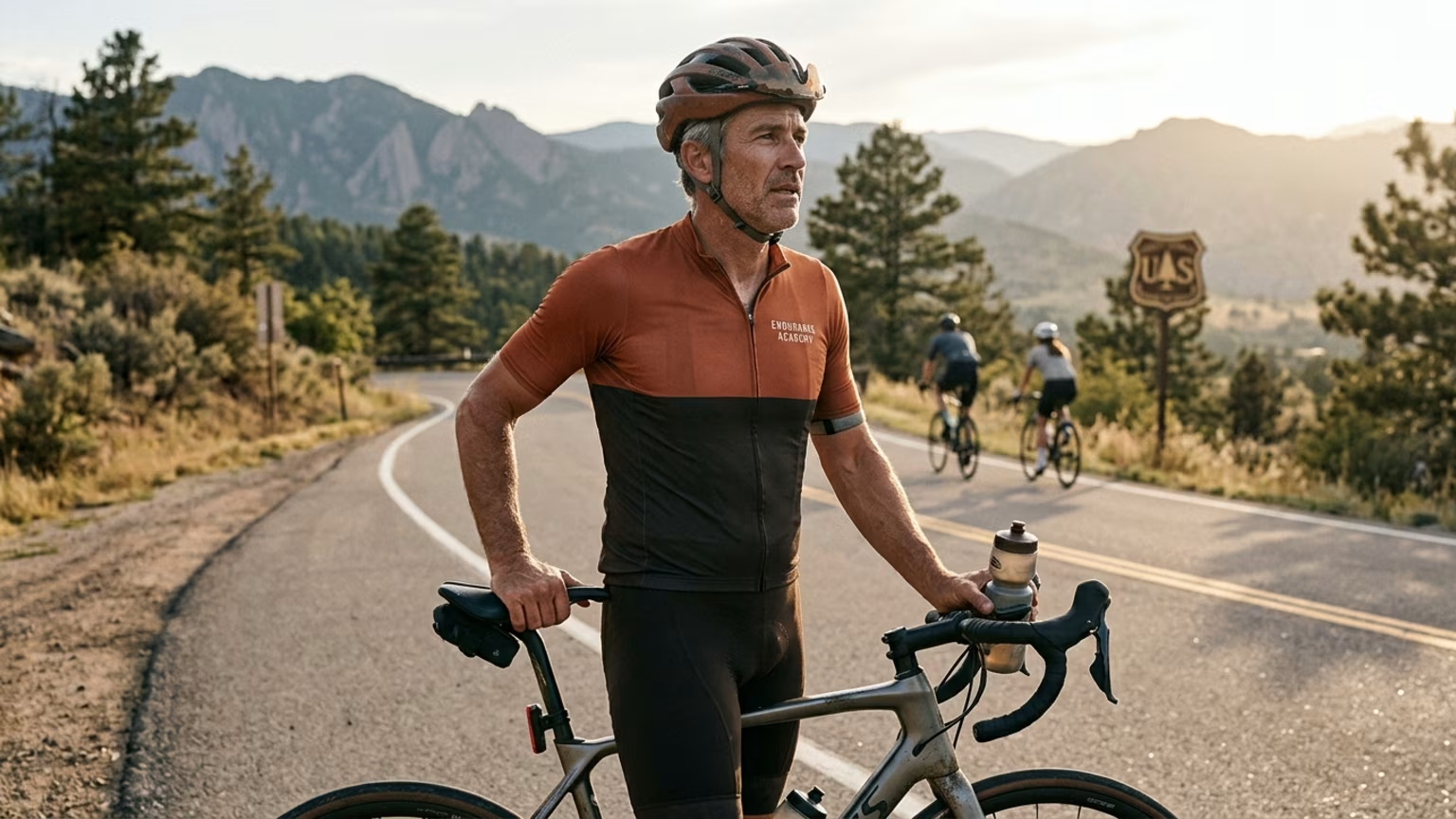

Eddie Dunbar's Stage 19 Vuelta a España win highlights the importance of a patient and structured return to endurance training after a severe injury.





On September 11, 2026, Eddie Dunbar won Stage 19 of the Vuelta a España with a highly calculated performance on the Alto de Estepona. The 30-year-old Irish rider, competing for the Pinarello Q36.5 Pro Cycling Team, secured the mountaintop victory after spending three months completely off his bike earlier this year. His decisive, race-winning move came inside the final kilometre of an approximately 18-kilometre summit climb.
The victory ended a challenging two-year wait for his next Grand Tour stage win. According to race coverage, this result represented his first win since he captured two victories at the 2024 Vuelta.
The victory paints a clear picture of progressive recovery rather than an overnight return to peak form. Dunbar suffered an ankle fracture during a March 2026 training crash after he was hit by a scooter or motorbike in Monaco. The severe injury kept him entirely off his bike until June.
Instead of expecting to win on his very first day back in the peloton, his timeline reveals a deliberate sequence of resuming riding and returning to racing in August. The gap between his injury and his eventual stage victory highlights that rebuilding elite fitness requires staging repeated competitive exposures rather than relying on a single dramatic workout.
A complete break from training drastically alters an athlete's physical baseline. According to a running-focused summary of earlier detraining research published by Runked, significant cardiovascular declines happen quite rapidly. The review highlighted that seven trained runners experienced a 7 percent reduction in VO₂max by 21 days of complete cessation. That metric worsened to a steep 16 percent reduction by 56 days.
While these running-specific numbers should not be used as an exact cycling prescription, the figures illustrate the formidable physiological hurdle athletes face after a major injury. Because he had not ridden at all for three months, Dunbar had to navigate a substantial fitness deficit when he finally resumed pedaling in June. The available reporting does not document his exact weekly riding volume, specific power targets, or medical clearance criteria. We only have the chronological evidence of his slow return to the professional ranks.
However, the progression from basic riding in June to racing in August provides a practical illustration of how an endurance base is successfully reconstructed over several months.
When an athlete spends a season preparing, a sudden trauma derails their mental focus. Reestablishing a basic routine is the critical first step of rehabilitation. For Dunbar, simply getting back on the bicycle in June represented a massive victory over his physical limitations. Establishing a regular cadence of daily movement creates a sturdy foundation for future high-intensity efforts.
The tactical execution on the 210- or 211-kilometre route from Vélez-Málaga to Peñas Blancas showcased masterful energy conservation. Early in the stage, Dunbar actually told his team that he was not feeling well and that it was not his day. He mentioned that his legs felt poor after 50 or 60 kilometres, but his physical sensations slowly improved once he established himself in the breakaway. Having two teammates in that breakaway helped him pace himself and remain relaxed throughout a grueling day in the saddle.
When the decisive racing action occurred on the final climb, Dunbar showed immense restraint. With approximately 12 kilometres remaining, he deliberately avoided going into the red. He allowed Santiago Buitrago to push the pace, relying entirely on a strategy of selective effort.
Dunbar described having only one bullet to fire, choosing to save his major acceleration for the final stretch of the stage. He eventually beat Buitrago to the line by a margin of 1.4 seconds.
For endurance athletes between the ages of 35 and 65, recovering from a major setback requires immense patience and a complete shift in expectations. You cannot erase a massive fitness gap with a few aggressive weeks of training. Older athletes face a shrinking margin of error when it comes to tissue resilience, joint health, and overall recovery capacity. A structured return must prioritize symptom-free consistency over immediate race-specific intensity.
Your initial goal is simply establishing a repeatable routine of easy aerobic volume. Executing a structured comeback plan provides a much safer foundation than chasing arbitrary fitness timelines.
Rebuilding an endurance engine demands a strict order of operations. You must restore easy aerobic tolerance before you even consider reintroducing hard climbing intervals or maximal sprints. Dunbar’s timeline perfectly illustrates why rushing the process is a costly mistake. He did not win immediately after he resumed riding.
He spent the summer months quietly logging base miles and testing the structural integrity of his injured ankle. When you are coming back from a fracture or a severe sprain, you should begin with short, highly controlled rides at an intensity that does not provoke pain.
A session that feels acceptable during exercise may still produce delayed pain, unusual swelling, or profound fatigue the following day. Athletes returning from an injury should monitor both the active workout and the subsequent 24 hours. Worsening symptoms should be treated as a strict warning to reassess the training load, not as a signal that more grit is required. The aging endurance athlete often benefits from adopting purposeful off-season rest to allow accumulated fatigue and minor injuries to fully heal.
Dunbar did not wait until he was at absolute peak fitness to pin on a race number. He officially returned to racing in August, just shortly before the start of the Vuelta. According to RTÉ, he finished 137th in the opening time trial. He then logged an eighth-place finish on Stage 7, slowly sharpening his competitive edge through repeated efforts.
Lower-stakes events can serve as vital performance checks for masters athletes, provided full medical clearance is firmly in place. Using a structured race tier framework allows you to treat early comeback events as rigorous training sessions. The objective is to gather data about your pacing and fatigue, not to prove you are suddenly back in peak condition.
The tactical restraint Dunbar showed on the Alto de Estepona applies directly to everyday training for veteran athletes. By holding back with 12 kilometres to go, he ensured he had the energy for his final, race-winning acceleration. Aging athletes must adopt a similar mindset when reintroducing hard efforts into their weekly schedule. You might begin with one highly controlled tempo session, keeping the rest of your week completely aerobic.
It takes time to rebuild the specific muscular stamina required for steep gradients and hard accelerations. Reading more training and performance articles can help you understand how to balance specific quality sessions against the necessity of deep, restorative recovery.
Following his stage win, Dunbar was highly emotional, noting he could not even imagine being at the Vuelta after spending three months off his bike. While this narrative is deeply inspiring, masters athletes must actively separate professional motivation from everyday physical readiness. Professional cyclists operate with full-time medical support, team mechanics, and dedicated coaching staffs.
A successful professional comeback does not mean a recreational rider should train through lingering pain. Returning to sport is an ongoing process that demands absolute honesty about how your body is actually responding to the new training load.
A forced break does not signal the end of your competitive years, provided you rebuild your capacity through absolute patience, controlled pacing, and a gradual reintroduction to intensity.

Follow ReEndure for practical insights on endurance training, recovery, nutrition and healthy aging. Stay connected for new articles, research led guidance and ideas to help you perform better for longer.





Read practical ideas on endurance training, recovery, nutrition and healthy aging to keep progressing for years to come.
Read the Blog