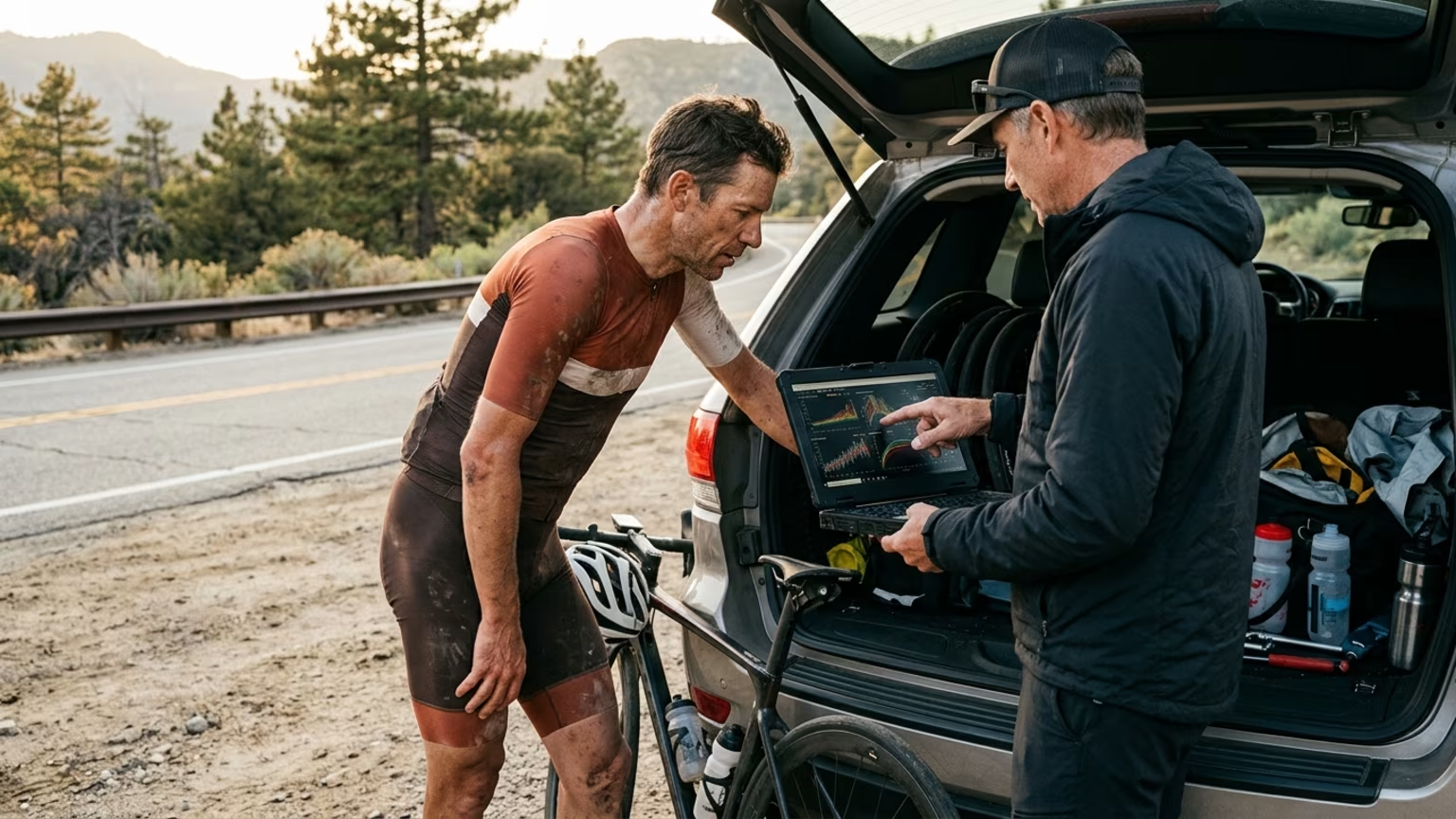

WorldTour teams use artificial intelligence to process data, but human coaching remains the ultimate authority. Why veteran athletes must rely on their instinct.





On September 30, 2026, The Athletic published a report examining how professional cyclists and WorldTour teams use or avoid artificial intelligence. The reporting looked closely at the reality behind the technology inside the professional peloton. It documented examples ranging from simple chatbot questions to complex team data partnerships. The findings show a sport that is currently testing new capabilities while fiercely protecting human expertise.
The central finding is that artificial intelligence serves primarily as a data processing assistant for elite cycling teams. The Athletic reported that professional teams draw heavily on athlete data to inform performance, strategy, and recruitment. This physiological information includes power output, core temperature, ventilation, and calories burned. Tracking a single rider requires monitoring hundreds of data points every hour.
When multiplied across an entire team over a long racing calendar, processing these vital metrics manually has become nearly impossible. To handle this massive influx of information, teams are forming specialized technological partnerships. UAE Emirates currently uses data from G42 and interacts with an agent named Ana, which was developed by Analog. Jayco-AlUla partners directly with ai.io for its team operations. Visma-Lease a Bike collaborates with Mistral to manage its vast internal data requirements.
These partnerships indicate a shift toward automated data management at the highest levels of the sport. Despite these significant financial and operational investments, human coaching remains the ultimate authority inside the professional peloton. Visma-Lease a Bike managing director Richard Plugge told The Athletic that Mistral insights support human decision making rather than replace it. Plugge noted the technology primarily assists the staff with scouting, performance monitoring, and nutrition planning.
The goal is to inform the coaching staff, not to remove them from the equation. Matteo Jorgenson of Visma-Lease a Bike added that he still relies on human expertise and experience. He maintains his trust in traditional coaching methods, while allowing his coach might use these technological tools when necessary. This balanced perspective is common among riders who understand the limitations of raw data.
Individual athletes who test automated training advice often revert to their own judgment. Michael Matthews is a 36 year old Australian rider for Jayco-AlUla. He asked a chatbot for advice before the World Championships road race in Montréal. The chatbot recommended adding 30 second seated sprints to his workouts. It also advised focusing heavily on accelerating out of the numerous turns on the specific race course.
Matthews ultimately finished second in the World Championships road race. He told The Athletic that the computer suggestions differed from what he expected. Stating that he rarely relies on artificial intelligence, he prefers his own instincts and what he knows about his own body. His approach highlights the tension between computer generated ideals and human reality.
Athletes building tools around their own personal records seem to find more targeted success. Kristen Faulkner is an Olympic gold medalist and a Harvard computer science graduate. She built a custom tool using her own training data and riding history. Relying on her own verified numbers removed the guesswork from the software outputs. The Athletic reported that this tool contributed to her best 20 minute power in training and helped her prepare for a three gold performance at the Pan American Cycling Championships.
For the ambitious endurance athlete over 35, this reporting clarifies exactly how to view modern training technology. WorldTour teams utilize these tools strictly to organize information, not to replace experienced coaching judgment. Veteran athletes should apply the exact same rigorous standard to their own daily routines. You must view automated workout suggestions as interesting questions to investigate rather than direct orders to execute.
When evaluating a new training protocol, reviewing common endurance training mistakes can help ground your expectations. A software tool cannot feel your joint fatigue, assess your daily recovery level, or understand your complex injury history. An algorithm assumes a rapid, linear recovery curve that rarely applies to mature, experienced athletes. Software programs simply lack the nuance required for long term athletic longevity.
Matthews provided an exceptional example of veteran restraint when he prioritized his own instincts over a generated prompt. As a 36 year old professional, he sits squarely in the demographic where self knowledge becomes critical. Older athletes have spent decades learning exactly how their bodies respond to intense physical stress. That deep historical self knowledge is your most valuable asset in endurance sports.
Technology should only serve to highlight useful patterns within your existing training logs. We emphasize this core principle heavily when redefining what improvement actually means after 35. You cannot blindly adopt a high intensity interval protocol just because a software program generated it. The physical cost of a misguided workout is significantly higher for a veteran athlete than for a younger competitor.
Faulkner demonstrated the most productive approach by restricting her algorithmic tool to her own riding history. Comparing a proposed training session against your own past physical responses is much safer than following generalized internet advice. If a software program suggests an intense block of high volume intervals, you must pause to consider your recent physical stress. Analyzing your own past performances guarantees that the data applies specifically to your unique physiology.
Many older athletes are already rethinking traditional weekly schedules to allow for extended recovery. Incorporating external data into these customized routines requires extreme caution. Professional riders continue to express healthy skepticism about the broader implications of these automated systems. Riley Pickrell of Modern Adventure Pro Cycling actively questioned the basic reliability of artificial intelligence in athletic preparation.
The Athletic reported that Pickrell also cited environmental costs and preferred discussing diet with knowledgeable human experts. Michał Kwiatkowski, the 2014 world champion, recognized that these tools might increase productivity across the peloton. However, he sharply questioned who actually benefits from that relentless increase in productivity. Pushing an athlete to their absolute limit using software modeling carries inherent physical risks.
For the everyday endurance athlete, the lesson is clear. You should prioritize consistency and physical resilience over chasing the latest software optimization. A computer program might identify a mathematical gap in your power curve. However, trying to close that gap could easily trigger an overuse injury if you ignore your own physical limitations.
The most effective endurance athletes maintain a tight circle of trusted human advisors. Technology can provide raw metrics, track your daily sleep, and monitor your power output. Translating those raw numbers into a sustainable, long term athletic career requires deep human context. Always discuss consequential changes to your training plan with a qualified coach or clinician.
Treat artificial intelligence as a high powered assistant for organizing your training data, but always let your personal instincts and human coaching dictate your final decisions.

Follow ReEndure for practical insights on endurance training, recovery, nutrition and healthy aging. Stay connected for new articles, research led guidance and ideas to help you perform better for longer.




Read practical ideas on endurance training, recovery, nutrition and healthy aging to keep progressing for years to come.
Read the Blog