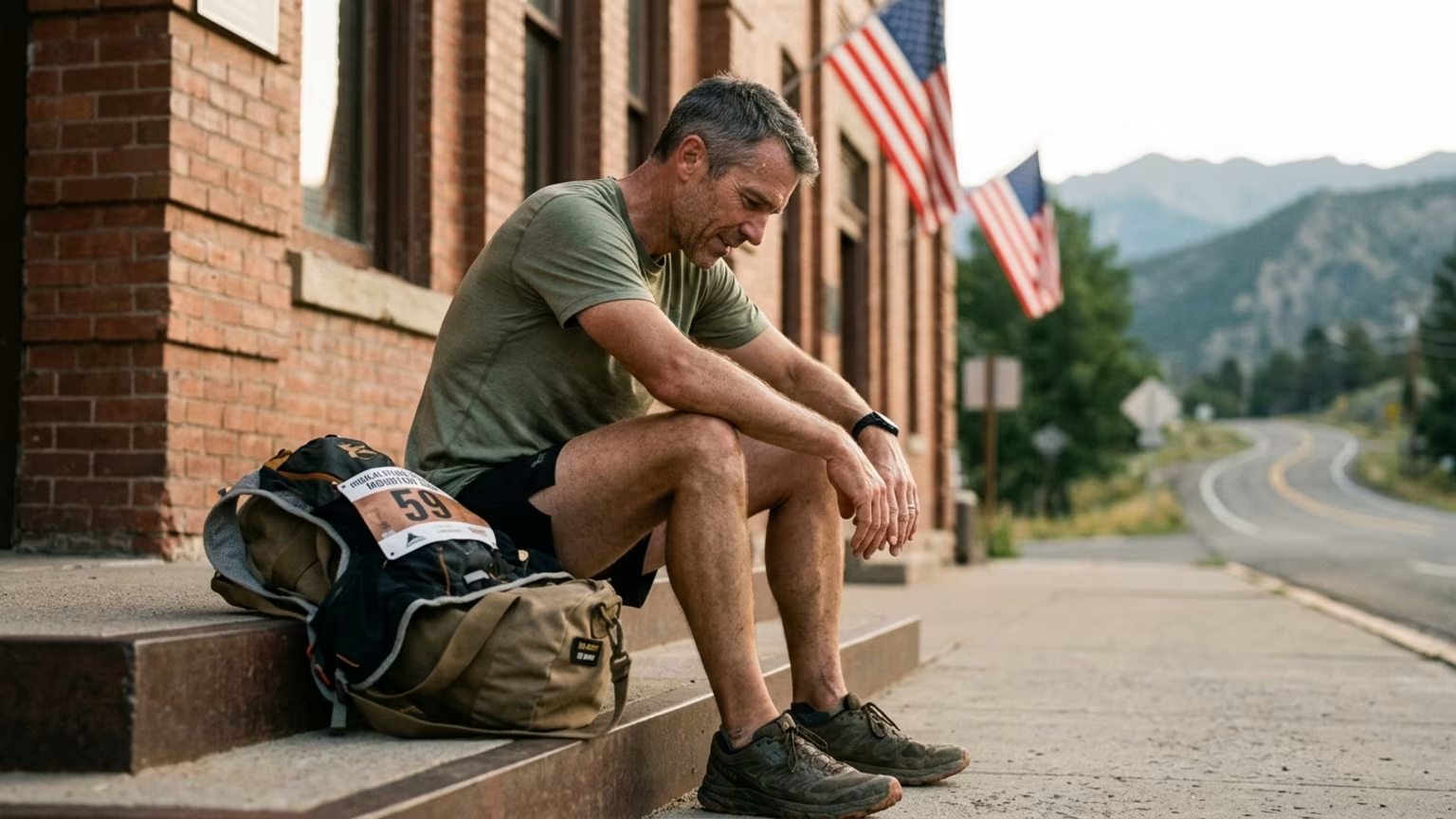

Army doctor Shivani Sangwan finished ninth at the 122-km Silk Route Ultra. We break down how ambitious athletes over 35 can balance training with a career.





On September 10, 2026, the 13th Ladakh Marathon hosted one of the most severe endurance events on the sporting calendar. The event featured the Silk Route Ultra. This is a 122 kilometer race that tests runners in a highly challenging high-altitude environment. Colonel Shivani Sangwan finished ninth in this demanding 2026 race. Sangwan is an Army Medical Corps superspecialist and a mother of two. The race forced competitors to navigate extremely steep gradients and cold conditions. The runners also dealt with severe sleep deprivation and unpredictable weather patterns.
The race began at Kyagar village in Nubra Valley and ended at Leh Market. Nawang Tsering of the Ladakh Police won the 122 kilometer race in 12 hours, 12 minutes, and 18 seconds. Suraj Meena of Rajasthan finished second. Rigzen Gyurmeth of 2 Ladakh Scouts finished third. The reported prize money for the first three finishers was highly structured. The event awarded ₹5 lakh for first place, ₹3.5 lakh for second, and ₹2.25 lakh for third. The wider event carried a reported record prize pool of ₹1 crore. The Ladakh administration described this as the highest prize commitment in the history of the event.
The primary takeaway from Sangwan's performance is how she approached her preparation. Her training had to fit around military work, organizational responsibilities, and family commitments. She did not utilize a conventional full-time athlete schedule. Instead, she built her endurance program directly into a demanding professional life. The reporting from India Today illustrates that she simply continued her training despite competing demands. She did not wait for an ideal or uninterrupted period in which to train.
This approach challenges the assumption that elite distances require completely clear calendars. Sangwan possesses a long record of successful endurance finishes. Her previously reported results include a podium finish in the Hundred Days of Running in 2022. She successfully completed the 100 kilometer Border Ultra in 2024. She secured a top-10 women's finish in the 72 kilometer Khardung La Challenge in 2025. She also completed the 84 kilometer Rohtang Epic from Manali to Sissu in 2026. She also took a podium spot at the 28 kilometer Trail-A-Thon in Gurugram. These consistent results highlight the effectiveness of an integrated training philosophy.
The Silk Route Ultra provides a clear look at extreme physical logistics. The 122 kilometer course included a massive ascent toward Khardung La. The Ladakh administration identifies Khardung La as the world's second-highest motorable pass. It sits at an imposing altitude of 17,618 feet. The total elevation gain for the race reached approximately 2,700 meters. Race organizers imposed a strict 22-hour overall cut-off. They also enforced five intermediate cut-offs to ensure competitor safety.
India Today reported that approximately 100 to 110 runners were admitted to the race. The event qualification requirements were highly demanding. The Union Territory of Ladakh reported that 477 ultra-runners participated in the Silk Route Ultra and the 72 kilometer Khardung La Challenge combined. Competitors faced low oxygen availability. They battled intense physical fatigue across a sustained period. The environment required strict pacing and constant physical assessment.
The broader event scale illustrates massive growth in the endurance sector. The official account reported that the 2026 Ladakh Marathon attracted 7,500 runners. These athletes came from 28 Indian states and six Union Territories. International participants were expected from all six inhabited continents. More than 3,000 family members visited Leh during the event. The Ladakh administration estimated that the 2026 event generated more than 70,000 bed nights. The event contributed approximately ₹40 to ₹47 crore directly to the grassroots economy.
The local administration sees the event as a key developmental tool. Lieutenant Governor Vinai Kumar Saxena described the marathon as a model of responsible tourism. He stated that it actively supports local communities and livelihoods. The administration noted that the event has grown significantly since its inception in 2012. It is now recognized as the world's highest AIMS-certified marathon. This highlights Ladakh's potential as a premier destination for high-altitude sports.
How does this high-altitude race alter how ambitious adult athletes should plan their own training schedules? For the endurance athlete over 35, time is always the primary limiting factor. We constantly face chronic scheduling constraints and professional stress. Sangwan's case provides a practical blueprint for managing a heavy athletic load. The central lesson is planning around constraints rather than hoping for an ideal schedule.
In our experience at Reendure, strict adherence to a static calendar often breaks older athletes. Hitting my forties brought a harsh reality check. The track workouts were not getting slower, but the days after them felt significantly heavier. Instead of forcing my old Tuesday and Thursday intensity schedule, I looked at the data on Masters athletes and muscle protein synthesis. I pushed my second hard session to Friday, allowing an extra forty eight hours of low intensity recovery. My total weekly volume stayed the same, but the quality of my intervals skyrocketed.
Consistency always outranks occasional heroic efforts. You do not need to mimic the lifestyle of a professional runner to see results. You simply need to keep moving forward despite daily friction. Many athletes struggle when they try to execute a standard training block while working a full-time job. They end up managing physical fatigue very poorly. You can prioritize strategic methods for balancing heavy resistance sessions with intense aerobic workouts to protect your health. The goal is building fitness that directly complements your life.
Athletes must also recognize severe environmental stress as a risk management issue. The high-altitude nature of the Silk Route Ultra presents a massive logistical hurdle. The reporting notes the severe altitude but does not outline a specific acclimatization protocol. Masters athletes must treat environmental factors with extreme caution. You cannot simply push your way through low oxygen or extreme cold without physical consequences. Planning for appropriate physiological adaptation is non-negotiable for longevity.
Long endurance events act as tools for building profound personal resilience. You can utilize strategic training reductions to preserve athletic conditioning during unplanned breaks. When work or family duties peak, lowering your athletic intensity is a highly smart tactic. You can easily maintain your baseline fitness. Once the personal stress finally subsides, you can carefully rebuild your weekly volume.
You also need to evaluate long events as tests of strict execution. A 122 kilometer race requires tight management of pacing, nutrition, and constant hydration. Sangwan had to solve these complex logistical problems while severely fatigued. Older athletes must approach race day as a strategic puzzle. Proper physical execution matters just as much as raw cardiovascular fitness. It is about carefully balancing ambition with aging physical realities. We must remain driven without burning out over the long haul.
The pursuit of ambitious athletic goals does not require abandoning professional obligations. You can achieve high performance while maintaining a demanding career. It simply requires a pragmatic approach to daily time management. You must respect your physical recovery curve. You must also adjust your training load to accommodate life stress.
The adult athlete must view endurance training as a flexible system. Rigidity leads to injury and chronic mental burnout. Adaptability allows for sustained progress over many decades. You can test your limits in demanding environments without sacrificing your daily responsibilities. The evidence shows that a balanced approach yields highly competitive results.
Your long-term performance relies on sustainable habits. Prioritize proper sleep and adequate daily nutrition. Do not force high-intensity workouts when your professional life requires your energy. You can always shift a hard session to a different day. The key is maintaining the overall structural integrity of your plan.
Building a support system is also crucial for long-term success. While the specific support arrangements for Sangwan are not detailed, older athletes universally benefit from clear communication. Discuss your training schedule with your family. Coordinate your long runs to minimize disruption. A supportive environment makes consistent training significantly easier to maintain.
The true challenge is managing your physical output across years. Short-term aggressive training blocks rarely serve the older athlete well. We need a measured approach that respects our physiological limits. You must listen to your body and adjust accordingly. This is how you stay competitive for life.
Ambitious endurance racing remains entirely accessible for busy adults. It simply requires abandoning the myth of the flawless training schedule. We must work with the time we actually possess. We must train smart and race with a clear strategy. This approach guarantees a longer athletic lifespan.
Success for the ambitious veteran athlete depends entirely on treating scheduling flexibility as a core training metric rather than a compromise.

Follow ReEndure for practical insights on endurance training, recovery, nutrition and healthy aging. Stay connected for new articles, research led guidance and ideas to help you perform better for longer.





Read practical ideas on endurance training, recovery, nutrition and healthy aging to keep progressing for years to come.
Read the Blog