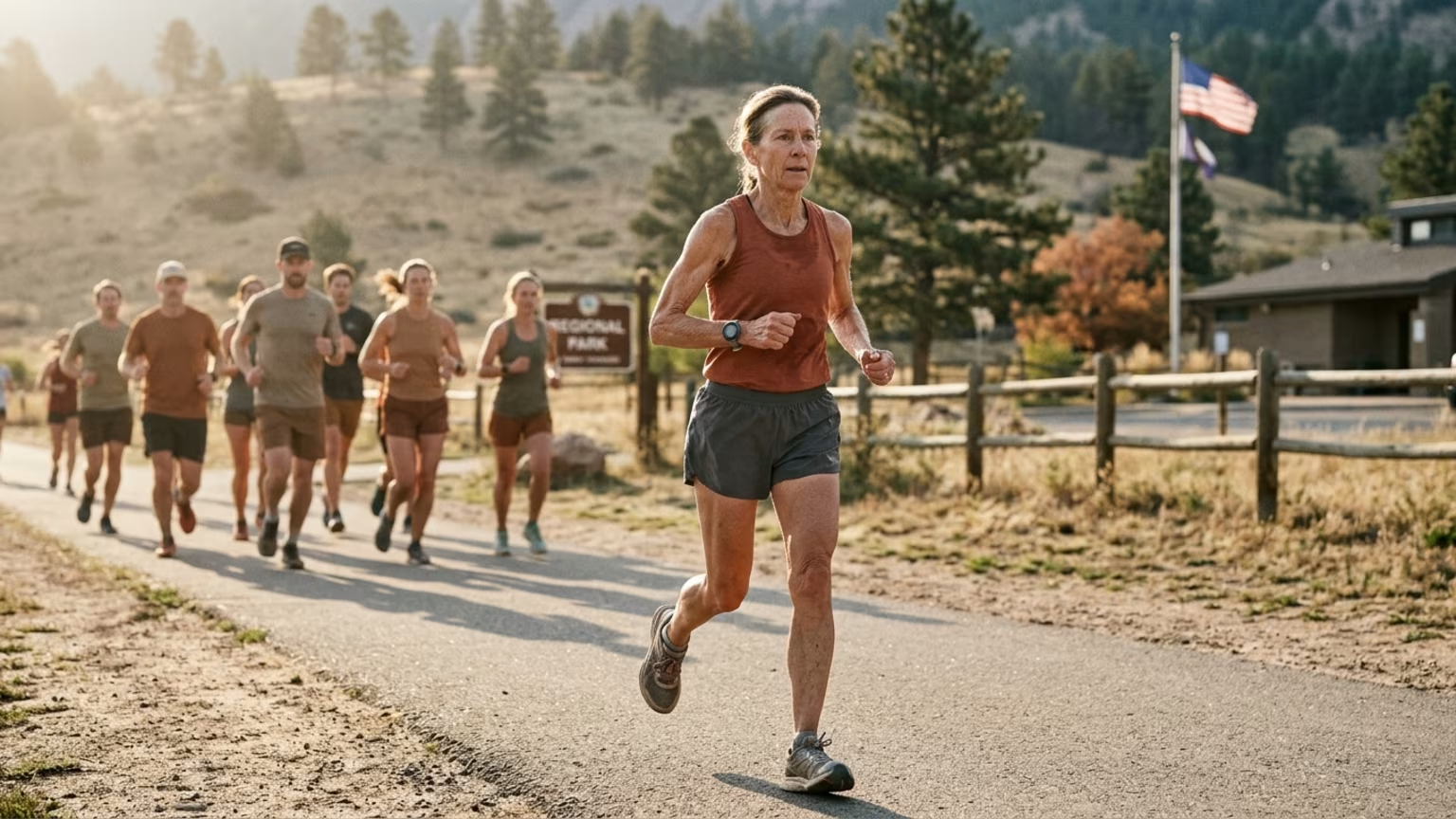

Recent profiles of Japanese athletes competing in their nineties reveal key lessons for masters athletes. We examine the science of pacing your athletic life.





On September 21, 2026, The Japan Times published a comprehensive feature profiling Japanese masters athletes who continue competing into their eighties and nineties. The reporting examined how these individuals weave intense physical training into their daily routines within a superaged society. It provided concrete examples of older people maintaining high athletic ambitions decades beyond conventional retirement age. The article highlighted Shoko Yonezawa, a 91-year-old swimmer from Yokohama and a grandmother of five.
Yonezawa reportedly set world records in the women's 90 to 94 age category 29 times during 2025. This incredible streak included breaking several records that had previously been hers. At a June 2025 meet in Niigata Prefecture, Yonezawa completed the short course 200 meter breaststroke in 4:32.36. The Japan Times reported that this performance was 13 percent faster than the previous masters world record for that event and age category.
While Yonezawa attributed some of her success to being relatively young within the 90 to 94 category, the scale of her performance is exceptional. Her achievements highlight a growing international interest in the physical capabilities of older athletes. These stories give masters endurance athletes a clear look at what is possible when training and lifestyle align over the long term. Seeing athletes perform at a high level in their nineties forces us to rethink what true athletic longevity looks like.
These remarkable individual performances parallel a growing body of scientific research on lifelong endurance training. A 2026 scoping review evaluated existing literature to determine how decades of physical training impact the aging body. The researchers concluded that lifelong endurance training is consistently associated with low adiposity and superior aerobic capacity. They also found that it leads to favorable muscle oxidative characteristics and preserved muscle quality in many cases.
However, the review provided a critical biological reality check regarding what endurance training cannot do. The data clearly showed that lifelong sports participation does not fully prevent age related reductions in muscle mass, motor unit loss, or power. Regardless of their training volume, older athletes will inevitably experience neuromuscular decline as they age. The review cautioned against treating lifelong athletic participation as a complete defense against these natural physiological changes.
Interestingly, the researchers emphasized the value of ongoing physical routine over past athletic glory. The review reported that continued training after elite retirement appeared more important than an individual's historical athletic status alone. This synthesis of existing studies proves that consistent participation is the primary driver of preserved physical function. It refutes the idea that achieving a high level of fitness in youth will permanently protect an athlete from age related decline.
To better understand these physical changes, major institutions are conducting long term observational field studies on masters athletes. The German Aerospace Center, widely known as the DLR, is currently running the Track and Field Masters Athletic Cohort Study. This ten year international field study, known as TaFMAC, examines fitness, training and health. The DLR frames masters athletes as a natural experiment to study the preservation of physical function, cognitive health, and well being.
The study collected new longitudinal data at the 2026 World Masters Championships in Daegu, South Korea. This massive project involves collaboration with Juntendo University in Japan and various research institutions in the United States, Canada, and South Korea. TaFMAC researchers track their subjects over time to study specific changes in their physiological profiles. They rigorously assess factors including aerobic capacity, muscle strength, cardiovascular and vascular function, and lung function.
The involvement of an aerospace agency highlights the unique biological stress of both aging and extreme environments. The DLR draws a direct comparison between the physiological impacts of aging and prolonged spaceflight. Both scenarios introduce severe challenges affecting muscles, bones, the cardiovascular system, and human metabolism. However, the DLR explicitly cautions that masters athletes do not demonstrate how to stop the aging process entirely.
For the ambitious endurance athlete over thirty five, this research fundamentally changes how we evaluate our long term training objectives. The traditional competitive mindset often prioritizes achieving lifetime personal bests and pushing through inevitable fatigue. The 2026 scoping review clearly demonstrates that top end power and motor units will eventually decline. We must shift our perspective from trying to halt biological aging to actively managing and preserving our physical function.
Hitting my forties brought a harsh reality check regarding how my body responded to intense workouts. The track sessions were not getting slower, but the days after them felt significantly heavier. Instead of forcing my old Tuesday and Thursday intensity schedule, I looked at the data on Masters athletes and muscle protein synthesis. I pushed my second hard session to Friday, allowing an extra forty eight hours of low intensity recovery.
My total weekly volume stayed the same, but the quality of my intervals skyrocketed. This adjustment directly aligns with the need to begin crafting a long term strategy that honors an older body. By extending our traditional weekly routine, we can maintain the aerobic capacity highlighted in the recent scoping review. Forcing a rigid, youthful training template onto an older body is a direct path to chronic overuse injuries.
The TaFMAC study tracks aerobic capacity, muscle strength, and vascular function because these metrics dictate long term athletic viability. Our daily training routines should proactively prioritize these specific foundational elements over short term race results. We need to accept that endurance sport does not make us immune to the natural passage of time. The DLR explicitly reminds us that consistent training preserves function rather than stopping the biological clock.
Athletes must logically separate their performance ambition from biological denial. Recognizing that sarcopenia and power loss are inevitable allows us to modify our strength programming safely. We can still set incredibly challenging goals, but those goals might require changing our event selection and our recovery expectations. Measuring our daily cardiovascular health can help us gauge our actual progress without comparing ourselves to an outdated ideal.
The Japan Times profile of Shoko Yonezawa illustrates that athletic longevity is deeply tied to daily habits and social connections. Her continuous participation demonstrates how weaving training into a daily routine sustains motivation over several decades. As athletes age, the social dimensions of the sport become just as important as the physiological adaptations. Staying connected to local clubs, training partners, and competition venues helps reinforce a lifelong athletic identity.
We should absolutely use age group competition as a structured and motivating framework. However, we must avoid comparing ourselves directly with exceptional, outlier record holders like Yonezawa. Her 29 world records in a single year show what is possible for a specific elite masters athlete. For the rest of us, the true victory lies in maintaining the capacity to train, recover, and compete consistently for the next thirty years.
To stay active and competitive for decades, older athletes must prioritize durable physical function and adaptable routines over the illusion of stopping the aging process.

Follow ReEndure for practical insights on endurance training, recovery, nutrition and healthy aging. Stay connected for new articles, research led guidance and ideas to help you perform better for longer.




Read practical ideas on endurance training, recovery, nutrition and healthy aging to keep progressing for years to come.
Read the Blog