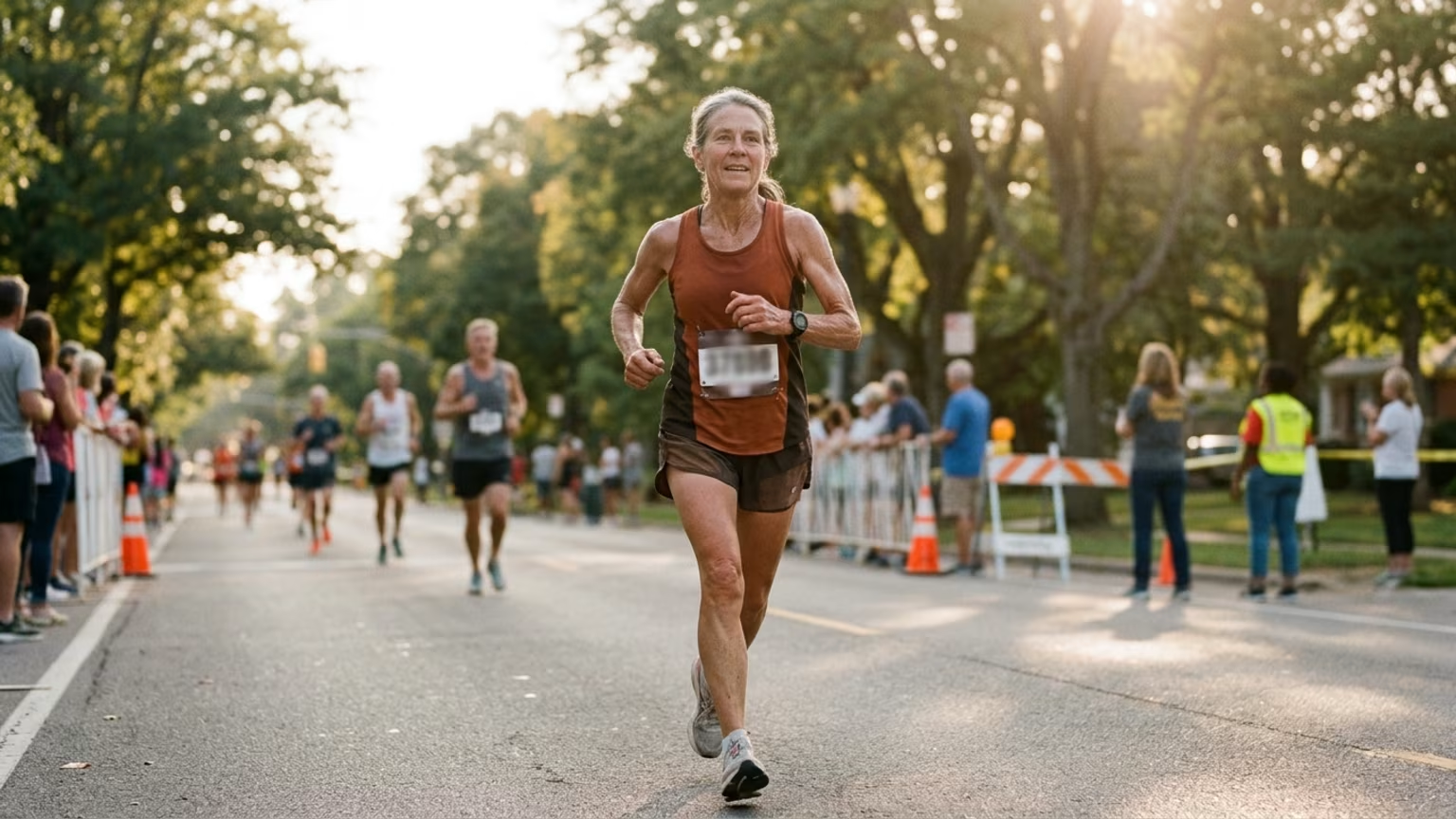

Jennifer MacDonell ran 3:23:59 at 70, with world-best ratification pending. Her goal-setting and pacing offer perspective for older endurance athletes.





Jennifer MacDonell, a 70-year-old runner from Ottawa, ran 3:23:59 at the Toronto Waterfront Marathon, according to CP24. The outlet described the result as a women’s 70 to 74 age-group world best pending official ratification.
Radio-Canada dated the race to October 18, 2026, and reported that her result had been submitted to World Masters Athletics for recognition. It reported the previous mark as 3:27:00, set by France’s Laurence Dupont Alnet in 2024. MacDonell’s time was 3 minutes and 1 second faster than that reported mark.
The performance deserves attention on its own terms. But for endurance athletes thinking about their next decade of racing, the background is just as relevant. CTV reported that MacDonell began running in her mid-30s and has completed more than 20 marathons.
That places the record attempt within a much longer history of participation. The story is not simply about an outstanding finish at 70. It is also about someone who started as an adult and continued pursuing demanding goals later in life.
The details of her preparation give that ambition a concrete shape. According to Radio-Canada, she had targeted the record since spring and adjusted her physical and mental preparation with her coach’s help. This was a defined objective that she had been working toward before race day.
Canadian Running reported that MacDonell also ran 1:39:42 at the Hamilton Marathon Road2Hope half-marathon about two weeks after Toronto. The outlet described that performance as a Canadian age-group record pending confirmation.
The same report credited her with Canadian age-group marks earlier in October at events in Montreal. Those included 6:51 for the mile and 21:40 for 5K. Together, the reported results document an active racing season across several distances.
CTV reported that MacDonell runs most days of the week, sometimes seven, and works with coach Steve Boyd. Those are details about her individual routine rather than a training prescription for other older athletes.
The coverage does not provide her full training volume, injury history, medical status or recovery schedule. It also offers no detailed coaching plan or independent sports-science assessment of its effectiveness. Her closely spaced races therefore provide no basis for setting someone else’s recovery timetable.
This is a profile of one athlete rather than a study of older runners. It establishes neither a population-wide performance trend nor the effects of a particular training method. The useful translation is to consider the reported features of her approach without treating her outcome as a forecast for anyone else.
For endurance athletes over 35, MacDonell’s story offers useful questions rather than a ready-made schedule. What is the goal? How does preparation relate to it? What will deserve attention during the race itself?
Those questions keep the focus on the parts of her account that readers can meaningfully discuss in their own circumstances. They also leave room for ambition that looks different from hers.
Radio-Canada reported that MacDonell had been pursuing the record since spring. CTV also reported that the record goal brought pressure and that she considered belief in her ability to achieve it important. Her account includes both determination and the weight of having a specific target.
A useful planning discussion can hold both ideas at once. A demanding goal may be worth pursuing without becoming the only acceptable outcome of a season. The question is what the target means to the athlete who has chosen it.
For one runner, that might be a faster finish. For another, it might be returning to an event or continuing to compete at a personally meaningful level. These are possible ways to define ambition rather than outcomes established by MacDonell’s experience.
Readers weighing that choice can also consider race goals with meaning beyond a personal best. The point is to choose the objective deliberately rather than borrow the headline from someone else’s season.
CTV identified Steve Boyd as MacDonell’s coach. Radio-Canada described his involvement in adjustments to her physical and mental preparation. Coaching was therefore a reported part of her record pursuit, not an explanation added afterward by observers.
For readers who work with a coach, the practical connection is a conversation about the relationship between the goal and the preparation. That discussion can address what the athlete hopes to achieve and how the proposed approach fits their circumstances. It need not begin with matching another runner’s frequency.
Reendure’s look at planning a half-marathon build for masters athletes offers a related planning topic. Personal questions about injury or medical readiness belong with a qualified healthcare professional.
In her account to CTV, MacDonell said she concentrated on maintaining an even pace and not getting ahead of herself. That is a useful distinction between the outcome she wanted and the task she described during the race.
The record was the larger objective. Even pacing was her stated focus while running. Her account does not require an elaborate interpretation to be relevant: a highly ambitious goal still had to be approached through the decisions made during the event.
For readers reviewing their own racing, a practical question is whether they can describe their intended race task as clearly as their finishing goal. That is a reflection prompted by her account rather than a pacing formula. The coverage supplies no split schedule to reproduce.
There is also no need to turn her description into a judgment about motivation. She reported feeling pressure around the goal while still focusing on how she wanted to run. Both parts belong in the story.
A performance like MacDonell’s can be motivating without becoming a standard that everyone else must meet. Admiration does not require comparison. An age-group world-best attempt and an individual runner’s next meaningful race can both deserve serious attention.
For the 35 to 65 audience, the most constructive reading is not to work backward from her result and assign an equivalent target. It is to consider what continued participation and purposeful competition mean in one’s own life. That keeps the example relevant without making it compulsory.
Her account also gives ambition more substance than a general message to believe in yourself. The reporting describes a chosen objective and a coaching relationship. It also includes her stated attention to pacing and her experience of pressure.
Those details are worth keeping together. Removing the preparation would turn the story into a motivational slogan. Removing the personal meaning would reduce it to a finishing time.
For Reendure, present-day performance and long-term participation are both worth taking seriously. MacDonell’s story fits that outlook because it centres an athlete still choosing demanding goals. The value is in recognising her achievement while leaving readers free to define their own.
MacDonell’s reported 3:23:59 marathon is a remarkable individual performance. The surrounding coverage adds a longer running history and a clear account of what she was pursuing. Her descriptions of preparation and pacing make the story more useful than the result alone.
For older endurance athletes, the practical takeaway is to give personal goals the same seriousness without adopting her routine as a template. A clear objective and an honest discussion about preparation are reasonable subjects to take into the next planning conversation.
The available evidence does not establish a reason to change training or recovery practice. It does offer a concrete example of continued competitive ambition at 70. That is worth celebrating on its own terms.

Follow ReEndure for practical insights on endurance training, recovery, nutrition and healthy aging. Stay connected for new articles, research led guidance and ideas to help you perform better for longer.



Read practical ideas on endurance training, recovery, nutrition and healthy aging to keep progressing for years to come.
Read the Blog