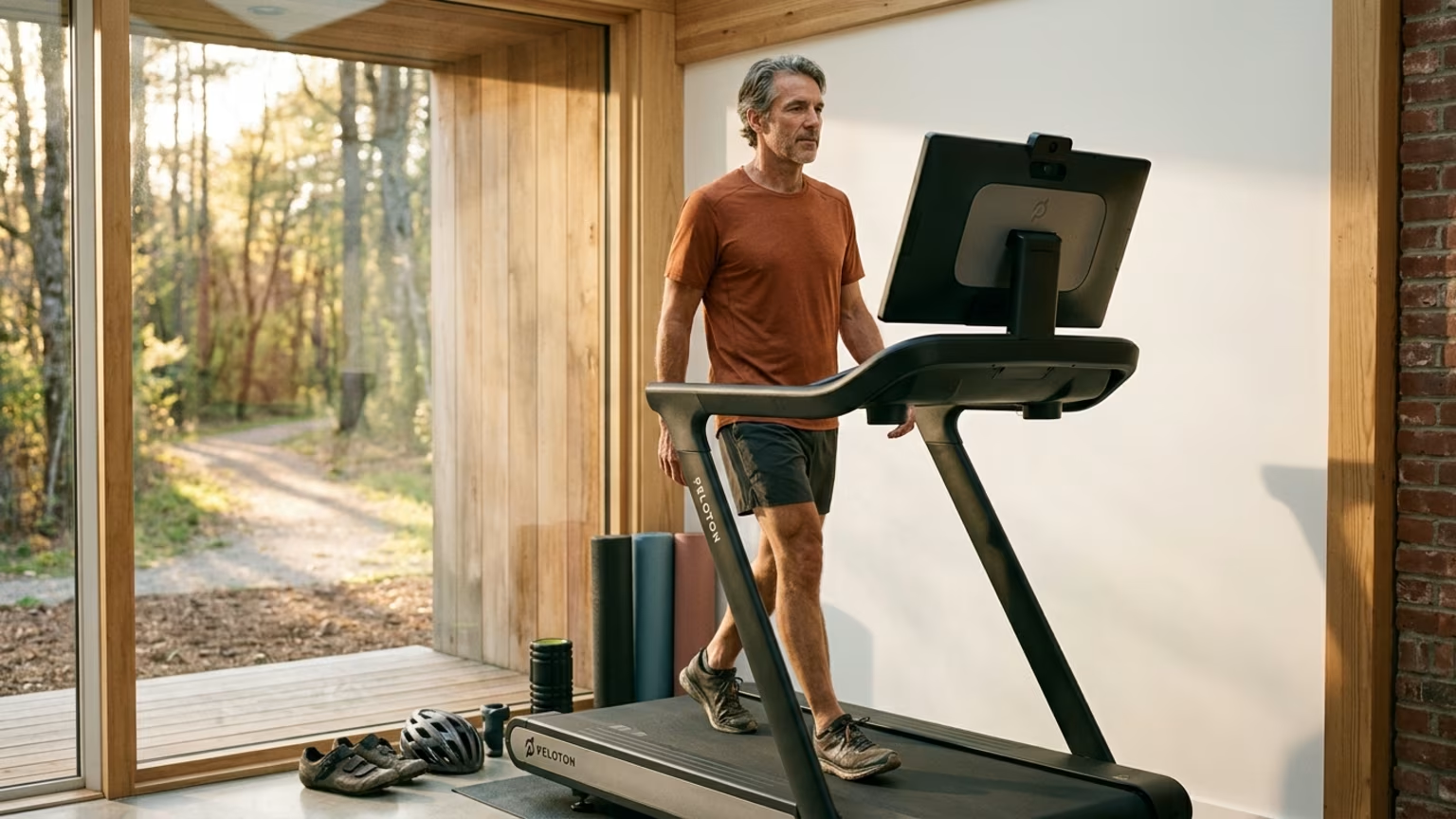

Peloton is launching three AI-equipped treadmills on October 1, 2026. Here is how ambitious veteran athletes should interpret the new running form feedback.





On September 23, 2026, Peloton announced three new treadmills aimed at the indoor running market. The hardware expansion introduces models equipped with camera-based movement tracking and automated form feedback. These products are scheduled for release in the United States beginning October 1, 2026. This launch marks a definitive expansion of the Peloton ecosystem beyond connected cycling.
The company is releasing three distinct tiers of treadmills to target different types of runners. The entry model is the Tread Flex. It starts at $2,195 and serves as Peloton’s first foldable treadmill designed specifically for users with limited space. This base model focuses on compact convenience rather than advanced motion tracking.
The midrange Tread Vision starts at $3,495. It adds a movement-tracking camera, a new cushioning system, and post-run feedback regarding your running mechanics. This model is aimed at athletes seeking integrated coaching data during their routine indoor miles.
The premium Tread+ Vision carries a cost of $6,695. This model includes an energy-returning slat belt, AI-powered movement insights, and a heavy resistance mode. The specialized sled mode offers up to 300 pounds of resistance for strength-focused intervals. The two Vision models utilize a built-in camera to monitor your physical movement on the belt. This integrated camera system can also count repetitions during specific off-belt strength exercises.
To process all this visual data, the company updated its digital ecosystem. The expanded Peloton IQ software analyzes cadence, vertical oscillation, and stride length. It uses these variables to generate running-related insights and a proprietary running-efficiency score. The software can also recreate outdoor routes by adjusting the treadmill incline to mimic the specific terrain of a selected run.
This launch represents a crucial strategic shift for the fitness company. According to Morning Brew, Peloton saw its market capitalization fall approximately 97 percent from a pandemic-era peak of roughly $50 billion. The company has also lost roughly 500,000 paid subscribers over the previous three years. CEO Peter Stern described the treadmill launch as a big move beyond the bike, stating the company was going all in on its treadmill category.
Financial analysts have taken note of this strategic pivot. Investing.com reported that UBS reiterated a buy rating following the treadmill announcement. The financial firm described the launch as a key part of the broader hardware and software strategy for the company. The Tread Flex is expected to launch initially in North America, while the Tread+ Vision is aimed at the United States and Canada.
The core technology relies entirely on computer vision rather than wearable physical sensors. As you run on the Vision or Tread+ Vision models, the integrated camera observes your body position relative to the belt. It records your stride length, measures how many steps you take per minute, and calculates how much you bounce vertically with each footfall. The Peloton IQ system aggregates this visual data to provide an overall efficiency score after your workout concludes.
However, this analytical system relies solely on optical estimates from a fixed front-facing angle. A recent report explicitly cautioned that these measurements are strictly coaching information. They should never be interpreted as a medical assessment or a clinical gait analysis. Furthermore, the feedback cannot serve as a promise of injury prevention for any athlete.
The collected data is intended to guide daily training rather than definitively diagnose complex biomechanical flaws. The treadmill simply tracks your stride characteristics and presents them as historical trends. Athletes must interpret these trends against their own perceived exertion, physical fatigue, and workout goals. The entry-level Tread Flex model does not include this movement-tracking hardware at all.
For the ambitious athlete over 35, indoor training is often a highly valued tool for training consistency. A controlled treadmill environment removes the unpredictability of dark mornings, severe weather, and icy roads. Adding objective data about your cadence and vertical oscillation can seem incredibly valuable for refining your technique. However, veteran runners must view this automated data through the lens of long-term physical durability.
Form feedback from a machine is a training aid, not an absolute mandate to change your stride. Hitting my forties brought a harsh reality check regarding how my body recovers from intense efforts. The track workouts were not getting slower, but the days after them felt significantly heavier. Instead of forcing my old Tuesday and Thursday intensity schedule, I looked at the data on Masters athletes and muscle protein synthesis.
I pushed my second hard session to Friday, allowing an extra forty eight hours of low intensity recovery. My total weekly volume stayed the same, but the quality of my intervals skyrocketed. That experience taught our team a vital lesson about using data to manage physical stress rather than compound it. When you receive a running-efficiency score from a treadmill camera, you cannot let it override your actual recovery status.
Chasing a longer stride length or a higher cadence while carrying heavy fatigue will only shift the impact load to vulnerable tissues. Older runners should look for repeatable trends across similar workouts rather than a single ideal score. Your form will naturally change based on your running pace, muscular fatigue, and the specific goal of your session. If your cadence drops significantly at the end of a long progression run, that data point provides useful context about your stamina.
You can use that specific metric alongside your heart rate and perceived exertion to measure your current endurance capacity. Sudden attempts to alter your mechanics based on artificial intelligence can be inherently risky. Altering your posture or vertical movement abruptly can overload tendons that have adapted to your natural stride over decades of running. Any mechanical adjustments should be gradual and carefully integrated with your overall running form and injury prevention strategy.
Your body strongly prefers the movement patterns it already knows well. The resistance training feature on the premium Tread+ Vision presents an interesting development for hybrid athletes. The ability to pull up to 300 pounds of resistance directly mimics heavy sled pushes and pulls. We know that heavy resistance work provides tremendous benefits for masters runners seeking long-term joint stability.
It builds essential durability and muscular power that pure aerobic volume simply cannot provide on its own. However, the $6,695 price tag for the top tier model is substantial and warrants careful consideration. You must weigh whether an integrated resistance mode offers more practical value than a standard gym membership or heavy kettlebells. The most critical factor for athletic longevity is absolute consistency in both aerobic volume and progressive strength training.
The hardware you choose must reliably support your ability to recover and train safely again tomorrow. Route simulation offers a highly practical benefit for specific race preparation. Recreating the exact incline profile of a target race allows you to practice climbing and descending mechanics in a controlled setting. This feature is especially helpful if you live in a flat geographic area but are training for a hilly event.
Understanding how endurance performance changes with age means recognizing that specific muscular endurance requires highly targeted physical preparation. Ultimately, outdoor running and dedicated strength work must remain fundamental pillars in your training plan. A treadmill provides a highly controlled, forgiving surface for structured interval sessions and recovery miles. However, it cannot fully replicate the varied structural demands of uneven outdoor terrain.
Racing requires your ankles, knees, and hips to stabilize against unpredictable forces on changing surfaces. Balancing indoor metric tracking with outdoor physical resilience is the true key to healthy aging in endurance sports. You should leverage technology to gather insights, monitor workload, and simulate difficult race profiles. True athletic mastery involves combining external data with your own hard-earned physical intuition.
Camera-based form feedback provides useful movement metrics for controlled indoor sessions, but ambitious veteran runners must always prioritize internal physical cues and sound recovery principles over an algorithm's efficiency score.

Follow ReEndure for practical insights on endurance training, recovery, nutrition and healthy aging. Stay connected for new articles, research led guidance and ideas to help you perform better for longer.






Read practical ideas on endurance training, recovery, nutrition and healthy aging to keep progressing for years to come.
Read the Blog