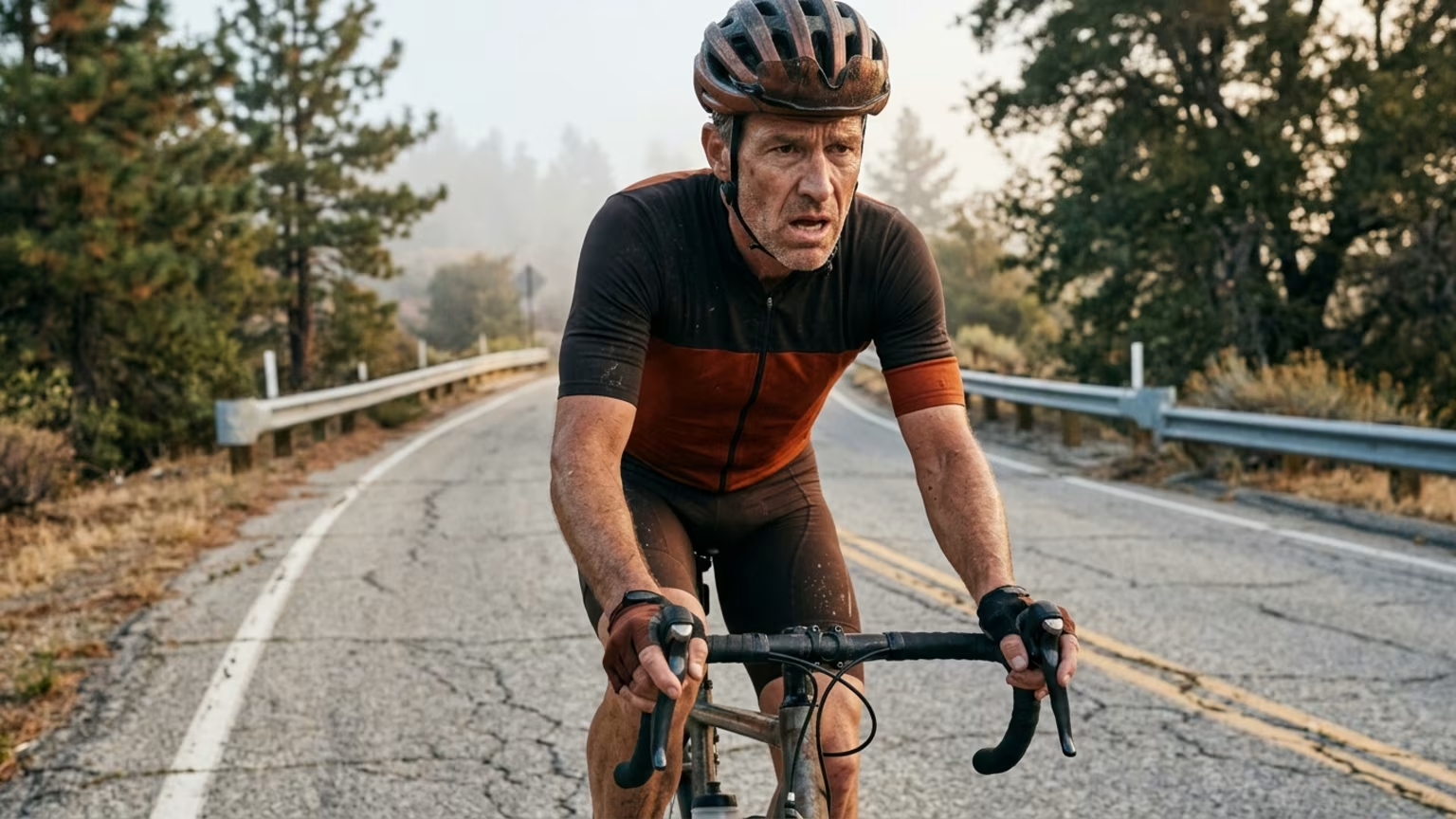

A reported cycling study links severe sleep loss to higher perceived effort. A careful look at the findings and implications for athletes over 35.





PezCyclingNews reported on October 16, 2026, that participants in a 2025 study rated moderate cycling as more effortful after 25 hours without sleep. Its account also described no significant effect on a separate time-trial test. Together, those findings raise a useful question for endurance athletes: how should we interpret a harder-feeling session when measured performance appears unchanged?
The answer starts with separating the outcomes. How demanding exercise feels and how someone performs in a particular test are related questions, but they are not interchangeable measurements.
According to the PezCyclingNews account, a 2025 study in the European Journal of Applied Physiology examined 26 male amateur cyclists and triathletes. Participants reported higher perceived effort during moderate-intensity cycling after 25 hours without sleep.
Perceived effort is the athlete's assessment of how hard the exercise feels. In this report, the important finding was a change in that assessment during moderate cycling. The same general intensity category felt more demanding after the sleep-loss condition.
PezCyclingNews also reports that the study found no significant effect on 20-minute time-trial performance. This was a distinct outcome from the effort ratings collected during moderate cycling. The account therefore describes a change in the experience of exercise without a statistically significant change in the reported performance test.
That is not inherently contradictory. The effort rating addresses the experience of doing the work. The time trial addresses performance in a particular test. Treating either result as a substitute for the other would lose part of the finding.
There was also a recovery result. According to PezCyclingNews, perceived effort returned to baseline after one subsequent recovery night. Here, baseline means the comparison level for that outcome before the reported increase.
The account deserves careful handling. PezCyclingNews published it as a sponsored post about activities and recovery between indoor cycling sessions. It was not a standalone presentation of the research. The article does not supply the study title or author names, and it provides neither a DOI nor a detailed protocol.
That leaves important methodological questions unanswered. The available summary does not explain the size of the change in perceived effort or provide detailed results for inspection. It supports discussing the reported direction of the findings rather than assigning them a precise practical magnitude.
The sample also sets boundaries. The report identifies 26 male amateur cyclists and triathletes. It does not establish a result specific to athletes over 35 or justify applying the findings equally across sexes and endurance sports.
The sleep condition matters just as much. Going 25 hours without sleep is not equivalent to an ordinary short night or a typical interrupted night. This account does not quantify what those more familiar situations would do to effort or performance.
Likewise, a finding of no significant effect on the time trial is not proof that sleep loss leaves cycling performance unaffected. It concerns the reported test rather than every possible performance outcome. The return of perceived effort to baseline after a recovery night also does not establish that every aspect of recovery had returned to baseline.
These boundaries define the useful interpretation. This is a report of a specific sleep-loss condition and a limited set of outcomes, not a complete account of sleep and endurance performance.
For an athlete balancing endurance ambitions with work and family commitments, the practical value is interpretive. The report offers a reason to keep sleep context alongside the experience of a session. It does not require a new training system.
Reendure's view is that the size of a recommendation should match the strength of its evidence. Here, that means taking the effort finding seriously without turning a short study summary into a rule for every disrupted week.
The most useful reading is not that performance matters more than effort, or that effort matters more than performance. Both belong in the account of a session. An athlete can acknowledge what was completed while also acknowledging that completing it felt unusually demanding.
That distinction prevents an unhelpful choice between dismissing the sensation and dismissing the result. A performance outcome does not need to invalidate the athlete's experience. Equally, a harder-feeling session does not need to erase what the athlete accomplished.
As a practical interpretation, a training note can hold both observations without forcing an immediate conclusion about fitness. The relevant context is what the session involved and how it felt alongside the recent sleep situation. Our guide to combining training data with perceived effort offers a broader framework for keeping those perspectives together.
PezCyclingNews recommends protecting bedtime, particularly before an early ride or interval session. It also suggests putting the phone aside before bed. These are the article's practical recommendations rather than interventions shown to improve performance in the featured study.
For a busy endurance athlete, the planning question is straightforward: does the proposed schedule leave room for sleep? That question can sit alongside decisions about when a session happens. It need not become another performance target or a reason to judge an imperfectly executed training week.
A separate cycling-focused overview describes seven to nine hours of sleep as general guidance for active people. That is background guidance, not a sleep target established for participants in the featured study. Individual sleep or medical decisions belong with a qualified healthcare professional.
The practical emphasis is on protecting the opportunity for sleep rather than claiming control over every night's outcome. That keeps the recommendation within the scope of the advice actually reported.
The PezCyclingNews article also suggests drinking fluids and eating a meal after demanding training. Those are general post-session recommendations in its broader indoor-cycling discussion. They are not findings from the sleep study.
Keeping that distinction visible matters. A recovery article can combine research findings with reasonable practical advice, but those elements do not all carry the same evidential weight. The sleep result should not be presented as a test of the article's entire recovery routine.
For the reader, the useful habit is to ask which claim comes from the study and which comes from the surrounding advice. In this case, the study summary concerns sleep loss and reported exercise outcomes. The bedtime and post-session suggestions belong to the article's recommendations.
The report is better treated as context than as an automatic instruction to cancel or complete a workout. It supplies no validated readiness threshold or session-adjustment rule. Adding one would go beyond the available evidence.
For athletes considering broader planning questions, our discussion of adjusting training around fatigue and life stress is a separate resource. The distinction is important: interpreting this research report and deciding how to manage an individual training situation are different tasks.
A long-term approach can leave room for both ambition and honest reporting of effort. There is no need to make a session sound easier than it felt simply because the performance result looks acceptable.
The clearest takeaway from the PezCyclingNews report is that severe acute sleep loss was associated with higher perceived effort during moderate cycling. The reported performance test told a different part of the story.
For endurance athletes over 35, the practical message is modest: protect the opportunity for sleep and keep the experience of a session in view alongside its result. The evidence supports paying attention to that distinction. It does not demand a wholesale change in training.

Follow ReEndure for practical insights on endurance training, recovery, nutrition and healthy aging. Stay connected for new articles, research led guidance and ideas to help you perform better for longer.


Read practical ideas on endurance training, recovery, nutrition and healthy aging to keep progressing for years to come.
Read the Blog