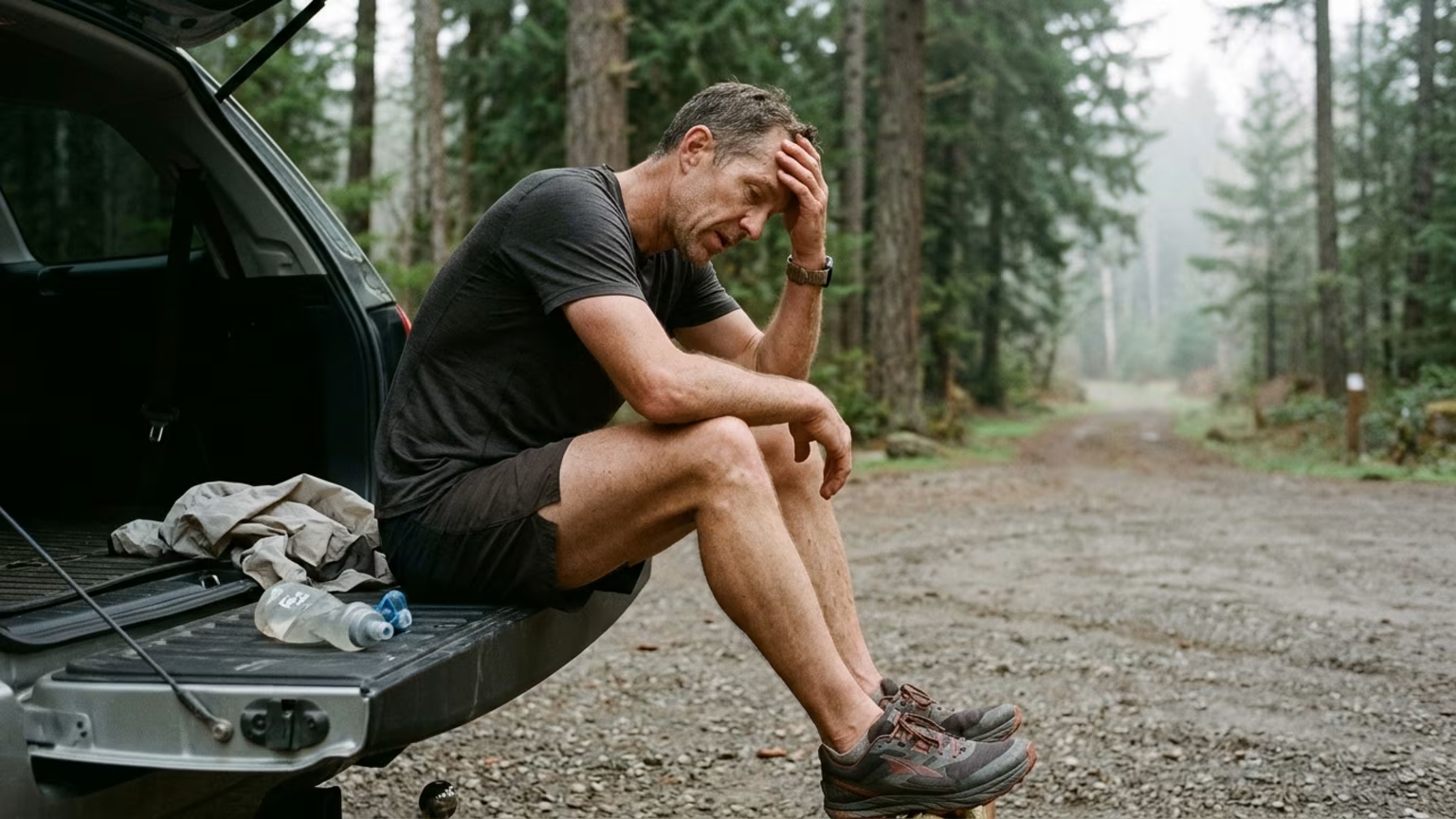

A sleep-loss study found earlier exhaustion during an arm hold. Here is what the brain-network findings mean for endurance athletes over 35.





In its October 21, 2026 report, Six Minute Mile described a study in which 35 young men stopped a sustained arm exercise sooner after fewer than four hours of sleep. Muscle sensors detected no significant difference in how quickly their muscles fatigued.
Brain recordings also suggested altered communication among networks involved in attention, movement and sensory processing. Together, those observations raise a useful question for endurance athletes: after severe sleep restriction, might sustaining effort become harder for reasons that a muscle measurement alone does not capture?
The task was straightforward. According to Six Minute Mile, participants held a resistance-band biceps contraction until exhaustion after normal sleep and again after restricted sleep. They stopped sooner in the restricted-sleep condition.
The central finding concerns how long participants sustained that specific effort. This was an observed difference in task performance, not merely a report that participants felt tired. The outcome was an earlier end to the hold.
The muscle and brain measurements provide context for that outcome. Six Minute Mile describes no significant difference in the measured rate of muscle fatigue, alongside changes in communication among brain networks. Its proposed explanation concerns the networks involved in attention, movement and sensory processing.
In plain English, the researchers were looking beyond the working muscle to understand why the effort ended earlier. The distinction is between the performance result and its possible explanation: participants stopped sooner, while the recordings offered a clue about what accompanied that change.
That distinction makes the research interesting without requiring a dramatic conclusion. A sustained effort ended earlier under severe sleep restriction. Understanding that result requires looking at more than the muscle-fatigue measurement alone.
PsyPost identifies the paper as “Changes in athletes’ brain network connections during isometric muscle contractions after sleep restriction,” published in the International Journal of Psychophysiology. Its coverage says participants in the restricted-sleep condition stayed awake until 3 a.m. and were woken at 7 a.m.
That schedule helps define the experiment. This was a deliberately short sleep opportunity rather than a comparison between broadly described good and bad sleepers. The same participants completed the sustained contraction under normal-sleep and restricted-sleep conditions, according to Six Minute Mile.
The measurements addressed different parts of the task. Researchers recorded how long participants maintained the contraction and used muscle sensors to assess fatigue. PsyPost also reports brain-wave recordings that showed differences in connectivity during the effort.
Several limits belong together. This was a short-term experiment in young men using a stationary arm task, not a trial of running or cycling performance. It does not establish whether the result applies to women or endurance athletes aged 35 to 65. The coverage also does not provide an exact reduction in holding time.
The brain-network changes accompanied earlier stopping, but the reports do not establish that those changes caused it. Likewise, finding no significant difference in one muscle-fatigue measure does not establish that sleep loss leaves muscles unaffected across exercise settings. The experiment did not test a training adjustment or establish a universal sleep threshold for changing a workout.
These boundaries define the finding rather than erase it. The study offers a specific observation and a possible explanation. Its value is in sharpening the question about sustained effort, not settling every decision that follows a poor night.
For athletes over 35, the most useful translation is a matter of judgment rather than a new training requirement. As a conservative interpretation, severe sleep restriction is a reasonable reason to reconsider an all-out session or adjust expectations. Neither response needs to become an automatic rule.
Reendure's focus is on immediate performance alongside long-term participation. From that perspective, the useful question is not whether a poor night demands punishment or compensation. It is whether the planned session still serves its purpose under the circumstances.
A demanding workout does not have to become a test of whether an athlete can ignore a very poor night. The research gives a reason to take that situation seriously without treating it as a verdict on fitness.
One practical option is to consider avoiding an all-out effort. Another is to adjust expectations rather than insisting that the original target must remain the only acceptable outcome. These are conservative choices about training priorities, not claims that a particular adjustment will reverse the observed changes.
That distinction preserves ambition. A decision to place less weight on one session is not the same as lowering a long-term goal. For an athlete focused on staying competitive for years, the purpose of the plan matters more than proving commitment through a single workout.
It helps to distinguish three questions: what was planned, how the effort feels and what actually happens during the session. They are related, but they are not interchangeable. A target describes an intention; completing the effort is an outcome.
This is where using effort to frame pacing decisions can provide a useful way to think about expectations. The aim is not to replace every performance target with a feeling. It is to keep the target in its proper role as a guide rather than an obligation.
The question of perceived effort also deserves its own attention. Our separate discussion of sleep loss and effort perception addresses that related topic. In the present experiment, the central observation was the earlier end to a sustained contraction.
For the veteran athlete, these distinctions support a calmer review of a difficult session. A disappointing outcome can be considered in context without immediately becoming a broad judgment about training quality or athletic ability.
Six Minute Mile's editorial takeaway is to prioritize sleep before a major endurance effort. That is a proportionate emphasis for this report. The finding gives sleep a place in the preparation conversation without requiring a complicated new recovery strategy.
The practical emphasis can stay simple: treat a severely restricted night as relevant information when considering demanding training. Give yourself room to reconsider an all-out effort or revise expectations. Avoid turning the laboratory sleep schedule into a pass-or-fail rule for every morning.
This approach is consistent with an ambitious training outlook. Long-term commitment does not require interpreting every session as a test of toughness. It allows judgment to sit alongside the plan.
For personal health decisions involving persistent sleep difficulties, seek guidance from a qualified clinician. A sports-science report is useful context for that conversation rather than a substitute for individualized care.
The important result is specific: after severe sleep restriction, participants sustained an arm hold for less time while brain recordings showed altered network communication. The muscle sensors did not detect a significant difference in the rate of fatigue.
For endurance athletes over 35, the modest practical takeaway is to give a very poor night appropriate weight when considering an all-out session. Adjusting expectations is a reasonable option, not a requirement imposed by this study.
The strongest response is neither alarm nor dismissal. Keep sleep part of preparation, keep the finding in context and let the purpose of training guide the decision.

Follow ReEndure for practical insights on endurance training, recovery, nutrition and healthy aging. Stay connected for new articles, research led guidance and ideas to help you perform better for longer.



Read practical ideas on endurance training, recovery, nutrition and healthy aging to keep progressing for years to come.
Read the Blog