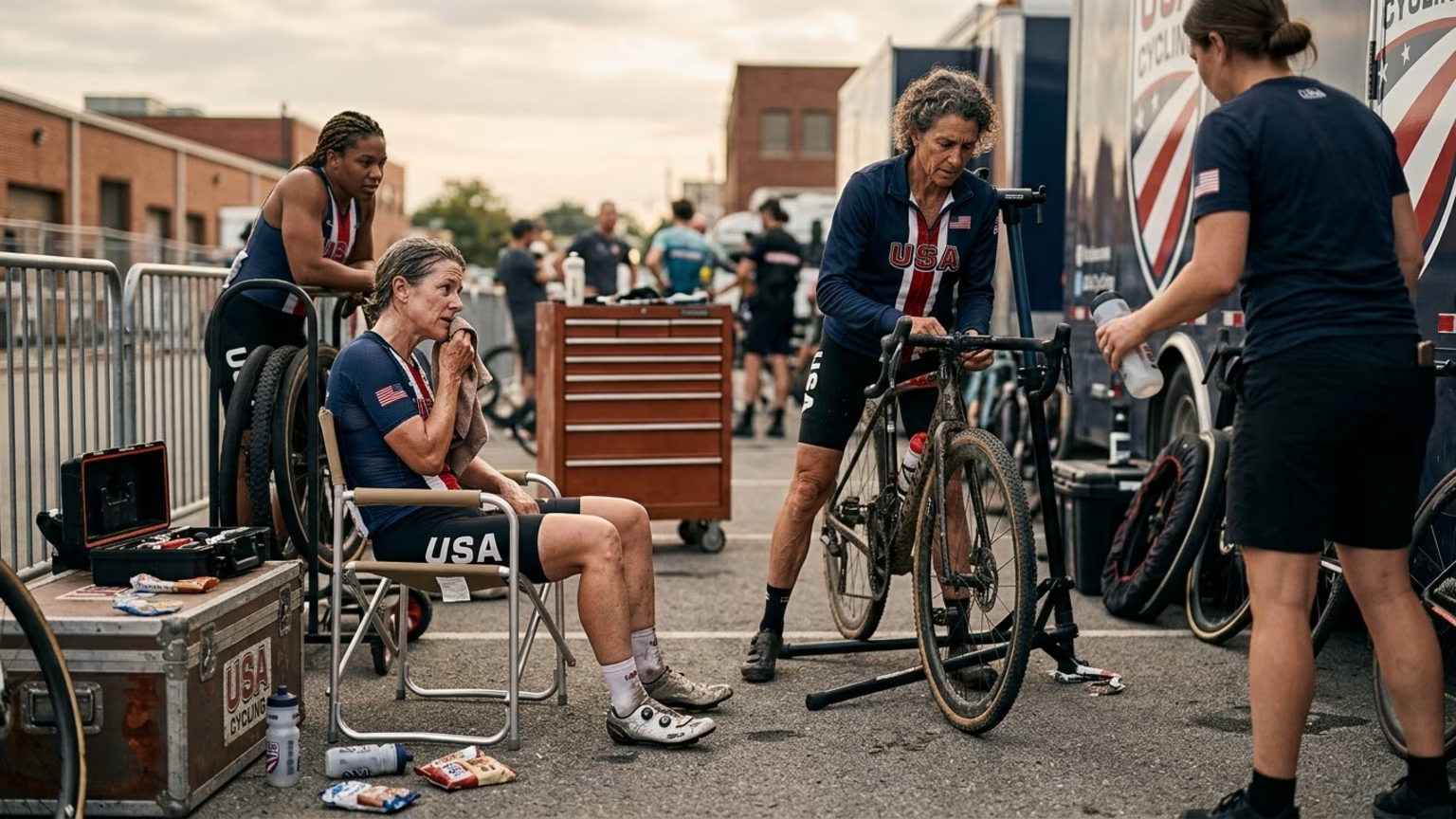

Team USA navigated the 2026 UCI Road World Championships without race radios. Ambitious endurance athletes can apply these lessons to pacing and race fueling.





On September 27, 2026, The Athletic published a detailed report on Team USA's preparation for the elite women's road race at the UCI Road World Championships in Montréal. The race itself took place on September 26, 2026. The media coverage highlighted the operational challenges of navigating a championship event where real-time radio communication is strictly prohibited. This technical restriction forces athletes to rely entirely on pre-race planning and their own tactical awareness on the road.
For veteran athletes, the report provides a compelling look at how professionals manage uncertainty. The insights drawn from the American squad reveal how heavily elite cyclists depend on internal communication and flexible contingency plans.
The championship event in Montréal set a grueling new standard for endurance demands on the world stage. The UCI described it as the longest women's elite road race in its World Championships history. Competitors faced an arduous 180.4 kilometers of racing that included 2,570 meters of cumulative climbing. Demi Vollering of the Netherlands secured the victory with a finishing time of 4:45:09, finishing ahead of Kasia Niewiadoma-Phinney and Elisa Longo Borghini.
While the physical demands were historic, the tactical constraints truly defined the race dynamics. World Championship events prohibit the use of team radios. This rule removes the constant stream of data, pacing advice, and strategic adjustments that define modern professional cycling. Instead, communication between coaches and riders was limited to traditional roadside chalkboard timings or the risky maneuver of a rider returning to the team car.
This restriction fundamentally changes how an athlete manages their physical effort. Instead of reacting to a coach's immediate command, the rider must interpret the tactical situation in real time. They must constantly calculate whether to follow a sudden attack or maintain a steady threshold pace. This dynamic requires immense mental focus over nearly five hours of intense physical exertion.
This silent racing environment requires teams to build extensive contingency plans before the starting gun fires. USA Cycling's women's team director, Rachel Hedderman, noted during a pre-race meeting that the team could devise 27 distinct scenarios for the day. She also acknowledged a hard truth of endurance racing. None of those carefully mapped scenarios might actually unfold as expected.
The event proved her point rapidly as the peloton rolled out. The team assigned specific roles to manage the chaos and protect their key riders. Natalie Quinn was tasked with monitoring early breakaways on the course, and she successfully joined a move just 15 kilometers into the day. This early action forced the Dutch squad to burn energy chasing the breakaway before Quinn was eventually caught.
The preparation for a 180.4-kilometer race begins long before the athletes arrive at the start line. The official US roster featured Kristen Faulkner and Kate Courtney alongside Alexis Magner, Natalie Quinn and Lauren Stephens. This group relied on months of extensive course analysis by Hedderman. The challenging route featured a 64-kilometer opening loop followed by eight grueling laps of a 13.4-kilometer finishing circuit.
Hedderman and the coaching staff focused their tactical discussions on critical sectors of the urban course. They identified potential crosswinds and a notoriously chaotic bridge section as key areas for group positioning. Because riders could not rely on a director in their ear, each athlete had to memorize these critical zones. The riders needed to know exactly when to move to the front of the peloton to avoid trouble.
Tanner Putt, USA Cycling's director of road, noted that wide roads can still create severe positioning problems. He warned that riders might get swarmed by competitors when the pace eases and other athletes come alongside them. He also described road captains as experienced riders who guide teammates directly on the course. Putt cautioned that any rider returning to the team car for instructions could easily miss important race developments.
The team also built a strategy around sheltering key riders to conserve their physical energy. Magner was assigned to protect Courtney from the wind for the first 50 kilometers of the race. Additionally, the coaching staff planned different attack timing for Faulkner and Courtney. Courtney noted that positioning required substantial mental and physical energy for her, and following Magner temporarily could help conserve those vital reserves.
Despite these detailed assignments, the unpredictable nature of racing took a heavy toll. A major crash involved Courtney and effectively ended her chances of competing at the front. The incident left her with minor abrasions, and a teammate had to help pace her after a mandatory bike change. At the finish line, CyclingNews reported that Faulkner placed 21st and Stephens finished 40th.
The events in Montréal offer a powerful case study for ambitious adult athletes. When you strip away the support vehicles and the radio earpieces, the professionals face the same fundamental challenges as any age-group competitor. You must learn to execute a race plan while managing unpredictable variables on the course. The physical preparation only matters if you can adapt to the actual conditions of the day.
Older athletes often build highly structured race plans to ensure consistent pacing. This is a very sound approach for long-term athletic progression and injury prevention. However, strict adherence to a rigid plan can become a massive liability when conditions suddenly change. A delayed start, an unexpected headwind, or a missed feed station requires immediate and calm adaptation.
Many athletes over the age of 35 fall into the trap of over-analyzing their data during an event. They stare at their power meters or heart rate monitors instead of reading the race unfolding around them. The American squad in Montréal had no choice but to read the peloton and react intuitively. You must cultivate that same situational awareness during your own local races.
Reendure consistently advises athletes to develop strong internal pacing awareness. You should occasionally train without live data to build this vital skill. When your technology fails on race day, your internal gauge becomes your primary pacing tool. You can review pacing lessons from recent global championships to see how elite runners manage similar challenges.
Nutrition logistics are another area where careful planning meets harsh reality. The USA team spent significant time discussing bottle order and feed zone management. They planned to collect bottles on the circuit laps and redistribute them among the riders based on physical need. This kind of planning ensures that riders do not miss critical hydration during key moments of the race.
Personal preference plays a massive role in successful endurance fueling. During the race, Faulkner opted for two bottles of drink mix rather than relying heavily on carbohydrate gels. She found it challenging to consume multiple gels while racing hard. Furthermore, she wanted to avoid the extra weight of carrying numerous gels on such a steep and demanding course.
The logistics of carrying your nutrition also require careful thought. Faulkner's decision to avoid heavy gels on a climbing route is a prime example of optimizing your setup for the course. Age-group competitors often overload their pockets with unnecessary weight out of fear of bonking. Instead, calculate your precise hourly needs and plan your on-course resupply points strategically to stay light and efficient.
This highlights a crucial lesson for ambitious older athletes. You must build a nutrition plan that actually works for your stomach and your race environment. The UCI Sports Nutrition Project published a position statement in September 2026 that underscores the importance of in-competition fueling. It explicitly notes age-specific and sex-specific considerations alongside general cycling demands.
You should test your own fueling strategy thoroughly during intense training blocks. Identify whether you absorb liquid calories better than solid food when climbing or riding near your threshold. Finding the right balance for extreme race fueling is a deeply individual process that requires real-world testing. What works in a laboratory might fail on a hot mountain pass.
The U.S. team's experience with crashes and early breakaways reinforces the need for flexible thinking. Hedderman's 27 scenarios represent an exercise in mental preparation rather than a rigid predictive script. You should adopt this exact same mindset when preparing for your most important target events. The goal is to think through potential problems before they occur in real time.
When you train for a marathon or a long gravel race, you spend months building physical fitness. However, that physical capability only translates to a strong finish if you can navigate the logistical hurdles of the day. You should mentally walk through the race course the week before your event. Identify the feed zones, the exposed sections of road, and the steep climbs where pacing errors are most costly.
Consider the variables you can control and calmly accept the ones you cannot. If you are targeting a major event this season, you might benefit from a structured race prioritization framework. Treat your preparation as a toolkit rather than a rigid promise of a specific outcome. Determine in advance how you will respond to a flat tire, a dropped nutrition bottle, or bad weather.
The primary objective is not to predict exactly how the race will unfold. The true goal is to build enough physical and mental resilience to handle whatever the course delivers. When you rehearse these variables in training, you remove the panic from race day. Practicing these scenarios will help you stay driven without burning out over a long season.
Ambitious endurance athletes must build flexible race plans and practice self-reliant pacing to succeed when external support and carefully scripted scenarios inevitably fail.

Follow ReEndure for practical insights on endurance training, recovery, nutrition and healthy aging. Stay connected for new articles, research led guidance and ideas to help you perform better for longer.




Read practical ideas on endurance training, recovery, nutrition and healthy aging to keep progressing for years to come.
Read the Blog