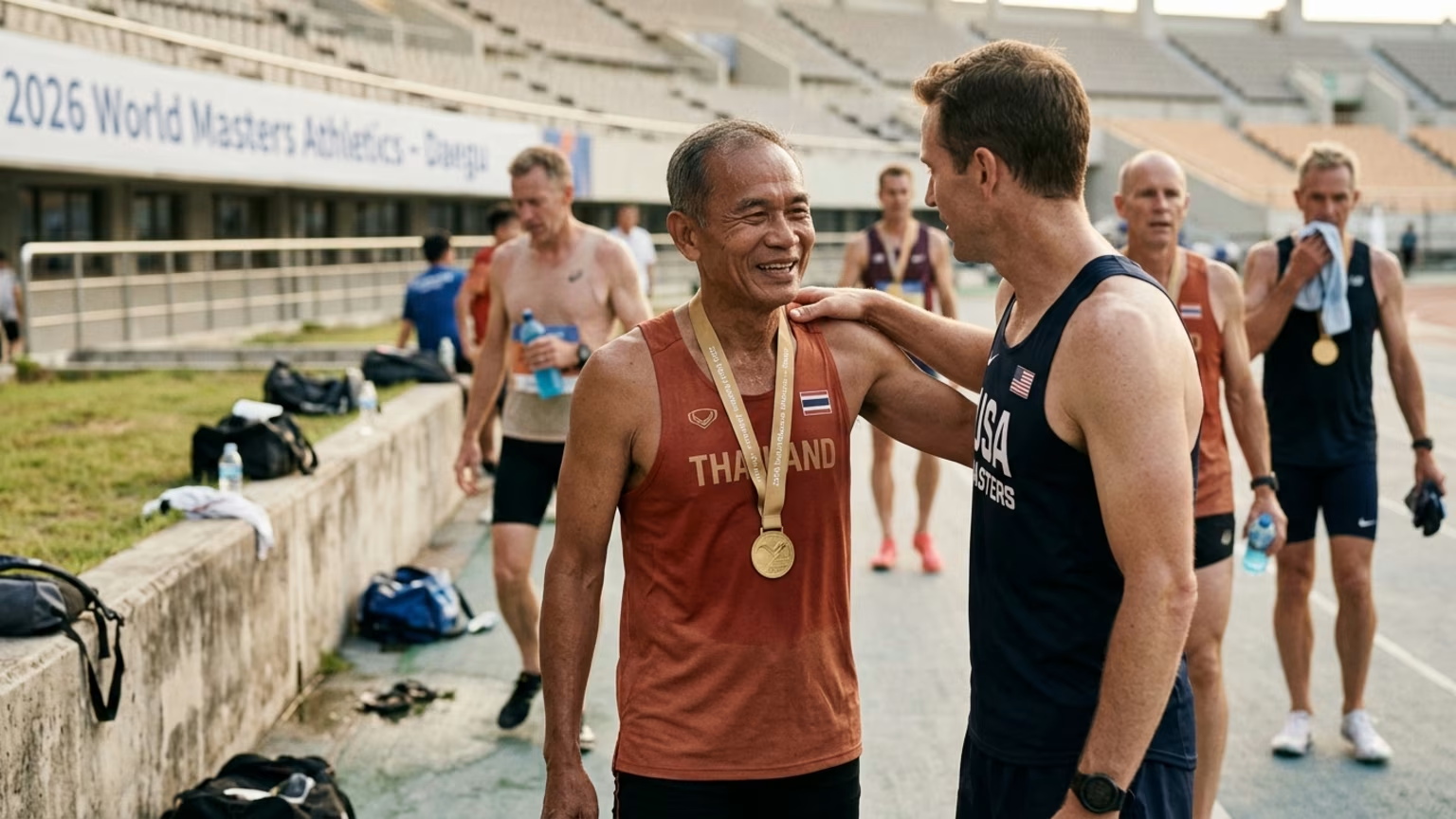

106-year-old Sawang Janpram won two gold medals at the Daegu World Masters Athletics Championships. Here is what his longevity teaches midlife athletes.





On August 29, 106-year-old Sawang Janpram recorded a 10.04-meter throw with a 400-gram javelin to secure his second gold medal at the 2026 Daegu World Masters Athletics Championships. This exact distance matters because it represents a measured athletic achievement rather than a mere participation trophy. Janpram recorded his winning mark on his very first attempt, proving his focused physical capability. His second and third throws were 9.08 meters and 9.30 meters. This performance shows endurance athletes that sustained physical output remains possible far beyond conventional expectations. The most pressing question midlife athletes ask is whether such late-stage performance requires a lifetime of elite competition. The answer is no, because adopting consistent strength and aerobic habits even in later decades can fundamentally alter your trajectory.
Many athletes assume that competitive days end when they reach a certain age. However, Janpram only began exercising regularly at age 80. According to coverage, he made this change after watching a friend suffer from declining health. He did not spend his youth competing on the world stage.
Instead, he built a sustainable routine that eventually led him to international masters competitions. The Asia Business Daily reported that his daughter Siripan, a Thai masters athlete herself, influenced his entry into these events. This late start challenges the idea that significant athletic achievements require decades of prior accumulation. Janpram won the discus title on August 27 with a 7.59-meter mark.
This result was reported as a world record in the amateur 100-and-over division. Endurance athletes in their 40s and 50s should view this timeline as highly encouraging. You have decades ahead to refine your approach and maintain your physical engine. The primary lesson is to think in terms of lifelong capability rather than immediate seasonal peaks.
When athletes set strategic goals for longevity, they prioritize consistency over unsustainable intensity. During the championships, reporters noted that Janpram walked or jogged lightly in a nearby park. He also maintained a simple diet, telling reporters he ate a breakfast of eggs or fruit. Janpram reportedly stated his next goal is a major athletics competition in Phetchabun in 2027.
Organizers and news reports identified Janpram as the oldest competitor at the Daegu championships. His presence at the event highlights how masters athletics provides structured competition for every stage of life. He competed in the 100-and-over category alongside other competitors in substantially younger divisions. This structure allows athletes to measure their progress against their peers rather than against absolute youthful benchmarks.
It is important to understand the context of his recent javelin victory. Reports noted that Janpram was the sole competitor in his age category for the event. His 10.04-meter throw was also below the division's reported 12.42-meter world record. This means his gold medal came from showing up and completing a measured performance.
It was not the result of defeating a massive field of international rivals. For midlife endurance athletes, this context actually makes the achievement more relevant. The goal of lifelong training is not necessarily to beat everyone else. The true victory lies in maintaining the physical health required to simply reach the starting line.
Measuring success by your ability to participate actively is a core component of building a sustainable training strategy. Sustained participation is a massive victory in itself. Showing up consistently year after year proves that your daily habits are working. Reendure advocates for this exact shift in competitive mindset as athletes age.
Janpram participated in throwing events rather than traditional endurance races. Therefore, his specific performance does not translate directly to marathon running or long-distance cycling. However, his success relies on a principle that applies to all disciplines. Technical skill remains a vital asset even as absolute strength or aerobic capacity changes with age.
Throws require precise coordination, timing, and biomechanical efficiency. As endurance athletes age, they often try to compensate for slowing recovery by simply pushing harder. This approach frequently leads to injury and frustration. A smarter strategy involves continuous technical practice to maximize mechanical efficiency.
Refining your swim stroke or running form can yield significant performance dividends over time. Athletes should treat technique as a long-term investment that pays off when brute force declines. Pacing by effort instead of ego is one technical skill that masters athletes must develop. Better pacing prevents early fatigue and allows for stronger finishes.
Focusing on these tactical elements keeps you competitive and engaged with your sport. Technique is the one variable that can continuously improve. When speed naturally fades, efficiency becomes your primary performance driver.
While Janpram offers an inspiring personal example, athletes should also look to established clinical guidelines. A summary of World Health Organization guidance provides a clear framework for healthy aging. The recommendations suggest 150 to 300 minutes of moderate aerobic activity weekly. Alternatively, individuals can perform 75 to 150 minutes of vigorous activity.
These targets provide a solid cardiovascular baseline for adults of all ages. For endurance athletes, hitting these aerobic minimums is rarely a problem. The real challenge often lies in avoiding the temptation to ignore other crucial aspects of fitness. Aerobic volume should never completely crowd out other necessary physical work.
The same guidance clearly states that adults should include muscle-strengthening work at least twice weekly. Maintaining a simple strength program preserves the physical qualities needed for endurance sports. A study discussed in the European Journal of Applied Physiology highlighted the clear benefits of lifting weights. The study reported tendon and mechanical-property improvements in men after 12 weeks of resistance training.
The report noted that performing resistance training three times per week increased the cross-sectional area of several tendons. These structural changes occurred in both younger and older men. Exercises like squats, hinges, and loaded carries support better running economy and cycling posture. This balanced approach ensures you maintain resilience against the repetitive stress of endurance training.
As athletes move into their later decades, pure cardiovascular fitness is not enough to secure independence. The WHO guidance summary specifically emphasizes balance and coordination activities for older adults. These elements are often neglected by runners and cyclists who move exclusively in a linear, forward direction. Without targeted practice, stability and coordination will naturally decline over time.
Endurance athletes should treat balance work as essential technical insurance. Incorporating single-leg stability drills and controlled step-downs can prevent minor missteps from becoming major injuries. Uneven-surface walking and lateral movements also challenge the nervous system in beneficial ways. You can easily integrate these small doses of stability work into your existing warm-up routines.
Relying solely on aerobic capacity leaves you vulnerable to functional decline in everyday life. A strong heart must be paired with a capable and responsive musculoskeletal system. By incorporating strength and stability frameworks, masters athletes build a robust defense against aging. This comprehensive preparation allows you to travel, compete, and handle daily tasks with confidence.
When Janpram launched that 10.04-meter javelin throw in Daegu, he achieved much more than a medal. He demonstrated that the human body can respond to consistent physical demands well past the century mark. The most valuable takeaway for ambitious midlife athletes is not that exercise produces a world record. It is that combining aerobic exercise with strength, balance, and coordination builds a resilient foundation for life.
Your current training habits are writing the script for your future capabilities. Janpram did not need a lifetime of elite competition to stand alone on that podium at 106. He simply needed the willingness to start at 80 and the discipline to continue. For those of us decades younger, the path forward is clear.
We must shift our focus from immediate seasonal triumphs to sustainable, lifelong participation. By prioritizing technique, strength, and recovery, we ensure that we can keep showing up to the starting line. True athletic success means retaining the freedom to move, compete, and thrive in the decades to come.

Follow ReEndure for practical insights on endurance training, recovery, nutrition and healthy aging. Stay connected for new articles, research led guidance and ideas to help you perform better for longer.





Read practical ideas on endurance training, recovery, nutrition and healthy aging to keep progressing for years to come.
Read the Blog