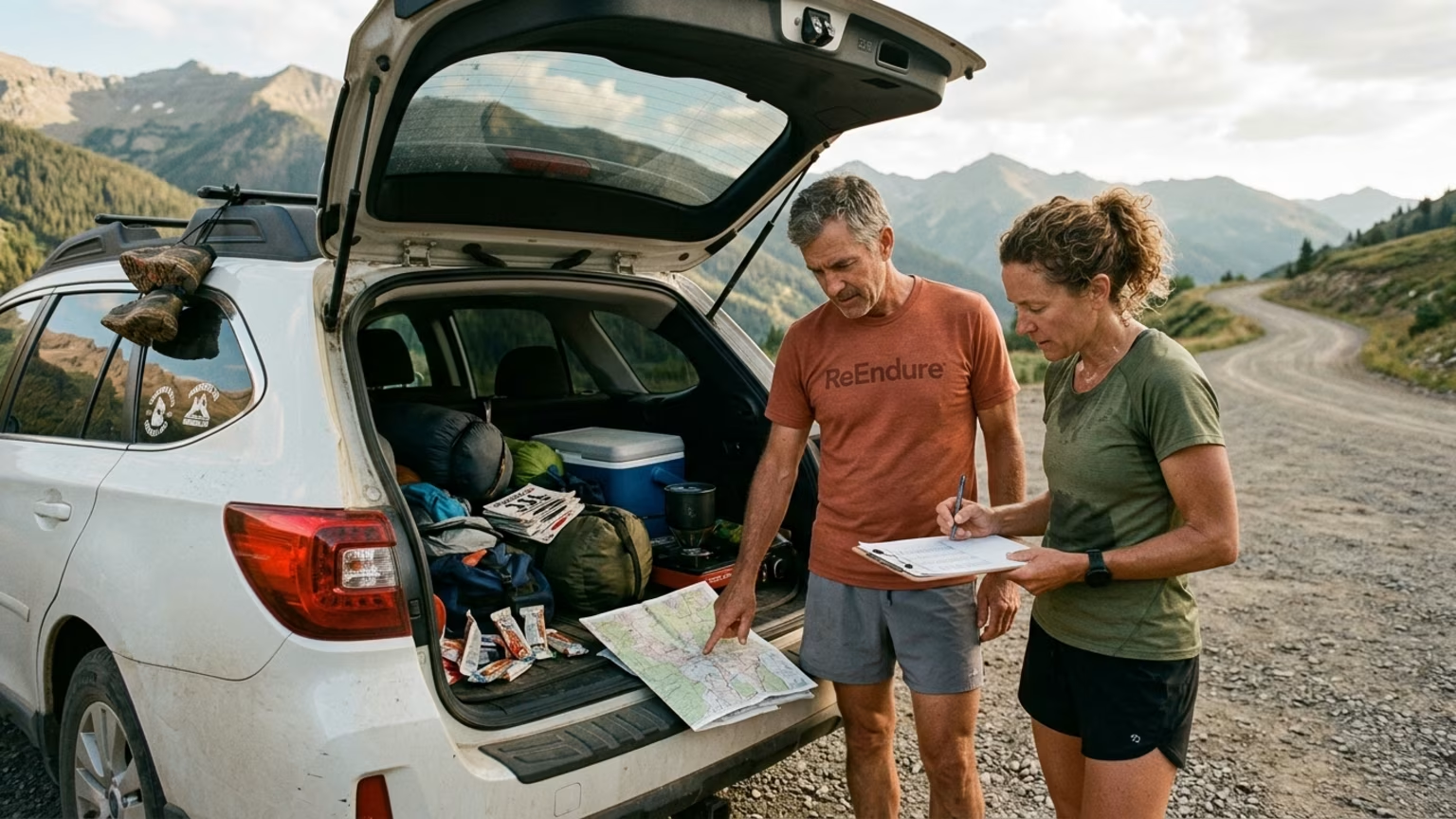

Trail Runner Magazine documented a 2,485-mile journey between Western States and Hardrock. Learn how travel stress and altitude impact older endurance athletes.





On September 18, 2026, Trail Runner Magazine updated a long-form photo feature documenting the unglamorous realities of ultramarathon travel. The feature follows Swedish photographer Jacob Zocherman on a 21-day journey across the American West. He covered approximately 2,485 miles in a rental car. The route connected the Western States 100 in Auburn, California, with the Hardrock 100 in Silverton, Colorado.
Rather than a conventional race report, the story highlights the cultural and environmental extremes of the American West. Zocherman describes the landscape as geographically and meteorologically intense. He moved constantly among mountains, deserts, forests, and coastlines. The piece documents the intense logistical friction that athletes and crews face during back-to-back event blocks.
The primary conclusion of the feature is that moving through these environments creates immense physiological stress. It strips away the polished social media image of endurance travel. Zocherman explicitly contrasts idealized adventure narratives with the realities of financial strain and physical exhaustion. Travel is not simply a background activity that happens between starting lines.
The trip exposed the sheer friction of daily life on the road. Moab reached 110 degrees, keeping most people indoors. Wildfire smoke choked the air near the San Juan Mountains. The story depicts coughing runners and the intense physical toll of high-elevation climbing. Zocherman himself reported experiencing exploding lungs while ascending toward an aid station.
This friction extends to basic recovery needs. The feature portrays race travel as a relentless mix of uncomfortable sleeping arrangements and improvised meals. Zocherman slept in a tent, rested in a rental car, and suffered back pain from sleeping upright. He cooked noodles in the back of his vehicle while trying to sustain his energy for the long driving days.
The feature is an observational travel essay rather than a controlled medical study. Zocherman spent three weeks embedding himself in the temporary communities that form around major endurance events. His journey spanned California, Nevada, Utah, and Colorado. At Western States, he traveled from Reno to Olympic Valley and Auburn to cover the 2026 race.
He spent time at the Robinson Flat aid station to observe the concentrated media presence and the intense activity at the front of the pack. The environment at Western States was highly public and energetic. An aid-station captain publicly welcomed everyone regardless of where they came from or whom they loved. This highlighted the inclusive nature of the event despite the fierce competition.
The Hardrock segment offered a stark contrast characterized by mountain isolation and rugged camping. Zocherman camped in the national forest near Silverton and traveled toward the Engineer Aid Station. After a week in Colorado, the article reports two course records and 116 race finishers. It notes Courtney Dauwalter securing her fourth Hardrock victory and mentions Ludovic Pommeret among the athletes preparing for the event.
The trip also documented the unconventional lifestyles of people drawn to these remote spaces. Zocherman met Dave Campbell, a 74-year-old man who has lived in his pickup truck for 30 years. While Campbell is not a race participant, his story illustrates the camp-style living prevalent in the ultra community. The story repeatedly connects travel, migration, and belonging, showing how people form temporary networks in remote places.
For the ambitious athlete over 35, this story highlights a critical vulnerability. Younger runners might bounce back easily from a night in a rental car and a meal of instant noodles. For a veteran athlete, combining long driving days with irregular meals and poor sleep is a recipe for physical breakdown. This accumulated fatigue directly impacts your ability to perform and recover.
Hitting my forties brought a harsh reality check. The track workouts were not getting slower, but the days after them felt significantly heavier. Instead of forcing my old Tuesday and Thursday intensity schedule, I looked at the data on Masters athletes and muscle protein synthesis.
I pushed my second hard session to Friday, allowing an extra forty eight hours of low intensity recovery. My total weekly volume stayed the same, but the quality of my intervals skyrocketed. We apply this exact same logic to race travel. You cannot treat a three-week road trip as a neutral period without consequences.
It is vital to adapt summer mileage and pacing structures to account for travel fatigue. The physical cost of crossing multiple environments is measurable and significant. In our Science Backed Training Guides, we emphasize that athletes must deliberately build recovery logistics into their travel plans.
Research strongly supports the need for deliberate rest during elevation changes. A review summarized by the High Performance Center reports that sudden altitude changes can disrupt sleep. It causes more awakenings, less deep sleep, lower oxygen saturation, and increased periodic breathing. Sleeping in a cramped vehicle only compounds these physiological sleep disruptions.
The consequences of poor rest are immediate. A recent study in the CISS Journal measured how lost sleep impacts next-day readiness. It associated each additional hour of individualized sleep debt with a 15.1 percent reduction in a specific recovery measure. The same study linked this sleep debt to a 4.34 percent drop in heart-rate variability and a 1.70 percent increase in resting heart rate.
This means that prioritizing sleep and tissue recovery is non-negotiable on the road. A reliable sleeping surface and a quiet environment are fundamental performance tools. Enduring poor sleep in a tent does not make you a tougher athlete. It simply reduces your physical capacity for the actual race.
Acclimation and fueling present their own set of challenges during mountain travel. Many athletes assume that simply being near a mountain race will trigger useful physiological adaptations. A recent study in PubMed Central found that endurance-trained athletes living at approximately 1,200 meters preserved more VO₂max at 2,500 meters than sea-level counterparts. However, a short road trip does not guarantee this same level of systemic adaptation.
Furthermore, high altitude significantly alters how the body processes fuel. Hardrock course director Brett Sublett told The Journal that extreme elevation can make food difficult to ingest. He observed that some runners rely heavily on liquid calories to maintain their energy levels. Combining this altitude-induced appetite suppression with improvised roadside meals is a major risk factor.
Veteran athletes need a framework for endurance longevity that includes robust travel logistics. Plan your rest stops, secure proper accommodations, and bring familiar nutrition. Do not let the idealized image of dirtbag travel ruin months of structured training.
To maintain performance during extended travel, veteran athletes should follow a few evidence-based guidelines.
Older endurance athletes must treat the logistical demands of travel, altitude, and sleep disruption as active stressors that require as much deliberate planning as the race itself.

Follow ReEndure for practical insights on endurance training, recovery, nutrition and healthy aging. Stay connected for new articles, research led guidance and ideas to help you perform better for longer.




Read practical ideas on endurance training, recovery, nutrition and healthy aging to keep progressing for years to come.
Read the Blog