

A new coaching framework outlines six essential recovery habits for athletes over 35, emphasizing daily protein targets and a practical load management rule.





On September 21, 2026, WFMD published an article summarizing six post-workout recommendations from fitness coach Jacob Zemer. The published material was originally attributed to Fox News Digital. The featured expert primarily works with clients between 35 and 55 who prioritize long-term longevity over powerlifting. This new report outlines a practical checklist for managing physical stress as older athletes continue to train.
Zemer argues that recovery strategies become increasingly critical as adults age. He notes that older muscles may become less responsive to protein and other important muscle-building signals. The article frames all exercise as a continuous cycle of a physical stress response, structural adaptation, and subsequent rest. If an athlete lacks adequate recovery time, the initial physical stress will fail to produce its intended benefits.
To combat this blunted physical response, the framework suggests six specific daily habits. The first recommendation urges adults to obtain seven to nine hours of quality sleep every night. The second step advises keeping up with individualized checkups and routine laboratory testing. The article specifically identifies blood pressure, prediabetes, and osteoporosis as key screening areas tied to U.S. Preventive Services Task Force guidance.
The third recommendation proposes using targeted heat exposure to aid the body after a difficult session. The article notes that a simple hot shower can serve as a practical substitute when a traditional sauna is unavailable. The fourth step focuses entirely on stretching and maintaining physical mobility. Zemer bases this advice on his view that muscles become shortened during exertion and must be actively lengthened afterward. He suggests moving joints through a complete range of motion after strength training is complete.
The final two habits focus on fueling and hydration to manage the stress of intense training. Zemer emphasizes drinking fluids before and after exercise to prevent a drop in performance. For nutrition, the article cites guidance from the International Society of Sports Nutrition regarding daily macronutrient targets. It recommends consuming approximately 20 to 40 grams of high-quality protein shortly after completing a training session.
The framework also provides clear targets for total daily consumption to ensure sufficient energy availability. It establishes a general daily range of 1.4 to 2.0 grams of protein per kilogram of body weight. A separate 2026 review article confirms this exact International Society of Sports Nutrition position. This scientific review likewise supports distributing protein in servings of 20 to 40 grams evenly across the day.
This recommended framework operates as a practical coaching methodology rather than a rigid clinical protocol. The article does not present a newly published controlled trial testing all six habits together. Instead, it aggregates several established concepts into an approachable routine for aging adults. The broad category of "over 35" naturally includes highly trained competitive athletes and recreational runners with vastly different needs.
Recent sports science literature continues to study the physical responses of older adults. A 2026 review evaluated high-intensity interval training in older populations and reported possible improvements in cardiorespiratory fitness. However, the review noted that heterogeneity and risk of bias concerns prevent firm conclusions about optimal exercise prescriptions. This highlights why any training or recovery plan must be highly individualized for the aging athlete.
The broader benefits of specific interventions remain heavily dependent on an individual's physical baseline. A 2026 meta-analysis evaluated the effects of combining creatine with resistance training in generally healthy older adults. The research found a small improvement in muscle strength compared to performing resistance training alone. However, the study cautioned against extrapolating these specific benefits directly to frail or functionally limited individuals.
The specific evidence supporting heat exposure is presented with cautious optimism in the published report. WFMD cites a 2025 review involving 22 separate studies on heat therapy and athletic recuperation. According to the report, nearly half of the participants experienced improved muscle-function recovery with heat exposure. However, heat therapy requires screening and may be inappropriate for athletes with certain cardiovascular conditions.
The article itself acknowledges that not every older adult needs the exact same recovery plan. It explicitly states that preventive medical testing and nutritional targets must be individualized according to sex and medical history. Protein targets should never be applied mechanically to individuals with kidney disease or other limiting conditions. Hydration protocols also require personalization since the article does not provide a universal sweat-rate equation.
For the ambitious athlete at Reendure, the most actionable idea in this report involves managing the daily training dose. Zemer notes that ordinary post-exercise soreness should generally be short-lived and resolve within one day. If muscle soreness lasts more than two or three days, it indicates that the athlete simply did too much. Understanding why muscle recovery slows down after 35 helps you set realistic volume expectations.
Aching knees or persistent joint pain should always be treated as a clear warning sign. Endorphins can temporarily mask physical discomfort while you are actively sweating through a difficult session. This biological response means the true physical cost of a hard effort might not appear until the next afternoon. Older athletes must pay close attention to these delayed physical signals to avoid chronic overuse injuries.
When soreness persists beyond three days, the framework offers a very practical load management rule. Zemer suggests reducing the workload of the very next session by exactly 30 percent. The article uses a clear weightlifting example, suggesting an athlete should reduce six sets of leg work to four sets. This sensible mathematical approach can easily be applied to weekly running mileage or interval durations.
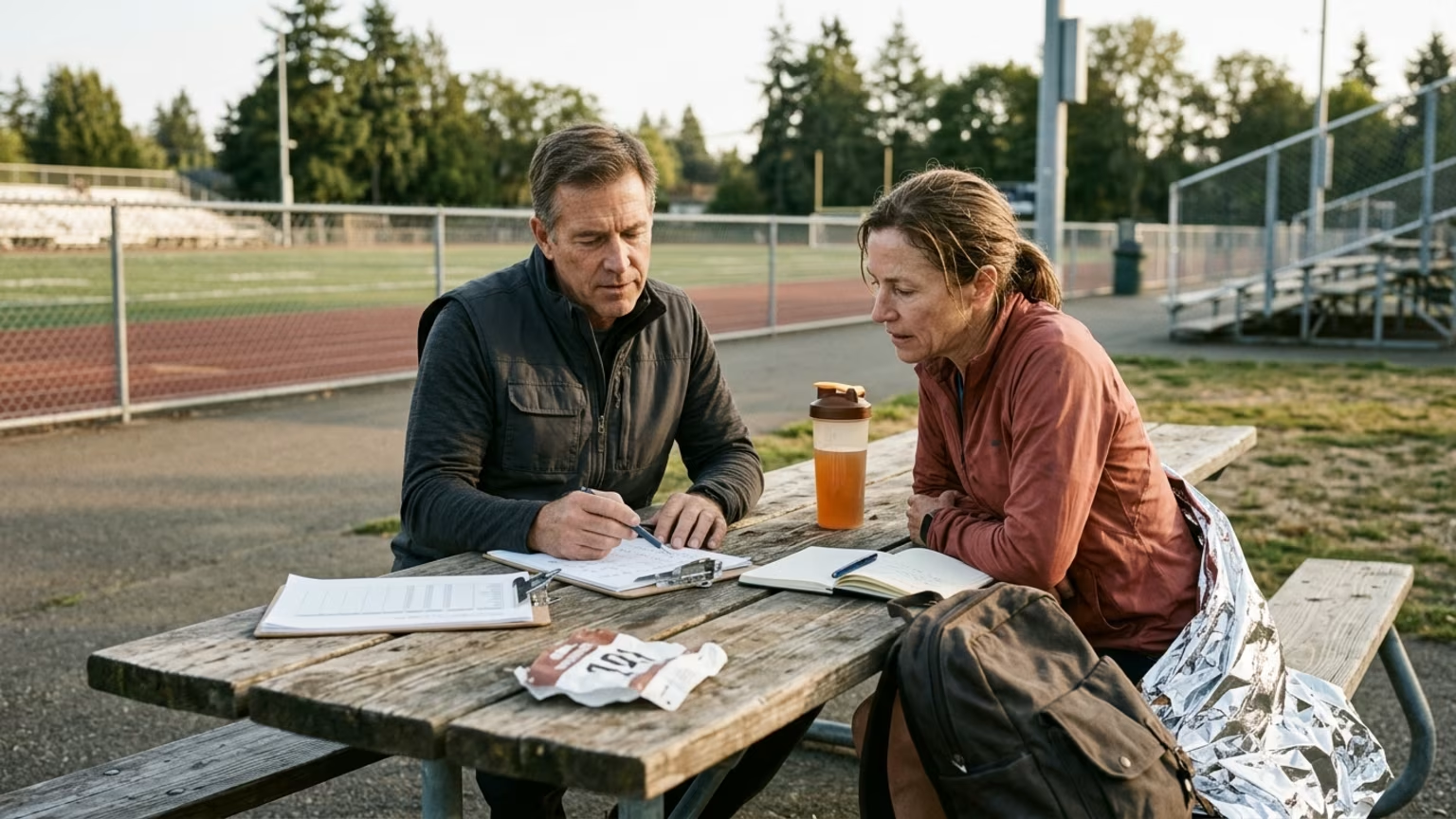
You should treat this 30 percent reduction as a practical adjustment rather than a validated clinical requirement. It pairs perfectly with deciding whether you should train today based on your subjective physical symptoms. Recording your perceived effort, sleep quality, and soreness duration in a simple log helps you recognize dangerous patterns. If a familiar workout repeatedly leaves you exhausted, you must proactively lower the intensity of future sessions.
Older athletes must also distinguish basic muscle fatigue from structural injuries requiring medical attention. Joint pain should not automatically be managed solely by reducing your weekly training volume. Persistent, worsening, or function-limiting pain warrants a thorough assessment by a qualified clinical professional. Simple mobility work will never resolve joint pain if it involves swelling, physical instability, or noticeable muscular weakness.
Endurance athletes should view fueling as an ongoing daily requirement rather than an isolated chore. How recovery changes after 35 dictates that older bodies need a consistent supply of daily nutrients. Recent sports nutrition literature continues to emphasize total daily intake rather than relying on one single feeding window. You should use the cited protein range as a starting point and adjust it based on your total training load.
Protecting your sleep and managing your daily stress response requires deliberate planning and consistency. While aiming for seven to nine hours of rest is a standard benchmark, older athletes often struggle with sleep quality. You must treat this baseline rest as an integrated part of your training plan rather than a passive afterthought. Understanding how you should use daily metrics for recovery decisions ensures that you do not ignore creeping fatigue.
For the ambitious endurance athlete, consistent training depends less on maximizing any single tactic than on matching the next hard session to how well the body has actually recovered.

Follow ReEndure for practical insights on endurance training, recovery, nutrition and healthy aging. Stay connected for new articles, research led guidance and ideas to help you perform better for longer.




Read practical ideas on endurance training, recovery, nutrition and healthy aging to keep progressing for years to come.
Read the Blog