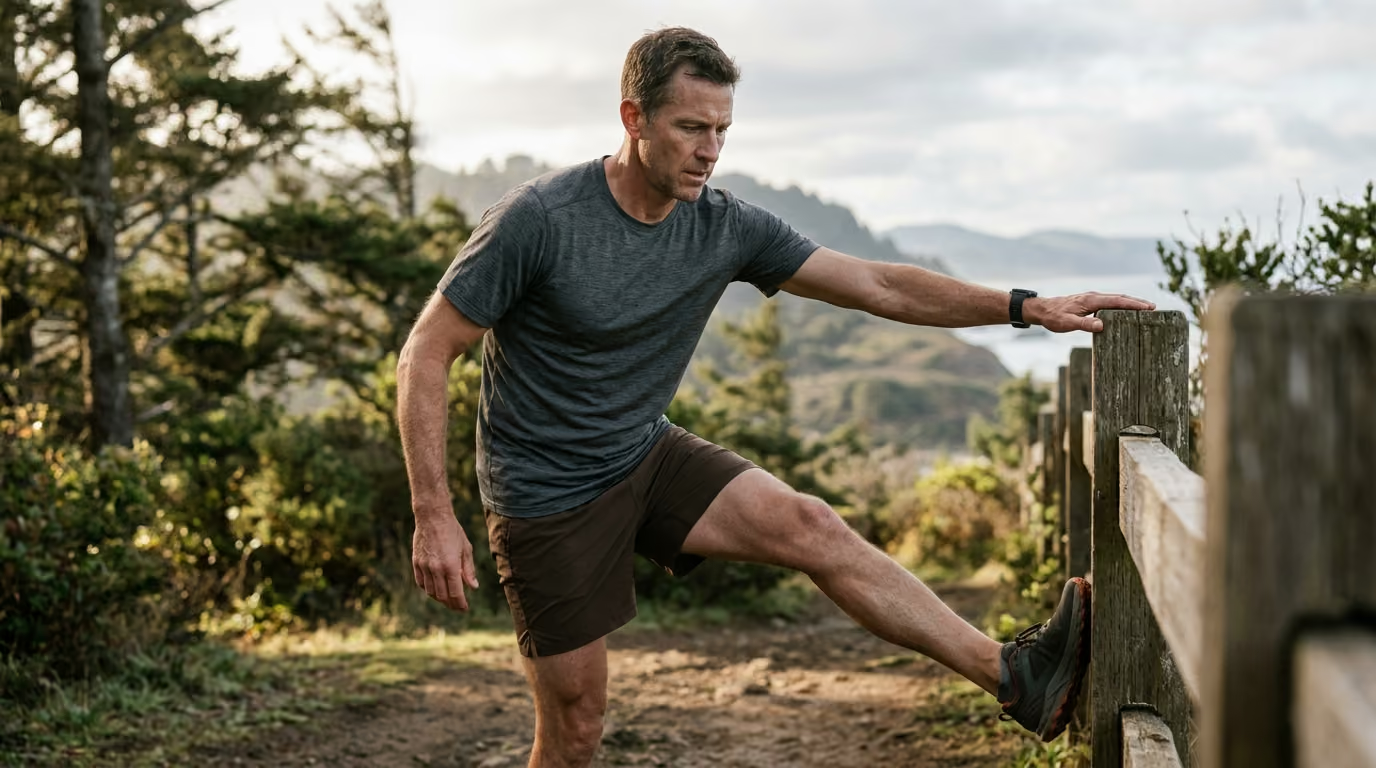

Progressive strength training and targeted loading protocols build tissue capacity in the Achilles tendon and calf complex to prevent running injuries.





Achilles and calf health is not a matter of aggressive stretching, complete rest, or hunting for a quick passive fix. True lower-leg resilience is the systematic development of tissue capacity, allowing the plantar-flexor complex to absorb and produce massive forces across thousands of running strides.
This guide examines the clinical anatomy, biomechanics, and evidence-based strength protocols required to keep the Achilles tendon and calf complex operating without pain. We will analyze why traditional rest protocols fail, how to program specific loading strategies, how masters athletes must adjust their recovery, and how to safely navigate footwear changes.
Understanding lower-leg pain requires precise terminology. For decades, athletes referred to persistent heel and tendon pain as tendinitis. Sports medicine has moved away from this term because chronic tendon problems are rarely characterized by acute inflammatory cell infiltration.
Achilles tendinopathy is a load-related disorder characterized by pain, localized stiffness, and impaired mechanical performance of the tendon and calf musculature. The condition involves cellular changes, ground substance alterations, and disorganized collagen structure.
The Achilles tendon works as part of a single functional unit called the triceps surae complex. This unit includes several distinct anatomical structures:
Clinical management depends on the exact anatomical location of symptoms. Midportion Achilles tendinopathy occurs approximately two to six centimeters above the heel attachment. In contrast, insertional Achilles tendinopathy occurs directly at the attachment site on the heel bone.
Insertional presentations often involve mechanical compression against the calcaneus during deep ankle dorsiflexion. Because of this compression, stretching the heel off the edge of a step can worsen insertional symptoms, whereas midportion cases often tolerate that range.
Calf muscle strains represent acute or subacute structural disruptions to the gastrocnemius or soleus muscle fibers. While a calf strain involves muscle tissue that heals rapidly due to rich blood flow, an Achilles tendon problem involves dense connective tissue with lower vascularity. Both conditions place interdependent demands on the lower leg, meaning a weak soleus frequently increases the tensile burden placed on the Achilles tendon.
Every step taken during running requires the Achilles tendon to behave like a powerful mechanical spring. As your foot strikes the ground, the tendon stretches under load, stores kinetic energy, and releases it during toe-off. This spring mechanism reduces the metabolic cost of running, but it exposes the tissue to forces between six and eight times your body weight.
During a simple ten-kilometer run, an athlete takes thousands of strides. If your calf musculature lacks the strength or endurance to decelerate and stabilize this force, the tendon absorbs excess stress.
Clinical practice guidelines indicate that annual incidence rates for Achilles tendinopathy in runners range from 7% to 9%. In a large prospective cohort study tracking 1,929 runners published in the British Journal of Sports Medicine, 100 runners developed Achilles tendinopathy during the observation window. The highest incidence occurred among marathon registrants at 7.4%.
The most significant risk factor identified in sports science research is a prior history of tendon symptoms. In the prospective runner study, experiencing Achilles tendinopathy in the prior 12 months increased the odds of developing a new episode by a factor of 6.3. Subsequent epidemiological research has confirmed this pattern, identifying previous tendinopathy as the primary risk factor with an odds ratio of 6.47.
This data underscores a vital training lesson for endurance athletes. Tendon rehabilitation is not finished simply because the pain has quieted down. When symptoms fade, the underlying tissue capacity often remains depressed. Without deliberate injury prevention resources and progressive strength training, returning to normal running volumes frequently triggers a rapid relapse.
Tendon health is governed by a basic relationship between tissue capacity and applied training demand. Injury rarely happens without warning. It occurs when external training demands exceed the biological capacity of the calf and Achilles complex over an extended duration.
Tissue capacity represents the maximum mechanical load your calf muscles and tendon can tolerate while recovering on schedule. This includes:
Training demand represents the sum total of physical stress placed upon that anatomical structure during training. High-demand exposures include:
When demand outpaces capacity, the tendon enters a reactive state. Many athletes respond by halting all physical activity for several weeks.
While complete immobilization removes the immediate mechanical stress, it also causes rapid muscle atrophy and degrades tendon stiffness. When the runner attempts to resume running, their tissue capacity is lower than it was before the injury.
A modern load-management framework favors relative load reduction rather than absolute rest. You remove the high-velocity, high-impact activities that irritate the tendon, while maintaining baseline calf loading through controlled resistance training. This approach preserves the muscular foundation while guiding the connective tissue back to health.
Tendons are living tissues that respond directly to mechanical signals. When tensile load is applied to a tendon, the resident cells (tenocytes) detect the strain through a process known as mechanotransduction. In response, tenocytes produce collagen and matrix proteins to reinforce the internal structure of the tendon.
According to the 2024 Clinical Practice Guideline published in the Journal of Orthopaedic & Sports Physical Therapy (JOSPT), progressive mechanical loading is the primary, first-line treatment for midportion Achilles tendinopathy. The guideline advises applying the highest mechanical loads tolerated by the individual, provided there is no evidence of structural tissue frailty.
Tendon remodeling operates on a different timeline than muscle adaptation. Skeletal muscle has a rich capillary network and adapts relatively quickly to training stimuli. Tendons have a lower metabolic rate and lower blood perfusion. Collagen synthesis peaks roughly 24 to 72 hours following an intensive loading session, but meaningful changes in tendon stiffness and cross-sectional area require months of consistent resistance training.
To navigate this adaptation safely, athletes must use an objective symptom-monitoring model. Rather than expecting zero discomfort, clinicians use a structured pain-monitoring framework to evaluate training tolerance:
Mild discomfort during exercise (up to 3 or 4 on a 10-point scale) is generally acceptable if it remains stable. The crucial metric is the next-morning response. If morning stiffness lasts less than 15 minutes and baseline walking is comfortable, the tissue tolerated the applied load.
Discomfort increases during the session or lingers into the evening. The following morning, the tendon feels noticeably stiffer, and normal walking is tender for more than 20 to 30 minutes. This indicates that the applied training demand slightly exceeded current tissue capacity, requiring an extra recovery day and a reduction in training volume.
Pain escalates progressively throughout the workout, causing the athlete to alter their running gait. The next morning brings marked pain, localized swelling, and limping during routine daily tasks. This reaction requires an immediate reduction in training intensity and a shift to low-irritability isometric exercises.
Pain severity alone does not describe the complete physical state of the tendon. However, monitoring next-morning stiffness gives runners a reliable feedback loop to guide progressive loading without causing unnecessary flare-ups.
A comprehensive calf and Achilles strength program must progress systematically through distinct loading phases. It is not enough to perform light bodyweight calf raises on a flat floor. The routine must build maximum force production, isolate both deep and superficial muscles, and develop high-speed elastic recoil.
Athletes should integrate structured training and performance strategies that build capacity before adding running intensity.
Isometric exercises involve producing muscular force without changing joint angle or muscle length. While current clinical trials show that isometrics are not inherently superior to other loading types for long-term outcomes, they provide an entry point when a tendon is reactive and painful during movement.
Isometrics allow athletes to apply heavy, static loads to the tendon unit while minimizing joint shear and compressive irritation.
Eccentric loading occurs when the muscle-tendon unit lengthens under tension. Historically popularized by the Alfredson protocol, eccentric training lowers the heel slowly against resistance to stimulate collagen remodeling.
While eccentric-only training has a long clinical history, Heavy Slow Resistance training provides equal or superior long-term results. In a randomized controlled trial published in the Scandinavian Journal of Medicine & Science in Sports, researchers compared 12 weeks of eccentric training against Heavy Slow Resistance in runners with Achilles tendinopathy.
Both groups achieved substantial, long-term improvements in symptoms and function at 12 and 52 weeks. However, the Heavy Slow Resistance group demonstrated a 92% program compliance rate compared to 78% in the eccentric group, alongside higher overall patient satisfaction.
A related controlled trial showed that heavy loading produced superior increases in tendon stiffness, maximum tendon strain, and tendon cross-sectional area compared to light eccentric training.
Heavy Slow Resistance uses both concentric (lifting) and eccentric (lowering) phases under heavy, controlled loads. Each repetition should take six seconds: three seconds up and three seconds down.
Endurance running is an elastic, high-velocity movement. Heavy resistance training builds foundational strength, but it does not train the rapid rate of force development required for running efficiency.
Before resuming fast running or hill workouts, an athlete must condition the tendon to handle rapid stretch-shortening cycles.
Achilles tendinopathy occurs across all age groups, but clinical epidemiological surveys show that its prevalence rises significantly between the ages of 35 and 60. The 2024 JOSPT guideline highlights that older age combined with high athletic training volume creates an elevated risk profile.
Aging influences connective tissue architecture. Over time, tendons experience a reduction in cellular water content, decreased proteoglycan synthesis, and a gradual stiffening of cross-linked collagen networks. Concurrently, masters athletes often face a natural decline in calf muscle volume and peak torque output.
These biological realities do not mean that older runners should avoid hard training. Instead, they require a more deliberate schedule that balances mechanical loading with systemic recovery.
Masters athletes should apply specific rules when structuring their training:
Avoid scheduling hard calf strength sessions, interval workouts, hill repeats, and long runs on consecutive days. Tendon collagen synthesis requires 48 to 72 hours to complete its adaptation cycle. Stacking fast running directly on top of a heavy calf workout can keep the tendon in a state of net collagen degradation.
Younger runners can sometimes get away with sporadic strength training, but older athletes lose muscular power and tendon stiffness quickly when resistance work is dropped. Masters runners should preserve a minimum of two weekly calf-loading sessions, even during the competitive racing season.
If an Achilles flare-up requires a temporary reduction in running mileage, masters athletes should protect their cardiovascular fitness using low-impact alternatives. Deep-water pool running, cycling, and rowing maintain high aerobic output without imposing high stretch-shortening loads on the healing Achilles tendon. For structured recovery ideas, athletes can consult dedicated recovery resources.
Tendon health is closely linked to metabolic and vascular health. Systemic conditions such as type 2 diabetes, elevated blood lipids, hypertension, and high systemic inflammation impair local microcirculation and disrupt tendon matrix turnover. Managing these metabolic markers through proper nutrition and medical oversight directly improves tissue resilience.
Certain medications can affect tendon integrity. Fluoroquinolone antibiotics (such as ciprofloxacin and levofloxacin) and systemic corticosteroids are clinically documented to increase the risk of tendon pathology and acute rupture. Masters runners should discuss their training demands with their prescribing physician whenever new medications are introduced.
For broader insights into sustaining competitive performance across decades, explore our comprehensive healthy aging resources.
Footwear selection alters how impact forces are distributed across the lower extremity. When an athlete changes their running shoes, they alter the mechanical loading demands placed upon the foot, calf, knee, and hip.
The drop of a shoe refers to the height difference between the heel and the forefoot cushioning. Traditional running shoes feature a heel drop of 8 to 12 millimeters, which elevates the heel and reduces the maximum ankle dorsiflexion angle during stance.
Low-drop (0 to 4 millimeters) and minimalist shoes place the foot parallel to the ground. This geometry shifts initial ground contact toward the midfoot or forefoot, which reduces impact forces at the knee joint.
However, this shift requires the calf and Achilles tendon to absorb substantially higher mechanical loads to decelerate the ankle.
A systematic review published in the Journal of Science and Medicine in Sport examined injury patterns during transitions to minimalist footwear. The overall injury rate during the transition was 17.9 injuries per 100 participants in minimalist shoes compared to 13.4 per 100 in traditional shoes.
In a randomized clinical trial tracking runners unfamiliar with minimalist footwear, participants assigned to minimalist shoes experienced significantly higher rates of calf pain and overall injury (20% and 38% across two minimalist groups) compared to 13% in conventional footwear. A related 12-week transition study demonstrated notable Achilles tendon structural remodeling in runners, reflecting the heightened triceps surae demand.
Minimalist and low-drop footwear can be integrated into training, but shoes are not a magic fix for running form. They represent a distinct training stimulus that requires gradual adaptation.
To safely transition footwear without irritating the Achilles tendon, follow these guidelines:
Athletes interested in equipment selection and biomechanical considerations can review our guides on gear and technology.
When managing Achilles and calf issues, athletes often fall into predictable training errors. Avoiding these common mistakes can shorten recovery times and prevent chronic setbacks.
While eccentric exercises are useful, treating them as the only effective loading method is outdated. Heavy Slow Resistance training provides comparable clinical outcomes with better structural tendon adaptation and higher compliance. A complete plan must combine static holds, heavy concentric-eccentric work, and high-speed elastic drills.
Halting all physical activity will temporarily alleviate tendon pain, but it lowers the tissue capacity of the calf complex. Prolonged rest leads to muscle atrophy, reduced tendon stiffness, and altered motor coordination. When running is resumed at previous volumes, the deconditioned tendon is even more vulnerable to overload.
Many endurance runners only perform standing calf raises with straight knees, which biases the gastrocnemius. The soleus acts as the primary engine for sustained running, generating up to eight times body weight in force during stance. Neglecting seated, bent-knee calf training leaves a critical gap in lower-leg force capacity.
A qualitative review of clinical return-to-sport criteria reveals that painless walking is insufficient proof of athletic readiness. Walking exposes the Achilles tendon to a fraction of the forces generated during running.
Before resuming running, an athlete must demonstrate adequate calf strength, single-leg hopping tolerance, and symmetric ankle mobility.
The common guideline to increase weekly mileage by no more than 10% does not guarantee injury prevention. Tendon injuries often occur when multiple training variables change at the same time, such as adding hill work, running in new shoes, and cutting recovery intervals. Monitoring total lower-leg stress is more effective than relying on a generic volume formula.
Returning to full running requires a progressive, criteria-based system. Moving through structured phases ensures that the Achilles tendon and calf complex are systematically prepared for running demands.
When running is too painful or reactive, shift primary aerobic training to non-impact cross-training modalities.
Reintroduce running using alternating intervals of walking and running on flat, predictable surfaces.
Once 20 minutes of continuous running is well tolerated, slowly rebuild your base aerobic volume.
Only after you have established a consistent base of easy running should you reintroduce demanding training elements.
Add these elements one at a time, allowing at least two weeks between changes to monitor tendon tolerance:
Before clearing yourself for full, unrestricted training and racing, verify that you meet these objective clinical benchmarks:
While most calf and Achilles issues can be managed with progressive loading, certain symptoms indicate severe structural damage that requires urgent clinical evaluation.
Consult a sports medicine physician or physical therapist immediately if you experience:
Morning stiffness reflects fluid redistribution and cellular reactivity within the tendon matrix following overnight rest. Avoid aggressive stretching first thing in the morning, as stretching a cold, irritated tendon can worsen symptoms.
Instead, perform gentle active ankle circles, seated ankle pumps, and light bodyweight calf raises while sitting on the edge of your bed before standing up. If stiffness persists for more than 30 minutes, reduce your training volume from the previous day.
Carbon-fiber plated shoes feature stiff forefoot rocker profiles and highly resilient, compliant midsoles. While these shoes improve running economy by returning energy and reducing mechanical demands at the metatarsophalangeal joints, they alter lower-leg mechanics.
Some runners experience an increase in Achilles tendon loading rates when racing in stiff, rockered super shoes. If you plan to compete in plated shoes, introduce them during select workout sessions to allow your calf and Achilles complex to adapt to their unique rebound dynamics.
Midportion tendinopathy occurs two to six centimeters above the heel, where the tendon relies heavily on tensile load tolerance. Insertional tendinopathy occurs directly at the attachment to the calcaneus, making it vulnerable to compression when the foot moves into deep dorsiflexion.
Because of this compression, athletes with insertional symptoms should avoid dropping their heels below step level during calf raises, avoid deep stretching, and consider running in shoes with a moderate to high heel drop (8 to 10 millimeters) to reduce compressive strain at the insertion.

Follow ReEndure for practical insights on endurance training, recovery, nutrition and healthy aging. Stay connected for new articles, research led guidance and ideas to help you perform better for longer.


Read practical ideas on endurance training, recovery, nutrition and healthy aging to keep progressing for years to come.
Read the Blog