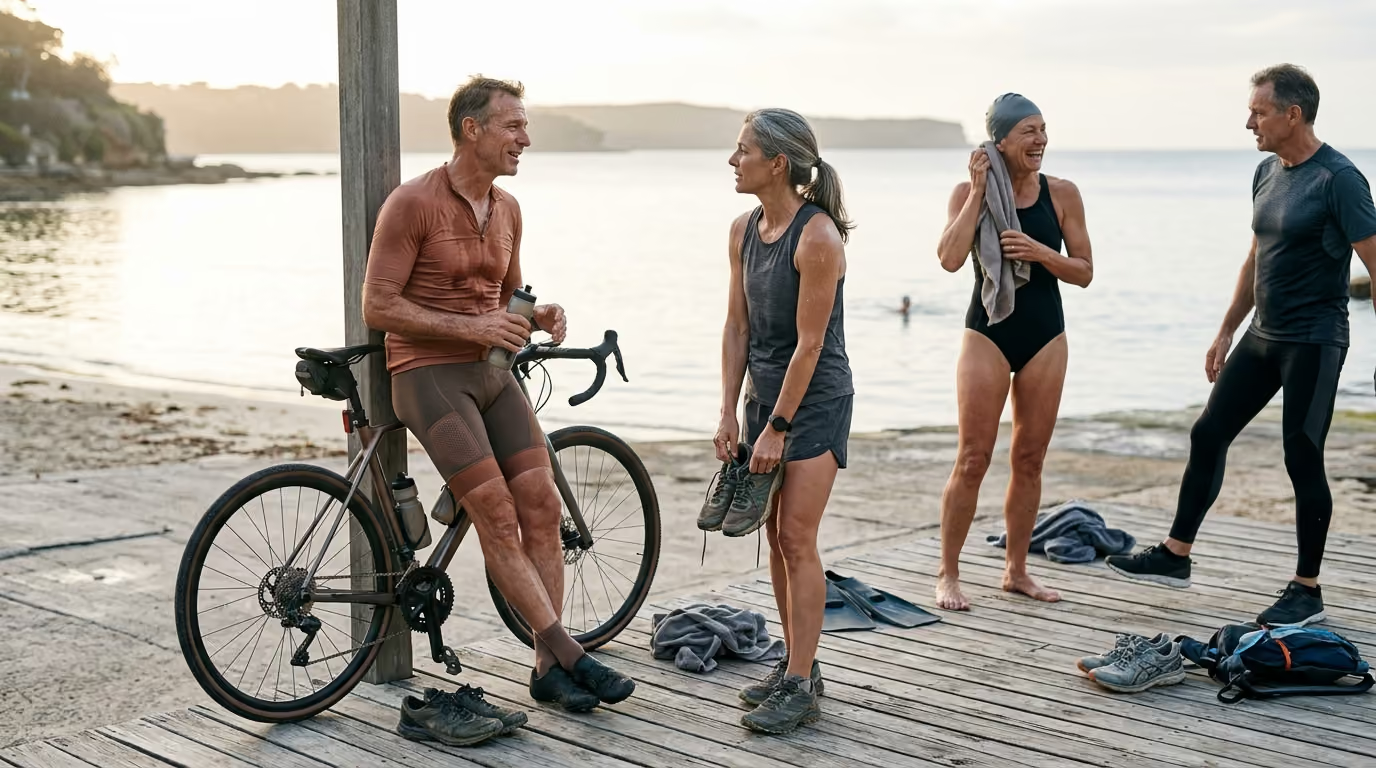

Aging competitors often equate declining speed with failure, but evolving psychological goals allows athletes to stay competitive throughout every decade of life.





Athletic identity is not a static calculation of your current personal records, your spot on a podium, or your weekly training volume. It is the psychological framework through which you understand your relationship to movement, discipline, mastery, and physical challenge.
Athletic identity is also not a permanent contract that expires when your absolute speed changes. Too often, athletes confuse their core identification with sport with their peak chronological performance. When personal bests become harder to reach, they assume their athletic life is winding down.
In this comprehensive resource, we examine the sports science, psychological research, and practical strategies behind maintaining a durable athletic self-concept across every decade of life. You will learn how physiological capacities change with age, how motivation evolves across the lifespan, and how to build a flexible goal architecture that protects your drive while expanding your definition of athletic success.
For many dedicated endurance competitors, the moment of cognitive dissonance arrives without warning. You complete a rigorous twelve-week training block with total consistency. You hit your planned intervals, prioritize sleep, and execute your target fueling strategy. Yet when you cross the finish line on race day, the clock shows a time two minutes slower than your performance from five years ago.
This gap between effort and absolute outcome often triggers a quiet internal crisis. You did not cut corners during your preparation. Your commitment to the process was as sharp as ever. Despite that dedication, your body produced a slower split.
In endurance sports culture, performance is frequently treated as a direct reflection of moral character and willpower. When pace slows down, athletes instinctively wonder if they have lost their edge, their discipline, or their focus. They may ask themselves if they can still call themselves a runner, a cyclist, or a triathlete if they can no longer match their previous standards.
This psychological tension is common among competitors navigating midlife and master categories. Without a structured framework to interpret physiological changes, athletes often choose one of two counterproductive paths. Some push harder into chronic fatigue and overuse injuries in a desperate bid to beat the clock. Others drop out of organized sport entirely to avoid confronting the reality of declining absolute times. Neither response is necessary.
Sports psychology defines athletic identity as the degree to which an individual identifies with the role of an athlete. Pioneering research on this topic breaks the construct down into three distinct dimensions: importance, strength, and exclusivity.
Importance reflects how central sport is to your overall self-concept. Strength measures the intensity with which you experience yourself as an athlete in your daily routine. Exclusivity describes the extent to which the athlete role crowds out other life dimensions, such as career, family, creative pursuits, or community roles.
A strong athletic identity provides immense psychological benefits. It builds daily discipline, emotional resilience, physical self-efficacy, and a deep sense of belonging within a athletic community. Highly identified athletes are more consistent in their training habits and rebound faster from ordinary setbacks.
The danger arises when strong identity crosses over into identity exclusivity, often termed identity foreclosure. Foreclosure happens when an athlete commits entirely to a narrow athletic role without developing other meaningful aspects of the self. If your self-worth depends entirely on hitting a specific finishing time, any threat to that number feels like a threat to your existence.
Research on self-complexity shows why this matters. Self-complexity refers to the number of distinct, meaningful social and personal roles a person maintains. When an athlete maintains high self-complexity, a bad race or an age-related performance shift affects only one aspect of their identity. The athlete remains a valued professional, parent, mentor, or creative individual.
When self-complexity is low, a decline in speed destabilizes the entire self. Sports science literature on athletic retirement and career transitions confirms that athletes with exclusive athletic identities suffer significantly higher rates of anxiety, psychological distress, and depression when their physical abilities shift. Identity diversification does not dilute your athletic ambition. Instead, it serves as psychological armor that preserves your mental health when performance dynamics change.
Identity continuity is the scientific answer to this dilemma. Identity continuity means preserving the core values of your athletic self, such as movement, challenge, grit, and structural routine, across changing physical conditions. You do not need to discard your athletic self when your personal bests recede. You simply translate those enduring athletic values into new formats, new competitive categories, and updated physiological targets.
To navigate performance changes rationally, athletes must understand the precise biological mechanisms of aging. Performance trajectories across the human lifespan follow predictable, research-backed patterns.
A comprehensive analysis of 27,088 track and field performances spanning ages 11 to 89 revealed distinct phases of physical capacity. Peak athletic performance typically occurs between ages 27 and 29 across most endurance and power disciplines. From age 35 to approximately age 60, performance decline follows a modest, nearly linear path of roughly 0.5% to 1.0% per year.
After age 60, population data shows a transition toward a curvilinear decline, with acceleration occurring after age 70. However, the timing and steepness of this trajectory vary dramatically depending on the specific sport and event demands.
Age-related endurance changes stem from clear physiological shifts:
While these biological shifts are real, sports science reviews emphasize a crucial caveat. A substantial portion of the performance loss observed in older athletes is not driven by biological aging alone. It is driven by voluntary or involuntary reductions in training volume and intensity.
As athletes age, work obligations, family caregiving, joint stiffness, and longer recovery timelines often lead to reduced weekly mileage and fewer high-intensity interval sessions. When older athletes maintain structured high-intensity training and progressive resistance work, their rate of VO2 max decline is cut substantially compared to sedentary populations.
Furthermore, performance decline is not uniform across different athletic disciplines. Research demonstrates that age-related decline accelerates earlier in long-distance endurance running, such as the 10,000-meter event, than in shorter sprint events like the 100-meter and 400-meter dashes. Endurance capacity depends heavily on cardiovascular oxygen delivery, which changes steadily over time, while technical and sprint events rely on qualities that can be preserved through focused neuromuscular training.
Understanding this distinction allows you to view your training data with calm objectivity. Slower times are not personal failures of character. They are the combined result of expected biological shifts and changing life constraints. Both factors can be managed, adapted to, and accommodated within an intelligent training framework.
Motivation in endurance sport is rarely static. A twenty-two-year-old collegiate runner and a fifty-five-year-old marathoner may line up at the same starting line, but their internal reasons for doing so are often completely different.
Research on master athletes challenges the stereotype that older competitors are motivated solely by general health maintenance. A study examining 373 master athletes across six sports identified five distinct motivational profiles based on achievement and social goals. Master athletes demonstrate varying combinations of task orientation (improving personal skill), ego orientation (beating others), affiliation (social connection), and status.
Athletes with high social-goal profiles display the highest levels of sustained sport enjoyment and feelings of belonging. Meanwhile, athletes who maintain strong achievement goals demonstrate elevated training consistency and confidence in their physical capabilities. Ambition and community connection do not cancel each other out. In older athletes, they reinforce each other.
A systematic review examining sport participation across older age groups found that 83% of studies identified community, friendship, and belonging as key drivers of lifelong athletic participation. Master athletes continually rank personal mastery, physical vitality, and deep camaraderie as their primary reasons for competing.
Psychologists categorize motivation along a spectrum from external to intrinsic:
Lifelong athletic sustainability requires shifting your motivational center of gravity away from introjected pressure and toward intrinsic and identified motivation. When you train because you value vitality, movement, and the pursuit of mastery, an age-adjusted race time does not ruin your morning. The satisfaction of the effort remains completely intact. To read more about sustaining your training mindset over decades, check out our healthy aging resources.
To stay competitive without suffering identity disruption, you must abandon single-variable goal setting. Relying solely on lifetime personal records creates an inevitable dead end as you age.
A resilient athlete uses a four-layer goal architecture. This system separates your fundamental identity values from the specific numbers on the race clock.
Direction goals define the type of athlete and human being you want to be across your entire life. They are grounded in character, values, and philosophy rather than race results. Direction goals answer the question of how you approach your physical life.
Examples of direction goals include:
Direction goals are entirely under your control. No biological shift, poor weather condition, or competitive field can take them away from you.
Outcome goals represent the external benchmarks you hope to achieve in competitive events. While they provide sharp focus and excitement, they are always partially vulnerable to external variables, such as competitor fitness, mechanical issues, or sudden illness.
Examples of outcome goals include:
Outcome goals keep your competitive instincts sharp. However, they must never sit at the top of your motivational hierarchy.
Performance goals measure your functional physical capabilities against an objective standard. They are independent of other competitors' results and reflect your current physiological execution.
Examples of performance goals include:
Performance goals should be recalibrated each season based on your current baseline fitness rather than your lifetime best from a decade ago.
Process goals are the daily, controllable behavioral habits that drive athletic development and physical longevity. They form the foundational engine of your athletic lifestyle.
Examples of process goals include:
When you judge the success of your week by process execution rather than pace, you protect your athletic consistency. For structured blueprints on managing these daily habits, review our endurance training resources.
A critical psychological skill for lifelong athletes is intentional goal adjustment. Goal adjustment involves two complementary steps: goal disengagement and goal reengagement.
Goal disengagement is the deliberate decision to step away from a goal that has become biologically unrealistic, unsafe, or incompatible with your current life situation. Disengagement is not quitting or failing. Research in behavioral psychology shows that athletes who successfully let go of unattainable targets experience lower levels of systemic stress and higher subjective well-being.
The golden rule of goal adaptation is simple: preserve the value, revise the target. If your underlying value is competitive mastery, you do not abandon competition. You simply change the target from an open-division personal best to an age-graded ranking, a technical mastery goal, or a completely new athletic discipline.
Conducting a quarterly goal audit helps maintain this balance. Every three months, ask yourself three diagnostic questions:
If a goal no longer serves your long-term athletic health, disengage without guilt and immediately reengage with a fresh, challenging alternative.
Preserving your athletic identity as you age requires adjusting your physical methodology. You cannot train at age fifty-two the exact way you trained at twenty-four and expect positive outcomes.
In our experience working with veteran endurance competitors, the athletes who maintain high performance across decades are those who treat recovery and fueling as active training disciplines. For years, I capped my mid-ride fueling at around sixty grams of carbohydrates per hour, convinced that taking in more would wreck my stomach. Then our team reviewed a series of recent studies on gut training and higher oxidation limits for endurance athletes.
I spent a three-month base phase gradually increasing my intake up to ninety grams per hour using an optimal mix of glucose and fructose. The difference during my next Gran Fondo was staggering. I had a late-race surge that I had never experienced before, completely avoiding the usual energy crash.
Applying modern sports science allowed me to achieve a massive performance breakthrough well into my master years without increasing my total weekly training hours. You can explore more of these nutritional strategies in our guide to fueling and hydration articles.
Adapting your athletic program across midlife requires several fundamental training adjustments.
Younger athletes can often absorb high weekly mileage alongside sloppy lifestyle habits. Master athletes must emphasize quality, recovery density, and minimum effective dose.
Replace junk miles with targeted workouts that have a precise physiological purpose. Instead of trying to maintain a high-mileage schedule seven days a week, insert dedicated recovery days between hard sessions. Many master athletes thrive on an eight-day or nine-day training microcycle rather than the traditional seven-day week. This extended cycle allows for forty-eight to seventy-two hours of full recovery between demanding interval sessions.
Resistance training is the most powerful tool available to combat age-related sarcopenia and neuromuscular decline. Endurance athletes over forty should complete two heavy resistance sessions per week focusing on compound movement patterns:
Lifting heavy loads (3 to 5 sets of 4 to 6 repetitions at an RPE of 8) stimulates neuromuscular recruitment and growth hormone production far more effectively than light-weight, high-repetition circuits.
If your absolute times in a specific event have plateaued or declined, consider changing the competitive frame. Lifelong athletes frequently find renewed motivation by exploring adjacent disciplines or shifting event lengths:
Changing the event breaks the psychological habit of comparing your current splits against your personal bests from twenty years ago. It gives you a clean slate, a new baseline, and a fresh trajectory of personal improvement. To learn more about modern workout structuring, check out our training and performance articles.
Navigating the shift in athletic capacity across the lifespan requires avoiding several common cognitive and training errors.
Many veteran athletes fall prey to binary thinking. They believe that if they cannot train twelve hours a week and contend for the overall win, training four hours a week is pointless.
This mindset ignores the massive physiological and psychological benefits of minimum effective dose training. Four hours of structured weekly training preserves significant cardiovascular fitness, metabolic health, and muscle mass compared to total inactivity. An athletic lifestyle is not all-or-nothing; it is an adaptable continuum.
Some athletes view age-graded performance calculators or master category podiums as patronizing participation trophies. This perspective is scientifically backward.
Age-graded tables are rigorous mathematical models based on world-record performances across every single age bracket. An 82% age-graded score at age fifty-five represents an elite level of cardiovascular and muscular execution. Embracing age-graded metrics allows you to track true physiological efficiency against your biological peers.
The opposite of the all-or-nothing trap is chronological denial. This happens when an athlete refuses to acknowledge their changing recovery needs, attempting to maintain identical high-intensity volume while ignoring chronic joint pain, elevated resting heart rate, and systemic fatigue.
Chronological denial inevitably ends in overtraining syndrome, tendon degeneration, or severe musculoskeletal injury. True athletic professionalism lies in respecting your biological reality and optimizing around it.
When athletes step back from top-tier competitive results, they often withdraw from their clubs, teams, and training groups out of embarrassment. This response cuts them off from the exact social network that supports long-term mental health and sport adherence.
Your athletic peers value your presence, your leadership, your humor, and your shared suffering during hard workouts far more than your final race split. Maintain your training relationships regardless of your current speed. For deeper strategies on staying healthy over decades of sport, visit our injury prevention resources.
If the absolute race clock is no longer your sole metric of success, how do you measure athletic development? A modern, science-backed athletic dashboard uses five distinct categories of progress.
Track variables that reflect how well you utilize your available physiological capacity:
Measure your ability to sustain training without interruptions:
Monitor how effectively your body absorbs training stress:
Evaluate your results against standardized demographic models:
Quantify your positive impact on the broader athletic ecosystem:
Tracking these five domains ensures that your sense of progress is continuous, robust, and completely protected from the narrow limits of a single stopwatch reading.
An involuntary exit caused by injury or medical advice is a significant psychological transition. Acknowledge the emotional grief of losing your primary physical outlet instead of minimizing it. Focus on transferring your athletic discipline to safe, non-impact physical challenges such as swimming, rowing, or targeted strength work. Preserving your daily routine of physical effort and staying connected to your training partners are essential steps for protecting your well-being.
This reaction is normal when an athlete first enters master competition. The solution is to create a clear division between your past career and your present athletic chapter. Treat your master athletic journey as an entirely new sport with its own distinct baseline records. Compare your current power outputs and times against current age-group benchmarks rather than your lifetime records from your twenties.
Shift your mindset from maximal training volume to minimum effective dose. Focus on training density by prioritizing two high-quality interval workouts and two strength sessions per week, filling remaining time with easy aerobic commuting or short runs. Communicate your athletic priorities clearly with family and colleagues, and view training as an essential tool for maintaining the physical energy and emotional calm needed for your work and home life.
Stepping away from organized competition is a valid, healthy decision if racing no longer brings you satisfaction or joy. You do not lose your status as an athlete simply because you stop pinning on a race number. An athlete is someone who values physical mastery, purposeful movement, and lifelong health. If training purely for vitality, outdoor exploration, and functional strength fulfills your values, that represents an intelligent evolution of your athletic identity.

Follow ReEndure for practical insights on endurance training, recovery, nutrition and healthy aging. Stay connected for new articles, research led guidance and ideas to help you perform better for longer.


Read practical ideas on endurance training, recovery, nutrition and healthy aging to keep progressing for years to come.
Read the Blog