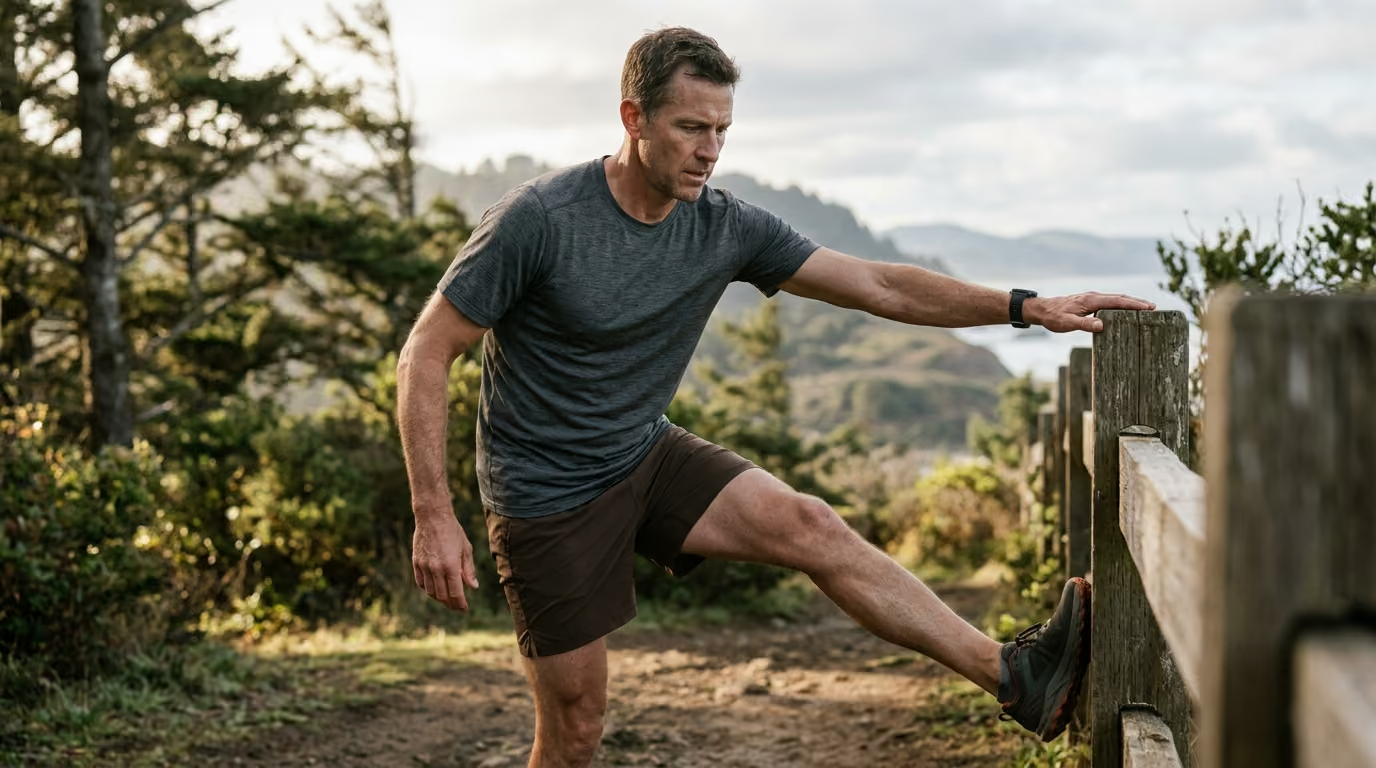

While athletes often assume all training pain demands complete rest, smart symptom classification allows you to modify workouts safely without losing fitness.





Every endurance athlete eventually types the same question into a search engine: can I train through this pain, or am I making it worse? You wake up with a dull ache in your Achilles tendon, an unfamiliar pinch in the front of your knee, or a sharp twinge in your shoulder. You have an important training block scheduled, and the thought of losing hard-earned cardiovascular fitness creates immediate anxiety.
The internet usually offers two useless extremes. One camp claims you must stop immediately at the first sign of discomfort. The other insists that pushing through agony is a badge of mental toughness. Both views are wrong and counterproductive.
This guide delivers a practical, evidence-backed decision framework to navigate discomfort, modify workouts, and protect your athletic longevity.
Consider a familiar scenario during marathon or triathlon preparation. You are six weeks away from your target event, and your weekly volume has reached its highest point. During an easy mid-week run, you notice a distinct tenderness along the inside of your lower leg. It is not severe enough to stop you in your tracks, but it does not feel like simple fatigue.
You finish the session, stretch, apply ice, and hope sleep will resolve the issue. The next morning, stepping out of bed produces a sharp stiffness that takes ten minutes of walking to subside. Your training calendar calls for a track interval session tomorrow and a long run on the weekend.
At this exact moment, athletes make decisions that determine their season. Continuing the planned schedule without adjustment frequently turns a minor load reaction into a chronic tissue breakdown. Conversely, shutting down all physical activity for three weeks leads to rapid detraining, reduced tendon stiffness, and psychological distress.
In our experience at ReEndure, athletes struggle most with the uncertainty between these two paths. Discomfort is an inevitable byproduct of endurance training, but genuine tissue pathology requires respect. Understanding how to interpret what your body is experiencing allows you to maintain training consistency without risking a catastrophic setback. You can review our training and performance guides to see how structured planning minimizes these conflicts.
To make rational training decisions, you must understand what pain actually represents. Sports medicine research shows that pain is not a direct measurement of tissue damage. The International Olympic Committee consensus on pain in elite athletes emphasizes that pain is a complex protective output influenced by biological, mechanical, and psychological factors.
Two identical tissue states can produce completely different levels of discomfort in different situations. A minor tendon irritation can feel agonizing when an athlete is stressed, sleep-deprived, or anxious about an upcoming race. Conversely, significant structural damage can sometimes produce surprisingly mild symptoms during exercise because movement generates natural pain-dampening mechanisms.
For endurance athletes, symptoms generally fall into distinct biological categories. You must distinguish between normal training sensations, physiological adaptations, and true injury patterns.
Normal training discomfort includes the expected sensations of heavy breathing, local muscular burning, and overall physical effort during a demanding workout. These sensations occur during the session, scale predictably with intensity, and resolve quickly once you stop exercising.
Another form of normal discomfort is delayed-onset muscle soreness, commonly known as DOMS. According to the American College of Sports Medicine, DOMS typically begins 12 to 24 hours after unfamiliar or strenuous muscular work. It frequently peaks between 24 and 72 hours post-exercise before gradually resolving.
DOMS is characterized by diffuse, symmetrical muscle soreness across large muscle groups. It is not concentrated sharply in a single joint, bone, or tendon sheath. While DOMS can temporarily impair force production, it is a benign response to mechanical loading and structural remodeling.
Load-sensitive pain is localized discomfort that increases predictably with specific mechanical tasks and decreases when that specific stress is removed. Common examples include patellar tendinopathy during downhill running, proximal hamstring irritation during steep hill climbing, or rotator cuff discomfort when using large swim paddles.
These symptoms do not necessarily indicate an emergency, but they serve as critical real-time feedback regarding your current tissue capacity. Tendons and bones respond to the magnitude, rate, and frequency of mechanical loading. When current load exceeds current tissue capacity, the structure becomes reactive and irritable.
If you manage this load carefully, the tissue can adapt, remodel, and tolerate higher stresses over time. If you ignore the signal and maintain the aggravating load, the tissue enters a cycle of progressive degradation.
Injury-pattern pain is characterized by mechanical failure, structural disruption, altered gait mechanics, or neurological involvement. This category includes bone stress fractures, ligament tears, muscle fiber avulsions, nerve compressions, and joint derangements.
These conditions rarely improve with simple in-session warm-ups and tend to worsen progressively with continued loading. They are frequently accompanied by swelling, bruising, joint instability, localized heat, or sharp focal tenderness directly over a bony landmark. Training through these symptoms does not stimulate adaptation. Instead, it accelerates structural damage and significantly prolongs recovery time.
You can consult our injury prevention resources for detailed anatomical breakdowns of these conditions.
Navigating discomfort requires a systematic evaluation rather than emotional guesswork. When an unexpected symptom arises, apply this five-stage framework before deciding whether to train, modify, or stop.
Before considering any training modification, you must rule out conditions that require immediate medical evaluation. If you observe any of the following red flag signs, stop all athletic activity immediately and seek professional clinical care:
Exertional rhabdomyolysis is a life-threatening medical emergency caused by rapid skeletal muscle breakdown. Clinical guidelines define this condition by severe muscle symptoms combined with extreme elevations in serum creatine kinase. Dark urine after a grueling workout is never normal and warrants an immediate visit to an emergency facility.
If no red flags are present, categorize your symptom into a traffic-light classification system based on its behavior and functional impact.
The Green Category represents acceptable training discomfort. This includes generalized muscle soreness, symmetrical fatigue, and mild stiffness that warms up completely within ten minutes of easy movement. Your movement mechanics remain entirely normal, and you do not limp or alter your technique. Symptoms remain stable or dissipate as the workout continues, and no swelling appears afterward.
The Amber Category represents a clear warning to modify your session. This involves localized discomfort in a specific tendon, joint, or muscle group that remains noticeable throughout the workout. The pain registers at a mild to moderate level, roughly 3 to 5 on a 10-point scale. Your movement mechanics remain intact, but you feel the symptom during specific loading phases.
The Red Category mandates an immediate cessation of the session. This includes sharp or stabbing pain, discomfort exceeding 5 on a 10-point scale, or any symptom that forces you to alter your running gait, pedaling stroke, or swimming mechanics. If you must limp to continue moving forward, your workout is over.
When a symptom lands in the Amber category, complete rest is rarely the only solution. The objective is to remove the specific mechanical trigger while preserving as much aerobic conditioning as possible.
Consider how mechanical loading variables can be adjusted individually:
The true test of whether a training load was acceptable does not happen during the workout itself. Tendons, cartilage, and bone stress reactions frequently feel tolerable during exercise due to tissue warming and endorphin release. The critical data point is how the tissue behaves several hours later and the following morning.
Clinical sports medicine guidelines for tendon rehabilitation utilize a robust 24-hour monitoring model. Discomfort during modified training is permitted to reach up to 5 out of 10, provided it returns to baseline levels by the following morning.
Assess your condition every morning using three specific criteria:
If your symptoms have fully returned to their baseline level by the next morning, the previous day's mechanical load was acceptable. If morning symptoms are noticeably worse, your load exceeded current tissue tolerance. In that case, you must introduce an easy recovery day or substitute a non-provocative cross-training modality.
Once an irritated tissue stabilizes, resist the urge to jump directly back into your previous training volume. The human body tolerates progressive adaptation exceptionally well, but it struggles with sudden spikes in training stress.
A systematic review published in the British Journal of Sports Medicine examined the relationship between training-load variations and running injuries. While the popular rule of never increasing weekly distance by more than ten percent is not an absolute law, large sudden spikes carry documented risks. Studies demonstrate that sudden weekly distance increases of twenty to thirty percent or more significantly elevate injury hazards compared to moderate progressions.
Progress only one major training variable at a time. If you decide to increase your weekly mileage, keep the intensity easy and avoid adding hill workouts during the same week. If you introduce high-intensity track intervals, keep the total weekly volume stable. This isolated approach makes it simple to identify your tissue thresholds and prevents compounding stressors.
Structured fueling also plays a critical role in supporting these training loads and tissue recovery. For years, I capped my mid ride fueling at around sixty grams of carbs per hour, convinced that taking in more would wreck my stomach. Then I read a series of recent studies on gut training and higher oxidation limits for endurance athletes.
I spent a three month base phase gradually increasing my intake up to ninety grams using a mix of glucose and fructose. The difference during my next Gran Fondo was staggering. I had a late race surge that I had never experienced before, completely avoiding the usual energy crash. You can read more about these strategies in our fueling and hydration articles.
Different endurance sports place unique mechanical and physiological demands on specific anatomical structures. Managing symptoms safely requires sport-specific adjustments.
Running produces repetitive impact forces ranging from two to three times your body weight with every single foot strike. Epidemiological studies consistently show that running accounts for the vast majority of overuse injuries in multisport athletes.
Common running scenarios and appropriate responses include:
Cycling is a non-impact sport, but the repetitive nature of pedaling can create substantial overuse problems. Cyclists make thousands of revolutions per hour, exposing the knees, lower back, neck, and perineal area to sustained mechanical stress.
A systematic review on cycling overuse injuries found that overall training load has a moderate correlation with symptoms. Interestingly, the research shows limited evidence supporting the idea that minor bike-fit changes automatically cure all overuse problems. While a professional bike fit is valuable, load management remains the primary driver of recovery.
Common cycling scenarios and appropriate responses include:
Swimming is a low-impact full-body activity, but the shoulder girdle absorbs immense repetitive stress. In triathlon injury surveillance studies, swimming generates the lowest total injury count among the three sports, but it accounts for the highest proportion of upper-limb and shoulder complaints.
Common swimming scenarios and appropriate responses include:
Triathletes face a unique challenge: the cumulative loading of multiple sports on the same musculoskeletal structures. Long-distance triathlon research reports that overuse injuries affect between 37% and 91% of competitors over a training year.
A calf muscle stressed by running is also loaded during the cycling stroke and transition workouts. The lumbar spine supports aerodynamic postures on the bike, handles rotational forces during swimming, and absorbs vertical impact while running.
When symptoms appear, multisport athletes must perform a whole-week load audit. Look back across all three disciplines over the preceding seven to ten days. A sudden knee flare-up during an easy run is often triggered by a heavy gear cycling workout performed two days earlier.
Triathlon training offers a built-in cross-training advantage. If an injured Achilles prevents you from running, you can frequently maintain or even build your aerobic engine by substituting pain-free swimming with a pull buoy and easy flat cycling. The rule remains absolute: cross-training is acceptable only if the alternative activity does not provoke the symptomatic tissue during or after exercise. Explore our healthy athletic aging resources for more guidance on multi-sport longevity.
Endurance athletes over the age of forty or fifty must adapt their decision-making to reflect changing tissue biology. While older athletes can maintain exceptional cardiovascular capacity, connective tissues undergo predictable physiological shifts over time.
Tendons and ligaments experience a decrease in collagen synthesis rates, reduced water content, and altered vascular supply. These changes reduce the speed at which connective tissues remodel following strenuous mechanical loading. A training stimulus that requires 24 hours of recovery in a 25-year-old may require 48 to 72 hours in a master athlete.
Bone mineral density naturally declines with age, particularly in post-menopausal women due to shifting estrogen levels. This makes diligent screening for bone stress injuries even more critical. Persistent, localized bone pain should never be managed with a wait-and-see approach in older runners.
For athletes over forty, the 24-hour response window becomes the single most important safety metric. If an Amber-category symptom leaves you with morning stiffness that lasts longer than fifteen minutes, your connective tissues have not fully adapted.
Adjust your schedule by separating high-load running sessions with at least two days of lower-impact cross-training or dedicated rest. Dedicate consistent time to heavy resistance training. Lifting challenging weights two times per week stimulates collagen synthesis, preserves muscle mass, and strengthens bone density far more effectively than endurance exercise alone.
Athletes frequently fall into recurring traps when attempting to manage training discomfort. Avoiding these mistakes will save you months of lost training time.
Using non-steroidal anti-inflammatory drugs, or NSAIDs, to get through a training session is exceptionally dangerous. Medications like ibuprofen dull your nervous system's ability to sense mechanical overload.
Masking pain allows you to push deeper into structural tissue damage without realizing it. Furthermore, medical research demonstrates that regular NSAID use can inhibit normal tendon remodeling, impair bone healing, and increase the risk of gastrointestinal and renal complications during endurance events. If you need a pill to complete a workout, you should not be doing the workout.
Tendon pain is notorious for decreasing as a workout gets underway. Tendon structures become more pliable and endorphins circulate, causing an irritated Achilles or patellar tendon to feel relatively comfortable twenty minutes into a run.
Athletes mistakenly assume this means the issue has resolved, prompting them to add extra miles or increase their pace. Several hours later, when the tissue cools down, the inflammatory cascade rebounds aggressively. Never use in-session comfort as your sole green light; judge the workout by the next morning's stiffness.
When pain strikes, inexperienced athletes often alternate between complete rest and maximal training. They feel an ache, sit on the couch for ten days until it feels better, and then jump right back into their previous training routine.
Complete rest causes tendons, muscles, and bones to lose load tolerance. When you abruptly reintroduce full training volume to a deconditioned tissue, the symptom returns almost immediately. The superior approach is relative rest: reducing the provocative load to a tolerable baseline and progressively rebuilding tissue capacity through controlled loading.
Many athletes demand an immediate MRI or ultrasound at the first sign of discomfort. While imaging is essential for diagnosing acute trauma or suspected fractures, its value in non-traumatic overuse pain is often misunderstood.
Sports medicine imaging studies consistently reveal that healthy, pain-free endurance athletes often show tendon thickening, partial tears, labral fraying, and degenerative disc changes on scans. An abnormal scan does not automatically explain your current pain, and a clean scan does not mean you can ignore functional limitations. Clinical assessment, symptom behavior, and functional testing should drive your training decisions.
To remove emotion from training decisions, establish a systematic monitoring log. Recording simple daily metrics allows you to identify subtle warning patterns weeks before an overuse injury forces you to stop.
Track the following metrics alongside your standard workout data:
Review your log at the end of each week. If your next-morning pain scores are consistently rising or your functional movement scores are declining, decrease your weekly volume by twenty percent. If your morning scores remain zero and your movement remains fluid, you can proceed with confidence. Read our recovery resources for comprehensive daily tracking templates.
Use this concise checklist to evaluate your symptoms and make informed training decisions throughout the coming week:

Follow ReEndure for practical insights on endurance training, recovery, nutrition and healthy aging. Stay connected for new articles, research led guidance and ideas to help you perform better for longer.


Read practical ideas on endurance training, recovery, nutrition and healthy aging to keep progressing for years to come.
Read the Blog