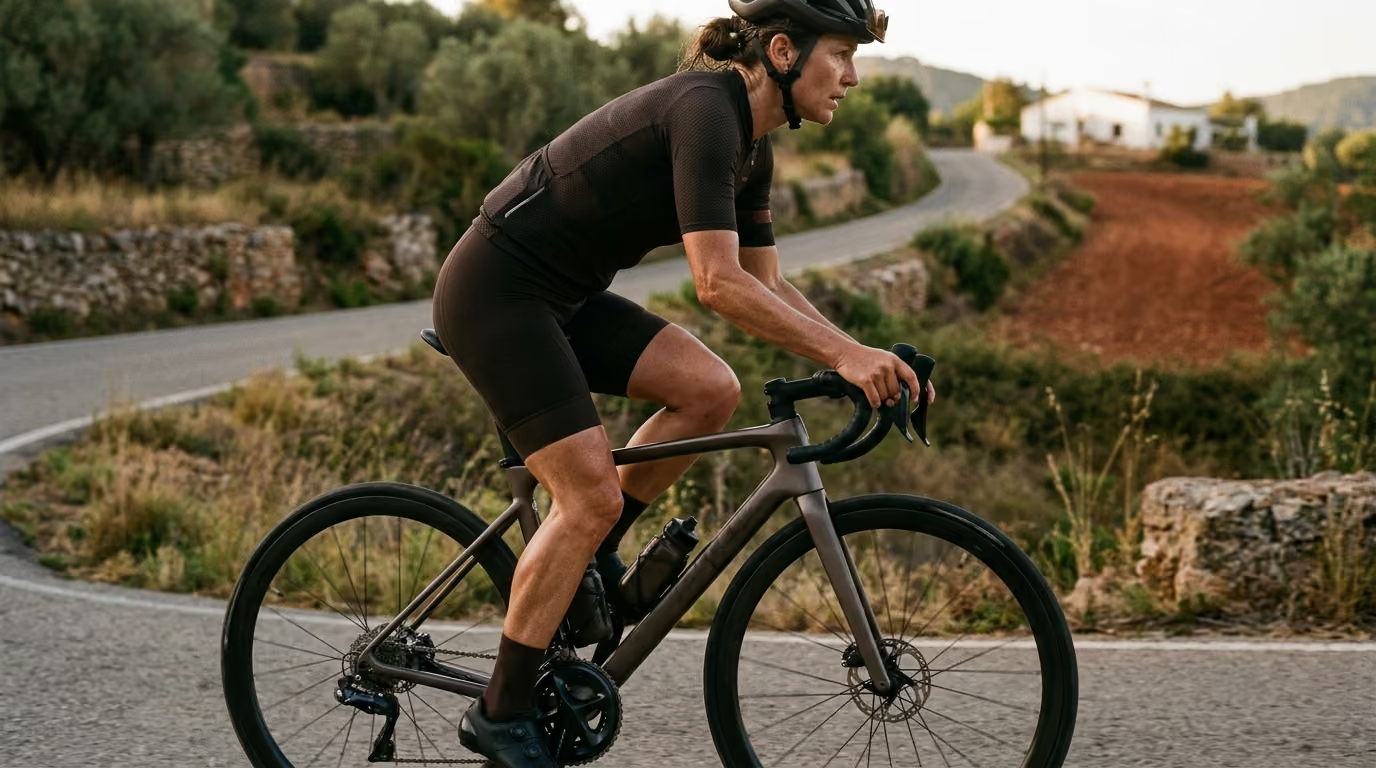

Leg fatigue on long endurance rides reveals how cadence selection, pedal stroke mechanics, and metabolic efficiency directly shape real cycling performance.





Cycling economy is the metabolic cost of sustaining a given power output on the bicycle. It is not an artistic rating of how round your pedal stroke looks on a computer screen. It is also not a single universal cadence that works for every rider on every climb.
At its core, true cycling efficiency is the measured interaction between metabolic energy expenditure, mechanical output, cadence selection, force distribution, muscle fatigue, and aerodynamic drag. Many riders spend hours chasing visual pedaling symmetry or spinning at high leg speeds because they believe it saves energy. Sports science paints a far more nuanced picture.
This guide breaks down the peer-reviewed evidence behind pedaling mechanics, gross efficiency, bike fit interactions, and resistance training. It provides a clear field framework to help you separate productive technique changes from unnecessary complexity.
Imagine riding eighty miles into a century or a long gravel race. Your cardiovascular system feels stable, and your breathing is steady. Yet your quadriceps burn on modest rollers, and your power begins to fade despite pushing your heart rate higher.
Many cyclists respond to this sensation by changing their pedaling technique mid-ride. They try to spin faster to save their legs, or they actively pull up on the pedals to share the load with their hamstrings. Within twenty minutes, their heart rate drifts upward while their forward speed slows down.
This frustration stems from a mismatch between cardiovascular cost and muscular force production. When you change cadence or pedal mechanics without understanding the metabolic trade-offs, you often shift stress from your muscles to your heart and lungs, or vice versa.
Real efficiency on the bike means minimizing the combined metabolic, aerodynamic, and neuromuscular cost of moving your bike forward. When you optimize this balance, you preserve glycogen, delay localized muscular exhaustion, and produce more speed for the same physiological effort.
To improve your pedaling, you must first understand the terms used in sports physiology laboratories. Cyclists and coaches frequently use words like economy, gross efficiency, and pedaling smoothness interchangeably. In scientific literature, these terms describe completely different phenomena.
Cycling economy refers to the rate of oxygen consumption required to produce a specific external power output. It is expressed as oxygen uptake in liters per minute at a defined wattage.
A rider who consumes 2.8 liters of oxygen per minute at 200 watts is more economical than a rider who consumes 3.2 liters per minute at the identical workload. Economy is specific to the workload, duration, cadence, and riding position. You may be highly economical at endurance power on flat roads, yet lose economy when riding in an aggressive aerodynamic position.
Gross efficiency is the percentage ratio between external mechanical work and total metabolic energy expenditure. Human gross efficiency during cycling typically ranges between 18 percent and 23 percent. The remaining 75 to 80 percent of the energy you burn is lost as heat.
Net efficiency calculates this ratio after subtracting your baseline resting metabolic rate. Delta efficiency measures the ratio between an increase in external work and the additional metabolic energy needed to produce it. These distinctions matter because gross efficiency includes the baseline energy required to keep your body alive and move your limbs.
Mechanical effectiveness describes how much of the total force applied to the pedal actively drives the crank forward. Modern power meters and biomechanical pedal systems can measure radial forces that push directly into the crank arm versus tangential forces that rotate the crank.
When a rider pushes straight down through the bottom of the stroke, that force creates zero forward torque. It simply pushes the pedal spindle into the crank arm. Raising your index of mechanical effectiveness means you direct a higher percentage of your force tangentially throughout the full 360-degree rotation.
External power is the wattage measured at your crank, spider, or hub that drives the bike forward. Internal power is the kinetic energy your muscles expend simply to accelerate and decelerate the mass of your legs in a circle.
As your cadence increases, internal power rises substantially. Even if your external power output remains completely unchanged, your legs require more oxygen simply to cycle up and down at high velocities. This internal energetic cost explains why a pedaling technique that feels light or smooth can still demand high metabolic energy.
For riders looking to build sustainable race capacity, exploring structured training and performance articles helps link these biomechanical principles directly to structured training plans.
Cadence selection is one of the most debated topics in endurance cycling. Many riders believe that professional cyclists pedal at 90 to 100 revolutions per minute because it is metabolically superior. Laboratory testing consistently demonstrates that the relationship between cadence, muscle fatigue, and oxygen consumption is more complex.
At low to moderate endurance workloads, cycling at a lower cadence requires less oxygen than cycling at a high cadence. Controlled laboratory studies repeatedly confirm that oxygen consumption at a fixed sub-maximal power is lower at 60 revolutions per minute than at 80 or 100 revolutions per minute.
In a well-known laboratory comparison, gross efficiency dropped from roughly 20 to 22 percent at 61 rpm down to 15 to 18 percent at 115 rpm. This drop occurs because faster leg turnover expends substantial internal power. When you pedal at 100 rpm during an easy endurance ride, you burn extra oxygen simply to move your lower extremities through space.
Despite the metabolic economy of low cadence, most trained cyclists naturally choose to pedal between 80 and 95 revolutions per minute. Research shows that when cyclists ride at moderate power, their preferred cadence is consistently 15 to 25 rpm higher than their most economical cadence.
This discrepancy exists because cadence controls pedal torque. Power equals torque multiplied by cadence. At a fixed power output, pedaling at 60 rpm requires significantly more force per pedal stroke than pedaling at 90 rpm.
High pedal torque recruits more Type II fast-twitch muscle fibers, which burn glycogen rapidly and generate greater localized fatigue. Cyclists naturally select a higher cadence to reduce pedal torque, protect their muscular force capacity, and preserve muscular endurance over long distances.
Optimal cadence is not a static number. It increases as your power output rises. Research indicates that the cadence that minimizes physiological stress rises progressively toward maximal aerobic power.
At recovery and steady endurance intensities, a cadence between 75 and 85 rpm often balances metabolic cost with moderate muscle torque. At lactate threshold and above, cadences between 88 and 96 rpm help distribute high mechanical strain across the cardiovascular system. During all-out sprints, cadence may exceed 110 rpm to maximize neuromuscular power production.
For decades, coaches instructed cyclists to pedal in perfect circles. Riders were told to scrape mud off the bottom of their shoes and pull hard upward on the backstroke. Modern sports science has evaluated this advice using force sensors and gas exchange analysis.
Actively pulling up on the pedals during the rising phase does increase mechanical effectiveness. Force traces look more symmetrical, and negative crank torque decreases. However, studies show that active upstroke pulling consistently decreases gross efficiency.
In a controlled study testing pedaling instructions, cyclists who deliberately pulled upward achieved a high mechanical effectiveness score of 62 percent. Their gross efficiency fell from 20.2 percent down to 19.0 percent. The metabolic cost of contracting the hip flexors and hamstrings to pull the pedal upward exceeded the mechanical assistance provided to the drivetrain.
Human lower limbs are built for powerful extension through the glutes and quadriceps. Using small flexor muscle groups to produce positive drive on the backstroke creates unnecessary metabolic waste during steady-state endurance riding.
If active pulling is counterproductive, what should the rising leg actually do? The practical goal during steady riding is unweighting, not pulling.
During a normal pedal stroke, the downstroke leg must push down its own pedal while also overcoming the resting weight of the opposite leg. If your rising leg is completely passive, the descending leg expends extra work to push the resting leg upward.
An economical pedaling technique simply unweights the rising foot so it does not act as dead weight. You do not need to pull upward against the pedal. You merely allow the hip flexors to lift the leg at the exact speed of the crank rotation.
Many cyclists purchase dual-sided power meters and discover they have a 53-47 or 54-46 percent power balance between their legs. This discovery often causes anxiety and leads to forced attempts to make both sides balance evenly.
Biomechanical research shows that mild pedal force asymmetry is completely normal in healthy, elite athletes. Small functional imbalances reflect natural anatomical differences, limb dominance, and pelvic alignment.
Trying to force artificial symmetry often disrupts coordination and increases metabolic cost. Asymmetry only requires intervention if it is linked to localized pain, joint instability, or a sudden change under fatigue. You can find more details on balancing biomechanical health and physical durability in our injury prevention resources.
Your position on the bicycle dictates two major performance variables: your aerodynamic drag and your muscular power production. Changes to your position alter joint angles, breathing mechanics, and muscle recruitment patterns.
Aerodynamic resistance accounts for the vast majority of total resistive force when riding on flat terrain above 18 miles per hour. Lowering your handlebars and flattening your torso reduces your frontal surface area, which cuts aerodynamic drag.
Lowering the torso also closes the angle between your thighs and your pelvis at the top of the pedal stroke. If your hip angle becomes excessively closed, your gluteal muscles lose mechanical leverage. Extreme hip closure can also compress the diaphragm, which impairs respiratory ventilation and increases perceived exertion.
A lower torso angle is only beneficial if the aerodynamic watts saved exceed the physiological watts lost from compromised biomechanics. At speeds above 28 miles per hour, aggressive aerodynamics almost always outweigh minor physiological losses. At speeds below 18 miles per hour on steep climbs, an upright position that opens the hip angle maximizes power output and respiratory ease.
Saddle fore-aft position directly controls your hip angle relative to the bottom bracket. Moving your saddle forward rotates your entire pelvis forward, which opens the hip angle even when your handlebars are low.
Biomechanical studies indicate that a more forward saddle position helps maintain mechanical effectiveness in aggressive aerodynamic postures. It allows you to maintain a flat torso without jamming your femur into your pelvis at the top of the stroke.
However, moving the saddle too far forward increases weight on your hands, wrists, and shoulders. Position adjustments must balance aerodynamic savings, muscular efficiency, and musculoskeletal comfort over your target race duration.
A common misconception among endurance cyclists is that lifting heavy weights in the gym makes you bulky and slow. Peer-reviewed exercise physiology shows the exact opposite. Heavy strength training is one of the few proven interventions that consistently improves cycling economy.
When competitive cyclists complete an eight to twelve-week heavy strength training program, their cycling economy improves significantly. In several classic studies, maximal strength training improved economy and time to exhaustion at maximal aerobic power without causing weight gain or changes in VO2max.
Heavy resistance training improves cycling economy through several clear pathways:
Maximal strength is your ability to produce high force against a resistance in a single effort. Muscular endurance is your ability to repeat sub-maximal contractions across hundreds of pedal revolutions without losing power.
Heavy squats and deadlifts develop raw neuromuscular force. To translate this capacity into cycling endurance, you must combine gym work with progressive on-bike training.
Building high peak force makes sustained tempo and threshold riding feel less taxing on a muscular level. To review specific training structures that integrate off-bike strength with endurance, explore our dedicated endurance performance resources.
Improving your efficiency requires structured, intentional practice on the road and trainer. Efficiency adaptations occur through targeted neuromuscular drills, controlled torque intervals, and deliberate position testing.
Many riders default to high cadences out of habit, running their heart rates higher than necessary. Use progressive cadence blocks during your Zone 2 base rides to evaluate your metabolic baseline.
Perform twenty minutes at your normal cadence, monitoring your heart rate and perceived effort. Shift up one gear to drop your cadence by 8 to 10 rpm for the next twenty minutes while maintaining identical wattage. Note whether your heart rate drops and whether your legs feel excessive strain. Use this test to identify your lowest-cost cruising cadence on flat roads.
Low-cadence intervals build local muscular fatigue resistance and help stabilize your pelvis under high pedal forces. These workouts train your nervous system to fire motor units smoothly through the top and bottom dead centers of the stroke.
High-cadence intervals improve intermuscular coordination, teaching your muscles to contract and relax rapidly without bouncing on the saddle.
Never race in an aerodynamic position that you have not tested over realistic durations. Perform steady threshold intervals in your intended aerodynamic posture while tracking heart rate and perceived breathing ease. If your power drops by more than five percent compared to an upright position, your posture is too aggressive for your current mobility.
For comprehensive workout progressions and periodized training frameworks, visit our Science Backed Training Guides to find plans suited to your event goals.
Athletes over the age of forty face specific physiological changes that influence pedaling mechanics and cadence selection. Understanding these age-related shifts allows older riders to adapt their training rather than forcing youth-focused prescriptions.
Aging is naturally accompanied by sarcopenia, which is the progressive loss of muscle mass. This process selectively affects Type II fast-twitch muscle fibers.
Because fast-twitch motor units produce high instantaneous torque, older riders may find low-cadence, high-torque efforts more taxing on their joints and muscular structure. Shifting toward a slightly higher cadence at threshold intensities can help master athletes offload muscular strain onto their well-preserved aerobic systems.
With advancing age, connective tissues lose water content and elasticity. This natural change reduces passive range of motion through the hips, lower back, and hamstrings.
Master athletes who attempt to ride in low, aggressive aerodynamic positions often experience hip impingement and lower back strain. When the hip angle is forced past its comfortable range of motion, pedaling efficiency declines sharply. Older riders often achieve better overall race times by using a slightly taller handlebar setup that protects breathing mechanics and spinal comfort.
Heavy pedal torque creates microscopic muscle damage that requires adequate recovery time. Older athletes synthesize muscle protein more slowly than younger riders.
Master cyclists should avoid stacking multiple low-cadence torque sessions in the same training block. Balancing on-bike torque work with targeted mobility and dedicated rest days preserves connective tissue integrity. To learn more about managing recovery and joint health as you age, browse our healthy aging resources.
Athletes frequently fall into predictable traps when trying to improve their pedaling economy. Avoiding these common mistakes will save you time and keep your training focused on proven methods.
Many riders believe that spinning at 95 rpm during an easy recovery or base ride is a sign of good form. At low power outputs, spinning fast wastes significant energy on internal leg movement. Match your cadence to your power output: use lower, comfortable cadences for easy riding and save higher cadences for hard efforts.
Attempting to pull up on the pedals during long endurance rides exhausts your hip flexors and lowers gross efficiency. Stop trying to make your power meter pedal-stroke graphs look like perfect circles. Focus on a strong downstroke and an unweighted upstroke.
Setting your handlebar height based on what WorldTour professionals ride often compromises your power and breathing. Professional riders possess exceptional flexibility and spend thirty hours a week adapting to their positions. Set your bike position based on your own mobility, power stability, and sustained comfort.
Skipping heavy resistance training out of fear of gaining weight is a major missed opportunity. Controlled strength training improves tendon stiffness, neuromuscular recruitment, and cycling economy without causing unwanted hypertrophy when paired with endurance training.
Spending money on specialized shims and cleat wedges solely to fix a painless 52-48 percent left-right power balance is unnecessary. Natural human movement is slightly asymmetric. Direct your energy toward balanced strength work and consistent riding instead.
You do not need an expensive exercise physiology laboratory to evaluate changes in your cycling economy. You can track practical markers of efficiency using your existing power meter and heart rate monitor.
Aerobic decoupling measures the stability of the relationship between your heart rate and your power output over time. In a well-conditioned, economical rider, heart rate and power run parallel during a steady-state endurance ride.
Perform a steady two-hour ride in your target aerodynamic position at a constant Zone 2 power output. Track your cardiac drift across the two halves of the workout.
If your heart rate rises by less than five percent during the second half at the same power, your economy and fatigue resistance are well developed. If your heart rate drifts upward by eight to ten percent, you are experiencing significant metabolic fatigue or positional strain.
You can test which cadence offers the best economy for your physiology using a standardized indoor trainer workout.
Record your average heart rate and rating of perceived exertion for the final three minutes of each block. The cadence that produces the lowest heart rate and lowest perceived effort indicates your current metabolically optimal cadence for that specific workload.
Track your post-ride muscle sensations when experimenting with new positions or cadences. If dropping your cadence lowers your heart rate but leaves your knees sore or your quadriceps stiff the following morning, the trade-off is not sustainable.
True efficiency produces a balance: low cardiovascular cost, stable power production, zero joint discomfort, and rapid recovery. To support tissue repair and maintain functional joint mobility between tough sessions, review our recovery and mobility routines.
Research shows that crank length within the standard range of 165 mm to 175 mm has no significant effect on gross efficiency or maximal power output. Shorter cranks can help riders open their hip angle at the top of the pedal stroke in aggressive time-trial or triathlon positions.
Yes. On steep climbs, your cadence will naturally drop due to gearing limitations. When climbing out of the saddle, your cadence typically falls to 60 to 70 rpm to allow your body weight to assist in generating pedal torque.
Neuromuscular adaptations to a new cadence range typically take four to six weeks of consistent practice. Introduce cadence changes gradually in fifteen-minute blocks during base rides to allow your nervous system and tendons to adapt.
Riding traditional rollers improves your intermuscular coordination and eliminates excessive upper-body movement. While rollers do not automatically change gross metabolic efficiency, they help smooth out jerky power delivery and enhance bike handling stability.

Follow ReEndure for practical insights on endurance training, recovery, nutrition and healthy aging. Stay connected for new articles, research led guidance and ideas to help you perform better for longer.


Read practical ideas on endurance training, recovery, nutrition and healthy aging to keep progressing for years to come.
Read the Blog