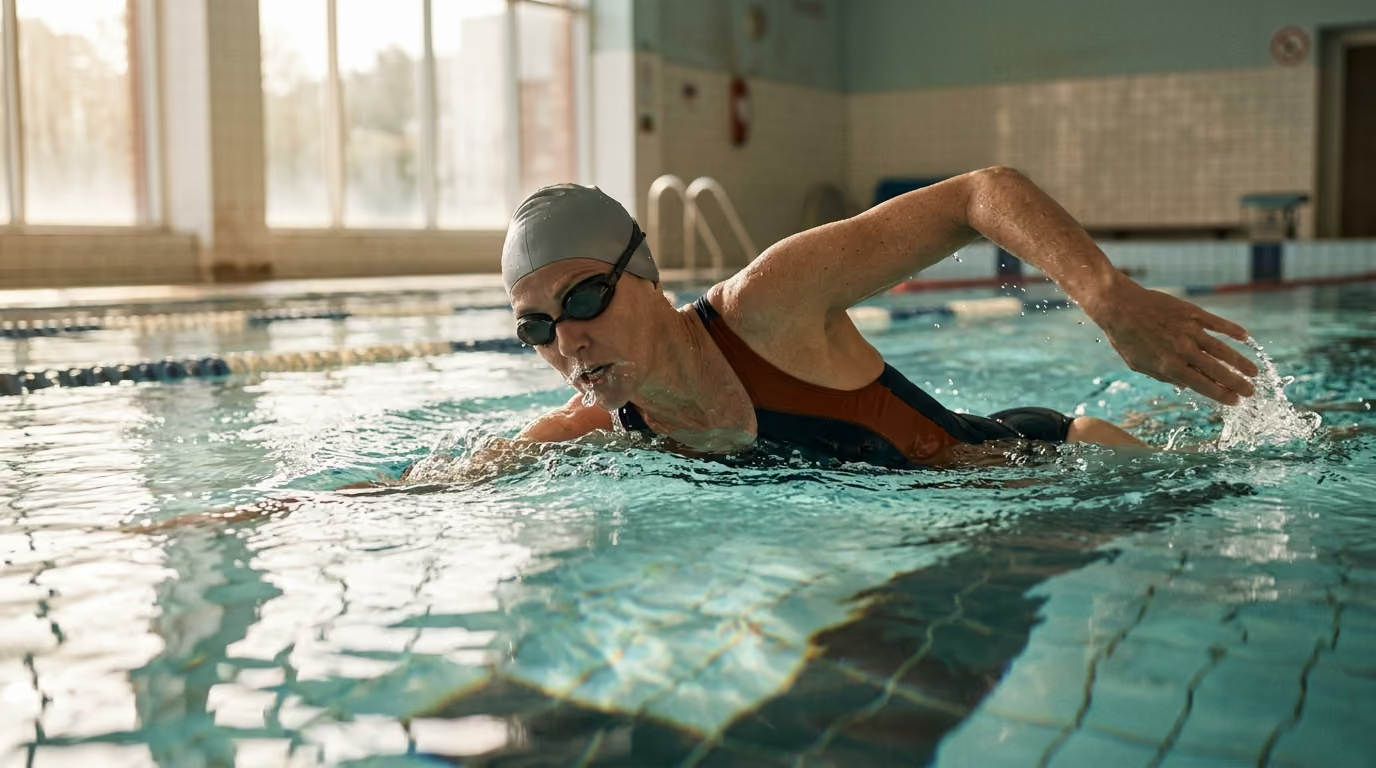

Three distinct training pace zones and targeted technique drills allow swimmers to maximize stroke length while reducing drag and energy expenditure.





Swimming efficiency is the ability to sustain a given speed through the water while expending the lowest practical amount of metabolic energy. It is not an arbitrary quest to take as few strokes as possible per lap. It is not a mandate to glide passively between arm cycles or kick with minimal effort regardless of context. True efficiency represents a balance between minimizing hydrodynamic drag and generating effective forward propulsion across a target duration.
Many adult endurance athletes spend years grinding through high-volume training blocks without getting faster. In running or cycling, adding aerobic volume almost always yields predictable cardiovascular adaptations and faster split times. In the pool, water is roughly eight hundred times denser than air. This physical reality means that raw fitness cannot overcome biomechanical drag.
When technique breaks down, extra effort produces turbulence rather than forward movement. This comprehensive guide examines the biomechanics, fluid dynamics, and energetics of front crawl swimming. It provides a structured roadmap to refine your body position, optimize your catch mechanics, balance your breathing, and preserve stroke integrity under fatigue. You will learn how to turn isolated pool drills into measurable race performance.
To understand how to swim faster with less effort, you must first understand the relationship between metabolic energy input and mechanical output. In sports science, swimming velocity is determined by dividing total metabolic power input by the energy cost of swimming over a given distance. Research by Paola Zamparo and colleagues in the European Journal of Applied Physiology shows that the energy cost of moving through water depends on the mechanical work needed to overcome drag, divided by the product of mechanical efficiency and propelling efficiency.
Mechanical efficiency refers to the percentage of chemical energy from your muscles converted into actual mechanical work. Propelling efficiency is the proportion of that mechanical work directed toward moving you forward against water resistance, rather than pushing water sideways, downward, or into turbulent eddies.
This mathematical relationship gives athletes two direct routes to better swimming performance:
Swimming has an unusually high energy cost compared to running or cycling at identical speeds. Water resists forward motion with a force that increases approximately with the square of your velocity. As you try to swim faster, the drag penalty multiplies quickly. Research published in Frontiers in Physiology confirms that skilled swimmers achieve high speeds not just by exerting more force, but by maintaining higher stroke index values, minimizing intracycle speed fluctuations, and sustaining superior Froude efficiency.
Speed is the direct mathematical product of stroke length and stroke rate. Stroke length is the distance your body travels forward during one complete stroke cycle. Stroke rate, or stroke frequency, is the number of stroke cycles you complete in a minute.
Coaches and sports scientists frequently track stroke index as a reliable benchmark of technical economy. A high stroke index indicates that you cover significant distance per stroke at a fast pace. The goal of technical training is finding the specific combination of stroke length and stroke rate that minimizes metabolic fatigue while hitting your target pace.
Understanding these concepts is foundational for any structured training and performance plan.
Hydrodynamic drag is the single largest barrier to fast swimming. When your body moves through water, total resistance is dictated by water density, your forward speed, your frontal surface area, and your drag coefficient. Because drag increases exponentially with speed, even small alignment errors create massive energy penalties.
A swimmer who lets their hips drop must expend immense energy simply pushing a wide wall of water out of the way before generating any forward propulsion.
Horizontal alignment in the water is governed by the physical relationship between your center of mass and your center of buoyancy. Your lungs act as natural flotation devices, placing your center of buoyancy near your upper chest. Your center of mass sits lower in the body, near the hips or pelvis. This natural spatial offset causes the lower body to sink like an anchor unless you actively balance your torso in the water.
Achieving horizontal alignment requires pressing the sternum down into the water to pivot the hips toward the surface. The head plays a critical role in controlling this balance. Lifting the head upward to look forward forces the neck into hyperextension, which immediately drops the pelvis and legs. You should maintain a neutral neck alignment with the eyes looking downward toward the bottom of the pool or slightly forward. Avoid excessive neck flexion, as tucking the chin tightly against the chest creates unwanted tension and disrupts natural breathing mechanics.
Streamlining is not a skill reserved exclusively for wall push-offs. It must be actively preserved across every second of swimming. A reliable diagnostic sequence for evaluating your body position includes:
Body rotation must support your line rather than distort it. Controlled torso rotation links the powerful muscles of your core and back to the arm stroke, which reduces stress on the shoulder joint. However, over-rotation causes lateral fishtailing and increases wave drag. Rotate along your longitudinal axis just enough to facilitate a clean arm recovery and an effective underwater catch.
Muscular effort does not automatically produce forward motion. Many swimmers generate high muscular tension in their shoulders and lats while slipping through the water with minimal propelling efficiency. Effective propulsion requires establishing firm pressure against still water and accelerating that water backward along your torso.
The underwater front crawl stroke is a continuous kinetic sequence:
An effective catch relies on early vertical forearm mechanics. Instead of dropping the elbow and sliding the hand backward through the water, you keep your elbow positioned higher than your hand and wrist. This turns your entire hand and forearm into a single, cohesive paddle. Do not force an exaggerated, rigid visual shape that causes shoulder pain. The goal is applying force directly backward while minimizing downward or lateral hand movement.
A study by Bassan and colleagues in the International Journal of Sports Physiology and Performance found that local muscular fatigue causes significant drops in elbow-flexor and elbow-extensor peak torque. As muscle force drops during exhaustive swimming, swimmers shorten their stroke length, increase their stroke rate, and alter the timing of their propulsive phases.
The kick serves three distinct functions: direct propulsion, postural stabilization, and timing. For distance swimmers and triathletes, the kick primarily stabilizes body position and counteracts the rotational forces generated by the arm stroke. A steady two-beat kick coordinates one kick per arm entry, conserving precious leg glycogen for running or cycling. A four-beat or six-beat kick provides greater instantaneous propulsion and higher hip lift, which is ideal for sprint events or breaking through rough open water.
Choose a kicking pattern that matches your ankle mobility, event distance, and energetic capacity, which is essential when optimizing your endurance performance resources.
Breathing is a major source of technical breakdown for adult swimmers. Many athletes treat breathing as an interruption to their stroke rather than an integrated component of their forward rhythm. Lifting the head to breathe immediately pushes the hips down, halts forward momentum, and forces the lead arm to press downward to stay afloat.
An efficient breathing cycle requires rotating the head in unison with the torso. As your body rotates toward the breathing side, your head turns just enough for your mouth to clear the water within the bow wave created by your head. One goggle lens should remain submerged in the water during inhalation. The breath must be quick and relaxed, without pausing the rotation of your hips or stalling the extending lead arm.
Underwater breath control dictates your metabolic comfort in the water. Holding your breath underwater causes carbon dioxide to accumulate rapidly in the lungs, triggering feelings of air hunger and upper-body tension. You must exhale continuously and smoothly through your nose and mouth the moment your face enters the water. When your mouth clears the surface to breathe, your lungs are empty, allowing for an effortless inhalation.
Bilateral breathing, or breathing every three strokes, helps maintain stroke symmetry and prevents one-sided muscular imbalances. It also allows swimmers to sight competition and navigate chop effectively in open water. However, bilateral breathing is not mandatory for all intensities or race distances. During high-intensity threshold sets or sprint finishes, oxygen demand rises substantially. Shifting to a two-stroke breathing pattern on your dominant side is often necessary to meet metabolic demands.
To refine your breathing mechanics without losing technical alignment, work through this step-by-step progression:
Many swimmers fall into the trap of believing that fewer strokes per length is always better. While reducing excessive stroke count is helpful for beginners who thrash through the water, elite swimming performance requires an optimal balance between stroke length and stroke rate. Artificially forcing a long stroke often introduces a glide phase, which allows forward speed to drop between pulls.
Research published in sports science literature demonstrates that increasing stroke frequency often increases the energy cost of swimming, particularly if the swimmer lacks the muscular endurance to hold water effectively. When stroke rate is driven too high, propelling efficiency drops because the hands slip through the water without anchoring. Conversely, over-gliding requires you to accelerate your body mass from a near-dead stop on every single stroke, which wastes energy against wave resistance.
Stroke index serves as an objective field calculation of overall swimming economy. It is calculated by multiplying your swimming velocity in meters per second by your stroke length in meters per cycle.
A study of competitive age-group swimmers evaluated by biomechanical testing found that top-tier swimmers produced a mean stroke index of 2.51 m²/s, compared to 2.14 m²/s in middle-tier swimmers and 1.70 m²/s in lower-tier athletes. The top-tier athletes did not achieve this advantage solely through slow, long strokes. They combined superior stroke length with higher sustainable stroke frequencies.
Testing your stroke variables across different training zones reveals where your technique breaks down:
At low cardiovascular intensities, focus on establishing your baseline stroke length. Count your strokes per 50-meter lap to ensure your body line remains horizontal and relaxed.
As intensity reaches lactate threshold, monitor your stroke rate using a tempo trainer. If your stroke count spikes significantly while your lap time stays flat, your catch mechanics are slipping under load.
During maximal efforts, stroke rate naturally reaches its highest levels. Pay close attention to your push phase and recovery rhythm to ensure you do not cut your stroke length short in an effort to move your arms faster.
Critical swimming speed represents the theoretical maximum swimming speed you can sustain for a long period without exhausting your aerobic system. Research from Piatrikova and colleagues showed that individualizing high-intensity interval training using critical speed and critical stroke rate yielded significant performance gains. Swimmers improved their critical speed by 5.4% and their stroke index by 4.2% while reducing their overall weekly yardage by 25%.
Tracking critical speed gives athletes a precise pace to target during workouts without overtraining.
Isolating technical components through drills is standard practice, but drills are useless if they do not transfer to whole-stroke swimming. Many athletes execute pool drills smoothly at low speeds, only to revert to poor biomechanics the moment they swim a hard set. A drill should be treated as a temporary constraint designed to fix a specific biomechanical failure.
To build meaningful transfer from drills into race-pace swimming, follow this four-step implementation process:
Several foundational drills offer direct transfer when applied correctly:
Float on your side with the bottom arm extended forward and the top arm resting along your hip. Keep your lower goggle lens submerged, look toward the bottom, and maintain a compact, rhythmic kick. This drill reinforces lateral balance, strengthens core alignment, and teaches you to breathe in the pocket without lifting your head.
Swim front crawl while holding a small object or baton in your extending hand. Do not begin the catch with one arm until the recovering hand touches and takes the baton. This drill teaches patience in the front quadrant, prevents rushing the recovery, and provides stability for swimmers who drop their lead arm during breathing.
Swim regular front crawl with your hands curled into tight fists. This constraint removes the surface area of your palms, forcing your brain and body to recruit your forearms to establish early vertical forearm mechanics. When you open your hands on the subsequent repetition, your water feel and catch pressure increase dramatically.
Swim front crawl using only one arm while keeping the non-working arm resting motionless along your thigh. Focus on driving body rotation from the core, setting an early catch, and breathing cleanly to both sides. This drill highlights any lateral instability, crossover entry, or pulling dead-spots.
Using technical equipment can accelerate learning when applied with clear purpose. A pull buoy eliminates leg sinking, allowing you to focus entirely on upper-body rotation and forearm catch pressure. Finger paddles provide tactile feedback on your hand pitch and entry angle without overloading your shoulder rotators.
Equipment should never become a crutch. Use tools to feel the proper movement pattern, then immediately swim without them to lock in neuromuscular adaptations.
Fatigue is a biomechanical event as much as a cardiovascular one. When your metabolic reserves drain and muscular fatigue sets in, your nervous system struggles to recruit muscle fibers with precise timing. Research shows that during exhaustive swimming, stroke length declines significantly. Swimmers naturally attempt to compensate for this lost distance per stroke by rapidly spinning their stroke rate.
This compensation creates a negative feedback loop. As your stroke shortens, your propelling efficiency drops. Increasing your stroke rate under fatigue causes your heart rate and lactate levels to spike even faster, accelerating muscular failure. Skilled endurance swimmers manage fatigue by minimizing the drop in stroke length rather than simply spinning their arms faster.
A systematic review on swimming pacing by McGibbon and colleagues in Sports Medicine highlights that optimal pacing strategies vary across race distances:
Maintaining technical durability requires integrating race-pace conditioning with strict technical constraints. Training sets should challenge you to hold a specific stroke count and pace target while operating under heavy metabolic load.
Sample Fatigue-Resistance Training Set:
If your stroke count increases by three or four strokes while your times slow down, your technical integrity has failed. When this happens, stop the set, take extra rest, or reduce the intensity. Grinding through high-volume pool sets with broken mechanics only trains your neuromuscular system to swim inefficiently when tired.
Prioritizing clean mechanics under load protects long-term progression, supporting your overall recovery and mobility habits.
Aging introduces physiological changes that directly influence swimming biomechanics. Tendons and joint capsules lose elasticity, resting muscle mass gradually declines, and shoulder internal rotation often becomes restricted. For masters swimmers and multi-sport athletes over forty, maintaining efficiency is the most reliable way to stay fast while protecting vulnerable joints.
Shoulder health is the primary technical limiter for aging swimmers. Decades of desk work combined with high-volume swimming can lead to forward-rounded shoulders and thoracic kyphosis. In the water, this postural alignment increases the risk of subacromial impingement during arm recovery and the underwater catch.
To protect your shoulders while maximizing efficiency:
Ankle flexibility also decreases with age. Stiff ankles turn the top of your foot into a flat surface that pushes water forward, creating substantial braking drag during the kick. If tight ankles prevent you from pointing your toes backward, spend five minutes daily gently stretching your plantar flexors and ankles on dry land. In the water, consider wearing short-blade training fins during warm-ups to gently improve ankle range of motion under dynamic load.
Recovery timelines lengthen as we age. Masters athletes cannot absorb the high-volume, continuous grinding workouts of their youth without accumulating systemic fatigue. Structure your training weeks with polarized intensity, alternating technically demanding interval days with easy, restorative aerobic sessions.
Building dryland strength training into your routine helps preserve type II muscle fibers, maintains core stiffness, and stabilizes the rotator cuff, which is critical for healthy aging athletes.
Improving swimming efficiency requires objective, repeatable measurement. Relying entirely on how a workout feels is unreliable because smooth, low-effort swimming can often be painfully slow. A layered assessment protocol allows you to measure both your physical output and technical economy over time.
To accurately evaluate your swimming efficiency, track metrics across four distinct layers:
Track your total time over standardized distances, your lap-to-lap split consistency, and your sustainable pace relative to your critical swimming speed.
Calculate your stroke count per lap, stroke rate (strokes per minute using a tempo timer), stroke length (meters per stroke cycle), and overall stroke index.
Record multi-angle underwater video to assess head position, hip height, early vertical forearm setup, and symmetrical kick amplitude.
Monitor your post-set heart rate, rate of perceived exertion, and local muscular fatigue to determine how much biological energy was required to produce that pace.
To establish clear benchmarks, perform these two simple field tests every four to six weeks:
Warm up thoroughly, then perform a maximal 400-meter time trial from a push start. Rest completely for 10 to 15 minutes, then perform a maximal 200-meter time trial. Calculate your critical speed using the formula:
This number provides your functional threshold pace per 100 meters. Retesting every six weeks measures real gains in sustainable aerobic power.
Swim 50 meters at your steady endurance pace. Add your total time in seconds to the number of strokes taken during that 50-meter lap. For example, swimming 50 meters in 42 seconds taking 36 strokes yields a SWOLF score of 78.
A lower SWOLF score generally reflects improved efficiency, provided the reduction is not achieved by gliding excessively and sacrificing pace.
Different athletes exhibit distinct failure patterns in the pool. Recognizing your specific technical profile helps you apply the correct training intervention:
Monitoring these layers ensures that changes to your stroke translate into genuine aerobic speed, helping you refine your comprehensive recovery and training strategy.
Open water swimming requires several adaptations to manage waves, chop, currents, and navigation. Swimmers should slightly increase their stroke rate to maintain forward momentum through rough water, as a long glide can cause you to stall in oncoming chop.
Sighting should be integrated into your breathing pattern by lifting your eyes just above the waterline before rotating to breathe, rather than lifting your entire head. Drafting behind or at the hip of another swimmer reduces drag, allowing you to swim at a faster pace with lower metabolic output.
Swimming faster with a pull buoy indicates that your natural body position creates excessive hydrodynamic drag. The foam buoy elevates your hips and legs to the surface without requiring muscular effort from your kick, streamlining your body line and reducing frontal resistance.
To bridge this gap, focus on horizontal alignment drills without the buoy. Work on pressing your chest downward, engaging your lower abdominals to lift the pelvis, and developing a steady, compact flutter kick that originates from the hips rather than bending from the knees.
Bilateral breathing is not mandatory during competition, but it is an essential developmental tool in training. Breathing to both sides during easy aerobic workouts helps balance shoulder muscular development, ensures symmetrical body rotation, and prevents steering offline.
During high-intensity racing or threshold efforts, oxygen delivery is paramount. Breathing every two strokes on your dominant or preferred side provides a higher continuous oxygen supply to working muscles, which is why many elite distance swimmers use a two-beat breathing pattern on race day.
Counting strokes can be misleading if evaluated without tracking your split time. A swimmer can easily lower their stroke count by gliding passively between arm pulls, kicking vigorously, or simply swimming significantly slower.
True efficiency means traveling further per stroke without stalling your forward momentum. Always evaluate stroke count alongside lap times or use the stroke index calculation to ensure that a lower stroke count actually reflects improved propelling efficiency rather than a loss of speed.

Follow ReEndure for practical insights on endurance training, recovery, nutrition and healthy aging. Stay connected for new articles, research led guidance and ideas to help you perform better for longer.


Read practical ideas on endurance training, recovery, nutrition and healthy aging to keep progressing for years to come.
Read the Blog