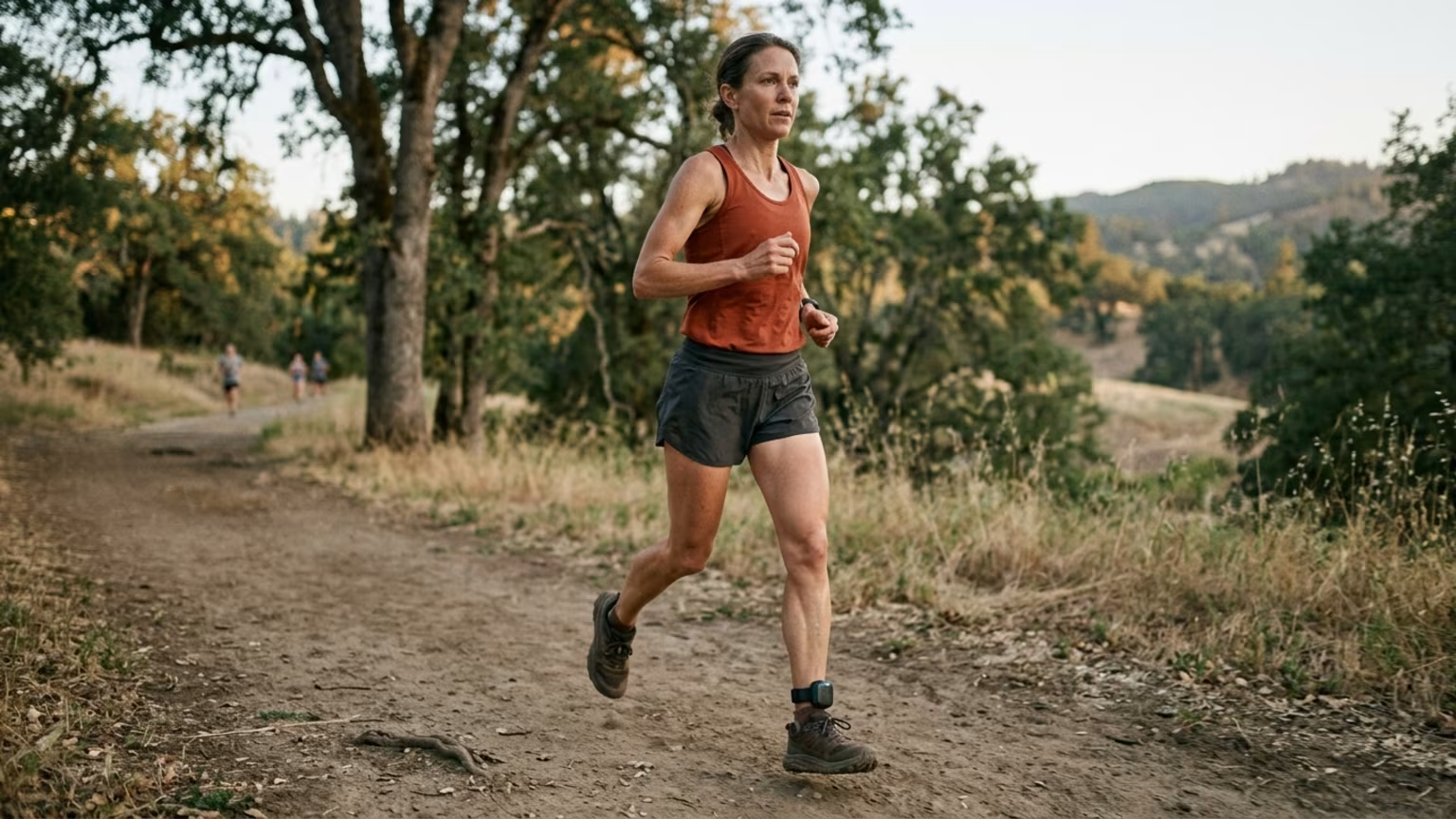

A Yale study shows foot-mounted wearable sensors track walking mobility with lab-level accuracy, offering future tracking tools for aging endurance athletes.





On September 14, 2026, a Yale-led study published in JMIR Formative Research evaluated whether small foot-mounted wearable sensors could measure mobility in people with knee osteoarthritis as accurately as laboratory optical motion capture. For athletes over thirty five, monitoring joint health often requires expensive clinic visits and specialized assessments. Optical motion capture uses infrared cameras and reflective body markers to analyze human movement. Yale describes this setup as the gold standard for movement analysis.
The new publication investigates whether everyday consumers can get similar accuracy from portable tools. The research team sought to determine if consumer technology could replace dedicated laboratory space for specific walking metrics. This effort fits a broader movement toward collecting objective mobility data outside specialized biomechanics laboratories. Yale described foot-mounted sensors as a potentially scalable way to gather real-world mobility information.
A 2026 systematic review on biomechanical analysis and motion capture in physical therapy and rehabilitation supports this trend. The review reported that newer motion-analysis technologies can support objective movement assessment and feedback. However, the systematic review also noted the importance of validation in clinical applications. The wider trend is a shift toward validating lower cost tools against established laboratory systems.
We often review how screenless wearables aim to track sleep and recovery without distraction. This new Yale study applies a similar validation standard to active gait tracking.
The primary conclusion is that portable foot-mounted sensors can accurately measure specific walking metrics without a dedicated laboratory. The wearable sensors showed extremely high agreement with motion capture for walking speed, stride length, and step frequency. In a Yale-led study of 20 participants, the foot-mounted sensors matched laboratory motion capture for these specific metrics. Yale reported that the two systems agreed almost exactly when measuring walking speed.
This technical agreement gives researchers a reliable foundation for future consumer testing. The study’s first author is Charles Odonkor. He is an MD and an associate professor of orthopaedics and rehabilitation at Yale School of Medicine. He described the technical agreement between the foot-mounted sensors and the motion-capture system as exceptionally strong.
Odonkor said the sensors performed on par with laboratory camera systems for the tested walking metrics. He noted that a clinical appointment provides only a snapshot of a patient. Wearable sensors could eventually offer an objective view of how people with knee osteoarthritis move outside the clinic.
The researchers also examined whether self-reported physical activity was associated with gait characteristics. More active participants tended to walk faster and take longer strides. Less active participants showed different foot-flat and push-off patterns. Odonkor said the activity-related findings suggest that wearable technology may eventually detect subtle changes in walking rhythm.
This early detection could happen before functional decline becomes a severe clinical concern. However, the researchers observed activity-related gait patterns, but those comparisons did not reach statistical significance in this small sample. Yale presented the detection of subtle changes as a future possibility rather than an established clinical capability.
Further validation could help researchers study how movement changes as osteoarthritis progresses. It could also show how patients respond to treatments like physical therapy and surgery.
The research team used a highly structured laboratory approach to compare the two measurement systems. The study compared 10 people with clinically confirmed knee osteoarthritis with 10 people without lower-body movement conditions. This created a balanced total sample of twenty individuals. Sensors were strapped to the top of each foot and recorded acceleration and rotation throughout each walking trial.
Participants completed three standardized walking protocols during their evaluation. The participants completed self-paced walking, fast-paced walking, and a six-minute endurance walk. The researchers then analyzed thousands of individual strides from the two measurement systems. This design supports confidence in the sensors' measurement agreement for the tested walking metrics.
It directly compares the portable hardware against the infrared camera baseline. The limitations of the trial are important for endurance athletes to understand. The sample was small, with only 20 participants. The results should not be generalized automatically to all people with knee osteoarthritis.
They also should not be generalized to all older adults or endurance athletes. Because participants were tested in a single laboratory session, longer studies and home-based validation are still needed. The study evaluated gait and mobility metrics, not direct knee joint loading.
It did not test running or establish long-term monitoring over months or years. The study also did not validate unsupervised home use for athletes. The study did not directly measure internal knee forces or joint moments.
Just as we must analyze wearable heart rate accuracy claims with scrutiny, we must verify the exact limits of mobility tracking.
In our experience, hitting our forties brought a harsh reality check regarding joint resilience and physical bounce back. The track workouts were not getting slower, but the days after them felt significantly heavier. The fatigue lingered deep in our legs, making consecutive intense days impossible to maintain without risking injury.
Instead of forcing our old Tuesday and Thursday intensity schedule, we looked at the data on Masters athletes and muscle protein synthesis. We pushed our second hard session to Friday, allowing an extra forty eight hours of low intensity recovery. Our total weekly volume stayed the same, but the quality of our intervals skyrocketed.
This adjustment highlights why objective measurement is crucial for older athletes. A persistent change in walking rhythm, stride length, or speed could be a reason to review your training load. You might also discuss recovery, footwear, or symptoms with a qualified clinician. The sensor result should be treated as supporting information rather than a diagnosis.
The strongest practical takeaway is that portable foot-mounted sensors may eventually make it easier to collect repeatable walking data outside a laboratory. Athletes should distinguish between tracking movement quality and measuring joint load. This study supports the measurement of movement quality, not internal joint stress.
Tracking how your foot lands is entirely different from measuring the mechanical force absorbed by your knee cartilage. The study did not directly measure internal knee forces or joint moments. It also did not track cartilage loading or other internal knee biomechanics.
For endurance athletes, the most relevant near-term opportunity is the measurement of walking-related mobility markers. These markers include speed, stride length, cadence, and rhythm. A future monitoring routine could use repeated walking observations under similar conditions to look for persistent changes.
Runners should not assume that the study validates the sensors for running. The tested protocols involved walking only. The evidence currently supports a cautious message regarding athletic applications.
Foot-mounted sensors appear promising for measuring selected walking metrics, while their usefulness for long-term home monitoring remains unproven. Exploring tools like a daily floor to stand mobility habit remains a practical way to maintain functional movement quality alongside your walking baseline.
While foot-mounted sensors show impressive accuracy for measuring walking metrics in a laboratory, ambitious athletes should treat this technology as a future monitoring tool rather than an immediate replacement for smart recovery habits and professional clinical guidance.

Follow ReEndure for practical insights on endurance training, recovery, nutrition and healthy aging. Stay connected for new articles, research led guidance and ideas to help you perform better for longer.



Read practical ideas on endurance training, recovery, nutrition and healthy aging to keep progressing for years to come.
Read the Blog