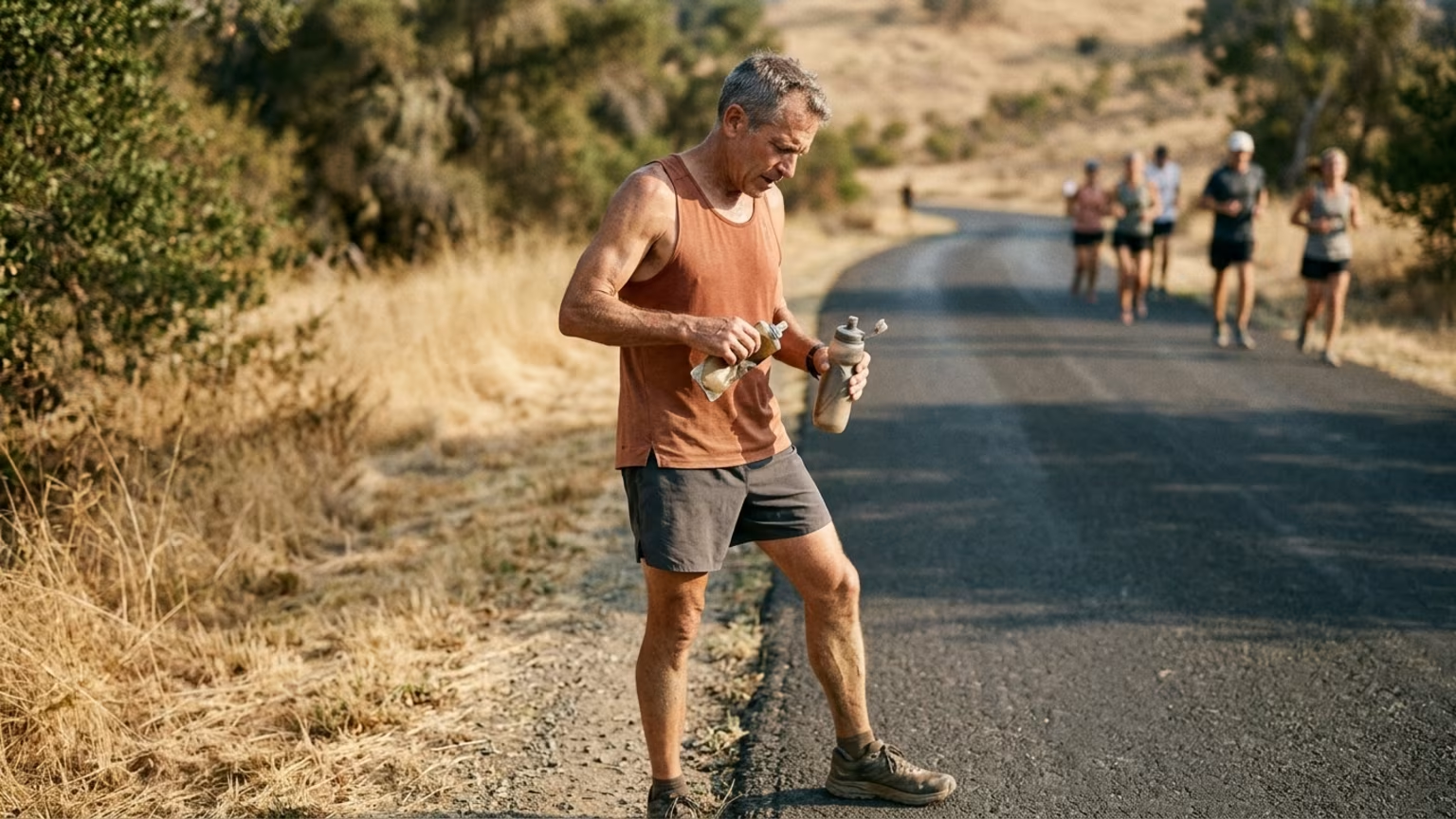

Learn how to adjust your race pacing when weather or steep hills strike. Master practical strategies for managing heat, wind, and finishing safely.





I stood shivering at the start line of a late season marathon. The forecast had promised cool temperatures and a tailwind. We were facing unseasonable heat and a steady headwind instead. In moments like that, the answer is to abandon your rigid pace and protect your physical effort.
A reliable pacing plan should never be a single finish time prediction. It needs to be a set of flexible rules for protecting your effort. Trying to hold a fixed speed when conditions deteriorate is a fast way to fail. You must adjust your expectations rather than forcing a fixed target.
Your body operates on a strict energy budget during intense competition. Forcing a fast pace in difficult weather forces your heart to pump more blood to the skin for cooling. This leaves less oxygen available for your working muscles. The result is an inevitable and dramatic collapse in the final miles.
Large datasets show exactly how much environment matters. A published analysis examined 1,791,972 finishes from 60 major marathons in relation to race temperature. The results showed that environmental conditions consistently alter pacing behavior. The best performances generally happen in cool temperatures.
This adjustment is particularly crucial for older or slower competitors. Research reviews generally find that heat related pacing effects may be stronger in longer races and among slower runners. These athletes spend much more time exposed to the conditions. A temperature that feels manageable for a fast runner may impose a massive penalty on someone racing for five hours.
Reviews of endurance pacing have generally considered even pacing or a slight negative split advantageous for longer events. A negative split means running the second half slightly faster than the first. You cannot achieve this if you stubbornly hold your goal pace through early heat. Start with a conservative effort ceiling and allow your speed to drop.
Heat increases thermoregulatory strain on the body. This means your heart works harder to cool you down while also fueling your muscles. On a hot day, your target pace might demand a cardiovascular effort you cannot sustain. Do not wait until you feel overheated to change your strategy.
You should never rely on rigid pace adjustment formulas. Practitioner guidance notes that a fixed rule, such as adding 10 to 20 seconds per mile for every 5 degrees above 60 degrees, is not a universally validated standard. The relationship between temperature and performance is not identical for every single athlete. Age, fitness, and heat acclimation all change how your body responds.
Understanding your personal fluid loss is completely essential. You should weigh yourself before and after a long training effort in the heat. The difference in weight helps you calculate exactly how much fluid you need to replace per hour. This allows you to create a customized drinking schedule instead of guessing on race day.
The American College of Sports Medicine emphasizes individualized strategies such as sweat profiling. They also note the importance of limiting excessive body mass loss during exercise. Losing more than two percent of your body mass is a serious performance and hydration concern. Build a racing in challenging weather conditions protocol based on your own sweat rate.
Fueling heavily in the heat can feel difficult. For years, I capped my mid ride fueling at around sixty grams of carbs per hour, convinced that taking in more would wreck my stomach. Then I read a series of recent studies on gut training and higher oxidation limits for endurance athletes. I spent a three month base phase gradually increasing my intake up to ninety grams using a mix of glucose and fructose.
The difference during my next Gran Fondo was staggering. I had a late race surge that I had never experienced before, completely avoiding the usual energy crash. This proves that you must test and trust your nutrition plan. Proper intake supports your cardiovascular system when the weather turns hostile.
Hills magnify pacing errors because athletes often treat every incline as a test of speed. When you combine steep gradients with warm weather, the physiological cost spikes dangerously. The heat adjustment must be made first. After that, you must apply additional restraint on the climbs to survive.
For hilly summer racing, practical coaching guidance recommends using heart rate or effort rather than current pace. You must keep your climbs around a controlled aerobic range. Pushing too hard up a long hill early in the race will ruin your legs for the final miles. You should shorten your stride and accept a substantial pace reduction.
When you reach the crest of a hill, do not sprint over the top. Hold a steady effort for several seconds to regain your posture. Let your breathing settle before you allow your speed to return naturally on the descent. Excessive downhill speed can damage your quadriceps and compromise the final third of your race.
Your goal is not to win back the time you lost on the climb. Your objective is to arrive at the late stages with usable legs. A smart race day contingency plan relies on effort control rather than speed defense. Let gravity do the work on the way down while remaining mechanically relaxed.
Wind creates a terrible psychological trap for ambitious adults. Runners and cyclists often fight a headwind to maintain target speed. They then waste the benefit of a tailwind by surging too aggressively. You should pace the exposed effort rather than the exposed speed.
When running into a headwind, shorten your stride and relax your upper body. Allow your pace to slow down naturally while keeping your breathing steady. A slower split into the wind is perfectly fine if it preserves your energy. When you finally turn into a tailwind, regain your speed gradually.
Avoid trying to apply rigid formulas to wind resistance. Your exact speed penalty depends on body size, course terrain, and drafting dynamics. The core rule is to keep the effort controlled and let the speed vary. Never surge dangerously just to attach yourself to a faster pack.
A pre agreed evaluation point removes emotion from race day choices. You should build clear checkpoints into your plan. Good evaluation moments include the end of the first major climb or the halfway mark. At each checkpoint, ask yourself if your breathing is controlled.
Evaluate if your effort is rising while your pace stays the same. If your heart rate continues to drift upward at a steady speed, you are working too hard. This is a clear signal to slow down temporarily. Seek shade if available and stick to your hydration routine.
Use a simple rule to manage deterioration. If your effort is clearly too high, reduce it by one level and reassess later. Making one adjustment at a time prevents unnecessary anxiety. Reendure helps older athletes build strategic race scheduling plans that prioritize this kind of calculated longevity.
Stop competing for your original time goal if your coordination deteriorates. A performance goal is completely optional, but safety is mandatory. If you feel severe dizziness or cannot keep fluids down, you must stop.
It is also critical to understand when the goal has fundamentally changed. When conditions turn extreme, finishing safely becomes your only priority. Do not let pride push you into a dangerous medical situation. If the event medical team advises you to stop, you must listen to them immediately.
The most important lesson in endurance sports is that flexibility equals durability. Adapting your pace to the course and weather is a sign of mastery. The conditions do not care about the time goal you wrote down last month. Adjust your effort early to protect your body.
Set a firm heart rate or breathing limit for the first hour of your next race, and absolutely refuse to exceed it regardless of how slow your watch says you are moving.

Follow ReEndure for practical insights on endurance training, recovery, nutrition and healthy aging. Stay connected for new articles, research led guidance and ideas to help you perform better for longer.


Read practical ideas on endurance training, recovery, nutrition and healthy aging to keep progressing for years to come.
Read the Blog