

Kenya’s Backyard Ultra preview highlights hourly recovery windows, team scoring and the limits of using race reports to guide training.





In its preview of the 2026 Backyard Ultra World Team Championship, Eastleigh Voice listed 15 Kenyan runners and reported 69 participating nations. Kenya’s race was scheduled for October 17 at Tatu City, with a 3:00 p.m. East African Time start. National teams were set to race simultaneously at separate locations rather than meet on one shared course.
The format makes the recovery question unusually visible. Competitors complete a loop every hour and must return for the next start. Whatever time remains has to accommodate the tasks that come between efforts.
That is the useful story for endurance athletes over 35: not a new recovery technique, but a race structure that puts competing demands on the same short interval. The next departure remains the organizing constraint.
In the format described by Eastleigh Voice, runners must complete a 6.706-kilometre loop within 60 minutes. Missing that cutoff or the next hourly start means elimination. There is no preset total distance, so the event continues until competitors can no longer continue.
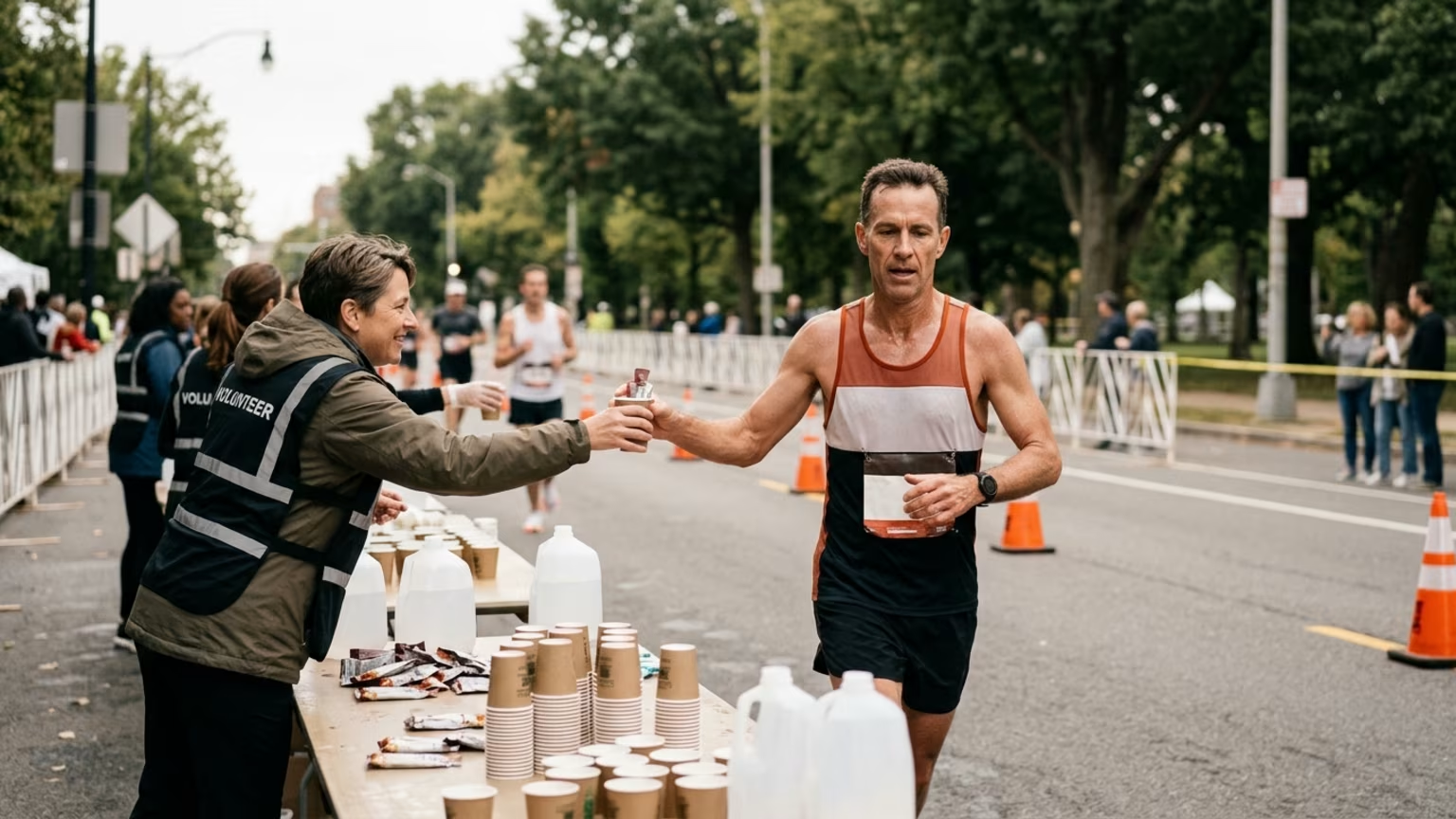
Finishing a loop is therefore only part of the task. An athlete also has to be ready for the next departure. The report says the time left after finishing can be used to eat, hydrate, change clothes and rest.
The distinction matters: an hourly start is fixed, but the interval before it is not. A runner who finishes earlier has more time available before the next departure. That is a feature of the timetable, not a reason to treat the fastest possible loop as the goal.
It is tempting to read the race as a simple trade between running and resting. A more careful interpretation is that several tasks share whatever time remains. Time available for a clothing change is also time that could have been spent eating or resting. The practical issue is allocation: the same interval cannot be treated as a separate block for every task.
The preview also describes the prospect of running overnight and into the following day as fatigue and sleep deprivation accumulate. That places the next restart inside a continuing event rather than after a normal break between training sessions. For a broader look at the format, our discussion of endurance limits in backyard racing provides related context.
The team competition adds another layer. Each runner’s completed laps contribute to the national tally, so an athlete can add to the team result without being the last person standing at the local venue.
Men’s Fitness Online Australia reported that Belgium won the 2024 team championship with 1,147 loops. It placed Australia second on 971 and the United States third on 969. Those were reported team totals, not the distances covered by individual winners.
For Kenya, the preview also supplied a historical reference point. Eastleigh Voice reported that its 2024 championship debut involved 14 Kenyan participants and ended third in Africa after 38 hours. It identified Reuben Josphat Mgonga Njorege as the national race winner with 38 yards.
This matters when interpreting Kenya’s 15-runner entry. The event is not solely a contest built around the strongest individual. It also counts repeated contributions across the roster. The recovery window sits inside that collective structure: being ready for another start gives a runner another opportunity to contribute.
The available coverage is a preview, not a report of the 2026 outcome or actual race duration. It contains no controlled comparison of recovery routines and no measured rest intervals, sleep data or medical outcomes. It also provides no age-specific recovery findings or evidence that sleep deprivation is safe or beneficial to train.
For athletes aged 35 and over, the useful translation is logistical. A fixed restart requires thinking about the period between efforts as part of the event. That does not turn a championship race into a model for an ordinary training week.
Reendure’s focus is race performance alongside long-term participation. From that perspective, this event is most useful as a planning example rather than a standard of toughness. The ambition can remain high without making accumulated exhaustion the measure of a good training decision.
A sensible reading of the preview leads to a few planning questions. These organize the reported demands without pretending to be a recovery protocol:
These are questions about organizing an event. Their value is in making the schedule explicit before the race begins. The transferable habit is to identify the real constraints before choosing a response, rather than copy the visible hardship of an extreme race.
For an everyday training decision, start with the question you actually need answered. Planning for a race with repeated departures is different from deciding how to arrange the next week of running. Our guide to assessing training plans for masters athletes is a separate place to consider that broader planning task.
The same distinction applies when watching elite or extreme endurance events. A report can accurately describe what competitors face without making those demands a useful target for everyone else. Here the relevant observation is the compression of tasks between starts. Keep the event’s demands attached to its rules rather than turning them into a general test of commitment.
Kenya’s championship preview puts a familiar endurance challenge into sharp relief: the next effort can arrive before every between-effort task has its own comfortable space. The reported format makes that scheduling problem visible, while team scoring gives each completed lap a collective value.
For veteran athletes, take the planning lesson rather than a recovery prescription. Understand the timetable and the tasks that must fit around it. This coverage offers no reason on its own to change training or recovery routines.

Follow ReEndure for practical insights on endurance training, recovery, nutrition and healthy aging. Stay connected for new articles, research led guidance and ideas to help you perform better for longer.


Read practical ideas on endurance training, recovery, nutrition and healthy aging to keep progressing for years to come.
Read the Blog