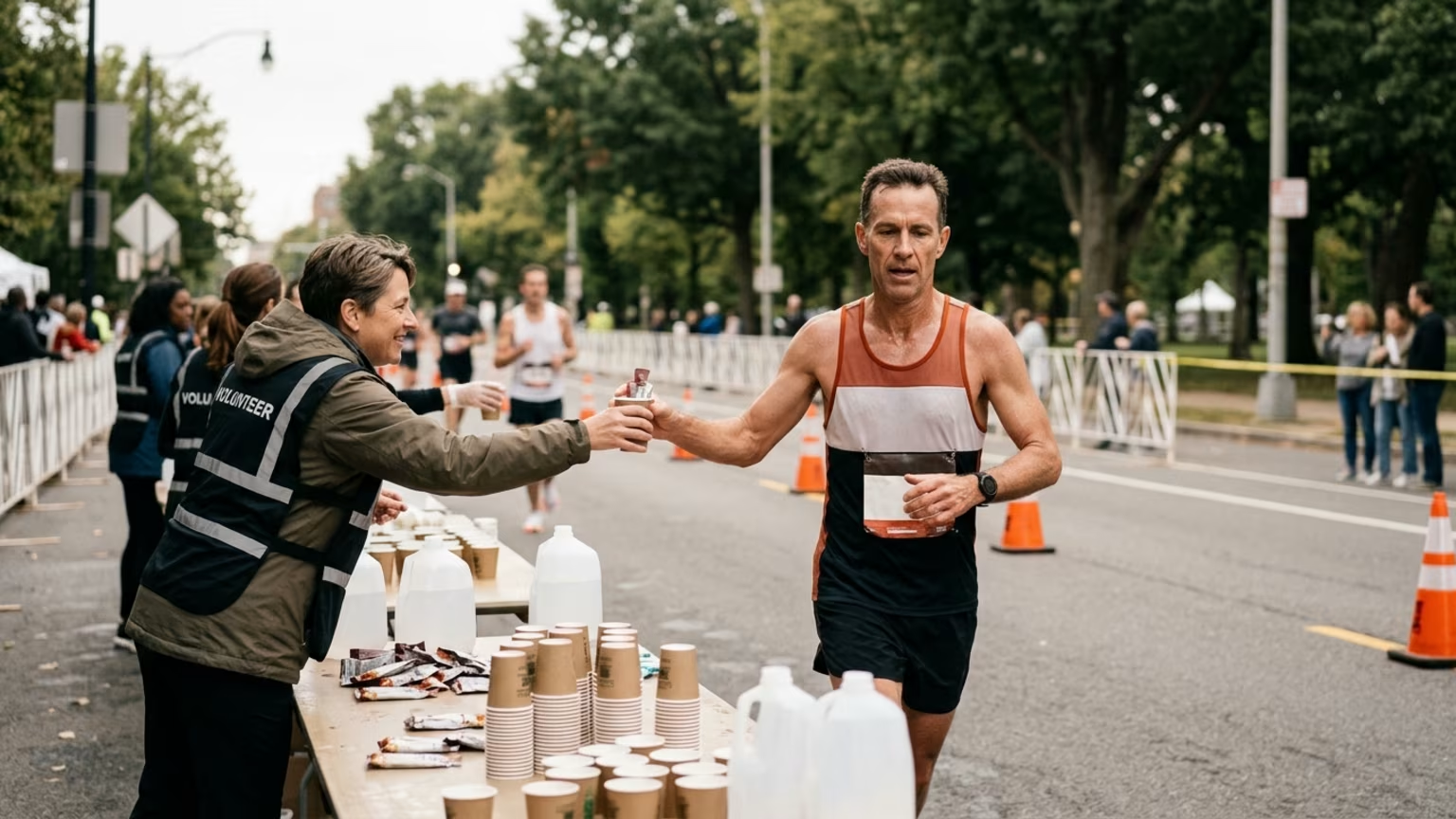

A practical reading of NBC Select’s marathon guide: carbohydrate reference ranges, individualized electrolyte planning, and event-specific hydration rules.





NBC Select’s marathon gear guide, published October 14, 2026, brings together recommendations from professional runners and other running experts. Its practical message goes beyond what to buy: rehearse fueling during training and check whether your race permits your chosen hydration system.
The NBC Select guide reports a general hourly carbohydrate range. It also discusses individualized electrolyte planning and warns that hydration equipment rules vary between events.
For endurance athletes over 35, the useful task is to connect those pieces. A fueling approach needs to be familiar to the runner. A carrying system needs to meet the event’s requirements. Those are related decisions, but they answer different questions.
NBC Select cites Mayo Clinic guidance of roughly 30 to 60 grams of carbohydrate per hour for longer runs. It lists sports drinks, fruit, gels, and chews as possible carbohydrate sources.
That gives readers a reference for planning rather than a reason to favor one product format. The guide’s advice is to test fueling during training and repeat the chosen products and schedule on race day. The emphasis is on familiarity with an approach rather than novelty in the shopping basket.
For readers comparing that reference with other marathon advice, Reendure’s discussion of putting hourly carbohydrate figures in context offers related reading. The distinction to keep in view is between a general range and an individually tested plan.
Sodium deserves separate attention. Experts consulted by NBC describe 500 to 1,000 milligrams of sodium as a usual range for long-distance runners. That figure should not be converted into an hourly instruction: the reported carbohydrate range explicitly includes a time period, while the sodium figure presented here does not.
The evidence has clear limits. This is expert-informed editorial guidance rather than a new intervention study, and its product selections do not establish that a particular item improves performance. NBC attributes the sodium figure to consulted experts rather than a named supporting study. The article also stresses that fueling needs differ between people, so its numbers are not personal prescriptions.
For questions about an appropriate electrolyte concentration, NBC recommends consulting sports-medicine doctors, nutritionists, or dietitians. That is the appropriate place for personal decisions rather than trying to extract an individual requirement from a general gear guide.
The useful guidance is therefore straightforward: consider the reported carbohydrate range as background for planning. Treat sodium as a separate individualized question. Use training to become familiar with the chosen fueling approach, as NBC’s contributors recommend.
For Reendure’s audience, the practical value lies in preparation rather than a wholesale change of routine. The guide does not create a reason to replace familiar products simply because another option appears on a recommended gear list.
Our view is that performance and long-term participation belong in the same conversation. Here, that means keeping the nutrition question distinct from the equipment question while preparing them together. The aim is a familiar approach that also fits the event’s stated conditions.
NBC advises checking the specific event because reservoir restrictions and container-size limits can vary. Its broad equipment observations should not replace the organizer’s own instructions.
The New York Road Runners prohibited-items listing includes hydration backpacks or vests with rear water reservoirs. It also lists containers larger than one liter among prohibited items. Those details make the reservoir’s location and the container’s capacity relevant to the equipment decision.
The Tokyo Marathon 2026 guidebook states that hydration bags and soft bottles are permitted only when empty under its listed food-and-drink requirements. That condition concerns the state of the container, not merely its design.
These are examples of particular event policies, not a universal marathon standard. A setup accepted under one event’s rules should not be assumed acceptable at another. Likewise, a general description such as “running vest” is not enough to settle whether a specific reservoir arrangement is permitted.
The practical order supported by NBC’s advice is to check the current event requirements before choosing a carrying system. Look for the exact equipment category and any stated size or empty-container condition. If the wording leaves your setup unclear, seek clarification from the organizer rather than treating a general gear recommendation as permission.
NBC’s contributors recommend trying fueling strategies in training and using familiar products on race day. For an experienced athlete, that recommendation is best understood as rehearsal of the chosen approach rather than an invitation to keep changing products.
A simple review can keep the nutrition and equipment questions connected:
These questions do not supply a new intake formula. They organize the practical advice in NBC’s guide alongside the official equipment examples. The nutrition rehearsal comes from the guide’s expert recommendations, while the equipment requirements come from the event rules.
The distinction matters when a race requires a different carrying arrangement from the one normally used in training. That becomes a planning issue to resolve before race day. It is not evidence that the underlying nutrition strategy needs to be replaced.
A permitted bottle does not determine an appropriate electrolyte concentration. Nor does a general sodium figure tell a runner which container an event will accept. Keeping these decisions separate makes the information easier to use without giving any source more authority than it has.
For equipment, the relevant authority is the race organizer. For a personal electrolyte plan, NBC points toward qualified sports-medicine and nutrition professionals. For product familiarity, its contributors recommend rehearsal in training.
Reendure’s broader discussion of hydration as an individual planning question provides related context. Within this guide, however, the practical focus remains specific: individualize the plan with appropriate support and verify the carrying rules for the event.
For ambitious masters athletes, this is useful preparation work rather than a demand to overhaul training or nutrition. The immediate question is whether the intended approach has been rehearsed and whether the equipment complies with the race’s requirements.
NBC Select’s guide is most useful as a prompt to connect fueling preparation with race logistics. It reports an hourly carbohydrate reference and recommends familiar products and a practiced schedule. Its electrolyte advice points toward individual planning rather than a universal sodium instruction.
The official NYRR and Tokyo examples add a separate lesson: check the event’s actual equipment requirements before relying on a favorite hydration setup.
For athletes over 35, the modest takeaway is enough. Prepare a familiar fueling approach, resolve personal electrolyte questions with qualified support, and confirm that the planned carrying system meets the race’s rules. This guidance supports preparation, not an automatic change to a routine that is already individually tested.

Follow ReEndure for practical insights on endurance training, recovery, nutrition and healthy aging. Stay connected for new articles, research led guidance and ideas to help you perform better for longer.





Read practical ideas on endurance training, recovery, nutrition and healthy aging to keep progressing for years to come.
Read the Blog