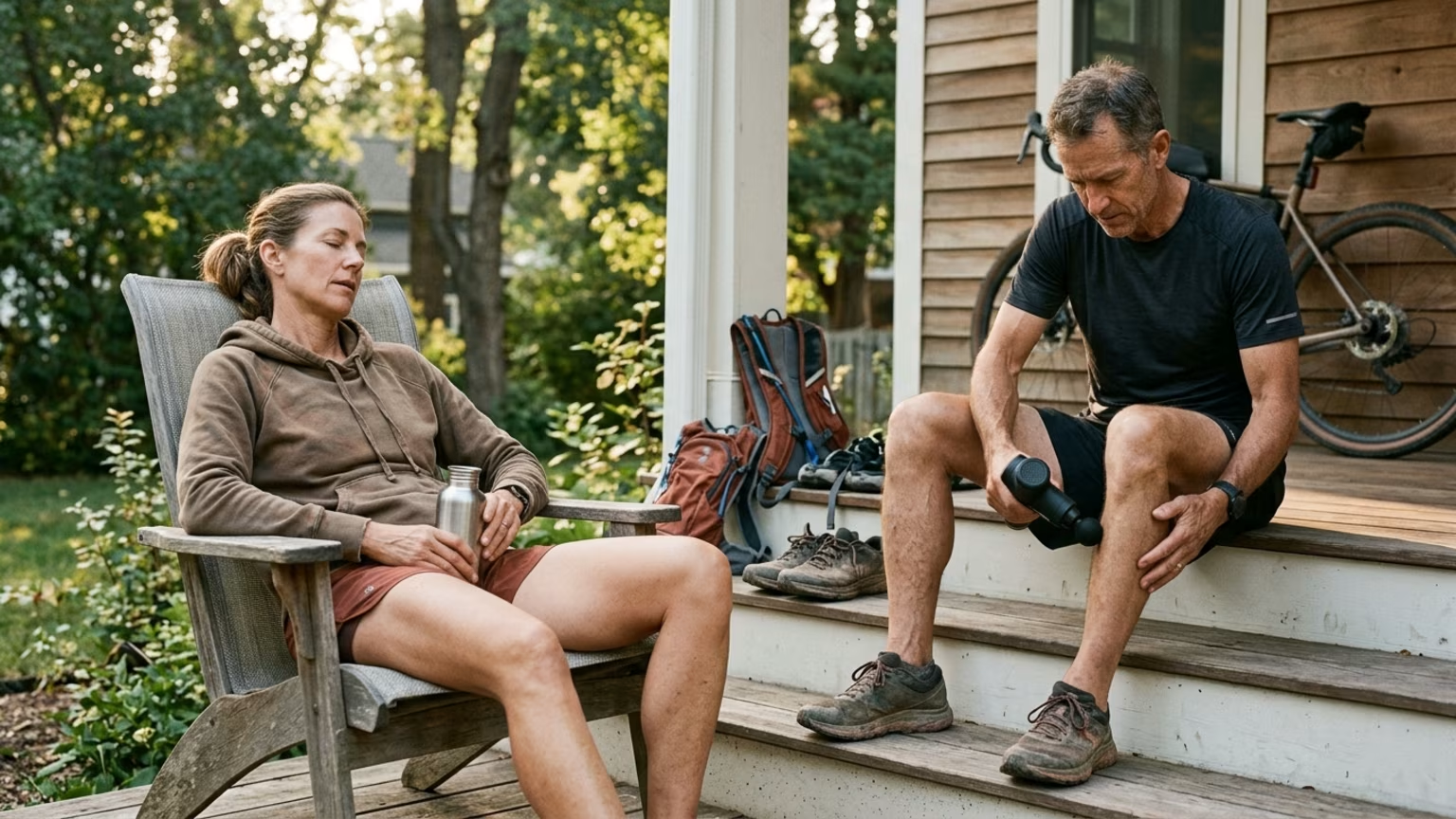

A review reported no clear recovery-tool advantage over passive rest. How athletes over 35 can weigh performance claims and personal preference.





A systematic review covered in a Velo report published October 15, 2026 found no physical recovery method that outperformed passive recovery on the outcomes examined. The methods included familiar options such as compression garments and massage alongside cold-water immersion and electrical stimulation.
For endurance athletes considering another recovery purchase, that finding deserves attention. The useful question is not whether a tool looks sophisticated or appears in a professional athlete’s routine. It is whether the evidence supports the particular benefit being promised.
According to Velo, the review’s overall conclusion was that none of the physical recovery methods examined demonstrated superiority over passive recovery. Doing something extra did not establish an advantage over simply resting across the outcomes assessed.
That comparison matters. A recovery method needs to demonstrate more than an appealing explanation for how it might work. To justify a claim that it improves recovery beyond rest, the relevant evidence needs to show an added benefit against that alternative.
The performance findings were more specific. Velo reports low-to-moderate certainty evidence against clinically important sport-specific performance benefits from compression garments, active recovery and neuromuscular electrical stimulation. In plain language, the evidence did not support a performance improvement substantial enough to matter for the sporting outcome being assessed.
Compression garments produced the clearest individual finding. The report describes moderate-certainty evidence that they did not improve performance in the reviewed population.
For a purchase framed around better subsequent performance, those findings weaken the case. A familiar method does not earn an exemption from comparison with rest simply because athletes commonly associate it with recovery.
It also helps to keep the promised outcome precise. Feeling more comfortable is one claim. Experiencing less soreness is another. Performing better in a sport-specific test is a third, and the terms should not be used interchangeably when assessing what a product offers.
Velo describes the research as a systematic review and network meta-analysis involving 273 competitive, elite or professional endurance athletes. It assessed 47 comparisons of recovery methods.
The athletes participated in cycling, running and swimming. Triathlon and cross-country skiing were also represented.
The methods examined included cold-water immersion, cryotherapy and neuromuscular electrical stimulation. Massage, compression garments and active recovery were also included. Comparisons involved passive recovery and a room-temperature bath used as a sham intervention.
The evidence had important boundaries. Velo reports that 31 of the 47 tool-versus-rest comparisons were rated very low certainty. The report does not establish direct transfer to every recreational athlete or every recovery goal, nor does it establish an age-specific benefit for athletes over 35. These limitations mean the review challenges strong performance claims without proving that every method is useless in every setting.
The setting of a claim deserves attention too. A separate article titled “Compression Shorts May Improve Recovery When Worn During Exercise” concerns garments worn during exercise. That title should not be treated as evidence that using compression after exercise improves subsequent performance compared with passive rest.
This is a useful reading habit: identify the population, the way the method was used and the outcome before comparing headlines. Two statements about “recovery” may address different questions. A clear purchase decision starts with knowing which question matters to you.
For ambitious endurance athletes over 35, the practical implication is to make recovery purchases earn their place. Age alone is not a reason to accept a stronger product claim than the evidence supports.
At Reendure, our focus is performance today alongside the ability to keep participating for years to come. Applied here, that means separating an optional preference from a demonstrated performance requirement. A recovery routine does not need to become an equipment collection to be taken seriously.
Before evaluating a method, distinguish what you hope to get from it. “Better recovery” is too broad to make a useful comparison.
A clearer assessment separates three questions:
The review’s performance findings are relevant to the last question. Personal satisfaction with a routine answers a different question and should be described that way.
This distinction is especially useful when considering a purchase. “I enjoy using this” is an honest reason to value something. “This reliably improves my next performance more than rest” is an evidence claim that requires support.
The same care belongs in conversations with training partners. An individual account of feeling better can be meaningful to that person without becoming proof of a general performance benefit. There is no need to dismiss the experience or turn it into a stronger claim.
Velo included commentary from Tudor Pro Cycling trainer James Spragg. He said some recovery practices may be placebos or not well-proven, yet he and the team may still value them when riders feel they help. He also considered greater confidence for the following day a worthwhile benefit.
That is a practitioner’s perspective on the value of a routine. It is not evidence that the routine improves physiological recovery or sport-specific performance.
There is room for both ideas. An athlete can enjoy a familiar recovery practice while remaining clear about why it stays in the routine. Comfort and confidence do not need to be presented as measured performance gains to have personal value.
The practical choice is to keep the label accurate. An optional ritual can remain optional. It does not have to become something every serious athlete supposedly needs.
Velo’s practical emphasis was on sleep, eating well, sensible work-rest balance and stress management before spending additional money or time on recovery tools. Those priorities were the report’s advice, not interventions the review directly tested against every modality.
That is a sensible order for reviewing a routine. Start with the elements the report identifies as priorities rather than allowing an accessory to define what recovery means.
For more detailed reading, Reendure’s guide to building a workable sleep routine addresses sleep within endurance training. Our resource on organizing post-training food decisions covers the nutrition side of that broader picture.
The distinction is one of priority rather than a demand to remove every extra. A preferred recovery method can sit alongside the basics. It should not be treated as a substitute for paying attention to them.
Whether a tool deserves your money and whether a session fits your recovery state are separate decisions. Keeping those questions separate avoids treating ownership of a recovery product as reassurance about the next workout.
An evidence-based approach does not require replacing enthusiasm for tools with enthusiasm for doing nothing. It requires keeping the decision tied to the actual question: what supports the next training choice, and what is merely an optional addition?
Reendure’s discussion of interpreting daily recovery information offers a related perspective on making those judgments. The goal is a considered decision rather than a verdict based on one product or one reassuring feeling.
Questions involving a medical condition or persistent symptoms belong with a qualified clinician. A recovery-product claim is not an appropriate basis for an individual medical decision.
The review reported by Velo gives endurance athletes a clear reason to question promises of reliable performance gains from added recovery tools. Passive rest is a meaningful comparison, not an option that should automatically lose to a more elaborate routine.
For athletes over 35, the grounded response is to keep claims and preferences separate. Value a routine for comfort or confidence if that is what it provides. Reserve claims of improved performance for evidence that supports them.
There is no obligation to buy another recovery method on the strength of this review. Keep sleep, nutrition and sensible work-rest balance at the center of the conversation, with additional tools treated as optional rather than essential.

Follow ReEndure for practical insights on endurance training, recovery, nutrition and healthy aging. Stay connected for new articles, research led guidance and ideas to help you perform better for longer.



Read practical ideas on endurance training, recovery, nutrition and healthy aging to keep progressing for years to come.
Read the Blog