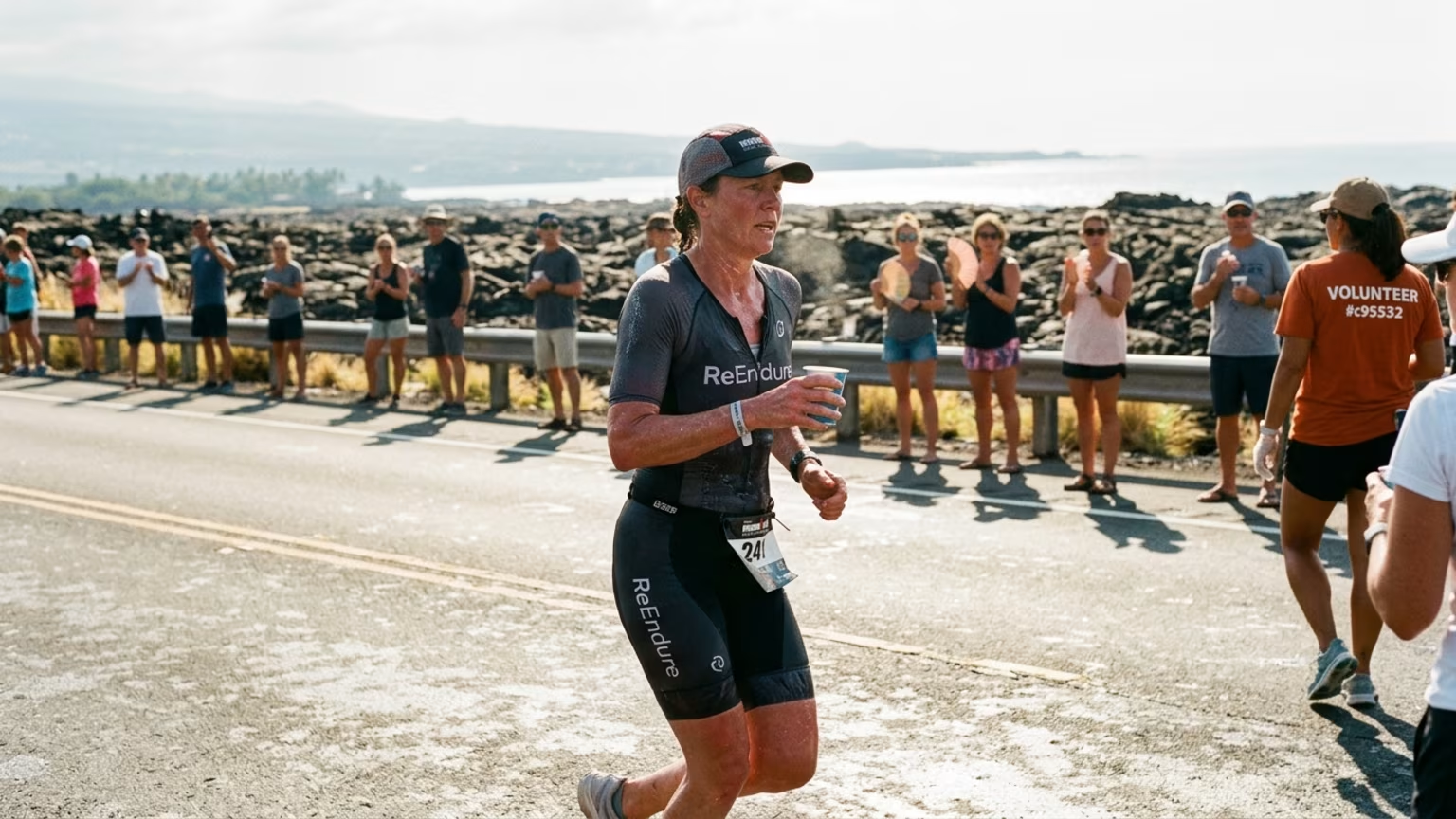

Coverage of the 2026 Kona IRONMAN highlights how severe heat and humidity degrade performance. Learn why veteran athletes must prioritize active cooling.





On October 5, 2026, Men's Fitness and the local outlet Big Island Now reported that the 2026 IRONMAN World Championship is scheduled for October 10 in Kailua-Kona, Hawaii. Coverage of the prestigious event notes that professional men and women will race there on the same day. This decision marks a return to a single-day format for the championship event. The primary article from Men's Fitness outlines the standard long course, which features a 2.4-mile swim, a 112-mile bike leg, and a marathon.
However, the publication emphasizes that the true challenge of the island lies in the environment. Men's Fitness characterizes typical Kona race conditions as roughly 30 degrees Celsius with 80 percent humidity. These specific environmental variables create a massive physiological burden for competitors. Endurance athletes train for months to build aerobic capacity, muscular endurance, and mental resilience.
Arriving on the island with peak fitness is only one part of the equation. The combination of intense solar radiation and dense, moisture-heavy air fundamentally alters human physiology. The body struggles to operate efficiently under sustained physical stress in these conditions. For athletes traveling to demanding environments, understanding these external factors is a critical component of race readiness.
The IRONMAN World Championship holds a unique place in the culture of long-distance triathlon. Competing on the Big Island is a career-defining achievement for many age-group athletes. The announcement that professional men and women will share the course adds a layer of logistical intensity. However, the prestige of the venue cannot shield competitors from the harsh reality of its climate.
The primary conclusion highlighted by the recent coverage is that environmental stress can degrade performance entirely independently of underlying fitness. To illustrate this physiological reality, Men's Fitness reports on a specific study involving trained participants. In that study, the athletes saw their time-trial performance fall by 3.6 percent to 6 percent when exercising at 36 degrees Celsius. Furthermore, researchers found that elevated humidity at that same high temperature added an additional 3.4 percent performance cost.
These performance percentages demonstrate the severe compounding effect of heat and humidity. When air temperature rises, the body relies heavily on sweat evaporation to dissipate internal heat and maintain a safe core temperature. However, high humidity means the surrounding air is already saturated with moisture. This saturation prevents sweat from evaporating efficiently, which leaves the athlete sweating profusely without receiving the necessary cooling benefit.
The cardiovascular system is then forced to work significantly harder just to manage this thermal strain. Blood that would normally carry oxygen to working muscles must be redirected to the skin for cooling purposes. This physiological triage explains why power output drops and perceived exertion spikes in hot environments. The data reported by Men's Fitness underscores that athletes cannot simply push through severe weather with sheer willpower.
The human body operates within strict thermal limits. Exceeding those limits forces an unavoidable decline in athletic output.
To provide a concrete picture of the conditions in Hawaii, Men's Fitness details historical field measurements taken directly from the race course. The article reports that researchers tracked the core temperatures of 15 qualified triathletes during the 2014 Kona marathon. This monitoring provided precise data on the specific environmental load these athletes faced during the running segment. According to the publication, the measurements revealed a mean wet-bulb globe temperature of roughly 24.7 degrees Celsius.
The data showed that conditions continued to escalate as the race progressed, reaching a maximum wet-bulb globe temperature of 28.5 degrees Celsius. This metric is particularly valuable for endurance athletes because it offers a highly accurate assessment of thermal stress. A wet-bulb globe temperature reading accounts for ambient heat, relative humidity, solar radiation, and air movement. The detailed tracking of those 15 triathletes confirms the severe reality of the Kona marathon course.
Standard thermometers only measure the ambient heat of the air. They fail to capture the actual physical experience of an athlete in continuous motion. The wet-bulb globe temperature metric solves this problem by integrating multiple forms of environmental stress into a single, actionable number. The humidity component dictates how well sweat evaporates, while the solar radiation factor accounts for the direct heat of the sun.
Air movement determines whether convective cooling can actively assist the sweating athlete. When the triathletes in the 2014 study faced a maximum reading of 28.5 degrees Celsius, their bodies were operating under severe physiological strain. Endurance athletes are continuously generating internal metabolic heat while pushing forward to the finish line. This internal heat production requires a meticulous approach to physical management when the external environment is already hostile.
For the ambitious endurance athlete over 35, these findings require a mature approach to race preparation and execution. As the body ages, thermoregulation can become less efficient, making older competitors potentially more vulnerable to unexpected heat spikes. Preparing for a warm race demands a structured, evidence-based approach rather than relying solely on accumulated fitness. Understanding the nuances of how weather changes endurance fueling is essential for longevity in the sport.
The most crucial adjustment veteran athletes must make in hot conditions is surrendering their attachment to rigid pace targets. The performance declines reported by Men's Fitness prove that a pace achievable in mild weather may become physiologically impossible in severe heat. Athletes who ignore the environment and attempt to force their goal pace will almost certainly face early exhaustion. Instead of fighting the conditions, experienced competitors must pace by perceived exertion, accepting that their overall time will likely be slower.
Adjusting your strategy is a necessary skill for managing race pacing in bad weather conditions. Older athletes must respect the physical toll of extreme weather. An athlete might struggle to hold their target pacing during a humid summer workout. Rather than assuming their conditioning has slipped, they should interpret the effort through the lens of the environment.
Because the environment limits natural sweat evaporation, athletes must manually lower their body temperature throughout the event. A recent Triathlon Magazine feature provides practical race execution guidance from Dr. Dan Plews on this exact subject. The publication reports that Dr. Plews strongly recommends using aid stations proactively for cooling. His specific tactical advice includes putting ice directly inside a race suit.
Furthermore, Dr. Plews advises athletes to pour water over their head and face. He also suggests making frequent use of wet sponges to maximize cooling. These methods mimic the cooling effect of sweat evaporation by applying cold water directly to the skin. For older athletes, executing this kind of active cooling at every available opportunity is absolutely vital for performance.
Skipping an aid station to save a few seconds is a risky decision that can result in a catastrophic loss of time later. Reendure consistently advises older athletes that managing systemic stress is just as important as maintaining a strong cadence.
The physical toll of extreme heat is obvious, but athletes must also recognize the mental degradation that accompanies severe thermal stress. As core temperatures rise, decision-making capabilities and mental focus naturally begin to deteriorate. Competitors may struggle to remember their nutrition timing or severely misjudge their hydration needs. Staying aware of how prolonged running and race fueling alter cognitive performance is essential for maintaining tactical discipline.
An athlete who loses their mental clarity in the heat is much more likely to abandon their pacing plan entirely. Maintaining a cool physical temperature directly supports a calm, focused mindset.
The impact of heat and humidity also extends far beyond race day. It directly influences how athletes should evaluate their daily training data. Men's Fitness explicitly advises readers to check the day's environmental conditions before interpreting a poor session as lost fitness. This is a vital piece of wisdom for ambitious adults who meticulously track their daily workout metrics.
When a standard tempo run feels unusually difficult in high humidity, the athlete has not suddenly lost their conditioning overnight. The elevated perceived effort is simply the cardiovascular system managing the heavy demands of thermoregulation. Reacting emotionally to a slow training session in the heat often leads athletes to push harder in subsequent workouts. This reactive approach increases the risk of chronic overuse injuries, which are particularly detrimental to athletes aged 35 to 65.
Slower recovery times due to aging mean that digging a deep fatigue hole takes much longer to resolve. Veteran athletes must remain calm, analyze the environmental context of their data, and recognize that adapting to the weather is part of the process. Prioritizing steady consistency over emotional reactions aligns with the long game of periodizing training for older competitors.
Veteran endurance athletes facing hot and humid conditions must abandon rigid pace targets and instead rely on aggressive active cooling and context-aware effort management.

Follow ReEndure for practical insights on endurance training, recovery, nutrition and healthy aging. Stay connected for new articles, research led guidance and ideas to help you perform better for longer.




Read practical ideas on endurance training, recovery, nutrition and healthy aging to keep progressing for years to come.
Read the Blog