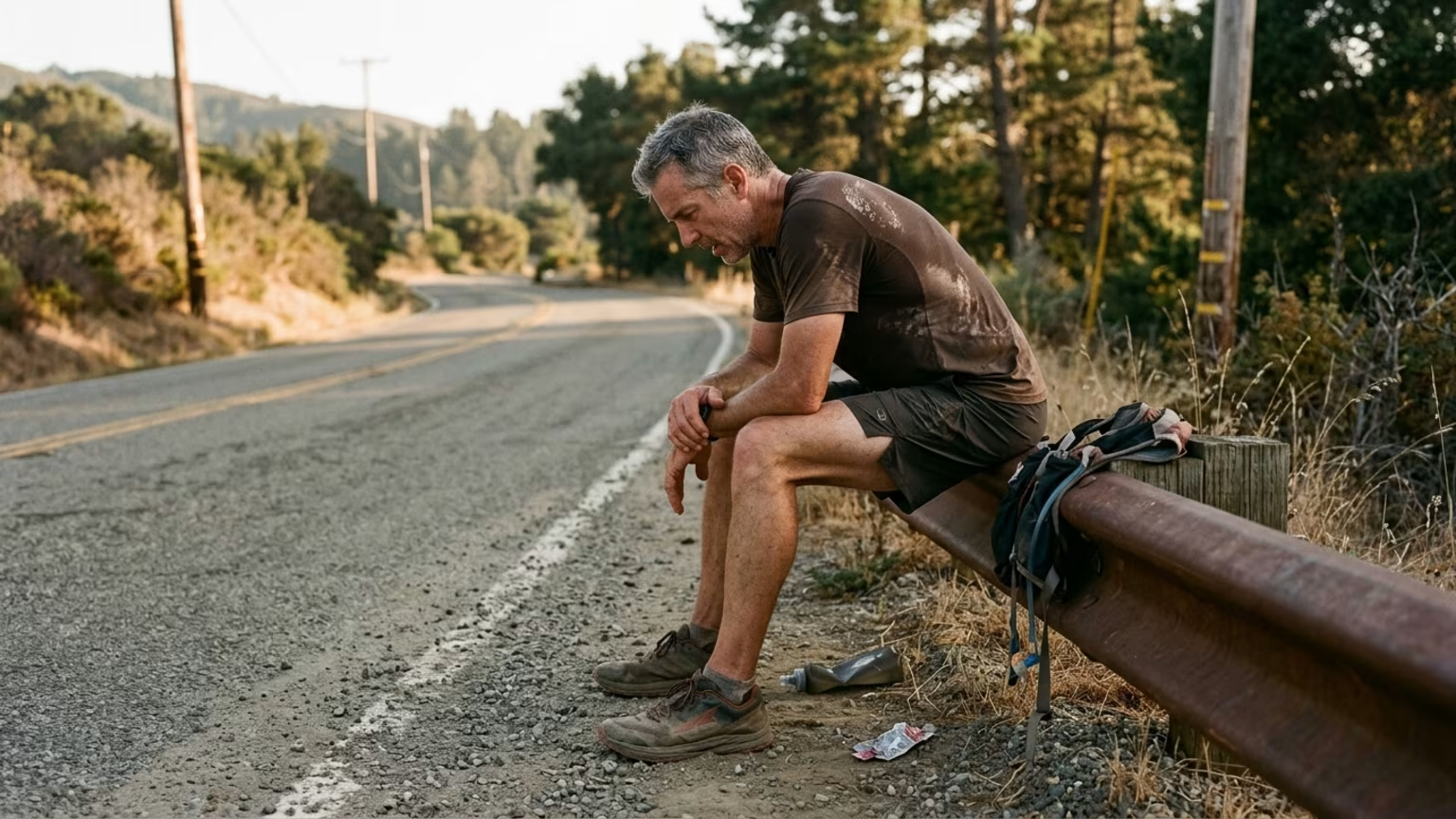

A 2026 report shows functional overreaching can boost performance by 2.6 percent, but it dramatically increases illness risk for masters endurance athletes.





On September 30, 2026, ScienceInsights published a report titled "Overreaching in Training: What Happens Inside the Body." The article reviewed how deliberate, short term fatigue impacts endurance athletes. It examined both the potential performance benefits and the physiological costs of pushing the body past its normal limits. The findings clarify the sharp line between productive overload and harmful exhaustion.
The research focuses heavily on the difference between functional and non-functional overreaching. Functional overreaching is a short term performance dip caused by an unusually demanding training block. When an athlete follows this acute stress with adequate recovery, their performance rebounds to a higher level. Non-functional overreaching occurs when that decline lasts much longer and brings additional negative symptoms.
The physiological mechanism behind this adaptation is complex. Functional overreaching creates a deliberate stress response that forces the body to adapt. When the stress is removed during a taper, the body overcompensates and builds back stronger. This is the exact mechanism that produced the performance gain observed by researchers.
According to ScienceInsights, the potential upside of functional overreaching is highly measurable. In one study of trained triathletes, researchers tracked athletes who pushed into this fatigued state. Those who reached functional overreaching and then completed a taper achieved roughly 2.6 percent greater peak performance. This was compared directly to athletes who merely maintained steady, hard training.
However, if the stress continues too long, the body fails to adapt. This pushes the athlete into non-functional overreaching, which requires a much longer recovery period. The athlete might experience a stagnation or a sharp decline in performance. Recovery from this deep state of exhaustion can take weeks or even months.
The physical toll required to reach that initial peak is incredibly severe. The same triathlete study tracked illness rates among the participants. Infections were reported in an astounding 70 percent of the functionally overreached group. In stark contrast, infections occurred in only 20 percent of the hard training group that did not reach overreaching.
To put that risk in perspective, the control group saw an infection rate of just 10 percent. This means the risk of illness spikes dramatically when an athlete pushes into deliberate overreaching. The physiological stress clearly compromises the immune system at a structural level. This leaves the body highly vulnerable precisely when it needs to recover most.
The intensity of the physical stress also impacts hormonal responses to exercise. Athletes in one study completed an 11 day intensified training period. After this block, they showed notably lower cortisol and testosterone responses to a hard workout. The endocrine system clearly struggled to mount a normal physiological reaction to physical stress.
The article reports specific numerical drops for these important hormonal markers. Cortisol responses fell from about 11 to 3 nmol/L. Testosterone responses dropped from about 407 to 258 pmol/L. These reductions highlight how deeply a short overload block taxes the body internally.
Finally, the report highlights a subtle but important shift in rest quality. A meta-analysis cited in the article examined sleep metrics after overreaching interventions. It found an approximately 2 percent reduction in objectively measured sleep efficiency. Interestingly, athletes did not report a significant change in their subjective sleep quality.
This sleep data suggests a concerning mismatch for athletes tracking their daily recovery. Your subjective perception of how well you slept might remain entirely unchanged. Meanwhile, your actual sleep efficiency is steadily declining under the heavy weight of the training stress. You might feel fine while your body is quietly failing to recover.
The findings reported by ScienceInsights draw from several different study types. The core performance and illness data came from a targeted study observing trained triathletes. The hormonal data was based specifically on an 11 day intensified training period. The sleep findings were drawn from a broader meta-analysis of multiple overreaching interventions.
While the article notes these specific parameters, it does not detail the exact sample sizes for all studies. Furthermore, the source does not mention masters athletes or offer specific age related findings. The available data provides a general overview of endurance training responses. We must apply these insights cautiously to ambitious endurance athletes aged 35 to 65.
For the ambitious endurance athlete over 35, this information requires a major shift in perspective. Many older athletes assume that pushing harder is the only way to keep improving. The 2.6 percent performance gain reported in the triathlete study might look very tempting. However, the accompanying 70 percent infection rate is a massive red flag for veterans.
As we age, our immune systems simply take longer to bounce back from acute stress. You should treat any overload block as a tightly bounded experiment. It is definitely not a routine default strategy for your everyday training. If you plan to push into functional overreaching, you must act with absolute precision.
For athletes aiming to stay competitive for decades, consistency is the ultimate metric. A 2.6 percent boost for a single race means nothing if you spend the next month sick. The high infection rate observed in the functionally overreached group is unacceptable for long term development. You cannot build a durable athletic foundation if you are constantly fighting off infections.
This is why Reendure always emphasizes a conservative approach to overload. We translate this complex science to ensure you can train hard without compromising your health. You must recognize that your biological resilience changes as you pass your 35th birthday. The margin for error during an intensified training block shrinks considerably.
You must plan the recovery period before the hard block even begins. You cannot just train until you feel tired and then hope to rest. You need a structured taper to secure the adaptation and avoid slipping into non-functional overreaching. Older athletes who ignore this strict boundary often find themselves sidelined by severe illness.
The hormonal data is equally vital for the older athlete to understand. A drop in testosterone and cortisol responses after an 11 day overload shows immense strain. Heavy training taxes the endocrine system deeply, and aging bodies require more time to restore baseline hormones. To mitigate this risk, you must ensure you are consuming enough calories during demanding blocks.
Proper fueling provides the energy necessary to sustain intense physical efforts. It also protects your baseline physiological health against the ravages of cumulative fatigue. Without adequate nutrition, the risk of a prolonged performance decline increases dramatically. You cannot undereat and expect to survive a deliberate overreaching phase without consequence.
Monitoring your actual training response is another critical piece of the puzzle. The ScienceInsights article points out that subjective measures actually performed better than objective measures. Metrics like mood, perceived stress, and general recovery status were highly sensitive indicators of fatigue. You must pay close attention to how you feel emotionally and mentally.
Tracking these subtle emotional changes is just as important as checking your GPS watch. However, you must be ruthlessly honest with yourself about those subjective feelings. The article warns that athletes often underreport fatigue because they fear losing precious training time. For the masters athlete, ignoring fatigue is a fast track to long term injury.
You have to build daily systems that make consistency easier rather than relying on stubborn denial. If you feel irritable or unusually stressed, respect that signal and adjust your plan immediately. Pushing through a bad mood might seem tough in the moment. In reality, it might just be the first symptom of non-functional overreaching.
Sleep remains your most valuable and reliable recovery tool during these demanding blocks. The finding that objective sleep efficiency drops by about 2 percent is highly significant. Because athletes did not notice a subjective change, you cannot rely purely on morning readiness feelings. Your perception is simply not accurate enough when you are deeply fatigued.
This is where combining heart rate variability-guided endurance training with basic sleep tracking helps. If your wearable device shows a consistent drop in sleep efficiency, take it seriously. It is a biological warning sign that your body is struggling to clear the stress. You must prioritize extra rest to reverse that trend before it escalates.
Ultimately, we must redefine what progress means after 35. You can absolutely still chase peak performance and execute intense training blocks. But you have to weigh the potential gains against the massive increase in illness risk. The veteran athlete wins by staying healthy enough to train consistently month after month.
Deliberate overreaching is a specialized tool you keep in the shed for special occasions. It is not the blunt instrument you use for every single workout on your schedule. Proper application requires patience, precise timing, and a deep respect for your body.
Veteran athletes should treat functional overreaching only as a carefully planned experiment with a mandatory taper, prioritizing long term consistency over marginal gains.

Follow ReEndure for practical insights on endurance training, recovery, nutrition and healthy aging. Stay connected for new articles, research led guidance and ideas to help you perform better for longer.





Read practical ideas on endurance training, recovery, nutrition and healthy aging to keep progressing for years to come.
Read the Blog